
Your organization has a 47-page agentic AI governance policy approved by the board. Your engineering team just deployed an autonomous AI agent that books customer meetings, modifies CRM records, and sends contract amendments. The policy says AI decisions require “appropriate oversight.”
The agent made 2,400 decisions yesterday. Which ones went through a review? Written policies articulate principles and intentions. Production systems require enforceable technical controls that prevent autonomous agents from operating outside defined boundaries.
In the above case, the governance policy never became operational because none of the policy guidelines were coded into the agents. This is a persistent challenge organizations deploying agentic AI systems face today.
Deloitte’s State of AI in the Enterprise 2026 report finds that agentic AI usage is expected to rise from 23% to 74% over the next two years. But only one in five enterprises has a governance-led AI model in place. The urgency is clear.
This article defines a production-ready agentic AI governance framework covering decision boundaries, runtime enforcement, observability architecture, human oversight integration, and compliance mapping.
Why Traditional AI Governance Fails for Agentic Systems
Traditional AI governance focuses on model accuracy, training data quality, bias detection, and pre-deployment validation, treating AI as a recommendation system that humans review before acting. Agentic AI governance must address autonomous execution, multi-step reasoning, tool use across systems, real-time decision-making, and multi-agent coordination.
The shift from “AI suggests, human executes” to “AI decides and executes within boundaries” requires runtime enforcement over design-time controls, continuous monitoring over periodic audits, and explainable reasoning traces over just model predictions.
The Execution Authority Problem
Traditional machine learning produces predictions that inform human decisions. A credit scoring model produces a risk assessment, but a loan officer decides whether to approve the loan. An agentic AI credit agent evaluates the application, checks policy compliance, determines approval within delegated authority, updates the loan management system, and sends the applicant a decision letter, all without human review for each application.
You can’t rely on human review of every decision when agents make thousands of autonomous choices daily. Governance must shift from review gates to boundary enforcement, i.e., technical controls that prevent agents from exceeding delegated authority.
Multi-Step Reasoning Requires Process Visibility
Traditional ML models map inputs to outputs through learned patterns. Agentic AI systems plan multi-step actions, select tools, evaluate intermediate results, and adapt their approach based on outcomes. An agent might have to retrieve customer data, analyze transaction history, consult policy documents, calculate risk scores, evaluate multiple resolution options, select an optimal approach, execute across multiple systems, and monitor results.
When an agent makes an inappropriate decision, you need to understand which step in the reasoning failed by logging the complete reasoning process with context at each step.
Tool Use Creates System-Wide Impact
Traditional ML models run in controlled environments, producing data outputs. Agentic AI agents call APIs, modify databases, send communications, trigger workflows, and coordinate with other systems.
Agents need authorization controls limiting which systems they can access. Rate limiting prevents runaway execution. Rollback capabilities allow reversal of erroneous decisions. Audit trails must capture agent reasoning and the actual system changes the agent executes.
Adaptive Behavior Demands Continuous Monitoring
Traditional models exhibit fixed behavior until humans retrain them with new data. Agentic systems learn from interactions and adjust strategies within operational parameters. An agent handling customer inquiries might notice certain phrasing patterns correlate with faster resolution and adjust its communication style accordingly.
Governance must detect when agent behavior drifts from intended patterns, even when individual decisions appear reasonable. Aggregate behavior analysis identifies systemic issues that wouldn’t surface in a single-decision review.
Multi-Agent Coordination Complicates Accountability
Traditional ML deployments involve discrete models, each handling specific tasks with humans coordinating outputs. Agentic systems deploy multiple specialized agents that collaborate autonomously.
When a multi-agent workflow fails, governance must determine which agent made the problematic decision, whether coordination logic failed, or if system-level emergent behavior created the issue by tracking agent interactions and shared context.
Traditional vs. Agentic AI Governance: Key Differences
| Dimension | Traditional AI Governance | Agentic AI Governance |
|---|---|---|
| Focus | Model accuracy, data quality, bias | Autonomous decisions, reasoning validity, action appropriateness |
| Validation | Pre-deployment testing, validation sets | Runtime monitoring, continuous decision review |
| Control Point | Model training and deployment pipeline | Agent reasoning process and execution runtime |
| Human Role | Reviews predictions before acting | Sets boundaries, monitors exceptions, approves high-stakes decisions |
| Audit Scope | Training data, model performance metrics | Decision traces, tool use logs, reasoning chains, outcomes |
| Risk Type | Inaccurate predictions, biased outputs | Inappropriate actions, unauthorized access, cascading failures |
| Compliance Evidence | Model documentation, testing results, bias reports | Decision logs, boundary enforcement records, and human oversight trails |
Applying traditional ML governance to agentic AI leaves critical gaps. Agents can operate outside intended boundaries while passing traditional ML audits focused on model accuracy.
Also Read: Agentic AI Use Cases Explained: From Automation to Autonomous Enterprises
The Five Pillars of an Agentic AI Governance Framework
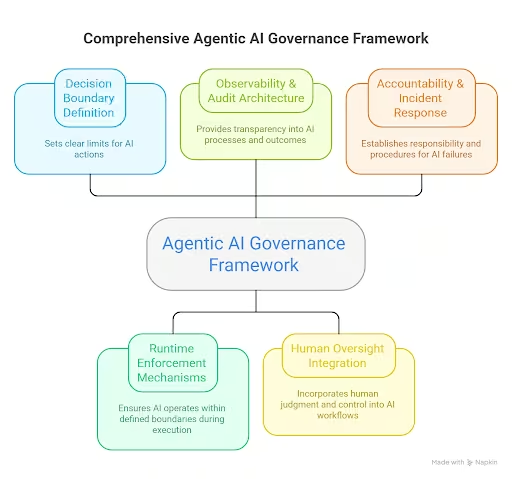
An effective agentic AI governance framework consists of five integrated pillars, which work together as a system.
Pillar 1: Decision Boundary Definition
Decision boundaries articulate what autonomous agents can execute without human approval versus what requires review or prohibition. These boundaries operate across multiple dimensions that together define the scope of agent autonomy.
Capability Boundaries
Capability boundaries specify which tools and APIs agents can access. An agent might have read access to customer databases but not write access. It can send emails through approved templates but not modify contract terms. These boundaries prevent agents from taking actions they lack the authorization or competence to handle.
Impact Boundaries
Impact boundaries define thresholds, such as financial limits, time-sensitive, and reputational boundaries based on business consequences. Financial limits might allow autonomous decisions under $1,000, with human approval required above.
Context Boundaries
Context boundaries determine when autonomy applies. An agent might operate autonomously during normal business conditions but require human oversight during market volatility, system incidents, or regulatory changes.
Implementation Note: Decision boundaries must be codified in machine-readable formats that agents validate against before execution. The agent framework should programmatically check whether a contemplated action falls within or outside boundaries before proceeding.
Pillar 2: Runtime Enforcement Mechanisms
Technical controls prevent agents from operating outside defined boundaries automatically rather than relying on agent compliance or human review.
Pre-Execution Validation
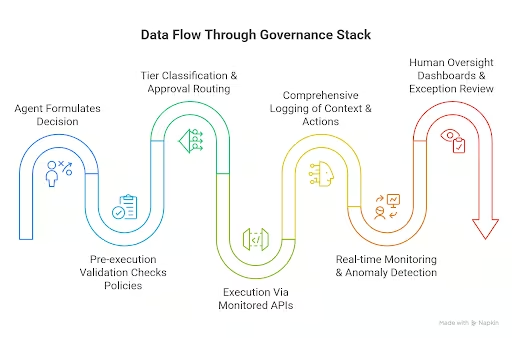
Pre-execution validation occurs before every agent action. The agent formulates a decision based on its reasoning, then submits it to a validation layer that checks against defined boundaries. For instance, does this action exceed financial thresholds? Does it require human approval? Only after clearing validation does execution proceed.
Circuit Breakers
Circuit breakers automatically pause agent operation when error rates or anomalies exceed thresholds. If an agent’s decisions are being overridden by humans at unusual rates, the circuit breaker triggers. If execution errors spike, the system pauses for human investigation.
Rate Limiting
Rate limiting controls the frequency and volume of agent actions. An agent might be limited to 100 API calls per minute, or 50 customer communications per hour. Rate limits prevent runaway execution where bugs or misconfigurations cause agents to take repetitive, inappropriate actions before humans detect the problem.
Rollback Capabilities
Rollback capabilities let you reverse agent decisions the moment you detect an error. For reversible actions, such as database updates, scheduled appointments, draft communications, etc., the system maintains state snapshots enabling restoration to pre-decision conditions.
Kill Switches
Kill switches provide emergency shutdown capability for individual agents or entire agent systems. When serious issues emerge, authorized personnel can immediately halt agent operations while preserving the ability to investigate what happened and why.
Pillar 3: Observability & Audit Architecture
Comprehensive logging and monitoring infrastructure captures the complete decision-making process, providing both operational visibility and compliance evidence.
Reasoning Traces
Reasoning traces the complete decision logic from input to action. When an agent decides to approve a refund, the trace shows: customer request received, order history retrieved, return policy consulted, eligibility determination made, approval threshold checked, refund amount calculated, and payment system updated. Each step includes the data examined, logic applied, and intermediate conclusions reached.
Tool Use Logs
Tool use logs capture every interaction with external systems. Which APIs did the agent call? What parameters were provided? What responses were received? This system-level audit trail enables incident investigation and compliance reporting.
Context Snapshots
Context snapshots preserve the complete state of data at decision time. When an agent makes a decision based on customer data, market conditions, or policy rules, the exact values of those inputs at decision time are captured. This immutable record allows reconstruction of the decision even if the underlying data subsequently changes.
Outcome Tracking
Outcome tracking monitors what happened after agent actions. Did the decision achieve its intended results? Were there unintended consequences? Did customers respond positively or negatively to agent communications? Outcome data feeds continuous improvement.
Performance Metrics
Performance metrics provide aggregate visibility into agent operations. How many decisions per hour? What percentage requires human approval? What’s the error rate? How do success rates vary by decision type, time of day, or agent version?
Pillar 4: Human Oversight Integration
Appropriate human involvement prevents failures without creating bottlenecks that negate the value of autonomous systems. Governance determines when humans review, approve, or override agent decisions.
Tiered Approval Workflows
Tiered approval workflows map different review requirements to decision criticality. Routine low-impact decisions proceed autonomously with periodic human sampling. Medium-stakes decisions might trigger approval when thresholds are exceeded. High-stakes decisions always require explicit human authorization before execution.
Exception Queues
Exception queues surface edge cases outside agent training for human review. When agents encounter scenarios with low confidence, conflicting policies, or novel conditions, they escalate to human experts.
Feedback Loops
Feedback loops allow humans to correct agent decisions and refine future behavior. When humans override agent recommendations or modify agent-drafted communications, the system captures the correction and reasoning. This feedback trains agents on organizational preferences and policy nuances.
Override Capabilities
Override capabilities ensure humans can intervene in agent operations at any time. Authorized personnel can pause agents, modify pending decisions, or reverse recent actions when issues are detected.
Pillar 5: Accountability & Incident Response
Clear ownership and processes for when things go wrong ensure governance failures drive improvement instead of blaming deflection.
Decision Ownership
Decision ownership establishes that humans retain ultimate accountability for agent actions. The organization is liable for what its agents do, just as it’s liable for employee actions. This legal and ethical accountability can’t be delegated to AI systems regardless of their autonomy level.
Incident Classification
Incident classification provides severity levels and escalation paths when agent governance fails. Minor issues (single incorrect decisions caught and corrected quickly) receive different treatment than major incidents (systematic failures affecting many customers or creating legal exposure).
Root Cause Analysis
Root cause analysis processes determine why governance failures occurred. Was the boundary inadequately defined? Did runtime enforcement fail? Was monitoring insufficient to detect the issue quickly?
Remediation Tracking
Remediation tracking ensures fixes are implemented and validated. When governance failures are identified, corrective actions are documented, assigned to owners, tracked to completion, and verified as effective.
Continuous Improvement
Continuous improvement uses operational data and incident learnings to refine governance over time. Quarterly reviews examine governance metrics, incident patterns, and stakeholder feedback to identify opportunities to improve boundary definitions, enforcement, or the integration of human oversight.
Key Insight
The five pillars interconnect to form a complete governance system. Decision boundaries define what’s allowed. Runtime enforcement prevents violations. Observability provides evidence and alerts. Human oversight handles exceptions and high-stakes decisions. Accountability ensures continuous improvement when failures occur.
Decision Boundary Taxonomy: Classifying Autonomous AI Decisions
Not all autonomous decisions carry equal risk or require identical oversight. Effective governance starts with classifying decisions by criticality and mapping each classification to appropriate controls.
Tier 1: Routine Operations (Fully Autonomous)
Tier 1 decisions have no financial impact, legal implications, or customer-facing consequences. They involve a well-defined scope, low complexity, and reversibility.
Examples of Tier 1 Decisions:
- Data retrieval from approved sources
- Report generation from standardized templates
- Scheduling internal meetings based on participant availability
- Status updates to project management systems
- Log aggregation for monitoring dashboards
Governance Controls:
- Automated monitoring with exception alerts when patterns deviate from normal
- Aggregate pattern review (weekly or monthly)
- Low-frequency audit sampling
Human Oversight Approach:
Periodic review of patterns, not individual decisions. Humans validate that the governance framework functions correctly without a comprehensive review of every action.
Tier 2: Low-Stakes Decisions (Autonomous with Comprehensive Logging)
Tier 2 decisions involve minimal financial impact below $100, carry low reputational risk, and remain internal-facing through standard workflows.
Examples of Tier 2 Decisions:
- Content summarization for internal use
- Notifications to team members about task status
- Routing of support tickets to appropriate departments
- Basic workflow automation, like file organization or data formatting
Governance Controls:
- Mandatory decision logging with complete reasoning traces
- Explainability requirements (agents must document why)
- Bias testing on aggregate outcomes
- Monthly governance reviews
Human Oversight Approach:
Sample-based review where humans examine a statistically significant subset of decisions. Bias audits check whether decision patterns disadvantage particular groups. Pattern analysis identifies drift before it becomes systematic.
Tier 3: Medium-Stakes Decisions (Autonomous with Approval Thresholds)
Tier 3 decisions carry a moderate financial impact from $100 to $10,000, are customer-facing, or affect multiple stakeholders.
Examples of Tier 3 Decisions:
- Customer communications beyond simple acknowledgments
- Resource allocation decisions affecting team workflows
- Pricing adjustments within approved bands
- Workflow changes impacting how multiple people or systems operate
Governance Controls:
- Threshold-based human approval (within parameters = autonomous, exceeding parameters = approval required)
- Real-time monitoring dashboards
- Rollback capabilities within defined timeframes
- Automatic escalation when confidence is low or edge cases are detected
Human Oversight Approach:
Active approval for decisions exceeding parameters. Exception review for novel scenarios. Approval workflows integrate with existing systems, providing context-rich requests.
Tier 4: High-Stakes Decisions (Human Approval Required)
Tier 4 decisions involve significant financial impact exceeding $10,000, create legal implications, or carry regulatory sensitivity.
Examples of Tier 4 Decisions:
- Contract modifications changing terms or obligations
- Large purchases or expenditures
- Compliance-sensitive communications to regulators
- System configuration changes affecting security or availability
Governance Controls:
- Mandatory human review before execution
- Dual approval for critical thresholds
- Complete audit trails with human attestation
- Agents provide analysis only, humans decide
Human Oversight Approach:
Human Oversight Approach: Humans own the decision with agent support. Agents conduct analysis, gather data, evaluate options, and present recommendations, but humans decide whether to proceed, modify, or reject.
Tier 5: Critical Decisions (Human Only, AI Support)
Tier 5 decisions carry strategic business impact, involve safety-critical operations, create legal liability, or have irreversible consequences.
Examples of Tier 5 Decisions:
- Mergers and acquisitions
- Product strategy and market positioning
- Safety certifications and critical infrastructure changes
- Crisis response during major incidents
Governance Controls:
- AI provides information synthesis and scenario analysis only
- No autonomous execution authority
- Humans retain complete decision ownership
- AI outputs treated as research, not recommendations
Human Oversight Approach:
Complete human ownership. AI serves as an analytical tool to process information, model scenarios, or surface relevant data, but decision-making authority remains entirely human.
Customizing the Taxonomy for Your Organization
| Factor | Impact on Tier Boundaries |
|---|---|
| Industry | Regulated industries (healthcare, finance) elevate more decisions to Tier 4/5 |
| Risk Tolerance | Conservative organizations lower thresholds for human approval |
| Operational Maturity | As confidence builds, some Tier 3 decisions migrate to Tier 2 |
| Regulatory Requirements | Compliance mandates may dictate minimum tiers for certain decision types |
Implementation requires mapping every potential agent use case to this taxonomy during the design phase. Runtime enforcement validates tier classification before execution. Observability tracks tier distribution to ensure agents make appropriately tiered decisions.
Runtime Governance Architecture: Technical Implementation
Runtime governance for agentic AI requires a technical architecture layer that sits between agent decision logic and execution systems, validating decisions against policies before execution, logging complete reasoning traces, enforcing rate limits and access controls, and providing circuit breakers for anomaly detection.
Layer 1: Policy Definition & Management
Centralized policy repositories maintain governance rules in machine-readable formats that agents can programmatically validate against.
Components:
- Decision boundary rules in JSON/YAML schemas
- Approval workflow definitions
- Access control lists for tools and APIs
- Rate limits and resource quotas
- Compliance requirement mappings
Integration Points:
- Enterprise GRC platforms (inherit organizational policies)
- HashiCorp Vault (secrets management)
- Open Policy Agent (policy-as-code enforcement)
- Custom policy DSLs (domain-specific languages)
Layer 2: Agent Design-Time Controls
Building governance into agent architecture from inception prevents issues rather than detecting them post-deployment.
Components:
- Agent template libraries with built-in guardrails
- Pre-approved tool catalogs (restricted to vetted APIs)
- Capability restriction frameworks (permission sets by agent class)
- Reasoning framework constraints (approved decision patterns)
Integration Points:
- MLOps pipelines (governance validation before production)
- CI/CD systems (automated testing of boundary respect)
- Security review workflows (mandatory checks before deployment)
Layer 3: Pre-Execution Validation
Every decision undergoes validation before execution.
Validation Steps:
- Decision tier classification engine determines Tier 1-5
- Policy compliance checker validates against applicable rules
- Risk scoring evaluates decision parameters
- Threshold validation confirms limits aren’t exceeded
- Human approval routing for Tier 3+ decisions
Implementation
Middleware in API gateways or agent orchestration runtimes. Custom policy plugins extend standard platforms with agentic AI-specific validation. The validation layer has authority to block execution, which agents can’t bypass.
Layer 4: Execution Runtime Monitoring
Continuous monitoring during agent operation detects issues in real-time.
Monitoring Capabilities:
- Decision stream analysis (patterns and anomalies)
- Anomaly detection (behavior deviations from baselines)
- Rate limit enforcement (prevents excessive actions)
- Circuit breakers (auto-pause on error thresholds)
- Resource utilization tracking (compute, memory, network)
Integration Points:
- Observability platforms (Datadog, New Relic)
- SIEM systems (security correlation)
- Custom metrics and distributed tracing
Layer 5: Comprehensive Audit Logging
Evidence trails for compliance, debugging, and improvement.
Log Components:
- Structured decision logs with reasoning traces
- Tool use records (every API call, database operation)
- Input data snapshots (exact state at decision time)
- Human approval records (who reviewed, when, outcome)
- Outcome tracking (post-execution results)
Integration Points:
- Log aggregation platforms (Splunk, Elasticsearch)
- Long-term retention systems
- Semantic search capabilities
- Compliance reporting tools
Layer 6: Human Oversight Interface
Appropriate human review without bottlenecks.
Interface Components:
- Exception review queues (prioritized decision requests)
- Approval workflow dashboards (context-rich packages)
- Governance KPI dashboards (aggregate metrics)
- Incident response interfaces (investigation tools)
- Agent performance analytics (effectiveness tracking)
Integration Points:
- Existing ticketing systems (Jira, ServiceNow)
- Notification platforms (Slack, PagerDuty)
- Business intelligence tools (visualization)
Integration with Existing Enterprise Systems
| Existing System | Integration Point | Governance Function |
|---|---|---|
| MLOps Pipeline | Design-time controls, deployment gates | Agent validation before production release |
| API Gateway | Pre-execution validation layer | Policy enforcement, rate limiting, access control |
| SIEM/SOC | Runtime monitoring, audit logging | Security event detection, threat response |
| GRC Platform | Policy management, compliance reporting | Centralized governance, audit evidence |
| Identity/Access Management | Authentication, authorization | Agent identity, permission management |
| Incident Management | Accountability, response workflows | Governance failure handling, remediation |
RTS Labs implements governance as integrated middleware rather than a separate infrastructure. Custom policy enforcement layers connect agent frameworks to existing enterprise systems without requiring platform replacement. Observability architecture is designed for compliance audits from inception.
Observability and Explainability: Making Agent Decisions Transparent
Most enterprises lack a governance model that can be explained across dimensions. For agentic AI to be efficient and optimally implemented at scale, explainability is the foundation of governance, compliance, and trust.
The Three Dimensions of Agentic AI Explainability
Agentic AI explainability operates across three dimensions that together provide complete transparency into autonomous decision-making.
Dimension 1: Decision Reasoning Traces
Agents must log the complete reasoning chain from input to action.
Goal Interpretation
How did the agent understand the request or triggering condition? What did the user ask for? What business objective is the agent trying to achieve? Misunderstanding goals is a common failure mode that reasoning traces reveal.
Planning Logic
What steps did the agent decide to take and why? Did it plan to retrieve data first, then analyze, then act? Or did it determine immediate action was appropriate? What alternatives did it consider?
Tool Selection
Why did the agent choose specific APIs or systems? Did it select the customer database because the query involved customer information? Did it call the pricing API because the decision required current rates?
Parameter Selection
How did the agent determine input values for tools? When calling an API, what parameters did it provide and why? When querying a database, what filters did it apply?
Outcome Evaluation
How did the agent assess whether actions succeeded? Did it check response codes from APIs? Did it verify data was written correctly? Did it monitor for error messages?
Dimension 2: Context & Input Transparency
Decisions depend on the data available when made.
Input Data Snapshots
The exact state of information the agent examined, preserved immutably. This matters because underlying data changes, customer records update, prices shift, and policies evolve. Reconstructing a decision requires knowing what the agent saw at the time of the decision.
Retrieved Information
What did RAG systems or knowledge retrieval surface? What documents did the agent consult? What information did vector search return? What knowledge base articles were deemed relevant?
Agent Memory and History
Prior interactions informing current decisions. Did previous customer communications influence how the agent responded? Did earlier failed attempts at a task shape the current approach?
External Signals
Market data, system state, user context, or environmental factors influencing decisions. Was the agent aware of system maintenance windows? Did it factor in business hours? Did it consider seasonal patterns or market conditions?
Dimension 3: Action Impact Documentation
Tracking what the agent actually did and what resulted.
Executed Actions
Specific API calls, database writes, communications sent—the concrete steps taken. These aren’t agent intentions but verified system interactions.
State Changes
Before-and-after system state showing what values changed in databases, what appointments were scheduled, and what was sent to customers. State diffs make the impact concrete and measurable.
Downstream Effects
What other systems or agents were affected? Did this decision trigger workflow in another system? Did other agents respond to the state changes this agent made?
Outcome Metrics
Did the action achieve its intended results? Did the customer respond positively? Did the process complete successfully? Did error rates increase after this configuration change?
Confidence Scoring and Uncertainty Flagging
Agents should indicate confidence in decisions. Low confidence triggers human review even for otherwise autonomous decisions. Uncertainty about boundary compliance escalates automatically. Making these confidence assessments explicit prevents agents from confidently executing poorly-founded decisions.
Multi-Audience Explanations
For Engineers and Auditors: Detailed reasoning traces with technical specifics for debugging and compliance validation.
For Business Stakeholders: Natural language summaries explaining decisions in business terms without technical jargon.
For Regulators: Compliance-focused reports demonstrating adherence to requirements with an evidence trail.
Audit Trail Requirements
For compliance and incident investigation:
- Immutability: Logs cannot be modified after creation
- Completeness: All decisions logged, not sampling
- Retention: Aligned with regulatory requirements (often 7+ years)
- Searchability: Semantic search on decision reasoning, not just metadata
- Privacy: PII handling in logs complies with GDPR/CCPA
Human-in-the-Loop Integration: When and How Humans Intervene
Effective governance isn’t maximum human oversight. Rather, it’s appropriate human oversight. The goal is strategic human involvement that prevents failures without creating bottlenecks, negating the value of autonomous systems.
Pattern 1: Pre-Execution Approval (High-Stakes Decisions)
When to Use:
- Tier 4 decisions
- Financial thresholds exceeded
- Legal implications present
- Compliance sensitivity requires review
How It Works:
The agent prepares a complete decision package including full reasoning, all data examined, alternatives considered, risk assessment, and a specific approval request. The package routes to appropriate approvers via existing workflow systems. The agent waits for explicit approval, denial, or modification before executing.
Latency: Minutes to hours (acceptable for non-time-sensitive high-stakes decisions)
Examples:
- Contract modifications requiring legal review
- Large financial commitments exceeding delegated authority
- Compliance-sensitive communications to regulators
Pattern 2: Exception Escalation (Edge Cases & Low Confidence)
When to Use:
- Agent encounters a scenario outside trained patterns
- Confidence below threshold
- Boundary ambiguity exists
How It Works:
The agent surfaces the exception to humans with complete context. It continues with other tasks rather than blocking. Humans review and either approve the proposed action, modify the approach, or add examples to training data, improving future handling.
Latency: Minutes to days, depending on severity
Examples:
- Unusual customer requests without policy guidance
- Conflicting policy applications where rules contradict
- Novel market conditions outside agent experience
Pattern 3: Asynchronous Review & Correction (Sample-Based Quality Control)
When to Use:
- Tier 2-3 autonomous decisions
- Routine operations requiring quality oversight
How It Works:
Agents execute autonomously with comprehensive logging. Decisions undergo periodic human review where humans sample and provide feedback. Patterns of errors trigger retraining, boundary adjustment, or policy clarification.
Latency: Post-facto review (doesn’t block execution)
Examples:
- Content generation spot-checking
- Customer communication sampling for tone and accuracy
- Resource allocation validation
Pattern 4: Real-Time Monitoring with Intervention Capability (Continuous Oversight)
When to Use:
- Critical business processes
- Learning phase for new agents
- High-risk operations
How It Works:
Humans monitor agent activity via dashboards and can intervene to pause, modify, or override decisions in real-time. Intervention patterns inform governance refinement.
Latency: Seconds to minutes
Examples:
- Live system migrations
- Customer-facing deployments during rollout
- Financial trading operations
Designing Effective HITL Workflows
Minimize False Positives
Overly aggressive escalation creates “alert fatigue” where humans rubber-stamp approvals without genuine review. Calibrate thresholds to escalate genuine exceptions only.
Provide Rich Context
Humans need full reasoning traces, not binary approve/reject prompts. Include agent recommendations with confidence scores, alternatives considered, relevant policies, and historical similar decisions with outcomes.
Enable Quick Decisions
Pre-populate approval forms with agent analysis. Provide decision templates for common scenarios. Integrate with mobile platforms for urgent approvals outside office hours.
Close the Feedback Loop
When humans override agent decisions, capture their reasoning. Use corrections to refine agent logic. Track which decision types improve with human input versus those where humans consistently agree with agents.
Human-in-the-Loop (HITL) Effectiveness Metrics
| Metric | What It Measures | Target Direction |
|---|---|---|
| Escalation Rate | % decisions requiring human review | Minimize for Tier 1-2 |
| Approval Latency | Time from escalation to human decision | Decrease over time |
| Override Rate | How often do humans change agent recommendations | Should stabilize as agents improve |
| False Positive Rate | Escalations where humans agree with the agent | Decrease over time |
Compliance Mapping: Aligning Agentic AI Governance with Regulatory Frameworks
Regulatory requirements for AI governance multiplied between 2023 and 2025, driven by the EU AI Act, emerging US state laws, and new industry frameworks. Agentic AI governance frameworks must map to these requirements or face compliance failures and penalties.
1. EU AI Act Requirements for High-Risk AI Systems
Agentic AI systems often qualify as “high-risk” when they make employment decisions, determine access to essential services, affect legal rights or safety, or score creditworthiness and insurability.
Core Requirements
Risk Management Systems
Continuous monitoring required, not just a pre-deployment assessment. Organizations must implement ongoing risk assessment processes that detect and respond to emerging issues.
Data Governance
Training and operational data must meet quality and representativeness standards. Systems must demonstrate data quality controls and bias mitigation.
Technical Documentation
Detailed system design, operation, capabilities, and limitations must be documented sufficiently for regulators to understand.
Transparency and User Information
Users must be informed about AI involvement in decisions affecting them. Clear disclosure requirements apply.
Human Oversight
Appropriate human intervention capability must be designed into systems. This means actual ability to intervene, not just theoretical capability.
Accuracy, Robustness, and Cybersecurity
Systems must protect against manipulation and ensure reliable operation through technical safeguards.
Automatic Event Recording
Comprehensive audit trails for accountability are mandatory.
Governance Framework Alignment
2. US State AI Regulations
Emerging state-level requirements in California, Colorado, and other jurisdictions focus on specific areas:
Key Focus Areas
Algorithmic Discrimination
Bias testing and mitigation required. Systems must demonstrate they don’t create unfair outcomes based on protected characteristics.
Consumer Rights
Right to know about AI decision-making. Consumers must be informed when AI significantly influences decisions affecting them.
Impact Assessments
Pre-deployment risk evaluation required. Organizations must assess potential harms before deploying AI systems.
Transparency Requirements
Disclosure of AI use in certain contexts mandatory.
Governance Alignment
- Bias testing integrates into the observability layer
- Decision explanations provide consumer transparency
- Pre-deployment validation in design-time controls
- Compliance reporting from audit logs
3. Financial Services Regulations
OCC, Federal Reserve, and other financial regulators emphasize:
- Model Risk Management: AI systems require the same rigorous model risk management as traditional models.
- Third-Party Risk Management: AI vendors must undergo vendor risk assessment processes.
- Fair Lending Compliance: Credit decisions must comply with fair lending laws regardless of whether AI or humans make them.
- Explainability for Adverse Actions: When AI contributes to adverse credit decisions, explanations must be provided to consumers.
4. Healthcare Regulations
HIPAA requirements and FDA AI/ML guidance emphasize:
- Patient Safety and Clinical Validation: AI systems involved in clinical care require validation for safety and effectiveness.
- Data Privacy for PHI: Protected health information in AI training and operation must meet HIPAA privacy and security requirements.
- Continuous Monitoring: AI performance in clinical settings requires ongoing monitoring to detect degradation.
- Transparency to Patients: Patients must be informed about AI involvement in their care.
5. Information Security Standards
SOC 2 and ISO 27001 requirements include:
- Access Controls: AI systems must have appropriate access restrictions.
- Change Management: AI updates must go through formal change management processes.
- Incident Response: AI failures must be handled through established incident response procedures.
- Audit Logging: Comprehensive logging and monitoring are required for security and compliance.
Regulatory Requirement Mapping Table
| Regulatory Requirement | Governance Framework Component | Evidence Artifact |
|---|---|---|
| Risk management (EU AI Act) | Decision tier classification | Risk assessment documentation |
| Human oversight (EU AI Act) | Human-in-the-loop workflows | Approval and override logs |
| Logging capability (EU AI Act) | Observability architecture | Complete decision audit trails |
| Bias mitigation (US state laws) | Monitoring & testing | Bias testing reports, outcome analysis |
| Explainability (Consumer rights) | Reasoning trace logs | Decision explanation reports |
| Model risk management (Financial) | Design & runtime controls | Model validation documentation |
| Safety monitoring (Healthcare) | Real-time monitoring | Performance dashboards, incident logs |
Organizations operating in multiple jurisdictions or industries need governance frameworks accommodating multiple regulatory regimes simultaneously. The architecture should support jurisdiction-specific controls and compliance reporting without creating separate governance systems for each requirement.
Building Your Agentic AI Governance Framework: Implementation Roadmap
Phase 1: Assessment & Policy Foundation (Weeks 1-4)
Key Activities:
Inventory existing AI governance policies and identify gaps for agentic systems. Map current and planned agentic AI use cases to the decision tier framework. Identify regulatory requirements applicable to your industry and geography. Define initial decision boundaries for pilot use cases. Establish a governance stakeholder group spanning engineering, compliance, security, legal, and business units.
Deliverables:
- Governance charter
- Decision boundary definitions for pilots
- Stakeholder alignment on approach and priorities
Phase 2: Technical Architecture Design (Weeks 5-8)
Key Activities:
Design runtime governance middleware architecture. Define policy schema and machine-readable formats. Specify observability requirements and logging standards. Design human-in-the-loop workflows for each decision tier. Plan integration with existing MLOps, security, and GRC infrastructure.
Deliverables:
- Governance architecture document
- Integration specifications
- Observability schema
- Workflow designs
Phase 3: Pilot Implementation (Months 3-5)
Key Activities:
Build governance middleware for 1-2 pilot use cases. Implement decision tier validation and enforcement. Deploy comprehensive logging and monitoring. Integrate human approval workflows. Run pilot agents with governance controls in production.
Deliverables:
- Working governance system for pilot agents
- Initial metrics on effectiveness
- Lessons learned from production experience
Phase 4: Validation & Refinement (Month 6)
Key Activities:
Analyze governance metrics from the pilot (escalation rates, compliance, performance). Conduct a compliance audit simulation. Gather stakeholder feedback on governance processes. Refine decision boundaries, policies, and workflows based on data. Document governance runbooks and training materials.
Deliverables:
- Refined governance framework
- Compliance validation
- Operational playbooks
Phase 5: Scale & Operationalize (Months 7-12)
Key Activities:
Expand governance to additional agents and use cases. Automate compliance reporting from governance infrastructure. Establish continuous improvement processes (quarterly reviews). Build governance capabilities into the agent development lifecycle. Train engineering teams on requirements and tools.
Deliverables:
- Enterprise-scale governance platform
- Embedded governance in development workflow
- Trained teams
- Continuous improvement cadence
Also Read: Enterprise AI Adoption Challenges Explained: Data, Integration, ROI & Governance
Common Pitfalls to Avoid
| Pitfall | Impact | Alternative Approach |
|---|---|---|
| Building governance after deploying agents | Retrofit is harder than design-in | Include governance from initial architecture |
| Policy-only governance without enforcement | Agents violate policies unintentionally | Implement technical controls that prevent violations |
| Over-engineering governance | Becomes bureaucratic burden | Start simple, add complexity only when needed |
| Insufficient observability | Audit and debugging impossible | Make comprehensive logging non-negotiable |
| One-time project mentality | Governance degrades over time | Establish ongoing governance operations |
From Policy to Production: Governance That Scales with Autonomous AI
Agentic AI governance requires a fundamental shift from policy documentation to production controls. The five pillars work together as an integrated system. The decision-tier taxonomy provides operational clarity on the level of oversight each type of decision requires. Technical architecture integrates governance with existing enterprise infrastructure rather than creating parallel systems. Compliance mapping ensures regulatory requirements translate to enforceable controls.
RTS Labs partners with CTOs, AI leaders, and compliance teams to design and implement production-ready agentic AI governance frameworks. We embed governance into agent architecture from inception, preventing the governance debt that accumulates from retrofitting controls after deployment.
Rather than creating parallel systems, we integrate with your existing MLOps pipelines, API gateways, SIEM/SOC platforms, and GRC infrastructure, reducing implementation time while enabling teams to work with familiar tools. We build technical controls, observability architecture, and integration layers that translate governance policies into enforced system behavior, generating compliance evidence automatically for audits.
The organizations that scale agentic AI successfully won’t have the longest policy documents. They’ll have governance embedded in every agent decision, enforced at runtime, and continuously improved through operational data.
Book a Demo Today.
FAQs
1. How do you measure whether an agentic AI governance system is effective?
Effectiveness is measured through operational metrics such as boundary compliance rates, escalation frequency, override rates, audit completeness, and incident detection time. A mature system shows a decrease in violations and stable human intervention patterns over time.
2. What is the biggest operational risk when deploying agentic AI without governance?
The biggest risk is silent failure at scale, where agents operate within functional expectations but violate policies, compliance requirements, or system boundaries without immediate detection.
3. How does multi-agent coordination impact governance complexity?
Multi-agent systems introduce emergent risks, where individually compliant agents create system-level failures. Governance must monitor aggregate behavior, shared resources, and cross-agent dependencies.
4. When should organizations introduce governance: before or after deploying agents?
Governance must be implemented before deployment. Retrofitting governance after agents are in production creates significant risk exposure, higher remediation costs, and operational disruption.
5. How do enterprises balance governance with speed of AI innovation?
The key is to embed governance into workflows, and not add it as a separate layer. When governance is integrated into architecture (validation, logging, controls), it enables faster scaling rather than slowing development.