
The real estate sector has finally begun using AI. But it’s still the humans doing all the work. A typical day in a real estate office looks like this.
Professionals receive AI-generated property valuations, lead scores, and market forecasts daily. Then they manually enter the information into five different systems, schedule follow-ups in their calendar, draft emails to clients, and update deal stages in their CRM.
Also Read: AI for Property Management: Benefits, Use Cases, Challenges & More (2026)
Though the AI told them what to do, they still did all the work.
This decision-action gap represents the fundamental limitation of traditional AI in real estate, where it analyzes and recommends, but humans must execute every step. The delay between insight and action costs deals, reduces conversion rates, and creates a competitive disadvantage in markets where speed determines success.
Agentic AI, if used optimally in real estate, has a compelling business case. Real estate firms using AI can save time by more than 30% and improve lead response times by more than 90% (McKinsey, 2026).
This article explores how agentic AI transforms real estate operations through autonomous execution across seven high-impact use cases, explains the architectural shift from recommendation to action, and provides a readiness framework for implementation.
What Makes AI “Agentic” in Real Estate? The Shift from Analysis to Execution
What is Agentic AI for real estate?
Agentic AI for real estate refers to autonomous AI systems that execute real estate workflows without requiring human intervention at each decision point. Agentic AI operates with delegated authority to act directly in CRM systems, property management platforms, and financial tools, coordinating multi-step processes based on defined business rules, market conditions, and compliance requirements
Agentic AI differs from traditional real estate AI in its ability to execute decisions autonomously rather than merely recommend them. Traditional AI analyzes property data and suggests valuations, scores leads, or forecasts market trends, but humans must manually act on every insight.
Agentic AI closes this loop by directly updating CRM records, scheduling showings, adjusting listing prices, coordinating deal workflows, and executing portfolio rebalancing decisions within defined parameters, transforming recommendations into completed actions.
Here are 4 ways agentic AI scores over traditional AI:
Autonomous Reasoning and Decision Logic
Agentic systems don’t just recognize patterns; they reason through multi-step decisions. A traditional lead scoring system might flag a prospect as “hot” based on web behavior and demographics.
An agentic lead qualification system evaluates the buyer profile, matches it against available inventory, considers agent specializations and current capacity, calculates optimal timing, and automatically books a showing with the best-fit agent while sending a personalized property package. The system reasons through the complete workflow.
Direct System Execution via APIs
The defining characteristic of agentic AI is execution authority. These systems can write to CRMs, update property management platforms, modify MLS listings, and trigger financial workflows. When market comparable data shows a property is overpriced, the system doesn’t just recommend a price drop.
It calculates the optimal new price based on days-on-market curves and recent absorption rates, updates the listing across syndication platforms, notifies the seller with data-backed reasoning, adjusts marketing spend allocation to match the new price point, and logs the complete decision chain for compliance review.
Multi-Agent Coordination
Complex real estate workflows require multiple specialized agents working together. A lead qualification agent identifies a high-value prospect and passes enriched data to a property matching agent. That agent finds optimal property fits and coordinates with a showing scheduler that books appointments based on agent availability and conversion-likelihood patterns.
Meanwhile, a follow-up coordinator monitors engagement and adjusts the nurture sequence based on prospect behavior. Each agent has domain expertise. Together, they execute the complete lead-to-showing workflow without manual handoffs.
Continuous Learning from Outcomes
Agentic systems monitor what happens after decisions are made. When an automated showing schedule consistently converts better at certain times for specific property types, the scheduling agent refines its logic. When dynamic pricing adjustments in a particular submarket show predictable patterns, the valuation agent incorporates those insights.
Also Read: AI for Real Estate Investors: Tools, Use Cases, and Custom Strategies (2025)
This learning happens within operational parameters, allowing systems to adapt to market shifts without data science intervention for every adjustment.
| Capability | Traditional AI | Agentic AI |
|---|---|---|
| Output | Lead scores, valuations, market forecasts | Completed actions: updated CRM, scheduled showings, adjusted prices |
| Human Role | Reviews all recommendations, executes manually | Sets policies, monitors exceptions, and handles escalations |
| System Integration | Displays data in dashboards | Executes directly via APIs to CRM/PMS/MLS |
| Decision Process | Single prediction or classification | Multi-step reasoning with context and business rules |
| Workflow Span | Analyzes one data point or transaction | Orchestrates end-to-end processes across systems |
| Adaptation | Requires a data scientist to retrain models | Adjusts within operational parameters based on outcomes |
Why Agentic AI for Real Estate Now? Market Forces Driving Adoption
Real estate has lagged behind finance and logistics in AI adoption, but four forces now make agentic systems both viable and necessary.
Operational Margins Face Sustained Pressure
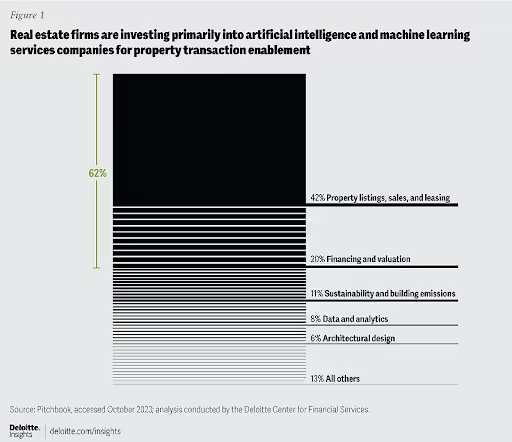
Real estate companies spend 40-60% of their operating budgets on manual processes that could be automated (Deloitte Real Estate Outlook, 2025). Traditional cost-cutting has reached limits. Firms can’t reduce headcount further without degrading service quality. Commission compression in residential markets and expense pressure in commercial create urgency for efficiency gains that don’t sacrifice client experience. Agentic AI frees professionals for high-value client interactions.
Data Infrastructure Reached Critical Mass
Data infrastructure reached critical mass between 2020 and 2026. Most real estate data previously lived in spreadsheets, PDFs, and email attachments. The COVID-accelerated digital transformation drove adoption of CRM and property management platforms across the residential and commercial sectors. API connectivity, webhook integrations, and real-time data feeds became standard.
Changing Customer Expectations
Customer expectations have fundamentally changed. Buyers and tenants expect instant responses measured in minutes. Investors expect real-time portfolio insights and rapid rebalancing capabilities. The traditional “I’ll get back to you tomorrow” service model no longer competes effectively in markets where speed determines deal success.
Agentic AI enables 24/7 responsiveness without 24/7 staffing costs, scheduling showings at 10 PM, qualifying leads on weekends, and responding to tenant inquiries during holidays.
Technology Maturity Reached an Inflection Point
Foundation models, combined with reasoning frameworks such as ReAct and tool calling, achieved production reliability between 2024 and 2026. Real estate-specific training data, using MLS (Multiple Listing Service) feeds, transaction histories, and market data, became available at scale.
Orchestration platforms like LangChain and custom agent frameworks have matured beyond research prototypes into production-grade tools. Governance infrastructure for monitoring autonomous AI decisions reached enterprise readiness with audit logging, explainability, and compliance controls.
7 Agentic AI Use Cases in Real Estate: The Business Case for Agentic AI
The business case compounds across multiple dimensions, including reduced deal cycle times, improved lead-to-client rates, and more precise property valuations. Efficiency gains free portfolio managers from hours of manual market research and analysis per week.
Also Read: AI in Construction: what it is, Use Cases + How to Implement (2025)
The question for real estate firms is more about which workflows to automate first and how to implement safely. These seven use cases represent the highest-impact starting points, given current technology maturity and measurable ROI.
Use Case 1: Autonomous Lead Qualification & Intelligent Routing
Autonomous lead qualification uses agentic AI to evaluate incoming leads across multiple dimensions, including financial qualification, property preferences, timeline urgency, and geographic constraints. It then automatically routes them to the best-matched agent, schedules initial contact, and prepares personalized property recommendations without manual triage. The system scores leads and executes the entire qualification and routing workflow while maintaining compliance with fair housing regulations.
Traditional lead management follows a slower path, with the entire process taking hours or days. Agentic systems complete qualification, routing, property matching, and initial outreach within minutes while the lead is still actively engaged.
Benefits: Leads contacted within 5 minutes convert at 9x the rate of those contacted after 30 minutes. Agentic systems deliver that five-minute response at 2 AM on Sunday just as reliably as 2 PM on Tuesday.
Agent productivity improves because professionals work qualified, matched leads instead of cold triage. Fair housing compliance strengthens because routing logic operates on objective criteria, such as property match quality, agent specialization, and capacity, without subjective bias in assignment decisions.
| Requirements | Details |
|---|---|
| Core Integrations | CRM integration with read-write access; MLS access for property matching; communication platform connections for automated outreach |
| Governance Requirements | Fair housing compliance rules embedded in routing logic; assignment decision audit trails; human escalation for low-confidence or edge cases |
| Implementation Timeline | 3–4 months for pilot deployment (single market or property type); 9–12 months for full market coverage and scaling |
Dynamic Property Valuation and Automated Pricing
Dynamic property valuation uses agentic AI to continuously monitor market comparables, demand signals, economic indicators, and property-specific factors, then autonomously adjusts listing prices, generates valuation reports, and triggers changes to pricing strategies without waiting for manual appraisal cycles. The system combines traditional comparable analysis with real-time market sensing to maintain optimal pricing positions.
A market monitoring agent tracks new comparable sales, pending listings, time-on-market trends across the submarket, and macroeconomic indicators, including interest rates, employment data, and building permits. When significant changes occur, the agent flags these signals for analysis.
- A pricing strategy agent determines an approach based on the seller’s objectives. Aggressive pricing targets quick sale, accepting some value sacrifice for speed.
- The pricing agent calculates optimal price points given the strategy and market conditions.
- Listing update agents modify prices on MLS, syndication platforms like Zillow and Realtor.com, the brokerage website, and any property-specific marketing materials.
- Stakeholder notification agents inform owners, listing agents, and marketing teams of changes with data-backed explanations.
Benefits: Property valuation accuracy improves, time to optimal price drops, and days on market reduce when AI incorporates real-time market signals compared with static comparables. Revenue optimization comes from capturing market upswings faster and adjusting to softening conditions before properties become stale.
| Category | Details |
|---|---|
| Core Integrations | MLS access with current comparable data; county records for property characteristics and sales history; macroeconomic data feeds; integration with listing syndication platforms |
| Governance Requirements | Defined price-change thresholds requiring human approval; owner-notification protocols for automated adjustments; audit trails documenting pricing decision logic |
| Implementation Timeline | 4–6 months for pilot deployment; 12–15 months for multi-market or full coverage rollout |
Automated Deal Workflow Coordination
Automated deal workflow coordination deploys agentic AI to manage end-to-end transaction processes, starting from offer preparation and contingency tracking to document coordination, deadline management, and closing coordination, autonomously executing routine steps while flagging issues requiring human attention. The system acts as a tireless transaction coordinator that never misses deadlines or loses documents.
- An offer management agent tracks the deal stage, outstanding contingencies, including inspection, appraisal, financing approval, and title clearance.
- A deadline monitor maintains calendars for every contractual timeline: inspection period, financing contingency expiration, appraisal deadline, and closing date.
- Document coordinators track which forms have been signed, which disclosures delivered, and which third-party reports received.
- Communication agents manage party coordination. They send status updates to clients, notify agents of required actions, coordinate scheduling for inspections and appraisals, and maintain document repositories.
Benefits: Reduced transaction cycle time, reduced errors, and increased agent capacity. Client satisfaction improves through faster closings, proactive communication, and fewer surprises.
| Category | Details |
|---|---|
| Core Integrations | CRM integration for deal data; transaction management platform connections; contract template libraries; service provider contact databases; document storage integration |
| Governance Requirements | Legal review of automated communications; escalation rules defining when human judgment is required; compliance audit logs for all actions |
| Implementation Timeline | 6–9 months for pilot (single deal type); 15–18 months for full transaction coverage across property types |
Portfolio Optimization and Investment Decision Support
Portfolio optimization agents continuously analyze investment performance, market conditions, risk factors, and opportunity signals to autonomously generate rebalancing recommendations, execute approved trades, or flag acquisition and disposition opportunities, all in line with defined investment strategies and risk parameters.
A portfolio monitoring agent tracks asset performance in terms of occupancy rates, net operating income, cap rates, and cash-on-cash returns.
- Market analysis agents monitor comparable sales, rental trends, development pipelines, and economic indicators in each market where the portfolio holds assets.
- Risk assessment agents evaluate concentration by property type, geographic exposure, tenant credit quality, and financing terms.
- The strategy agent reasons through rebalancing needs given the investment thesis and current market conditions.
- For approved strategies, execution agents prepare detailed acquisition and disposition analyses, including cash flow modeling, financing options, tax implications, and hold-period scenarios.
Benefits: Portfolio managers report saving 12-15 hours per week on manual market research and comparative analysis. More importantly, they identify underperforming assets and market opportunities faster. Investment criteria application becomes more consistent across the portfolio because the AI applies the same analytical framework to every decision, rather than relying on individual judgment, which varies with workload and attention.
| Category | Details |
|---|---|
| Core Integrations | Integration with property management systems for operating data; financial reporting platforms; market data feeds (including CoStar or similar); and deal modeling tools |
| Governance Requirements | Strong governance due to complex financial decisions and regulatory implications; defined oversight and validation processes for decision-making |
| Implementation Timeline | 9–12 months for development and validation before production deployment |
Intelligent Showing Coordination and Scheduling
Showing coordination agents autonomously schedule property viewings by reasoning across buyer preferences, agent availability, property access rules, and optimal timing. They execute scheduling, send confirmations, manage rescheduling requests, and track showing outcomes without manual calendar coordination.
The agent books the showing across all relevant calendars, sends confirmations to buyer, seller, and agents, creates calendar blocks with property details and showing instructions, and sets up automated reminders. For properties requiring special access to lockbox codes, tenant coordination, or building security procedures, the system includes specific instructions in agent materials.
Benefits: Showing booking time drops from hours to minutes. No-show rates decline through optimized scheduling and reminder sequences. Conversion improves through strategic timing recommendations based on historical performance data. Agents spend less time on coordination logistics and more time on buyer consultation and negotiation.
| Category | Details |
|---|---|
| Core Integrations | CRM integration; calendar system access; property access instruction databases; showing feedback tracking systems |
| Implementation Timeline | 3–4 months for pilot deployment in a defined market |
Automated Market Research and Comparative Analysis
Market research agents continuously aggregate data from MLS platforms, public records, economic indicators, and news sources to autonomously generate market reports, comparable analyses, and trend summaries customized for specific properties, submarkets, or portfolio segments.
These agents monitor data sources for relevant changes, including new listings, closed sales, building permits, zoning changes, and economic releases. When significant activity occurs in a tracked submarket, the system analyzes trends, identifies patterns, and compares current conditions to historical baselines.
Report distribution happens automatically on defined schedules or on a trigger basis when significant market changes occur.
- Portfolio managers receive weekly market updates for their submarkets.
- Listing agents get comparable analysis refreshed as new sales data becomes available.
- Investment committees receive monthly performance reports comparing portfolio assets to market benchmarks.
Benefits: Manual comparable research traditionally consumes hours per property. Automated systems eliminate this work while providing more frequent, data-current insights. The analysis methodology remains consistent across properties and markets, rather than varying based on individual analyst judgment or available time.
Tenant Communication and Lease Management Automation
Tenant communication agents handle routine inquiries, maintenance requests, lease renewals, and payment reminders autonomously. They escalate complex issues to property managers while maintaining response quality and compliance with tenant rights regulations.
When a tenant submits an inquiry via portal, email, or text, the agent classifies the request type and checks knowledge bases for standard responses. The system monitors lease expiration dates, initiates renewal conversations 90 days before expiration, presents renewal terms based on market rates and tenant history, tracks responses, and coordinates the preparation of lease documents.
Benefits: Response time for routine inquiries drops from hours to minutes. Property managers handle larger portfolios with the same team size because agents resolve 60-70% of inquiries autonomously. Tenant satisfaction improves through faster resolution and 24/7 availability.
| Category | Details |
|---|---|
| Core Integrations | Integration with property management systems; maintenance coordination platforms; communication channels |
| Governance Requirements | Compliance with tenant rights and fair housing regulations embedded directly into agent logic from inception |
| Implementation Timeline | 4–6 months for pilot deployment |
The Decision Boundary Framework for Real Estate AI
Real estate transactions carry legal, financial, and regulatory implications that make blanket AI autonomy inappropriate. Successful implementation requires explicit decision boundaries that define what AI executes autonomously and what requires human judgment.
Green Zone: Autonomous Execution
AI agents operate independently without approval requirements for lead scoring and CRM updates; appointment scheduling for standard properties; market data aggregation and reporting; routine tenant inquiry responses following approved scripts; document template population with transaction data; sending reminders and notifications to parties and agents; and standard comparable analysis generation.
Yellow Zone: Autonomous Recommendation Plus Human Approval
AI generates detailed recommendations, but humans approve them before execution. This applies to decisions such as property pricing changes above defined thresholds, offer negotiation parameters, counteroffer terms, and portfolio rebalancing moves involving significant capital.
Human approval also remains necessary for lease renewal pricing in competitive markets, high-value lead assignments, major marketing spend changes, and investment property acquisition or disposition recommendations.
Red Zone: Human-Initiated and Executed
Humans must initiate and execute these actions without AI automation. This includes contract signing, legal disclosures, fair housing compliance decisions involving protected classes, and major financial commitments above deal-specific thresholds. Human control is also required for eviction proceedings, regulatory filings, major renovation decisions, and conflict resolution between transaction parties.
How to Assess Where Your Real-Estate Firm Fits?
These boundaries vary by firm type and risk tolerance. Residential brokerages typically maintain greater Green Zone authority for showings and lead management while maintaining tight Red Zone controls over contracts and compliance.
Commercial real estate firms often place valuation and investment decisions in the Yellow Zone given larger transaction values. Property management companies might allow more autonomous tenant communication while maintaining strict Red Zone controls around evictions and legal proceedings.
Governance implementation requires documenting decision boundaries in written policy, configuring boundaries in agent logic with hard stops at zone transitions, maintaining comprehensive audit logs of all autonomous decisions, reviewing Yellow Zone approval patterns quarterly to identify candidates for Green Zone migration as confidence builds, and conducting regular governance reviews to adjust boundaries based on agent performance and changing business needs.
Data Readiness: The Foundation for Agentic Real Estate AI
Agentic AI amplifies whatever data quality exists. Implementation success requires an honest assessment of data readiness before deployment.
Level 1: Data Chaos
Organizations at this level maintain spreadsheets for critical business data, rely on manual entry without validation, operate siloed systems across MLS, CRM, and property management with no integration, lack API access to core platforms, and use inconsistent property identifiers across systems.
These firms are not ready for agentic AI. They need 6-12 months of foundational work, including CRM implementation or upgrade, basic system integrations, and data quality improvement, before attempting autonomous AI deployment.
Level 2: Basic Integration
These organizations have connected CRM and property management systems, established API access to core platforms, implemented batch data synchronization that runs nightly or weekly, and achieved relatively clean property master data.
They’re ready for pilot agentic workflows in a controlled scope. Starting points include lead qualification automation, showing scheduling, and basic reporting. Real-time pricing optimization and complex multi-agent coordination remain out of reach until data infrastructure matures further.
Level 3: Real-Time Data
Organizations at this level maintain live API connections between systems, use webhook-driven updates for immediate synchronization, operate unified customer and property data models, integrate MLS feeds in real-time, and connect document management systems.
They’re ready for production agentic systems across most use cases, including pricing optimization, deal workflow automation, portfolio analysis, and market research automation. Remaining gaps may include advanced observability or event-driven architecture needed for the most complex multi-agent coordination.
Level 4: AI-Native Infrastructure
These organizations have implemented event-driven architecture, built streaming data pipelines, deployed AI-ready data quality monitoring, established comprehensive audit logging across all systems, and achieved full system observability.
They’re ready for sophisticated multi-agent coordination, complex portfolio optimization, and enterprise-scale deployment supporting all seven use cases simultaneously with advanced inter-agent communication.
Organizations can assess readiness by answering five questions:
- Can you pull a complete lead history, including all touchpoints, from a single system via an API?
- Do property updates in one system automatically flow to all other systems within minutes?
- Can you trace every data change back to the source system and timestamp?
- Do you have real-time visibility into your complete transaction pipeline?
- Can you programmatically access MLS data beyond web interface screen scraping?
The path forward varies by starting level.
- Moving from Level 1 to Level 2 requires implementing modern CRM, establishing basic integrations, and cleaning property master data over 6-12 months.
- Progressing from Level 2 to Level 3 involves moving to real-time synchronization, implementing unified data models, and adding webhook capabilities over 4-6 months.
- Advancing from Level 3 to Level 4 requires building event-driven architecture and adding observability layers over 3-6 months.
From Analysis to Action: Your Path to Autonomous Real Estate Operations
Agentic AI represents the evolution from real estate analytics to autonomous execution. The seven high-impact use cases provide concrete starting points for organizations at different maturity levels. 50% of realtors report that AI has a positive effect on their business (NARS).
Most real estate firms exploring agentic AI encounter an unsatisfying build-or-buy tradeoff: off-the-shelf tools that don’t fit their workflows, or custom development projects stretching years with budgets in millions. RTS Labs offers rapid custom development of production-grade agentic systems tailored to existing technology stacks and business processes.
The RTS Labs methodology begins with discovery and use case validation over weeks one through four. Deep-dive workshops with operations, sales, and investment teams map current-state workflows and identify friction points. Data and system integration assessments establish technical readiness. ROI modeling for prioritized use cases quantifies expected business impact. Regulatory compliance reviews ensure proposed automation meets industry requirements.
We’ve built autonomous lead-qualification systems, dynamic pricing engines, and deal-workflow coordinators for residential brokerages, commercial investment firms, and property management companies. We implement working production systems that execute decisions, maintain compliance, and scale with your business.
Looking to automate your real estate business? Book a demo today.
FAQs
1. What is agentic AI in real estate, and how does it differ from traditional real estate AI?
Agentic AI executes real estate workflows autonomously, updating CRMs, scheduling showings, adjusting prices, and coordinating deals. Traditional AI analyzes data and suggests actions, based on which humans must manually execute every step. Agentic AI closes this loop by acting directly within property systems, CRMs, and financial tools based on defined business rules, transforming insights into completed actions without requiring human intervention at each step.
2. What are the main use cases where agentic AI delivers the highest ROI in real estate?
The highest-ROI use cases are autonomous lead qualification, dynamic property valuation, and automated deal workflow coordination. Lead qualification and showing scheduling offer the lowest implementation complexity for firms new to agentic AI, while portfolio optimization and deal coordination deliver greater value for organizations with mature data infrastructure.
3. What data infrastructure do I need before implementing agentic AI in real estate?
You need at minimum Level 2 data maturity: connected CRM and property management systems, basic API access, batch data synchronization, and relatively clean property master data. For production deployment across multiple use cases, Level 3 is required: real-time API connections, webhook-driven updates, unified customer/property data models, and integrated MLS feeds. Organizations with spreadsheet-based data, manual entry, and no system integration should invest 6-12 months in foundational infrastructure before attempting agentic AI.
4. How do you ensure agentic AI complies with fair housing regulations and doesn’t introduce bias?
Fair housing compliance requires removing protected classes (race, color, religion, sex, disability, familial status, national origin) from all training data and decision inputs, conducting adversarial testing to detect proxy discrimination, implementing regular bias audits comparing outcomes across demographic groups, maintaining human review for decisions flagged with potential bias concerns, and documenting complete reasoning traces for all autonomous decisions. The decision boundary framework ensures high-stakes decisions involving protected classes remain in the Red Zone, requiring human judgment, while routine operational tasks operate in the Green Zone with automated compliance monitoring.
5. What’s the typical implementation timeline and ROI for agentic AI in real estate operations?
Implementation follows a 6-12-month path: 4-6 weeks of readiness assessment, 3-6 months of pilot development in shadow mode, 2-3 months of validation, and 3-4 months of production rollout. ROI typically materializes within 6-9 months through improved conversion rates, reduced cycle times, and operational efficiency gains. RTS Labs accelerates this timeline through rapid prototyping methodologies. Clients see working agents for their highest-priority use case within 12 weeks, with production deployment in 6-9 months rather than the 18-24 month timelines typical of traditional enterprise AI projects.