Only 24% of organizations are currently scaling AI successfully across multiple use cases, despite 68% stating they aim to reach the highest level of AI maturity by the end of 2026 (KPMG Global Tech Report, 2026). AI initiatives fail to achieve the expected ROI because systems, data pipelines, and governance structures surrounding them are not built for production.
Also Read: AI Development Cost in 2026: Complete Enterprise Guide to Budgeting & ROI
Knowing how to scale AI agents is not primarily a question of selecting the right framework or the fastest model. It is a question of engineering the data foundations, integration architecture, governance structures, and operating models that let agents perform reliably when the stakes are real.
This guide maps the full scaling journey, from the five foundations every scalable agent system requires, to the five stages organizations move through, to a step-by-step framework for getting from where you are to where you need to be.
What Does Scaling AI Agents Actually Mean?
Organizations do not have a scaling problem with AI agents. The agents can be built quickly on improvised architecture using whatever data is available, and they work well enough in a controlled pilot to earn approval for the next phase.
Therefore, before outlining how to scale AI agents, it is worth being precise about what scaling actually means. The word covers three fundamentally different challenges, and most organizations are struggling with a different one than they think..
The Three Real Meanings of Scale
Scaling AI agents involves three distinct problems that are often encountered in sequence and require different solutions and organizational capabilities.
- The prototype-to-production phase is the transition from a controlled environment to a live one. It means handling edge cases, failure states, and volume without human intervention at every decision point. Most agents that pass a pilot never make it through this cleanly because the architecture that worked reliably on 20 test queries was never designed for 20,000 live ones.
- The transition from one agent to multiple agents is an architectural shift rather than a replication exercise. Building a system in which many agents work together reliably requires orchestration, shared memory, standardised access to tools, and coordination logic that simply does not exist in a single-agent setup. Once agents are chained, errors propagate differently. An isolated failure becomes a systemic one.
- The transition from experimentation to business impact is the least technical of the three and the one where most programs stall. Moving from internal tools to revenue-driving, cost-reducing automation that finance teams can measure is fundamentally an organizational challenge. This requires workflow ownership, executive sponsorship, and measurement infrastructure that most AI teams were never asked to build.
Also Read: Agentic AI vs AI Agents: Key Differences and Enterprise Use Cases
McKinsey’s State of AI 2025 report found that while 23% of organizations are scaling an agentic AI system somewhere in the business, no more than 10% are doing so within any individual business function. The gap between enterprise adoption and functional impact is where most scaling ambition disappears.
Organizational Scaling vs Technical Scaling
Most organizations fail to distinguish between how they want to scale AI agents. The absence of this distinction is one of the main reasons scaling programs fail. Organizational and technical scaling are different in nature, require different expertise, and need to happen in parallel.
-
Technical scaling covers the infrastructure and architecture layer.
APIs, deployment pipelines, orchestration frameworks, cloud environments, and the agent runtime itself are included in this layer. This is the layer most engineering teams feel comfortable working with. It is visible, measurable, and familiar.
-
Organizational scaling covers everything the technology depends on.
Most scaling failures stem from how organizations handle workflow ownership, change management, team design, governance accountability, and the operating model that determines who builds, maintains, and improves agents over time.
Also Read: How to Scale AI in Your Organization
The 5 Foundations Every Scalable Agent System Needs
Scaling AI agents without the right foundations does not just slow progress. It produces a rollout that eventually breaks in production, requiring a rebuild from scratch. These five foundations are not optional architectural choices. They are the conditions under which reliable, scalable agent systems are possible.
1. Data Foundation
Agents require real-time, reliable, and governed data pipelines they can trust. Agents are only as good as the data they act on. Batch-processed, inconsistent, or poorly integrated data pipelines are the leading cause of agent failure in production. The data foundation must be built and validated before agents go live.
2. Integration Layer
This layer consists of agents being connected to Customer Relationship Management platforms (CRMs), data warehouses, APIs, and enterprise systems through documented, versioned interfaces. The integration layer determines what agents can actually do in the real business environment. Without it, agents operate in isolation from the systems where work happens.
Model Context Protocol (MCP) is emerging as an interoperability standard that enables agents to connect to enterprise systems without brittle, point-to-point integrations that break under change.
3. Orchestration Layer
This layer serves as a coordination system in which multiple agents work together rather than operating in silos. Orchestration manages task routing, agent communication, context passing, and failure recovery across a multi-agent system. Without this layer, adding more agents increases fragility rather than capability.
4. Governance and Observability Layer
This layer handles monitoring, security, accuracy tracking, cost controls, and human-in-the-loop mechanisms embedded in the platform. Governance cannot live only on paper — on-paper policies do not, by themselves, protect organizations. It needs to be instrumented, audited, and enforced at the platform level.
5. Operating Model
The operating model is the human architecture behind the technical architecture. It decides how teams build, deploy, manage, and improve agents across the organization. This includes ownership models, skill requirements, documentation standards, and the decision rights that determine who can deploy what and when.
The 5 Stages of AI Agent Scaling and Which Stage You Are In
Most organizations know they want to scale AI agents. Fewer know precisely where they are in that journey, which means they are often solving the wrong problem at the wrong time.
The framework below maps the five stages organizations go through when scaling AI agents, the primary challenge at each stage, and the risk that derails progress if not addressed directly.
| Stage | Name | What is happening | Primary risk |
|---|---|---|---|
| Stage 1 | Experimentation | Teams are testing AI agents internally with no long-term architecture in place. | Building without a scalable foundation — everything will need to be rebuilt. |
| Stage 2 | Production Pilot | The first real use case is deployed in customer support, data analysis, or internal tooling. | A fragile, one-off architecture that cannot be replicated across teams or use cases. |
| Stage 3 | Integration | Agents must connect to CRMs, data warehouses, APIs, and internal systems. | Integration complexity consumes time and budget. |
| Stage 4 | Multi-Agent | Multiple departments each want their own agents, and governance becomes non-negotiable. | Agent sprawl occurs, with siloed teams building redundant agents with no shared infrastructure. |
| Stage 5 | Enterprise Scale | Agents are driving real revenue and efficiency across the business. | Governance failure; only 1 in 5 enterprises has a mature governance model (Deloitte, 2026). |
Most organizations are at Stage 2 or Stage 3, i.e., they are past the experiment but not yet past the first real scaling obstacle. The table is designed to be honest: each stage has one primary risk because that is how scaling failures actually happen. They do not fail at everything at once. They fail due to the one thing that was not addressed before moving forward.
Why AI Agents Break at Scale, and It Is Not the Model’s Fault
Most AI agents fail not because the model is bad, but because the system around the model is weak. Understanding the failure modes is the fastest way to identify where a scaling program is most at risk. Each of the following has a clear structural cause and a clear structural solution.
1. Agent Sprawl
Siloed teams build redundant agents with no shared infrastructure, memory, or coordination layer. As a result, errors from one agent compound throughout the system, and the same problems are solved five times in five different ways using five different data connections.
KPMG Global Tech Report 2026 found that 32% of respondents had too many disconnected projects and teams with limited coordination and governance. The antidote is shared infrastructure, i.e., a common data layer, a shared tool catalogue, and governance that applies across teams, not within them.
2. Data Debt at Scale
Agents built on inconsistent, batch-processed, or poorly governed data pipelines perform adequately in a pilot and fail in production. Scaling on a weak data foundation amplifies every existing data quality issue. What was a minor inconsistency at low volume becomes a systematic error at enterprise scale. Deloitte’s 2026 report found that data management readiness sits at just 40% across surveyed organizations, a gap that directly translates into agent unreliability as volume increases.
3. Governance Theatre
Governance policies that exist on paper but are not embedded in the platform produce a false sense of safety. Review processes that create approval delays without actually preventing risk erode trust in governance structures over time. Governance is less visible red tape and more about invisible infrastructure.
When governance is built into the architecture from the start, with role-based access, tool-call auditing, and model-drift alerts, it accelerates production timelines rather than slowing them.
4. Compounding Errors
In multi-agent systems, an error from one agent propagates to the next, compounding along the chain. A 5% error rate per individual agent produces roughly a 23% failure rate across a five-agent chain. The system failure rate increases through the quiet accumulation of small mistakes.
Human-in-the-loop controls at key decision junctions are the only reliable mitigation. The design question is not whether to include human oversight, but where in the chain it adds the most value without creating bottlenecks.
5. Stack Churn
Teams that rebuild agent infrastructure every quarter as models and frameworks evolve never accumulate the institutional knowledge and stability that production-grade scaling requires.
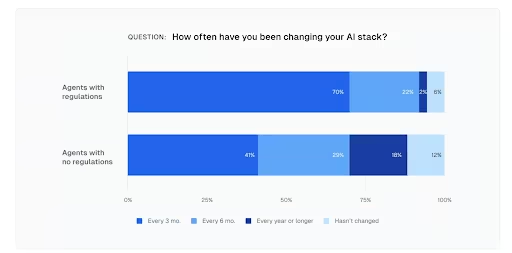
Cleanlab’s 2025 survey of 1,837 engineering leaders found that 70% of regulated enterprises update their agent stack every three months or faster, a pace that makes it nearly impossible to establish stable foundations. The organizations that scale successfully treat their agent architecture as a platform investment rather than a project to be revisited each time a new model is released.
Gartner Warns:
Gartner predicts over 40% of agentic AI projects will be cancelled by the end of 2027 due to escalating costs, unclear business value, or inadequate risk controls.
Source: Gartner, June 2025
How to Scale AI Agents: A Step-by-Step Framework
The following framework reflects what actually works in production environments. Each step is sequenced deliberately: skipping or compressing earlier steps does not accelerate scaling; it moves the reckoning forward to a point where it is more expensive to address the issue.
Step 1: Audit Your Current Agent Setup Before Scaling Anything
Most enterprises discover two to three times as many AI agents as they thought they had once they conduct a structured audit, i.e., agents built by different teams on different data connections with no shared governance or documentation.
- Map every existing agent: what it does, what data it touches, who owns it, and what happens when it fails.
- Score data readiness: Are pipelines real-time or batch-based? Is data consistent, documented, and accessible to agents across systems?
- Assess governance maturity using a three-level model: Ad hoc (no formal oversight), Managed (policies exist but are not enforced in the platform), Optimised (governance is embedded, audited, and enforced automatically).
RTS Labs offers an AI Workshop designed specifically for this stage to assess current agent state, data readiness, and infrastructure gaps before recommending a scaling path. For organizations that have already built agents but are not seeing consistent production performance, this diagnostic step is typically where the root cause is identified.
Step 2: Build a Reusable AI Architecture, Not One-Off Agents
The defining difference between organizations that scale and those that plateau is whether they build agents or build an agent platform. One-off agents produce one-off results. A reusable architecture, with shared tool catalogues, standardised templates, and common data access layers, lets every new use case build on what already exists.
- Design for modularity: shared tool catalogue, common data access layer, standardised agent templates that any team can deploy consistently.
- API-first integration strategy: every agent connects through documented, versioned APIs. This prevents brittle point integrations that break silently when upstream systems change.
- Adopt MCP as the emerging interoperability standard. MCP enables agents to connect to enterprise systems, such as CRMs, ERPs, and data warehouses, without hard-coded integrations that require rebuilding every time a system is updated.
- Cloud-native vs hybrid: AWS Bedrock Agents, Azure AI, and GCP Vertex AI Agent Builder offer native platforms that reduce infrastructure overhead. Custom builds offer more flexibility but require more maintenance. The right choice depends on existing cloud infrastructure, data residency requirements, and the internal engineering capacity available for long-term maintenance.
Step 3: Connect Agents to Your Real Data Systems
This step is frequently underestimated in project plans and overrun in execution because most organizations discover that their data infrastructure is less production-ready than assumed.
- Validate data pipelines for real-time capability, access-control policies, data-lineage tracking, and deduplication.
- Build a unified, real-time data layer accessible across cloud, on-premises, and edge environments. Batch-processed data feeds produce agents that are accurate yesterday and wrong today.
- Fix data pipelines before deploying agents. Every data quality issue that exists at deployment will be amplified, not resolved, by agent activity at scale.
RTS Labs’ Data Engineering practice builds the pipeline architecture and data infrastructure that makes agent scaling structurally possible.
The Momentum Holdings engagement is a direct example: a scalable data warehouse built by RTS Labs produced a 4x improvement in reporting speed and a data foundation clean enough to support future agent deployment across the organization.
Step 4: Set Up Governance and Monitoring Before Deploying at Scale
Organizations that embed governance before production deployment experience fewer rollbacks, fewer production incidents, and faster recovery when issues do occur. Those who treat governance as something to address after scaling typically spend more time in remediation than they saved by moving fast.
- Governance checklist: role-based access, tool call auditing, human override triggers, data privacy segmentation, and model drift alerts.
- The four observability metrics that actually matter: accuracy drift, context relevance, cost per task, and journey completion rate. Everything else is noise.
- Human-in-the-loop design: explicitly define where human approval is required and design those junctions to avoid bottlenecks in time-sensitive workflows — especially in regulated industries, where approval delays carry their own risk.
- Introduce Agent Lifecycle Management as a formal discipline: design, train, test, deploy, monitor, optimise, and retire. Agents that are never formally retired create technical debt and governance gaps that compound over time.
RTS Labs’ Generative AI and ML Consulting practice builds governance frameworks and observability setups as part of every production deployment, with particular depth in logistics and financial services environments where regulatory requirements make governance a prerequisite, not an enhancement.
Step 5: Standardise, Deploy Iteratively, and Measure
The final step is establishing a repeatable, measurable process for rolling out AI agents across the organization. Standardization at this stage means that any team can deploy a new agent without rebuilding the foundation, and that every deployment produces data that improves the next one.
- Build reusable agent templates, shared security rules, and living documentation so any team can deploy consistently without specialist support for every new use case.
- Use a prioritisation matrix to decide what to automate next: task frequency × decision risk × data availability. High-frequency, low-risk tasks with clean data are always the right place to start.
- 90-day deployment sprint: Days 1-30 for audit and data foundation. Days 31-60 for build and integrate. Days 61-90 to deploy and govern. Do not compress. The phases exist because skipping the first produces a broken third.
- Stage-gate expansion: only scale to the next use case when accuracy drift, error rate, cost per action, and human override frequency all pass defined thresholds. Scaling a broken process faster is not progress.
RTS Labs delivers scalable, production-ready AI agent systems within a 90-day deployment commitment. For organizations at Stage 3, 4, or 5 that need to move from stuck to scaling, the starting point is an AI Workshop to assess the current state and build a concrete 90-day action plan.
Scaling AI Agents vs Building AI Agents: What Most Companies Get Wrong
The most widespread misconception about scaling AI agents is that it is an extension of building them. It is not. Building an agent is an engineering problem. Scaling an agent system is an organizational, architectural, and governance problem that also involves engineering.
Most companies arrive at Stage 3 or Stage 4 and discover this gap the hard way. They deploy a second agent and find it does not interact cleanly with the first. They add a third and find that two teams have built redundant tools with incompatible data connections. They bring in a governance reviewer and find there is nothing to review because no audit trail was ever built. The agent works. The system does not.
The table below captures the fundamental shift in mindset and architecture that separates organizations that build agents from those that successfully scale them.
| Building AI Agents | Scaling AI Agents |
|---|---|
| One use case | Multiple coordinated use cases |
| Manual, one-off workflows | Automated, reusable pipelines |
| Experimentation mindset | Enterprise adoption mindset |
| Short-term value | Long-term ROI with governance |
| Technical focus only | Organizational and technical |
| Individual agent | Governed agent ecosystem |
| Speed to prototype | Speed to reliable production |
Real Examples of How Companies Scale AI Agents by Industry
The following examples are drawn from real deployments across industries where AI agent scaling is a present operational reality.
Suncoast Case Study: Conversational AI for Customer Support
Suncoast needed faster, more accurate customer responses without growing its support headcount proportionally. A Retrieval-Augmented Generation (RAG)-powered conversational AI agent was deployed to retrieve answers from internal documents, with an OpenAI web search fallback for queries outside that scope. High-frequency, rule-based queries now route to the agent, freeing human staff to handle complex escalations.
Evergreen Case Study: Sales Analytics Agents for Revenue Teams
Evergreen’s sales teams lacked real-time access to client revenue data and product trends during live conversations, which were stored in systems requiring manual queries. A conversational AI agent was built to give representatives direct, natural-language access to that data when it was needed. The result was faster, better-informed client conversations.
Momentum Holdings Case Study: Data and Reporting Agents for Operations
Momentum Holdings needed to move from manually compiled reports to a data infrastructure capable of supporting both faster reporting and future agent deployment. A scalable data warehouse was built to clean, structure, and unify operational data across the organization, producing a 4x improvement in reporting speed and a data foundation production-ready for agents, rather than the improvised pipelines most AI programs inherit.
PLG Case Study: Document Processing Agents for Legal and Compliance
PLG needed to handle high volumes of legal analysis and contract review without scaling headcount at the same rate. An AI-assisted document processing system was implemented to manage that volume to the precision standards required by legal work. In this context, governance is not optional.
Each of these deployments reflects a different entry point into AI agent scaling and a different set of infrastructure decisions that determined whether the system held up in production. RTS Labs has worked across all four of these contexts, bringing the data engineering, integration architecture, and governance depth needed to move AI agent programs from pilot outcomes to measurable business results.
When Should a Company Work With an AI Consulting Partner?
A consulting partner fills the gaps that cause internal teams to stall. The following triggers are diagnostic. If your organization recognises itself in one or more of them, an experienced implementation partner will typically compress your timeline significantly and reduce the cost of the scaling mistakes you would otherwise make on your own.
Scenario 1: You have built an agent, but cannot scale it
This is Stage 2, the most common scenario. The pilot worked. The production deployment is inconsistent. The issue is almost always architectural: a data pipeline that was adequate for testing but not for live volume, or an integration that was hard-coded and breaks when upstream systems change.
Scenario 2: Your teams are building agents separately with no shared infrastructure
Agent sprawl has begun. You are entering Stage 4 without a governance foundation, which means every new agent adds fragility rather than capability. The cost of letting this continue compounds quickly. The shared infrastructure that would have taken two months to build at Stage 2 takes six months to retrofit at Stage 4.
Scenario 3: Data integration is your biggest bottleneck
The complexity of integrating agents with real enterprise systems is consuming your timeline and budget. This is the integration tax, and it affects nearly every scaling program that did not design an API-first architecture from the outset.
Scenario 4: Costs are increasing faster than the value you are producing
You are scaling spend but not outcomes. This is a signal that the architecture is wrong. Compute costs, maintenance overhead, and integration rework are consuming the value that automation was supposed to generate.
Scenario 5: You want production-grade AI, not more experiments
You need a partner who can commit to a deployment timeline, not a discovery engagement that produces another roadmap. The organizations that accelerate most at this stage are those that bring in a partner with a proven production-deployment methodology and reference architectures already validated in comparable environments.
RTS Labs works with organizations at Stages 3, 4, and 5, past the experimentation phase and ready to build at scale. The 90-day production deployment commitment is structured to move organizations from the current-state audit to live deployment within a defined, predictable timeline.
Scaling AI Agents Is an Engineering Problem, Not Just an AI Problem
The companies winning in 2026 are not the ones with access to the best models. Every competitive organization has access to roughly the same models. The ones pulling ahead are those with the best systems around those models, cleaner data foundations, more robust integration architecture, governance that is embedded rather than bolted on, and operating models that let agents extend human capability rather than replace it prematurely.
Companies at Stage 3, 4, or 5 typically accelerate their timeline significantly when they bring in an experienced implementation partner, not to replace the internal team, but to fill the gaps that cause most scaling efforts to stall. The integration complexity, the data engineering depth, and the governance architecture that determine whether an AI agent program delivers or disappoints are precisely where the difference between an internal build and a production-grade deployment is most visible.
RTS Labs offers a free AI Workshop to assess your current agent setup, identify your biggest scaling bottlenecks, and build your 90-day action plan.
FAQs
1. What is the difference between an AI agent and a scaled AI agent system?
A single agent executes a defined task in isolation. A scaled system coordinates multiple agents across live workflows, with shared data, orchestration logic, and governance controls that determine how agents communicate, hand off tasks, and recover from failures.
2. How do you know when an AI agent is ready to move from pilot to production?
It handles edge cases and failure states without human intervention, performs consistently at two to three times expected peak volume, and has a documented data pipeline, audit trail, and rollback procedure in place.
3. What is agent sprawl, and why does it become expensive so quickly?
Agent sprawl occurs when different teams independently build agents using separate data connections, with no shared infrastructure. The cost compounds with every new agent added. Consolidation that takes two months at Stage 2 typically takes six months to retrofit at Stage 4.
4. Should organizations build their own orchestration layer or use an existing framework?
Existing frameworks, including LangGraph, CrewAI, and AutoGen, are appropriate for most organizations at Stage 2 and 3. Custom orchestration only makes sense when off-the-shelf tools cannot meet latency requirements or regulatory constraints.
5. How does RTS Labs approach organizations that already have agents deployed but are not seeing consistent production performance?
RTS Labs starts with a structured diagnostic process, mapping existing agents, assessing data pipeline readiness, and identifying the exact layer where performance is breaking down before recommending any new deployment or architectural change.