
Most organizations expect AI automation to pay off within three years, yet nearly 60% acknowledge that more sophisticated levels of automation will take longer to deliver returns, with many unable to measure progress at all (Deloitte, 2025). The expectation is there. The framework to realize it is usually not.
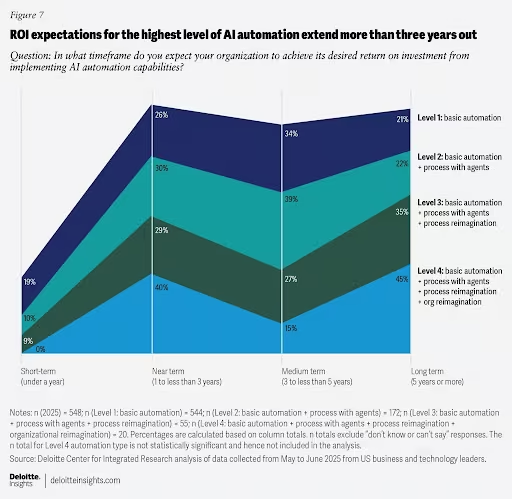
Without a structured approach to calculating costs, defining ROI layers, and measuring results before deployment, even well-funded automation programs drift, producing activity without accountability. This guide closes that gap. It covers what AI automation ROI actually means, how to calculate it accurately, what it truly costs, and how to build business cases that hold up to scrutiny from first pilot through enterprise scale.
What Does AI Automation ROI Actually Mean?
AI automation ROI is the total value generated from AI-driven automation initiatives, measured across financial gains, operational improvements, and long-term strategic impact relative to the investment made.
Also Read: Intelligent Automation Strategy Guide for Enterprise Leaders
Most conversations about AI ROI collapse a complex, multi-layered concept into a single number, and that is precisely where they go wrong. AI automation delivers value across three distinct timelines, each with a different measurement approach, audience, and risk.
AI Automation ROI isn’t just one number. Treating it as one is one of the most reliable ways to undermine an AI business case. A three-layer framework gives finance leaders, operations teams, and executives a more accurate and defensible picture of where value actually comes from:
Hard ROI (Direct, Measurable Impact)
Hard ROI captures tangible financial outcomes that can be directly quantified. Hard ROI is reflected in cost savings, revenue growth, efficiency gains, and reduced operational expenses. Typically tracked through metrics like ROI %, payback period, and margin improvement.
Soft ROI (Indirect, Experience-Driven Impact)
Soft ROI consists of benefits that are harder to quantify but still influence performance over time. Soft ROI includes improved customer satisfaction, employee productivity, brand perception, and reduced friction. Often measured through proxies like NPS, engagement scores, retention rates, or time saved.
Strategic ROI (Long-Term, Competitive Advantage)
Strategic ROI is the value created by positioning the business for sustained growth and resilience. It shows up in faster innovation cycles, better decision-making, market expansion, and risk reduction. It is realized over time through a durable competitive advantage rather than immediate financial returns.
| ROI Layer | Timeline | Impact/Improvements |
|---|---|---|
| Hard ROI | 3–12 months | Measurable financial impact includes labor savings, cycle time reduction, error reduction, and cost-per-transaction improvements. |
| Soft ROI | 12–36 months | Operational improvements that include higher-quality decisions, employee productivity gains, improved customer experience, and reduced operational risk. |
| Strategic ROI | 36+ months | Long-term competitive advantages include scalability without proportional headcount growth, proprietary data insights, operational resilience, and advantages that competitors struggle to replicate quickly. |
Quick Tip: Keep the Three Layers Separate
- Hard ROI = what you can show a CFO this quarter.
- Soft ROI = real value that takes 1-3 years to prove.
- Strategic ROI = long-term advantages competitors struggle to replicate.
Blending these into a single composite number weakens business cases by mixing near-term, verifiable savings with long-range projections that finance teams rightly treat skeptically.
What Are the Key Metrics Used to Measure AI Automation ROI?
Measuring AI automation ROI requires a consistent set of KPIs that finance and operations teams can track before and after deployment. The challenge, however, is that most organizations lack baseline measurements prior to deployment, making it impossible to demonstrate what automation actually saved.
Which KPIs Do CFOs and Analysts Track for AI ROI?
| KPI | Typical Impact | Why It Matters |
|---|---|---|
| Process cycle time reduction | 30–70% | Faster workflows increase operational throughput without adding headcount. |
| Error rate reduction | 50–80% | Fewer mistakes reduce costly rework, compliance exposure, and operational risk. |
| Cost per transaction | 40–60% reduction | The clearest direct savings metric for finance teams. Trackable at the process level. |
| Employee capacity reallocation | Varies | Measures where freed hours are reinvested. Critical for proving soft ROI over time. |
| Time-to-value | 3–6 months | How quickly automation produces measurable results after go-live. Shorter is better. |
Measurement Warning
Many companies report productivity improvements from AI but struggle to translate them into financial metrics that finance teams trust.
The most common reason is the absence of baseline measurements before deployment. If you do not know what a process costs today in time, labor, error rates, and transaction volume, you cannot prove what automation saved.
How Do You Calculate AI Automation ROI?
To calculate AI automation ROI effectively, the goal is not just to arrive at a single percentage but to capture the full spectrum of value AI delivers across cost savings, performance improvements, and long-term business impact. This requires a structured approach that aligns measurable outcomes with investment, while accounting for both immediate returns and benefits that compound over time.
A: What Is the Basic AI ROI Formula?
The foundational formula for calculating ROI is straightforward:
ROI Formula
ROI (%) = [(Total Benefits − Total Costs) ÷ Total Costs] × 100
Example: Suppose AI automation delivers $300,000 in annual benefits through labor savings, error reduction, and productivity gains. If the total cost — including implementation, integration, and first-year maintenance — is $120,000, the ROI is 150%. That is a straightforward business case.
B: How Do You Calculate the Payback Period?
Payback Period Formula
Payback Period = Total Investment ÷ Monthly Net Savings
Example: A $120,000 investment that saves $15,000 per month has an 8-month payback period.
Industry Benchmark: Payback Period
- 3–6 months: High-quality automation use case. Strong indicator of well-scoped implementation.
- 9–14 months: Common enterprise timeline for moderately complex deployments.
- 18+ months: Revisit the use case or examine whether the cost assumptions are realistic.
Note: Mid-market teams typically see ROI within 6–9 months; enterprise-scale programs often require 12–18 months (Aloa AI Adoption Research, 2025).
C: What Is the Fully-Loaded Labor Savings Formula?
Most ROI calculations undercount labor savings by using base salary rather than fully-loaded cost. The correct formula:
Labor Savings = (Time Saved Per Task × Monthly Volume × 12) × Fully-Loaded Hourly Cost
Fully-loaded cost includes salary, benefits, payroll taxes, and management overhead, typically 1.25–1.4× base salary. For a $75,000 base-salary employee, the fully loaded cost ranges from $93,750 to $105,000 per year. Using the base salary alone understates savings by 25–40%.
When Should You Use Advanced Financial Models (NPV or IRR)?
For multi-process or enterprise AI programs spanning multiple years, Net Present Value (NPV) gives a more accurate financial picture than year-one ROI because it accounts for the time value of money.
Net Present Value (NPV) Formula
Where r is the discount rate (typically the organization’s hurdle rate or cost of capital) and t is each year.
- A positive NPV means the investment creates value.
- A negative NPV means it does not, regardless of what the year-one ROI looks like.
Which ROI Formula Should You Use?
Single process automation → Basic ROI + Payback Period
Multiple workflows → ROI + Fully-Loaded Labor Savings
Enterprise AI program → NPV / IRR for multi-year modeling
What Does AI Automation ROI Look Like Across Different Industries?
ROI from AI automation varies significantly across industries, driven by data maturity, workflow complexity, the regulatory environment, and the availability of well-defined, repeatable processes.
The ranges below reflect reported benchmarks from industry research published between 2023 and 2025. They represent typical outcomes for organizations with adequate data infrastructure.
| Industry | Common AI Use Case | Typical ROI Range | Key Prerequisite |
|---|---|---|---|
| Financial Services | Invoice processing, fraud detection, compliance automation | 20–35%+ (up to 10.3x for leaders) | Structured financial data; regulatory integration. McKinsey projects 15–20% net cost reduction across banking. |
| Logistics & Transportation | Route optimization, predictive maintenance, and demand forecasting | 35–55% | Real-time operational data. AI helps reduce procurement spend by 5–15% (McKinsey, 2024). |
| Manufacturing | Quality inspection, supply chain automation, predictive maintenance | 3.4x return on GenAI (avg.) | Sensor and production data. 72% of manufacturers report reduced costs after AI implementation (Aristek, 2025). |
| Healthcare | Clinical documentation, claims processing, and diagnostic support | $3.20 per $1 invested | Secure, structured patient and billing data. Regulatory compliance is a major prerequisite. |
| Legal | Contract analysis, document review, legal research | 25–50% | Structured document repositories. AI can reduce drafting time from 16 hours to minutes for high-volume work (Aristek, 2025). |
| Marketing & SaaS | Campaign automation, customer analytics, and content generation | 50–100% | Centralized marketing and product data. Companies using AI in marketing report 37% cost reduction and 39% revenue increase (AI Statistics 2025). |
| Customer Support | Ticket classification, chatbot resolution, sentiment analysis | 30–60% | Historical ticket data. AI chatbots now resolve up to 70% of inquiries autonomously (Zendesk, 2024). |
| Pharma & Life Sciences | Document automation, trial data management, and regulatory compliance | 25–45% | Regulated workflow integration. High data-quality standards are essential for compliance and model reliability. |
Organizations that reach the upper end of these ranges typically share three characteristics:
- Clean, well-governed data
- Workflows that were defined and stabilized before automation was introduced
- Strong integration between AI systems and operational data sources.
These factors matter more than the choice of technology platform.
What Is the Total Cost of Ownership (TCO) of AI Automation?
The most common financial mistake in AI automation is confusing the cost of the tool with the cost of the implementation. Research consistently shows that organizations underestimate the total cost of getting AI operational by 30–40%, with some analyses putting the figure even higher (IDC). The licensing fee, which vendors naturally lead with, typically represents only 20–30% of the actual cost to deploy and sustain an AI system in production.
What Is AI Automation TCO?
Total Cost of Ownership (TCO) is the full lifecycle cost of an AI system from initial design through deployment, integration, ongoing maintenance, and organizational change management.
It differs from traditional software TCO in four important ways:
- Compute costs scale non-linearly with usage
- Data engineering is a major cost driver that vendors rarely price
- AI models require continuous maintenance to prevent performance degradation
- Integration complexity is typically 2–3x what initial proposals suggest.
The Six Components of AI Automation TCO
TCO captures every cost layer, both visible and hidden, so businesses can evaluate ROI accurately and avoid underestimating the costs of long-term commitments. Let’s discuss the six components that make up AI automation TCO:
1. Acquisition Costs
Acquisition costs cover software licensing, cloud infrastructure, and any hardware required for on-premises deployments. For mid-sized enterprise implementations, software licensing alone typically ranges from $50,000 to $500,000, depending on scale and capabilities.
2. Implementation and Integration Costs
Organizations routinely underestimate the cost of connecting AI systems to existing operational infrastructure. Integration services for mid-market implementations typically run $75,000–$250,000, with enterprise deployments significantly higher.
3. Data Preparation Costs
Data preparation is the single largest hidden cost in most AI programs. Cleaning, structuring, and integrating data account for 20–30% of total project costs, and most organizations underestimate this effort because they assume their data is cleaner and better structured than it actually is. Gartner research found that organizations would abandon 60% of all AI projects due to unsupported data in 2026.
Organizations frequently engage data engineering specialists to handle this layer before deployment, reducing downstream rework and keeping automation initiatives within budget.
4. Talent and Personnel Costs
AI systems require skilled people to design, deploy, monitor, and improve them. Technical training for IT staff typically runs $2,000–$5,000 per person, with total training investment representing 10–15% of implementation budgets. Change management programs add further cost, with cross-departmental AI integration programs ranging from $150,000 to $500,000, depending on organizational complexity.
5. Maintenance and Model Drift
AI models are not static. As real-world data drifts from the conditions under which models were trained, performance degrades. This phenomenon is called model drift. Monitoring, drift detection, and periodic retraining typically add 15–30% overhead to annual operating costs. Organizations that fail to budget for this find themselves in year two or three with AI systems that perform significantly worse than they did at launch.
6. Downtime Risk and Opportunity Cost
When AI systems fail or underperform, organizations often revert to manual processes, sometimes running both in parallel for an extended period while operational trust is established. This dual-running phase is a real and recurring cost that almost never appears in vendor proposals or initial business cases. The longer it runs, the more it erodes the ROI projections that the implementation was sold on.
TCO Reality Check
- An AI system that shows 200% ROI based on licensing costs alone may show only 40% ROI when full TCO is included. Both figures are mathematically correct. Only the TCO-based figure is useful for making investment decisions.
- Budget 30-40% of the total AI project effort for data preparation alone. Organizations that plan realistically at the outset avoid the budget overruns that characterize most failed AI programs in years 2-3.
Why Do Many AI Automation Initiatives Fail to Deliver ROI?
The NTT DATA research found that 70–85% of generative AI (GenAI) deployments fail to meet desired ROI targets. The failure to achieve the ROI target is not primarily a technology indictment. It is an organizational and structural one. The failures follow predictable patterns.
Hidden Costs Often Missing From AI Proposals
Vendor proposals almost never include the full cost picture. Four categories are routinely missing:
• Data preparation
If a vendor’s proposal does not include a detailed data readiness assessment, the true cost of getting the data into usable shape is not in the budget.
• Workflow redesign
Layering AI on top of broken or inefficient manual workflows amplifies their flaws rather than resolving them. Effective automation requires redesigning workflows around the technology, not beneath it.
• Model maintenance
The ongoing 15–30% overhead for drift monitoring and retraining is almost never included in year-one cost estimates.
• Adoption infrastructure
Training, change management, and the organizational work of building trust in AI systems can represent 10–15% of total program cost, and largely determine whether the system is actually used.
Also Read: AI Automation Implementation: Avoiding Failure and Scaling with Confidence
Why Do AI Pilots Stall Before Scaling?
Pilots succeed in controlled conditions that rarely reflect production reality. Four structural causes explain most scaling failures:
Generic tools deployed against specific problems
Horizontal AI tools like copilots and chatbots spread benefits thinly across an organization. Many enterprises rely on these tools, but their benefits are too diffuse to show up in financial results. Vertical, workflow-specific automation produces measurably different outcomes.
Missing baseline measurements
Without pre-deployment data on process costs, cycle times, and error rates, there is no way to demonstrate what changed. This is the most common reason AI programs fail to secure continued investment.
Treating AI as a technology project
AI programs with clear business ownership and executive sponsorship show significantly higher success rates than those managed as IT deployments. Only 15% of U.S. employees report that their workplaces have communicated a clear AI strategy (Gallup, 2024).
Poor data readiness
Data quality failures are the leading cause of AI project failure. Organizations that fix the data before deploying the model consistently outperform those that deploy first and discover data problems later.
Best Practices to Maximize AI Automation ROI
Achieving strong, sustainable returns from AI automation is less a function of which technology you choose than of how you deploy it. The practices below represent the operational and strategic decisions that consistently separate high-performing AI programs from those that stall after the pilot, covering everything from securing executive sponsorship to accounting for freed capacity.
Secure Executive Sponsorship Early
AI initiatives with strong leadership sponsorship at the C-suite or senior VP level show significantly higher success rates. Sponsorship matters not just for budget protection but for the organizational authority to drive workflow redesign, mandate adoption, and reallocate capacity freed by automation. Top-down enterprise programs, where senior leadership selects focus areas and applies coordinated organizational muscle, are the emerging standard for high-ROI AI.
Start With High-Impact, High-Volume Use Cases
The fastest path to demonstrable ROI is a single high-volume, rule-based process with clear inputs, outputs, and measurable outcomes. This provides a verifiable proof point for finance teams, builds organizational confidence, and generates the baseline data needed to evaluate adjacent automation opportunities. Resist the temptation to automate multiple processes simultaneously in the early stages.
Fix the Data Before Deploying AI
Data quality determines AI performance more than any other single factor. A model operating on incomplete, inconsistent, or poorly integrated data will produce unreliable outputs, and unreliable outputs destroy trust in AI systems faster than any other failure mode. Allocate 30–40% of the total project effort to data preparation. Organizations that engage experienced data engineering partners for this layer consistently reduce downstream rework and maintain stronger cost control throughout implementation.
Redesign Workflows Instead of Simply Automating Them
The highest ROI from AI automation comes when workflows are restructured around what automation does well. AI high performers are three times more likely than less progressive organizations to redesign workflows before or alongside automation deployment (McKinsey). This is also where many implementation partners add disproportionate value, bringing process design expertise alongside technical deployment capability.
Also Read: How Enterprises Identify Automation Opportunities Quickly
Invest in Organizational AI Literacy
71% of AI tools fail to integrate into daily operations and are abandoned within six months, and adoption failure is almost always a people problem (Kore.ai). Training programs, change management, and clear communication about how AI affects existing roles are not optional costs. They are ROI multipliers.
Redirect Freed Capacity Into Higher-Value Work
Automation savings only generate ROI when the time saved is redirected toward measurable, revenue-generating, or cost-reducing activities. This is the capacity trap: organizations that automate routine work but allow the freed hours to dissipate into unfocused activity see productivity improvements that never show up in financial results. Define in advance where freed capacity will be reinvested and measure it.
How Do You Build an AI Automation ROI Business Case?
A strong AI ROI business case is built before deployment. The following five-step framework provides the structure finance leaders and operations teams need to evaluate, approve, and measure AI automation investments.
Step 1: Establish Baseline Process Metrics
Before evaluating any automation solution, document the current state of the target process: cycle time per transaction, error rate, monthly volume, fully loaded labor cost, and any downstream costs resulting from errors or delays. This baseline is the measurement anchor for every subsequent ROI calculation.
Step 2: Calculate the Full Automation Cost
Include all six TCO components: acquisition, implementation, data preparation, talent, maintenance, and downtime risk. Use the 30–40% underestimation adjustment as a stress test. If the ROI calculation survives a cost overrun of that magnitude, the business case is robust.
Step 3: Estimate Hard ROI Using Conservative Assumptions
Apply the basic ROI formula using conservative benefit estimates, the lower bound of expected improvements, rather than the midpoint or optimistic case. A business case that works under conservative assumptions is far more credible than one that requires optimistic projections to turn positive.
Step 4: Separate Soft ROI Into a Different Timeline
Present soft ROI in a separate section with longer timelines and explicit acknowledgment that these benefits are harder to attribute directly. Mixing them with hard ROI in a single calculation reduces the credibility of the entire business case in the eyes of finance leaders.
Step 5: Define Measurement Cadence Before Deployment
Establish the specific metrics, measurement frequency, and responsible parties before the system goes live. Monthly measurement against baseline in the first six months, quarterly thereafter. If the hard ROI is not materializing within the expected payback period, the measurement cadence provides early warning.
Business Case Checklist
Turning AI Automation ROI From Theory Into Measurable Results
The organizations generating the strongest returns from AI automation are establishing baselines before deployment, calculating full costs rather than licensing fees alone, fixing data infrastructure before models go live, and redesigning workflows rather than automating broken ones.
That discipline is harder to execute than it sounds. The integration layer, the data preparation work, and the workflow redesign decisions that determine whether an AI program delivers or disappoints are precisely where most organizations lack in-house depth, and where the gap between a promising pilot and a scalable program opens up.
RTS Labs works with mid-market and enterprise organizations at exactly this layer. From data engineering and systems integration to workflow design and automation implementation, RTS Labs handles the data engineering, systems integration, and workflow redesign that turn AI business cases into measurable, auditable outcomes — without the budget overruns that come from underestimating what production-grade automation requires.
If your organization is evaluating an AI automation investment or trying to scale beyond an initial pilot, the place to start is a structured assessment of your data readiness, integration architecture, and process design before any technology is selected or deployed.
RTS Labs has helped mid-market and enterprise teams close the gap between AI pilots and production ROI. Start with a conversation.
FAQs
1. Does the size of an organization affect the ROI timeline for AI automation?
Smaller organizations with simpler workflows typically see payback in three to six months, while enterprise deployments often require twelve to eighteen months due to integration complexity and change-management overhead.
2. Should AI automation ROI be measured at the process level or the program level?
AI automation ROI should be measured at both levels, but separately. Measure at the process level in the first 12 months to achieve clear, attributable results, then shift to program-level measurement once multiple workflows are automated and compounding effects become visible.
3. How do you handle AI automation ROI when the primary benefit is risk reduction rather than cost savings?
Use expected value modeling: multiply the probability of a risk event by its estimated financial impact, then compare that to the cost of the automation that prevents it. This approach is especially effective in compliance-heavy industries like financial services and healthcare.
4. What is the difference between AI automation ROI and digital transformation ROI?
AI automation ROI ties to specific processes, cost inputs, and measurable outputs, making it far more trackable than broad digital transformation ROI, which spans culture, technology, and competitive positioning over many years.
5. How does RTS Labs help organizations that have already deployed AI but are not seeing expected returns?
RTS Labs runs a structured diagnostic to identify whether the shortfall stems from data quality, integration gaps, or workflow design, then builds a targeted remediation roadmap rather than recommending a platform replacement.