Enterprises rarely fail at transformation because they lack tools. They fail because they don’t fully understand how work actually flows through their organization across systems, teams, and people. As automation, AI, and operational transformation initiatives accelerate, leaders increasingly turn to process mining and task mining to uncover inefficiencies, justify investments, and prioritize automation.
Yet many organizations approach these capabilities incorrectly, treating process mining and task mining as interchangeable tools rather than complementary lenses on different layers of work. The result is a familiar pattern: dashboards without execution, automation without alignment, and pilots that never scale.
This article reframes the discussion. Instead of asking which tool is better, it explains what each approach actually reveals, where each breaks down, and why enterprises stall when they choose only one. It then introduces an AI-driven model to move from insight to measurable operational outcomes, with RTS Labs.
What Is Process Mining?
Process mining is a system-level analytical approach that reconstructs how business processes actually run by analyzing event logs generated by enterprise applications. Process mining doesn’t rely on documented workflows or assumed handoffs; It uses timestamped system data to reveal the real end-to-end flow of work across the organization.
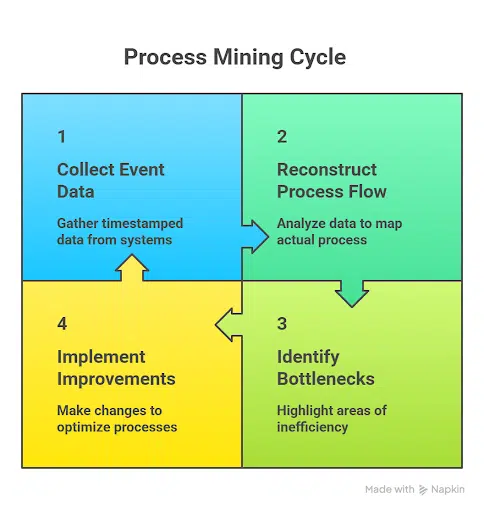
From where does process mining derive data?
Process mining derives information from any system that records when activities occur, in what sequence, and by which entity. Typical data sources include ERPs, CRMs, finance platforms, supply chain systems, ticketing tools, and workflow engines. Process mining correlates events to surface how work truly moves across systems and teams, often exposing a wide gap between designed processes and executed reality.
How is process mining useful?
Process mining provides visibility at the structural and macro-level. It highlights bottlenecks, rework loops, process variants, handoff delays, and compliance deviations that are invisible in traditional reporting. Leaders use it to understand where processes break down, where value leaks occur, and which steps drive cost, delay, or risk at scale.
At which level does process mining happen?
Process mining operates at the process and system level, not at the level of individual user behavior. Its primary role in enterprise transformation is to create a shared, objective view of operational reality, informing automation strategy, process redesign, compliance remediation, and large-scale efficiency initiatives.
What Is Task Mining?
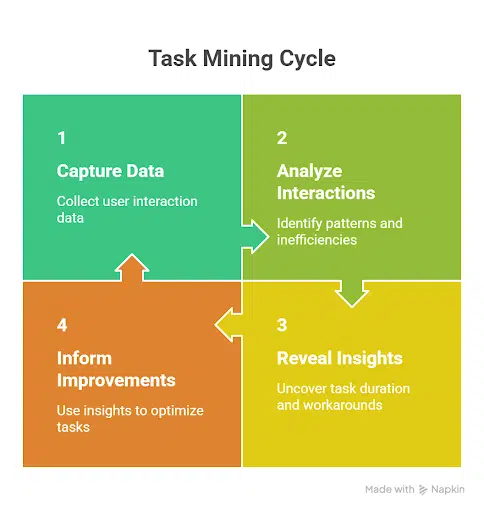
Task mining doesn’t reconstruct an end-to-end process from system logs. It focuses on how individual tasks are actually performed step by step, within user interfaces. This makes it particularly effective in environments where work is manual, repetitive, and heavily UI-driven, such as data entry, reconciliations, customer support operations, and back-office processing.
From where does task mining derive data?
Data is typically captured through desktop agents, activity logs, or screen-level observation mechanisms, allowing organizations to see how work is done. It does not explain how it was designed.
How is task mining useful?
Task mining provides granular insight into task duration, execution variability, workarounds, and inefficiencies that are often invisible to system-level analysis. It is commonly used to identify automation candidates, inform RPA design, and quantify the effort required to complete specific tasks.
Task mining explains execution behavior, not process structure. It reveals local inefficiencies but does not inherently show upstream or downstream impact across the broader enterprise workflow.
At which level does task mining happen?
Task mining shifts the lens from systems to people. It is a user-level observation approach that captures how work is executed on desktops and applications by analyzing interactions such as clicks, keystrokes, screen changes, and activity sequences.
Task Mining vs Process Mining: What’s the Real Difference?
The task mining vs process mining comparison is often framed as a tooling debate, which is misleading.
Process mining and task mining answer fundamentally different questions at different layers of work. Treating them as substitutes leads enterprises to optimize locally while missing systemic issues, or to gain high-level insight without knowing how to act on it.
The right way to evaluate them is as complementary lenses within an automation and transformation lifecycle.
Core Differences at a Glance
| Dimension | Process Mining | Task Mining |
|---|---|---|
| Level of analysis | System-level, end-to-end processes | User-level, task execution |
| Primary data source | Event logs from ERP, CRM, workflow systems | Desktop interactions, UI activity, keystrokes |
| Scope of visibility | Cross-system workflows and handoffs | Individual tasks and execution steps |
| Key question answered | Where does the process break? | How is work actually done? |
| Typical outputs | Bottlenecks, variants, rework, compliance gaps | Task duration, inefficiencies, automation candidates |
| Best-fit use cases | Order-to-cash, procure-to-pay, claims, audits | Data entry, reconciliations, support operations |
| Role in automation lifecycle | Strategic prioritization and redesign | Tactical automation and RPA design |
| Primary limitation | Blind to manual work outside systems | Lacks end-to-end process context |
Process mining surfaces what matters most to fix. Task mining reveals how to fix it efficiently. Used together and reinforced with AI, they move organizations from insight to action instead of stopping at dashboards or isolated bots.
When Process Mining Works Best and Where It Fails
Process mining is exceptionally powerful but only in the right conditions and with the right expectations. Enterprises often struggle because it’s applied in the wrong way or asked to solve the wrong problem.
When Process Mining Works Best
Process mining delivers the most value when organizations need system-level clarity across complex, cross-functional workflows.
It works particularly well when:
Processes span multiple systems and teams
End-to-end workflows like order-to-cash, procure-to-pay, claims processing, or compliance reviews touch ERPs, CRMs, finance tools, and workflow platforms. Process mining reconstructs how these systems actually interact, revealing delays, rework loops, and broken handoffs that no single team can see in isolation.
Reliable event-log data exists
Modern enterprise platforms generate rich event data. When this data is accessible and reasonably consistent, process mining can automatically surface variants, bottlenecks, and deviations at scale far faster than interviews or workshops.
Organizations need macro-level optimization
For leaders focused on throughput, cycle time reduction, compliance, or cost leakage, process mining provides a factual baseline. It shows where to intervene first and which processes are worth redesigning or automating.
Typical high-impact use cases include
- Order-to-cash optimization
- Procure-to-pay compliance monitoring
- Claims and case management workflows
- Audit and regulatory reporting processes
- ERP transformation and migration readiness
In these scenarios, process mining acts as a strategic diagnostic layer, guiding where effort and investment will matter most.
Where Process Mining Falls Short
Despite its strengths, process mining is not a silver bullet. Many initiatives stall when their limitations are ignored.
It is blind to manual work outside systems
If critical steps happen in spreadsheets, email, or informal tools, process mining will show gaps but not explain what actually happens in those gaps.
It explains ‘what,’ not always ‘why’
Process mining can show that invoices stall after approval or that cases loop repeatedly, but it cannot fully explain human behavior, workarounds, or intent without additional context.
Dashboards are mistaken for outcomes
A common failure pattern is stopping at insights. Enterprises generate compelling visualizations but fail to redesign processes, embed changes into workflows, or hold teams accountable for execution.
Lack of operational follow-through
Without integration into automation programs, decision systems, or governance models, process mining becomes a reporting tool rather than a transformation enabler.
When Task Mining Works Best (and Where It Fails)
Task mining zooms in where process mining cannot, i.e., at the point of human execution. It captures how work is actually performed on desktops and applications, revealing inefficiencies that never appear in system logs.
Used correctly, it is one of the fastest ways to uncover automation-ready work. Used in isolation, however, it often creates a false sense of progress.
When Task Mining Works Best
Task mining is most effective in environments dominated by manual, repetitive, and UI-driven work where execution varies by person, team, or region.
It works best when:
Work is highly manual and repetitive
Back-office operations such as data entry, reconciliations, ticket handling, and document processing involve repeated screen interactions. Task mining captures the exact steps, time spent, and variations across users, making inefficiency visible at a granular level.
Automation candidates need execution detail
RPA and workflow automation require precision. Task mining provides the click-by-click insight needed to design bots that actually work in production, rather than brittle automations based on assumptions.
There is significant variation in how work is done
When the same task is performed differently across users, task mining exposes inconsistencies, unnecessary steps, and best practices that can be standardized.
Ideal use cases include
- Data entry and validation
- Financial reconciliations
- Customer support and ticket triage
- Back-office operations in finance, HR, and insurance
- Manual reporting and spreadsheet-driven workflows
In these contexts, task mining is a high-fidelity lens into execution reality, especially valuable early in automation programs.
Strengths of Task Mining
Task mining excels at answering questions that process mining cannot:
- How long does work actually take?
- Where do users struggle or improvise?
- Which steps are most repetitive and error-prone?
It is particularly effective as input for RPA, workflow automation, and productivity improvements, where success depends on understanding human interaction with systems.
Where Task Mining Falls Short
Despite its precision, task mining has critical limitations that enterprises often underestimate.
It lacks end-to-end process context
Task mining shows what happens on a screen, but not how that task fits into the broader workflow. It cannot explain upstream causes or downstream consequences.
It does not capture system-to-system behavior
Automated handoffs, integrations, and background processing are invisible to task mining, creating blind spots in complex enterprise environments.
It encourages local optimization
Automating a task may save minutes, but if the surrounding process remains broken, overall cycle time and cost may not improve. This is how organizations end up with dozens of bots and little enterprise impact.
It cannot guide strategic transformation alone
Without process-level insight, task mining leads to tactical fixes rather than structural improvement.
| Dimension | Process Mining | Task Mining |
|---|---|---|
| Best At | End-to-end, cross-system process visibility | Deep insight into manual, UI-driven work |
| Primary Strength | Identifies bottlenecks, variants, and control gaps at scale | Reveals execution detail needed for RPA and task automation |
| Where It Excels | O2C, P2P, claims, compliance, ERP transformations | Data entry, reconciliations, ticket handling, back-office work |
| Key Limitation | Cannot fully explain human behavior or off-system work | Lacks process context and system-to-system visibility |
| Common Failure Mode | Stops at dashboards without operational follow-through | Optimizes tasks locally without improving end-to-end outcomes |
| Role in Automation | Strategic diagnostic and prioritization layer | Tactical input for bot and workflow design |
Why Enterprises Fail When They Choose Only One
One of the most common and costly mistakes enterprises make is treating process mining and task mining as substitutes rather than complementary capabilities. On paper, both promise visibility and automation insight. In practice, choosing only one creates blind spots that prevent real transformation.
Also Read: Enterprise AI Roadmap: The Complete 2026 Guide
The Process-Only Trap: Insight Without Execution
Organizations that rely exclusively on process mining gain strong system-level visibility but often struggle to translate insight into action.
What happens in practice:
- Leaders can see where bottlenecks occur, but not how work is actually executed.
- Dashboards highlight delays, rework loops, or compliance gaps, but teams lack clarity on which manual steps cause them.
- Automation teams are forced to guess execution details, leading to brittle bots or stalled implementation.
The Task-Only Trap: Automation Without Strategy
At the other extreme, organizations adopt task mining as a shortcut to automation—often driven by RPA initiatives or pressure to show quick wins.
What goes wrong:
- Teams automate individual tasks without understanding upstream or downstream dependencies.
- Local efficiency improves, but end-to-end cycle time stays flat.
- Bots proliferate across teams with no orchestration, governance, or shared metrics.
This leads to automation sprawl, i.e., many bots, little enterprise impact, and rising maintenance costs.
The Real Cost of Choosing One
When process and task mining are siloed:
- Discovery and execution are disconnected
- Automation stalls at the pilot stage
- ROI is difficult to measure or defend
- Business stakeholders lose confidence
Most importantly, insights never make it into live operations.
Why This Happens
Enterprises fail because:
- Mining initiatives are owned by separate teams
- Insights are treated as reports rather than inputs for change
- There is no execution layer connecting discovery to automation and decision-making
This gap between visibility and action is where most mining-led transformation efforts break down.
The Intelligent Approach: Process Mining + Task Mining + AI
Enterprises that succeed don’t ask whether process mining or task mining is better. They design an intelligent operating model where both are connected and amplified by AI to drive execution.
AI is the missing layer that turns fragmented visibility into coordinated action.
Also Read: Top AI Integration Companies in 2026: Full Comparison & Expert Guide
How AI Connects System Insight to Real Execution
When process mining and task mining operate together, AI provides the intelligence that neither can deliver alone:
-
Correlation across levels
AI links system-level events (from ERP, CRM, finance, supply chain platforms) with task-level execution data (user actions, manual steps, handoffs). This reveals why bottlenecks occur, not just where.
-
Root-cause intelligence, not symptom reporting
Instead of showing that invoices are delayed, AI identifies the specific behaviors, exceptions, or task variants driving the delay, across teams, regions, or systems.
-
Predictive and prescriptive insight
AI models forecast where breakdowns are likely to occur next and recommend which process changes or automation interventions will deliver the highest impact.
-
Execution-ready prioritization
Opportunities are ranked by feasibility, ROI, and risk so teams know what to automate, redesign, or eliminate first.
In this model, mining stops being a diagnostic exercise and becomes a decision engine.
Why AI Changes the Economics of Mining Initiatives
Without AI, mining outputs often remain static analyses. With AI:
- Insights refresh continuously as processes evolve
- Variants and drift are detected automatically
- Improvement becomes iterative, not episodic
- Automation decisions are data-driven, not opinion-based
Where RTS Labs Fits In
RTS Labs operates at this integration layer as an execution partner that connects insight to outcome. Rather than asking teams to ‘interpret the data,’ RTS Labs helps organizations operationalize it inside finance systems, supply chains, customer operations, and compliance workflows.
Our end-to-end solutions bring:
- Platform-agnostic integration of process mining and task mining data
- Enterprise-grade data engineering to unify logs, events, and execution signals
- AI modeling to surface root causes, predict impact, and prioritize action
- Automation orchestration that embeds insights directly into workflows
- Production-scale deployment, not dashboard delivery
Applying Process and Task Mining Across Enterprise Maturity Stages
Process and task mining deliver very different kinds of value depending on where an organization sits in its transformation journey. One of the most common reasons mining initiatives stall is that enterprises apply the same approach regardless of maturity.
High-performing organizations instead evolve how they use mining as their capabilities grow, moving from visibility to prioritization to continuous optimization.
1. Pilot / Discovery Stage: Creating Clarity Where None Exists
At early stages, enterprises lack a shared, objective view of how work actually flows across systems and teams. Documentation is outdated, ownership is fragmented, and automation ideas are driven by intuition rather than evidence.
How mining is used
- Process mining establishes baseline visibility across core systems (ERP, CRM, finance, operations)
- Task mining reveals manual workarounds, shadow processes, and execution gaps
- AI validates data quality and highlights where insight is reliable versus misleading
Primary outcomes
- A fact-based understanding of real workflows
- Identification of obvious inefficiencies and high-friction areas
- Early validation of automation and redesign opportunities
2. Scale / Transformation Stage: Turning Insight Into Prioritized Action
Once visibility exists, the challenge shifts to decision-making. Enterprises often accumulate dashboards but struggle to determine which changes will deliver real ROI—or how to sequence them.
How mining is used
- Process mining highlights systemic bottlenecks, compliance risks, and cross-team dependencies
- Task mining explains execution variance and automation feasibility
- AI correlates system and task signals to rank opportunities by impact, cost, and risk
Primary outcomes
- Clear prioritization of automation and process redesign
- Reduced debate over ‘where to start.’
- Stronger business cases tied to measurable outcomes
3. Optimization / Continuous Improvement Stage: Making Processes Adaptive
At maturity, enterprises no longer treat mining as a one-time exercise. The goal becomes continuous, self-improving operations that adapt as demand, systems, and behaviors change.
How mining is used
- AI models monitor process drift and performance degradation
- Predictive insights anticipate delays, failures, or compliance risk
- Mining outputs feed automation orchestration and decision systems directly
Primary outcomes
- Sustained cycle-time reduction and cost control
- Proactive intervention instead of reactive firefighting
- Continuous improvement is embedded in daily operations
Future Trends: From Mining to Autonomous Operations
Process and task mining are already reshaping how enterprises understand work. But the next phase is far more consequential: the shift from descriptive insight to autonomous execution. Forward-looking organizations are no longer asking “What happened?” Instead, they’re building systems that can anticipate, decide, and act with minimal human intervention.
Here’s how that evolution is unfolding.
From Retrospective Analysis to Predictive and Prescriptive Intelligence
Traditional mining looks backward, identifying where delays or inefficiencies occurred. The future lies in AI models that predict outcomes before they materialize, flagging likely SLA breaches, compliance risks, or resource constraints days or weeks in advance. Prescriptive layers then recommend (or trigger) corrective actions, transforming mining from reporting into decision intelligence.
AI-Driven Process Orchestration
As enterprises integrate insights into execution layers, mining feeds directly into orchestration engines. This enables workflows to re-route work, rebalance capacity, or escalate exceptions automatically when risk thresholds are crossed. The process no longer waits for human review; it adapts in real time.
Generative AI as the Interface to Process Intelligence
Generative AI is changing how leaders and operators interact with mining insights. Instead of navigating dashboards, users can ask questions like:
- ‘Why are claims taking longer this week?’
- ‘What happens if we automate this approval step?’
Behind the scenes, GenAI synthesizes system-level and task-level signals into narratives, simulations, and scenario analysis, making process intelligence accessible beyond technical teams.
Movement Toward Self-Healing and Adaptive Workflows
The most advanced organizations are experimenting with self-healing processes, which are systems that detect deviation, diagnose root cause, and initiate remediation automatically. Over time, these workflows learn which interventions work best, continuously optimizing without manual redesign.
Why Tools Alone Aren’t Enough
Many enterprises stall because they own powerful tools but lack the execution architecture to operationalize them.
These trends demand more than software adoption. Autonomous operations require clean, unified data pipelines, AI models trained on enterprise context, tight integration with operational systems, and governance, controls, and human oversight.
How RTS Labs Turns Mining Insights Into Measurable Outcomes
By this stage, one truth should be clear: process and task mining only create value when insight turns into execution. Dashboards, models, and discovery reports don’t reduce cost or cycle time on their own; operational change does. RTS Labs consistently differentiates:
From Insight to Action, Not Just Visibility
RTS Labs approaches process and task mining as inputs to execution. Mining outputs are treated as signals that feed directly into:
- process redesign decisions
- automation prioritization
- AI-driven decision logic
- orchestration and workflow changes
Instead of stopping at ‘here’s where the process breaks,’ RTS Labs focuses on ‘what changes next, and how do we deploy it safely in production?’
Strategy → Build → Integrate → Execute
RTS Labs operates across the full lifecycle:
- Strategy: Identify where system-level and task-level insights will drive the highest ROI
- Build: Develop AI models, automation logic, and orchestration layers aligned to real operational constraints
- Integrate: Embed insights into ERPs, CRMs, workflow tools, and automation platforms
- Execute: Deploy production-grade solutions with monitoring, governance, and continuous optimization
Also Read: Enterprise AI Strategy: A Complete Blueprint for 2026 (Frameworks + Use Cases)
This end-to-end ownership closes the gap that causes most mining initiatives to stall after discovery.
Measurable, Enterprise-Relevant Outcomes
When mining insights are operationalized correctly, enterprises see results that matter to leadership:
- Cost reduction through elimination of rework, delays, and redundant effort
- Cycle time improvement by removing hidden bottlenecks and unnecessary handoffs
- Automation ROI driven by prioritizing the right processes—not just the easiest ones
- Scalability across functions, regions, and systems instead of isolated pilots
Platform-Agnostic, Enterprise-Scale Delivery
RTS Labs is deliberately not a tool vendor. The team works across leading process mining, task mining, automation, and AI platforms, selecting and integrating what fits the enterprise environment rather than forcing a one-size-fits-all solution. This platform-agnostic approach ensures:
- deeper integration with legacy and modern systems
- flexibility as enterprise needs evolve
- long-term value beyond a single technology investment
The Bottom Line
Process mining and task mining generate insight. RTS Labs turns that insight into outcomes. By combining system-level visibility, user-level execution data, AI intelligence, and production-grade delivery, RTS Labs helps enterprises move from analysis to action and from fragmented improvement to sustained transformation.
If your organization is generating process insights but struggling to translate them into real operational change, contact RTS Labs and bridge that final and most critical gap.
FAQs
1. Can process mining and task mining be used together?
Yes. The highest-performing enterprises use process mining to identify where workflows break and task mining to understand how work is executed. Combined, they create a complete discovery-to-execution pipeline.
2. Which approach should enterprises start with?
Most organizations begin with process mining to gain system-level visibility, then apply task mining to validate execution details and design automation. Starting with task mining alone often leads to isolated optimization.
3. Why do many mining initiatives fail to deliver ROI?
They stop at insight. Without redesign, orchestration, and integration into live workflows, mining outputs remain analytical artifacts instead of operational change.
4. Is task mining enough for large-scale automation programs?
No. Task mining excels at identifying repetitive work but lacks end-to-end context. Without process mining, automation decisions risk local optimization and misaligned priorities.
5. Do enterprises need a platform or an implementation partner?
Tools provide visibility; partners deliver outcomes. Enterprises with complex systems and cross-functional workflows typically require an execution partner to operationalize insights at scale.