In 2023, only 3% of healthcare organizations had implemented domain-specific AI. By 2025, that number reached 22%. (Menlo Ventures).
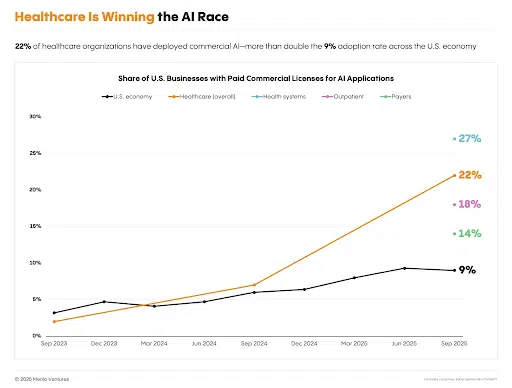
In sharp contrast, during the same period, fewer than 9% of companies have implemented AI in production across the broader economy. The urgency is led by pure economics. Healthcare faced administrative burnout, rising costs, labor shortages, and constrained margins. AI offered something traditional systems could not, i.e., predictive efficiency at scale.
Occupational health and safety is entering the same inflection point.
According to the International Labour Organization, AI-powered systems are improving hazard detection, reducing exposure to dangerous tasks, and enhancing workplace health monitoring. This article examines how AI and workplace safety are reshaping operational risk and the role RTS Labs plays as an AI partner for occupational health and safety.
How Early Safety Investments Focused on Stability, Reporting, and Risk Control
For most of the past two decades, occupational health and safety systems were built around a single organizing question: What happened? That question produced a generation of tools designed for documentation, compliance, and post-incident analysis. They reduced chaos, standardized reporting, and created audit trails that satisfied regulators. But they did not create foresight.
The legacy model operated on familiar patterns. Field reporting was fragmented across paper forms, spreadsheets, and disconnected digital tools. Incident visibility was delayed, often by days or weeks after an event occurred. Leadership made decisions based on lagging indicators such as the Total Recordable Incident Rate (TRIR). These metrics, by definition, measure what has already gone wrong.
A 2024 analysis published in the National Institutes of Health database confirms that traditional OHS systems rely on retrospective incident data rather than predictive modeling to identify risk patterns. The architecture of legacy safety was not designed to get ahead of risk but to record and respond to it.
| Safety Tool | Primary Purpose | Limitation |
|---|---|---|
| Incident Logs | After-the-fact documentation | No predictive signal |
| Compliance Audits | Regulatory validation | Backward-looking |
| Monthly Reviews | Historical trend analysis | Too slow for real-time risk |
| TRIR / KPI Dashboards | Performance benchmarking | Measures past failures only |
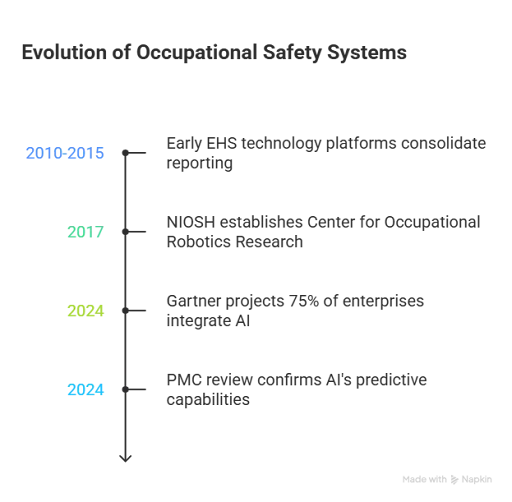
The shift began gradually over the past 10 to 15 years. Between 2010 and 2015, early EHS technology platforms began consolidating fragmented reporting into centralized dashboards.
By 2017, the National Institute for Occupational Safety and Health (NIOSH) established the Center for Occupational Robotics Research, reflecting how fundamentally technology was beginning to intersect with field safety.
By 2024, Gartner projected that up to 75% of enterprises would have integrated AI into their operational workflows, a projection that has largely materialized through 2024 and 2025.
The University of South Florida’s College of Public Health notes that AI systems can now detect unsafe conditions, analyze behavioral trends, and forecast injury risk before incidents escalate.
The 2024 PMC review published in the Journal of Occupational Health reinforces the point: AI-driven technologies are no longer experimental tools. They offer predictive insights, real-time monitoring, and risk mitigation strategies that enable a fundamentally more proactive approach to workforce protection.
The past 15 years didn’t just introduce new safety tools. They reset the baseline for what competent safety management looks like. Safety has stopped being retrospective documentation and started becoming predictive intelligence.
AI-powered safety is much more than a competitive differentiator today. It is becoming the baseline expectation. Organizations that haven’t moved aren’t holding a cautious position. They are falling behind a standard that is actively being set around them. The risk of inaction shows up in incident rates, insurance exposure, and the widening gap between organizations operating with predictive intelligence and those still making decisions from last month’s reports.
Where Safety Leadership Meets Predictive Decision-Making
The most significant change predictive safety systems have introduced is at the organizational level. When safety data moves from monthly reports to real-time dashboards, and from incident logs to forward-looking risk scores, the nature of the safety conversation inside a company changes entirely.
Predictive systems influence:
- Insurance risk modeling
- Project scheduling confidence
- Workforce productivity stability
- Investor perception of operational resilience
Modern safety platforms unify daily field workflows and convert frontline inputs into real-time intelligence. That unification matters because data that sits in disconnected systems cannot be analyzed, and data that cannot be analyzed cannot drive decisions.
For instance, when a construction crew supervisor submits a near-miss report through a mobile-first platform, that input immediately becomes part of a pattern-recognition layer that might surface a risk trend across five job sites before any single site reaches the incident threshold.
That’s how the position of safety leaders inside the enterprise changes. Risk conversations move upstream. Safety teams are no longer presenting post-incident analyses to operations leadership. The discussions focus on presenting forecasts. The dynamic shifts from accountability for what went wrong to ownership of what can be prevented.
Instead of asking: Why did this incident happen?
Leadership asks:
- Where are the next three likely failure points?
- Which crews show rising exposure patterns?
- Which projects are trending toward elevated risk?
For executives, this represents a meaningful evolution. Safety metrics begin aligning with operational KPIs in ways they never did under legacy systems. Reduced incident rates translate directly into lower insurance exposure, improved project timelines, and workforce continuity. The safety function moves from cost center to operational advantage.
RTS Labs operates precisely at this intersection, helping enterprises connect AI ambition to operational architecture so that predictive safety becomes a measurable impact rather than an isolated experiment.
Case Insight: What Happens When Predictive Safety Moves Into the Field
The gap between predictive safety in theory and in practice is often most visible in field-heavy industries such as construction, utilities, infrastructure, and energy. These are environments where crews are distributed, conditions change daily, and the cost of a single serious incident can affect an entire project’s economics.
Organizations in these industries have historically struggled with two compounding problems:
- Inconsistent data capture from the field
- Delayed visibility for leadership
These two problems compound, leading to paper forms being incomplete and digital forms being submitted at the end of the day. Supervisors lack the context they need to intervene before a hazard becomes an incident.
Field1st, a safety operations platform created by RTS Labs, offers a useful contextual example of this transformation. Unified safety workflows replace fragmented systems by combining mobile-first hazard reporting, photo-based risk detection, and AI-driven trend analysis in a single platform. Here, several things happen simultaneously:
- Data capture becomes consistent because the tools are built for field conditions, including offline use.
- Visibility improves because incidents, near-misses, and hazard flags are surfaced in real time across crews and worksites.
When frontline inputs reach leadership in real time, much before the weekly reports, the window for intervention widens. Organizations shift from managing incident outcomes to managing incident probability.
How Predictive Insights Influence Risk, Cost, and Performance Outcomes
The ROI case for predictive safety is not built on cost savings in isolation. Predictive safety reduces volatility, stabilizing outcomes that would otherwise fluctuate unpredictably. Executive decision-making considers this distinction to reframe the investment thesis.
Consider what workplace injuries actually cost at scale. According to OSHA’s business case data, serious non-fatal workplace injuries amount to more than $1 billion per week in direct workers’ compensation costs for U.S. employers. These figures represent operational exposure that predictive systems are specifically designed to reduce.
The mechanisms through which predictive safety delivers ROI include several interconnected dimensions.
Operational Continuity
Operational continuity improves when hazards are identified before they cause downtime. In industries like construction and utilities, a single lost-time incident can cascade into project schedule delays, subcontractor disruptions, and client relationship damage that far exceeds the direct cost of the injury itself.
Insurance Exposure
Organizations that demonstrate measurable improvements in their Total Recordable Incident Rate (TRIR) benefit from improved Experience Modification Rates, which directly reduce workers’ compensation premiums. Proactively identifying and addressing ergonomic risks leads to a considerable reduction in injuries in documented deployments.
Also Read: AI Agents for Insurance: Streamline Claims, Underwriting & Compliance
Workforce Productivity
A safer work environment reduces absenteeism, improves crew retention, and accelerates project timelines. OSHA data indicates that over 60% of CFOs surveyed reported that each dollar invested in injury prevention returns two or more dollars in productivity gains.
RTS Labs approaches these outcomes through a consistent philosophy. We elevate AI from concept to measurable business impact. The goal is to deploy AI to connect predictive capability to the specific operational and financial outcomes that leadership is accountable for.
- Predictive safety elevates safety leadership from incident review to enterprise risk forecasting.
- Real-time, unified field data enables early intervention before risk becomes loss.
- Visibility into leading indicators reduces operational volatility across projects and crews.
- Measurable safety performance strengthens insurance position, scheduling confidence, and workforce stability.
Are You Ready for Predictive Safety? A Diagnostic for Decision-Makers
Before an organization can move toward predictive safety, it helps to understand clearly where it currently stands. Most organizations that believe they are operating modern safety programs are, in practice, still functioning within a pre-predictive model. Several signals indicate this.
Safety Data Lives in Isolated Systems
Incident reports sit on one platform, field observations on another, and training records on a third. There is no unified view that enables pattern recognition across sources. When a safety leader wants to understand risk exposure across all active sites, they must manually aggregate data from multiple disconnected tools.
Manual Workflows Slow Response Time
When a hazard is identified, the path from field observation to supervisory awareness involves multiple handoffs and often a significant time delay. By the time leadership sees a trend, it has frequently already produced an incident.
Safety Metrics Poorly Aligned with KPIs
Safety metrics are poorly aligned with operational KPIs. TRIR is reported to the board, but it has no formal connection to project schedule risk, insurance renewal strategy, or workforce planning. Safety and operations continue to operate as parallel tracks rather than integrated functions.
Also Read: Enterprise AI Strategy: A Complete Blueprint for 2026 (Frameworks + Use Cases)
- □ Is safety data consolidated in a single platform accessible to leadership in real time?
- □ Do field crews report hazards and near-misses digitally, at the moment of observation?
- □ Does your safety team use leading indicators, not just lagging metrics like TRIR?
- □ Are safety trends analyzed across sites, not just at the individual site level?
- □ Is there a formal connection between safety performance data and insurance strategy?
- □ Can your safety system flag emerging risk patterns before they produce incidents?
- □ Do safety leaders have a seat at the table in operational planning conversations?
If the majority of these answers are no, the organization is still operating in a reporting-first model. The checklist is not an indictment, but a diagnostic check. Most organizations achieve predictive readiness through a deliberate sequence of capability-building that goes beyond single technology deployment.
What Implementation Actually Requires
Predictive safety does not succeed through platform selection alone. Organizations that have attempted to deploy AI-powered safety tools without the underlying infrastructure frequently find themselves with sophisticated software sitting on top of fragmented, incomplete data and a system that cannot deliver the predictions it promised.
Successful implementation depends on three interconnected layers working together.
Data Engineering
Predictive analytics requires clean, consistent, and unified data. If field reporting is fragmented, if incident logs use inconsistent taxonomy, or if data pipelines between systems are unreliable, AI models will reflect those flaws in their outputs. Data engineering is not a preliminary step that can be skipped. It should be considered the foundation for predictive capability.
AI Strategy Aligned With Business Outcomes
Predictive safety models need to be calibrated to the specific risk environment of the organization, i.e., the industries it operates in, the nature of its workforce, and the type of hazards that dominate its incident history. Generic models produce generic insights. The value of AI in safety comes from its specificity, and that specificity requires deliberate strategic design.
Scalable Platform and Integration Architecture
Safety platforms must connect with the systems that operations teams already use, including project management tools, HR platforms, and ERP systems. A safety platform that operates as an island is limited in its ability to influence operational decisions. Integration is what enables safety intelligence to flow into the workflows where decisions are actually made.
RTS Labs connects all three of these layers. As an enterprise AI consulting, data engineering, and software solutions firm, RTS Labs is designed to operationalize predictive systems at scale. It doesn’t just configure software, but builds the data infrastructure, AI strategy, and integration architecture that make predictive safety actually work in complex enterprise environments.
How Modern Safety Platforms Translate AI Strategy Into Action
Once the foundational work for clean data, aligned strategy, and integrated architecture is in place, organizations begin exploring platforms that can deliver on the promise of predictive safety. The criteria shift from “what does this platform do” to “how does this platform transform the way our field teams and leadership teams work together.”
Field1st represents what that transformation looks like when it reaches the field. The platform addresses the core operational challenges that have historically prevented field safety data from becoming useful intelligence: adoption friction, inconsistent reporting, and the gap between frontline observation and leadership visibility.
Also Watch: Intro to Field1st: AI-Driven Safety Management for Utilities
Voice-enabled reporting eliminates the administrative burden that causes field crews to delay or skip safety documentation. Photo-based hazard analysis applies AI in real time, surfacing risks that manual inspection might miss. Predictive analytics surfaces patterns across crews and worksites, allowing safety managers to act on trend signals rather than waiting for incident thresholds to be crossed.
The result is a platform where:
- Frontline inputs become actionable intelligence in real time
- Safety directors gain visibility across distributed operations
- Operations managers can forecast safety performance
- Executives see the connection between safety investment and financial outcomes more clearly than legacy systems ever allowed.
Predictive safety goes beyond just being a dashboard upgrade, bringing a fundamental change to the relationship between field conditions and executive decision-making.
The New Baseline for Safety ROI
Whether AI belongs in occupational health and safety, that debate has been settled by the evidence and by the organizations that have already moved. The real question is whether existing systems allow organizations to operate at the predictive pace now shaping the industry.
The economic case for predictive safety is grounded in the operational realities of industries where the cost of a single serious incident can exceed the annual investment in the technology that might have prevented it.
RTS Labs helps enterprises convert AI ambition into operational execution. For organizations evaluating their readiness, the work begins not with platform selection but with an honest assessment of data infrastructure, strategic alignment, and the organizational will to move from reactive to predictive. That is where the real competitive advantage is built.
Interested in learning more? Book a call with RTS Labs today and turn your AI readiness into a powerful predictive analytics solution for occupational health and safety.
FAQs
1. How long does it typically take to see measurable ROI from AI in occupational health and safety?
Organizations often begin observing improved visibility and earlier risk detection within months of implementation. Financial impact, including reduced incident volatility, improved operational continuity, and stabilized insurance exposure, typically becomes measurable within 6 to 18 months, depending on the scale and depth of integration.
2. Do predictive safety systems replace existing EHS platforms or work alongside them?
Most AI workplace safety systems integrate with existing EHS platforms. They enhance data streams with predictive analytics rather than replacing compliance infrastructure entirely.
3. What type of safety data is most valuable for building predictive insights?
Near-miss reports, hazard observations, inspection records, corrective action timelines, environmental conditions, and time-stamped event logs provide the strongest foundation for predictive modeling.
4. How should leadership balance AI investment with regulatory compliance priorities?
Predictive systems strengthen compliance by enabling continuous monitoring rather than periodic audits. AI and workplace safety become complementary to regulatory adherence, not competitive with it.
5. What internal teams should be involved when evaluating AI for workplace safety?
Safety leadership, operations, IT, and data teams, compliance officers, and executive sponsors must collaborate. Predictive safety requires cross-functional alignment to translate intelligence into action.