Enterprise adoption of vibe coding has accelerated sharply over the past two years. But a Deloitte Access Economics Report finds that 90% of the enterprises feel there’s still room to improve their AI governance. This gap between rapid adoption and governance readiness is creating a quiet crisis in engineering organizations across regulated industries, scaling startups, and Fortune 500 technology teams.
Most CTOs, VPs of Engineering, and CISOs are already navigating one of these scenarios:
- Your developers are using Cursor, Claude Code, or GitHub Copilot without a formal policy, and a near-miss security incident has exposed weaknesses in governance.
- You’ve been mandated to “do something with AI”, but lack a clear framework for what safe, compliant AI-assisted development looks like at enterprise scale.
- You’ve discovered vibe-coded logic in production that nobody on the team can confidently modify, debug, or explain to an auditor.
This article outlines three governance frameworks enterprises can implement immediately. It covers a Green Zone/Red Zone policy model for code classification and a comprehension debt management strategy.
It also explains a compliance mapping approach for SOC 2, HIPAA, and PCI DSS environments that supports safer AI-accelerated development without accumulating risk.
The Enterprise Vibe Coding Landscape in 2026
Is vibe coding safe for enterprise use? Yes. But only with a governance layer that addresses security scanning, code comprehension, compliance controls, and tool consolidation. Without these controls, enterprises face vulnerability rates 2.74x higher than human-written code (CodeRabbit, 2025) and a rapidly accumulating comprehension debt that becomes a maintenance crisis.
The current state of enterprise vibe coding is defined by explosive adoption without proportional governance maturity. 85% of developers were already using AI to generate large code blocks from natural language prompts by early 2026 (JetBrains Developer Survey, Q1 2026).
But organizational readiness tells a different story. While 91% of enterprises lack an AI governance framework (McKinsey), Common Vulnerabilities and Exposures (CVEs) formally attributed to AI-generated code rose from 6 in January 2026 to 35 in March 2026 (Georgia Tech Systems Software and Security Lab, Vibe Security Radar, 2026).
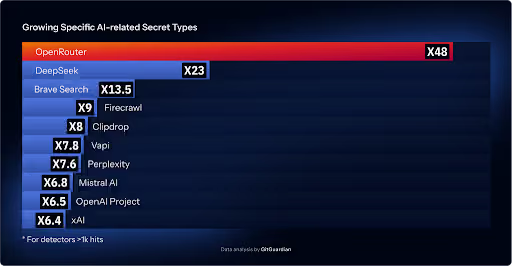
AI-assisted commits expose secrets at 3.2%, compared with 1.5% for public human commits, more than double the rate (GitGuardian State of Secrets Sprawl, 2026).
This is not a future problem. Engineering leaders need to address the question: “How do we scale this safely before it becomes a compliance liability or a security incident?” The early mover window for building governance is closing fast. Organizations that define their frameworks now will ship faster and more safely.
The Critical Risks of Ungoverned Enterprise Vibe Coding
Enterprise vibe coding without governance creates several compounding risks. These risks don’t manifest immediately. Rather, they accumulate silently until an audit, incident, or refactoring effort exposes them.
1. Security Vulnerabilities at Scale
The vulnerability data is unambiguous. 65% of vibe-coded production applications contained security issues, and 58% had at least one critical vulnerability (Escape.tech, 2025 scan of 1,400+ applications). AI-generated code has 2.74x the security vulnerability rate of human-written code (CodeRabbit, analysis of 470 GitHub pull requests, 2025).
The vulnerability patterns in AI-generated code differ from traditional human errors. Most enterprise Static Application Security Testing (SAST) tools were designed to catch human mistakes. They miss AI-specific patterns, such as hallucinated dependencies or race conditions in async code, that the AI never fully understood.
2. Comprehension Debt: The Hidden Cost Enterprises Aren’t Measuring
Comprehension debt is the accumulating cost enterprises pay when their teams cannot understand, modify, debug, or transfer ownership of AI-generated code. Technical debt is usually documented and measurable.
But comprehension debt hides in functions that work today but that no developer on the team can confidently refactor or extend. It compounds when the developer who wrote the prompt leaves the company, when the AI’s training data becomes outdated, or when the generated code interacts with systems the AI was never trained to fully understand.
3. Shadow IT Proliferation
Developers use consumer-grade AI coding tools, like Cursor free tier, Claude Code without enterprise controls, ChatGPT for code generation, because they’re faster to set up than going through enterprise procurement. This creates shadow IT at scale. No SSO integration means no centralized access control.
Without audit logs, security teams can’t track which code was generated or by whom. Proprietary business logic is leaving the corporate network without IT awareness because of zero data residency controls.
4. Compliance Exposure in Regulated Industries
Vibe coding intersects with compliance frameworks in ways that most engineering teams haven’t documented yet. SOC 2 auditors are beginning to ask whether AI code generation tools have access to production data and whether AI-generated changes go through the same change management controls as human-written code.
HIPAA’s minimum necessary standard applies to AI coding tools that process PHI-adjacent logic. PCI DSS 4.0’s secure software development requirements now explicitly include AI-assisted development.
The issue is that compliance teams haven’t updated their control documentation to account for AI code generation. When engineering teams are using AI tools, security teams aren’t tracking it, and compliance teams aren’t aware it’s happening, the disconnect widens.
5. Skill Atrophy in Development Teams
When junior developers rely on AI to generate all their boilerplate code, they never learn the foundational patterns that make them effective mid-level engineers. Senior developers who use AI for every implementation lose the muscle memory for debugging complex logic. Organizational knowledge transfer happens through AI prompts instead of mentorship and documentation, which starts eroding the institutional knowledge that makes an engineering team resilient.
How Enterprises Govern Vibe Coding: A Framework Approach
Enterprises govern vibe coding through a multi-layer framework that combines tool standardization, policy-based code classification, automated security controls, and continuous audit mechanisms.
The most effective approach is a tiered governance model that explicitly defines which code types can be AI-generated with light review and which require mandatory human authorship or senior-level validation.
Governance can be understood as a system with four integrated pillars.
Pillar 1: Tool Standardization & Control
Enterprises that allow developers to use any AI coding tool create ungovernable sprawl. The first governance move is tool consolidation: select 1-2 enterprise-grade platforms and sunset all consumer tool usage.
Enterprise-grade AI coding tools differ from consumer tools in several critical ways.
| Capability | GitHub Copilot Enterprise | Amazon Q Developer | Cursor for Teams | Consumer Tools |
|---|---|---|---|---|
| SSO/RBAC | Yes | Yes | Yes | No |
| Audit Logs | Yes | Yes | Limited | No |
| Data Residency Controls | Yes | Yes | Limited | No |
| Custom Model Training | Yes | Yes | No | No |
| SOC 2 / ISO 27001 | Yes | Yes | In Progress | No |
| HIPAA/PCI Support | Contractual | Contractual | No | No |
Tool selection should follow stack alignment and compliance requirements. For instance, if your compliance posture is highly regulated, such as financial services, healthcare, and government, prioritize tools with existing compliance certifications.
Pillar 2: The Green Zone / Red Zone Framework
The Green Zone/Red Zone framework is a code classification model that explicitly defines which application components are safe for AI generation with standard review (Green Zone) and which require mandatory human authorship or line-by-line senior validation (Red Zone).
Most enterprises try to govern AI code generation with vague guidance like “use AI responsibly” or “review AI-generated code carefully.” This doesn’t work because developers make inconsistent judgment calls under deadline pressure.
The Green Zone/Red Zone model removes ambiguity. It tells every developer exactly which code they can generate with AI and which code requires a different approach.
| Green Zone (AI can write, standard peer review) | Red Zone (human must author OR senior must review line-by-line) |
|---|---|
| UI components, CSS/styling, layout code | Authentication and authorization logic |
| Boilerplate scaffolding, project setup | Payment processing and financial transactions |
| Test fixtures, mock data, unit test templates | Encryption implementations and key management |
| Documentation generation, API docs, comments | API credential handling, secret management |
| Data migration scripts (non-production) | PHI/PII data access logic |
| Non-critical utility functions | Infrastructure provisioning scripts |
| Standard CRUD operations for low-risk entities | Financial calculation engines, pricing logic |
| Logging and monitoring instrumentation | Database schema migrations (production) |
The boundaries are not universal. A fintech company will have a stricter Red Zone than a media company. A healthcare application will classify PHI-adjacent logic as the Red Zone, which a SaaS tool would consider the Green Zone.
The value of the framework is in its explicitness. Define your zones, document them, and enforce them through code review checklists and pre-commit automation.
At RTS Labs, we use a tiered code classification model similar to this when auditing enterprise AI development environments. The specific boundaries differ by stack, industry, and compliance posture, but the principle of explicit risk-tiering is consistent across every engagement.
If you want to apply this to your team, the first step is to map your application architecture to risk categories and secure buy-in from both engineering leadership and your security team.
Pillar 3: Automated Security & Quality Controls
Automated controls enforce governance without requiring perfect human discipline. Code ownership and documentation requirements provide controls for comprehension debt. Every AI-generated component should have a documented prompt context, an assigned owner, and an architectural decision record if it implements business logic.
Integrate AI-specific security checks at multiple points in the development pipeline. Pre-commit hooks should validate that AI-generated code doesn’t contain hallucinated package dependencies, hardcoded credentials, or insecure patterns. Pull request automation should flag AI-generated code for enhanced review and run AI-aware linting rules. SAST and DAST tools in CI/CD pipelines should include checks for the most common vulnerability patterns in AI-generated code: incomplete error handling, permission logic gaps, credential mismanagement, and SQL injection in generated queries.
Pillar 4: Continuous Audit and Metrics
What gets measured gets managed. Establish quarterly metrics reviews that track the percentage of AI-generated code, security vulnerability rates in AI code versus human code, comprehension debt indicators such as average review time per line, and the completeness of the compliance audit trail.
The metrics answer three governance questions. Are we using AI code generation safely? Track vulnerability rates and incident counts. Are we using it sustainably? Track comprehension debt metrics and developer satisfaction. Are we using it compliantly? Track audit log completeness and compliance control coverage.
Comprehension Debt: The Hidden Cost Enterprises Aren’t Measuring
Teams that come to RTS Labs after a vibe coding scaling phase consistently identify comprehension debt as their highest-priority remediation need. We help engineering organizations audit, document, and systematically address this before it becomes a product liability.
Comprehension debt manifests most acutely in four enterprise scenarios, each with direct business impact.
M&A Technical Diligence
When a private equity firm or strategic acquirer conducts technical due diligence,its team sends senior engineers to evaluate code quality, maintainability, and technical debt. If 40% of your codebase is AI-generated without documentation, their engineers will flag it as high-risk. They can’t assess whether the code is maintainable long-term. They can’t estimate refactoring costs. This creates valuation risk or kills deals outright.
Regulatory Code Reviews
Financial services regulators, healthcare compliance auditors, and government oversight bodies increasingly request source code reviews for critical systems. When an auditor asks, “explain the business logic in this payment calculation function” and the answer is “an AI generated it, and the original developer left the company,” that’s a control failure. Regulators expect documented design rationale for any code that handles money, health data, or sensitive information.
Critical Production Incidents
During a production outage, debugging speed is everything. When the incident involves AI-generated code with no design documentation, no prompt history, and non-standard implementation patterns, the mean time to resolution increases significantly. Engineers waste hours trying to understand what the code does before they can fix what’s broken.
Senior Engineer Onboarding
When you hire an experienced staff engineer or architect, they expect to read the codebase and understand system design within two weeks. If significant portions of the codebase are AI-generated black boxes, their onboarding stalls. They can’t mentor junior developers on code they don’t understand. They can’t make architectural decisions without knowing why existing systems work the way they do.
Compliance Mapping: Vibe Coding Governance for Regulated Industries
Enterprise vibe coding creates compliance risk when AI-generated code handles sensitive data, implements security controls, or executes in regulated workflows without the same change management, review, and audit processes that human-written code undergoes.
Let’s answer the compliance question that almost no one is answering clearly: how do existing regulatory frameworks apply to AI-generated code?
SOC 2 Controls for AI-Generated Code
SOC 2 Trust Services Criteria include several controls that directly intersect with enterprise vibe coding.
- Change management controls (CC8.1) require that system changes, including code changes, go through documented change management processes with appropriate review and approval. If AI-generated code is being committed to production without the same change control as human-written code, that’s a control deficiency.
- Logical and physical access controls (CC6.1) require organizations to restrict access to systems and data based on job requirements. If AI coding tools have access to production databases, customer data, or proprietary algorithms as part of code generation, auditors will ask: Who approved that access? Is it logged? Is it necessary? Is it monitored?
- System operations controls (CC7.2) require that system processing be monitored and that deviations be investigated. AI-generated code deployments should be logged, traceable, and subject to the same monitoring as human deployments.
Specific guidance for SOC 2 compliance
Document which AI coding tools are approved for enterprise use and which are prohibited. Maintain audit logs that show who used AI tools, when, and what code was generated. Implement mandatory review gates before AI-generated code reaches production. Include AI code generation in your change management procedures and demonstrate to auditors that the same controls apply regardless of code authorship.
HIPAA Compliance for Vibe Coding
HIPAA’s minimum necessary standard (§164.502(b)) requires that access to protected health information be limited to the minimum necessary to accomplish the intended purpose. When an AI coding tool processes logic adjacent to PHI, even if it’s not directly accessing patient records, compliance teams need to document why that tool needs that access and what controls limit it.
- Access controls under the Security Rule require that organizations implement technical policies and procedures that allow only authorized persons to access electronic protected health information. If developers are using consumer AI tools to generate PHI-handling code, those tools likely don’t have Business Associate Agreements, audit logging, or access controls that meet HIPAA requirements.
- Audit controls require covered entities to maintain logs that can demonstrate compliance. Can you produce a complete audit trail showing what AI tools generated code that touches ePHI, who reviewed it, and what security testing it underwent? If not, you have an audit control gap.
Specific guidance for HIPAA compliance
Restrict AI coding tools from direct PHI access. Require senior review of all code that handles health data, whether AI-generated or human-written. Ensure AI tool vendors sign Business Associate Agreements if they process any PHI or PHI-adjacent data. Document these controls in your HIPAA Security Risk Assessment and be prepared to demonstrate them to OCR auditors.
PCI DSS 4.0 and Secure Software Development
PCI DSS Requirement 6.3 on secure software development now explicitly addresses AI-assisted development. Code review requirements apply equally to AI-generated and human-written code. Vulnerability management processes must include AI-specific vulnerability scanning. Security testing must occur before production deployment, regardless of code source.
The 2024 updates to PCI DSS make it clear that “secure development” includes any development method, including AI code generation. If you’re building or maintaining payment card processing systems, AI-generated code must go through the same secure development lifecycle as human code.
Specific guidance for PCI DSS compliance
Add AI code classification to your change management procedures. Implement pre-production security testing specifically for AI-generated payment logic. Maintain documentation showing that AI-generated code in cardholder data environments underwent the same review, testing, and approval as human code. Include AI tool usage in your quarterly vulnerability scans and annual penetration tests.
ISO 27001 Change Management
ISO 27001 Control A.8.32 on change management requires that changes to information processing facilities and systems be controlled through formal change management procedures. AI code generation constitutes a configuration change and should be tracked accordingly.
Documentation requirements under ISO 27001 require maintaining records of AI tool usage, outputs, and reviews. Version control for AI prompts provides traceability. Audit trails for AI-generated infrastructure code demonstrate control over changes to production systems.
Specific guidance for ISO 27001 compliance
Include AI code generation in your change management procedures. Maintain version control not just for generated code but for the prompts that produced it. Document AI tool approval processes and demonstrate that only approved tools are used in production systems.
| Framework | Key Requirement | What It Means for Vibe Coding | Implementation Control |
|---|---|---|---|
| SOC 2 | Change management (CC8.1) | AI code changes must be tracked and reviewed | Git commit metadata, AI tool audit logs, mandatory PR review |
| HIPAA | Minimum Necessary (§164.502(b)) | AI tools can’t process unnecessary PHI | Data access controls, BAAs with AI vendors, audit logging |
| PCI DSS 4.0 | Secure development (6.3) | AI code needs same security testing as human | Mandatory review gates, pre-production scanning, documentation |
| ISO 27001 | Configuration management (A.8.32) | AI generation = configuration change | Prompt versioning, Architectural Decision Record (ADR) documentation, change control logs |
The compliance mapping for enterprise vibe coding comes down to a simple principle: AI-generated code should flow through the same governance, security, and compliance controls as human-written code.
Enterprise-Grade AI Coding Tools: What to Use and Why
Enterprise vibe coding requires tools with SSO integration, role-based access control, audit logging, data residency guarantees, and compliance certifications. The primary enterprise-grade platforms, each with different strengths in governance, customization, and integration depth, are discussed below.
- GitHub Copilot Enterprise provides the deepest integration with GitHub-based development workflows. It offers organization-wide policy controls, comprehensive audit logging, and custom model training on private repositories. For organizations already standardized on GitHub for version control, CI/CD, and project management, Copilot Enterprise provides the smoothest governance implementation.
- Amazon Q Developer excels in AWS-native environments. It provides infrastructure-as-code generation optimized for AWS services, cost optimization suggestions, and deep integration with AWS CodeCommit, CodeBuild, and CodePipeline. For enterprises running primarily on AWS infrastructure, Q Developer offers governance features built into the AWS IAM and CloudTrail ecosystem.
- Cursor for Teams emphasizes developer experience with collaborative prompting and conversational code generation. While its enterprise governance features are still maturing compared to GitHub and AWS offerings, it’s gaining traction in startups and mid-market companies that prioritize developer productivity over maximum governance controls.
- AWS Kiro is an emerging platform with a strong compliance posture designed specifically for regulated industries. Its infrastructure automation capabilities and built-in compliance controls make it worth evaluating for financial services and healthcare organizations.
Implementing an Enterprise Vibe Coding Governance Program
Implementing enterprise vibe coding governance is a phased program that starts with tool standardization, adds security controls, builds review processes, and ends with continuous measurement and adaptation.
Phase 1: Assessment & Tool Standardization (Week 1-4)
Start with a current state audit. Survey engineering teams to discover what AI tools they’re already using. Check network logs for traffic to known AI coding services. Review recent commits for patterns that suggest AI generation. This shadow IT discovery is critical. You can’t govern what you can’t see.
Select your enterprise AI coding platform based on stack alignment, compliance needs, and integration capabilities. Involve stakeholders from engineering, security, and compliance in the selection process. Negotiate enterprise agreements that include the governance features you need: audit logging, SSO integration, data residency controls, and compliance certifications.
Build a migration plan that moves teams from consumer tools to the approved enterprise platform. Provide training and documentation. Make the approved tool easier to use than the unapproved alternatives. Set a sunset date for consumer tool usage and communicate it clearly.
Establish baseline metrics before you implement governance controls. Measure current AI-generated code percentage, vulnerability rates in AI code versus human code, and developer productivity indicators. These baselines let you measure whether governance helps or hinders velocity.
Phase 2: Policy & Framework Definition (Week 4-8)
Define your Green Zone / Red Zone boundaries. Start with the framework provided in this article and customize it for your technology stack, industry, and risk tolerance. Get buy-in from engineering leadership, security teams, and, if applicable, compliance officers.
Document approval workflows for each zone. The Green Zone code undergoes standard peer review. Red Zone code requires a senior engineer review or security team approval before merging. Ambiguous cases escalate to the engineering manager or architect.
Create prompt-engineering guidelines to help developers write better, safer prompts. Good prompts include context, constraints, and specific requirements. Dangerous prompts ask AI to implement security controls, handle sensitive data, or make architectural decisions without human oversight.
Establish code review standards specifically for AI-generated code. Reviewers should verify that the code does what it claims, contains no hallucinated dependencies, implements proper error handling, and doesn’t introduce security vulnerabilities through subtle logic errors.
Phase 3: Security & Compliance Integration (Week 8-12)
Deploy AI-specific security tooling in your CI/CD pipeline. Add pre-commit hooks that check for hallucinated dependencies, hardcoded credentials, and insecure patterns. Configure SAST tools to flag AI-generated code for enhanced scrutiny. Implement DAST testing that specifically targets the most common vulnerability patterns in AI code.
Configure audit logging and monitoring. Every AI code-generation event should log who generated it, which prompt was used, what code was produced, and whether it was committed to the repository. These logs provide the audit trail you’ll need for compliance reviews.
Map your AI governance controls to existing compliance frameworks. Update your SOC 2 control documentation to include AI code generation. Add AI tool usage to your HIPAA Security Risk Assessment. Include AI-generated code in your PCI DSS secure development lifecycle documentation.
Train your security team on AI code vulnerability patterns. Traditional security training covers SQL injection, XSS, and authentication bypasses. AI-specific training should cover hallucinated APIs, incomplete error handling, permission logic gaps, and the unique ways AI coding tools introduce vulnerabilities.
Phase 4: Team Training & Rollout (Week 12-16)
Train developers on the approved AI coding tools and your governance policies. Explain the Green Zone / Red Zone framework. Demonstrate good prompt engineering. Show them how to properly document AI-generated code.
Train code reviewers on AI-specific review practices. AI-generated code requires different scrutiny than human code. Reviewers should verify the correctness of business logic, check for hallucinated dependencies, validate the completeness of error handling, and ensure proper documentation.
Pilot the governance program with one or two teams before rolling it out organization-wide. Use the pilot to identify friction points, refine policies, and build case studies that demonstrate governance working in practice. Create internal documentation and runbooks that developers can reference when they have questions.
Phase 5: Continuous Measurement & Improvement (Ongoing)
Track metrics such as the percentage of AI-generated code, vulnerability rates in AI versus human code, comprehension debt indicators, code review velocity, and developer satisfaction with AI tools quarterly.
Conduct governance reviews every quarter. Governance should evolve as your team’s AI development maturity increases. Update your Green Zone / Red Zone boundaries as AI coding tools improve. When a team encounters an AI-specific vulnerability, turn it into a learning moment for the entire organization.
When to Bring in External Help
Build internal governance if you have time, strong internal security expertise, and a low-to-moderate compliance burden. Bring in external consulting if you’re
- In a regulated industry with SOC 2, HIPAA, or PCI requirements
- You’ve already accumulated significant vibe-coded technical debt and need rapid remediation
- Your security team lacks AI-specific vulnerability expertise
- You need to build governance fast for an upcoming compliance audit or M&A event.
Checklist for Security Best Practices for Enterprise Vibe Coding
Enterprise Vibe Coding is Not Optional
Gartner forecasts that 40% of all new code will be AI-generated by the end of 2026. The governance gap is not a future problem. It’s happening in your engineering organization right now.
The three frameworks in this article provide a starting point. The Green Zone/Red Zone policy model gives you an explicit, implementable code classification system. Comprehension debt management ensures AI-generated code remains maintainable over the long term, and compliance mapping to SOC 2, HIPAA, PCI DSS, and ISO 27001 provides the control documentation your auditors will ask for.
You can build this governance layer now, while you still have control over the process. Or you can wait until a security incident, compliance audit failure, or M&A technical diligence issue forces a crisis remediation. Early movers gain a competitive advantage.
If your organization is implementing enterprise vibe coding at scale and needs a governance audit, security review, or policy framework built by practitioners with production experience, RTS Labs can help. We’ve worked with regulated enterprises to build AI development governance that satisfies auditors, scales with teams, and accelerates delivery without accumulating technical or comprehension debt.
FAQs
1. Is vibe coding safe for enterprise use?
Yes, but only with proper governance. Without structured controls, such as security validation, compliance mapping, and tool standardization, vibe coding can introduce significant operational and regulatory risk.
2. What are the biggest risks of enterprise vibe coding?
The key risks include large-scale security vulnerabilities, comprehension debt (code teams cannot understand), shadow IT from unmanaged AI tools, compliance exposure, and long-term skill degradation in engineering teams.
3. What is the Green Zone / Red Zone framework?
It is a governance model that classifies code into:
- Green Zone: Safe for AI generation with standard review
- Red Zone: Requires human authorship or strict senior-level validation
This removes ambiguity and enforces consistent security decisions.
4. Why is comprehension debt a major enterprise concern?
Comprehension debt occurs when teams cannot understand or modify AI-generated code. This creates risks in audits, production incidents, onboarding, and even M&A evaluations, where code maintainability directly impacts valuation.
5. How should enterprises implement vibe coding governance?
Enterprises should adopt a multi-layer framework, including:
- Tool standardization (approved AI platforms)
- Code classification policies (Green/Red zones)
- Automated security checks in CI/CD
- Continuous audit and compliance tracking