AI is running inside your organization right now, powering decisions, surfacing recommendations, and automating workflows. The investment is real. The results are visible.
But one question keeps surfacing in the boardroom, the legal team, and the audit committee: who is actually responsible when something goes wrong — the question at the heart of every AI accountability framework.
A 2026 GitHub Research survey of 1,528 developers and technology buyers found that 80% of organizations adopted AI tools faster than they established governance policies, while 92% face challenges managing AI-generated code.
Accountability isn’t a future concern anymore. Regulatory scrutiny is escalating. Customer expectations are shifting. Internal audit teams are asking harder questions. Enterprise leaders who treat AI accountability as a governance formality are already behind. Those who build it as an operational discipline are gaining a measurable edge in deployment confidence, regulatory readiness, and organizational trust.
This guide gives you the framework, the structure, and the roadmap to build AI accountability that holds up under pressure.
What Is an AI Accountability Framework?
An AI accountability framework is a structured set of policies, roles, processes, and controls that governs how an organization deploys, monitors, and assumes responsibility for AI systems throughout their full lifecycle, from the initial procurement decision through ongoing operations to eventual decommissioning.
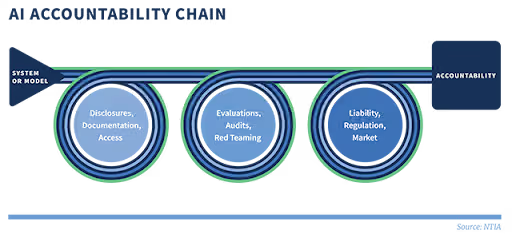
It defines, with specificity, who owns each AI system, what standards the system must meet, how risks are identified and managed, what visibility there is into system behavior, and how failures are identified, corrected, and documented.
What It Typically Includes:
| Component | What It Covers |
|---|---|
| Governance structure | Ownership assignments, oversight bodies, and executive accountability |
| Risk classification | Tiering of AI systems by potential impact and consequence |
| Transparency standards | Documentation requirements, audit logging, and explainability obligations |
| Human oversight design | When AI operates autonomously vs. when humans must review |
| Monitoring and response | Performance tracking, bias auditing, incident response protocols |
| Vendor governance | Contractual requirements for third-party AI tools |
| Review cadence | Annual framework reviews, change management processes |
The framework is the operating infrastructure that turns “responsible AI” from a principle into a daily practice. Without it, accountability is informal, inconsistently applied, and essentially unenforceable, whether internally or externally.
Why It Matters
78% of business executives in Grant Thornton’s 2026 AI Impact Survey lack strong confidence that they could pass an independent AI governance audit within 90 days. That is the accountability divide in measurable terms.
Organizations with fully integrated AI (58%) are nearly four times more likely to report revenue growth than those still piloting (15%). Though technology is a factor here, accountability matters more. The survey also points out that 46% of C-suite and senior business leaders cite governance and compliance failures as a leading cause of AI underperformance.
The regulatory landscape is further compounding this urgency. In 2024, U.S. federal agencies introduced 59 AI-related regulations, more than double the number in 2023, and issued by twice as many agencies. Globally, legislative mentions of AI rose 21.3% across 75 countries since 2023.
The 2024 IAPP Governance Survey found that only 28% of organizations have formally defined oversight roles for AI governance, meaning nearly three-quarters of enterprises are running AI systems without a clear answer to who is responsible for them.
Also Read: How to Build AI Governance Enterprises Can Trust
The business case for an AI accountability framework today is measurable in audit readiness, regulatory exposure, revenue performance, and customer trust.
The Five Pillars of an Enterprise AI Accountability Framework
An effective AI accountability framework goes beyond policies to establish clear governance, oversight, and operational controls. These five pillars help organizations manage AI risks, ensure compliance, and build trust across the AI lifecycle.
Pillar 1: Governance Structure and Ownership
Every AI accountability framework begins with a clear answer to one question: who is responsible? The answer must be specific, documented, and assigned and formally held by named individuals, with clear scope and escalation authority.
Effective governance operates across three layers:
- Executive accountability places a senior leader. Such as a Chief AI Officer, Chief Risk Officer, or a formal AI Steering Committee, in the role of ultimate owner for AI strategy, policy compliance, and organizational risk posture. This is a business accountability role and a strategic one.
- Functional ownership assigns a named business owner to each AI system or use case. That person is accountable for the system’s performance against business objectives, for ensuring appropriate oversight is in place, and for escalating concerns when they arise. They are the accountable party when the system underperforms or causes harm.
- Technical stewardship provides the cross-functional team consisting of experts in data science, engineering, legal, and compliance, responsible for building, monitoring, and maintaining the system to the standards set by governance policy.
Gartner’s 2025 poll of over 1,800 executive leaders found that 55% of organizations now have an AI board or dedicated oversight committee in place, reflecting a measurable shift toward formal governance. 56% of executives say their first-line teams, including those in IT, engineering, data, and AI, now lead Responsible AI efforts, reinforcing the idea that governance requires operational owners at every level.
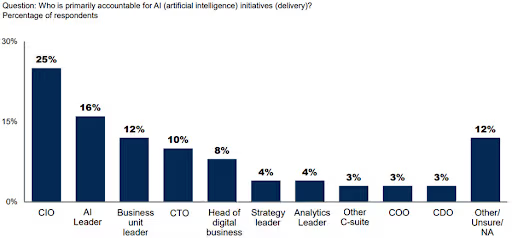
Many enterprises are formalizing this through an AI Center of Excellence or an AI Governance Board, a standing body that reviews new AI deployments, sets enterprise standards, and maintains a register of all active AI systems in production.
Pillar 2: Risk Classification and Assessment
Proportionate governance requires a classification system. Applying the same level of scrutiny to an internal productivity tool as to a model influencing credit decisions creates bottlenecks without improving accountability.
| Risk Tier | System Type | Examples | Governance Requirements |
|---|---|---|---|
| Tier 1: High | Decisions about individuals, safety-critical environments | Hiring screens, credit scoring, healthcare triage | Pre-deployment assessment, continuous monitoring, and mandatory human review |
| Tier 2: Medium | Significant business process automation; customer-facing outputs | Customer service AI, strategic analytics, content generation | Documented review and approval, defined monitoring cadence, and escalation paths |
| Tier 3: Low | Internal productivity support; limited downstream consequence | Internal assistants, drafting tools, low-stakes analytics | Baseline documentation, periodic review |
The pre-deployment risk assessment for each system should examine: the nature and provenance of training data, the potential for discriminatory or biased outputs, the degree of human oversight in the downstream workflow, the reversibility of decisions influenced by the system, and the applicable regulatory context.
This assessment is a recurring obligation. It feeds into ongoing monitoring requirements and must be revisited when the system, its use case, or the regulatory environment changes materially.
Pillar 3: Transparency and Explainability Standards
A core requirement of AI accountability is the ability to explain to regulators, customers, employees, or courts how a decision was reached or influenced by an AI system.
Enterprise frameworks must define what level of explainability is required for each system tier and how that requirement will be met in practice.
Transparency Standards by Requirement Type
- Documentation standards require that every deployed AI system has a maintained model card, i.e., a document describing the system’s purpose, training data, known limitations, intended uses, and explicitly out-of-scope uses.
- Audit logging requires that AI system inputs, outputs, and confidence signals be logged at sufficient granularity to support investigation. For high-stakes decisions, this log must be human-readable and retained for a defined retention period.
- Decision explanation capability for Tier 1 systems requires that the organization can provide a meaningful account of why a specific output was generated, whether through interpretable model architectures, explanation frameworks, or a documented human decision layer.
- Vendor transparency requirements extend these standards contractually to third-party AI systems embedded in vendor software, including audit rights, disclosure obligations, and performance reporting.
The accountability void is too deep to avoid here. Just 20% of organizations have a tested AI incident response plan for when AI fails, even as nearly three-quarters are giving agentic AI access to their data and processes. Transparency infrastructure is what makes incident response possible.
Pillar 4: Human Oversight and Intervention Design
The question of when AI operates autonomously and when a human must be in the loop is one of the most consequential design decisions in enterprise AI deployment. An accountability framework must answer this question at the policy level, applied consistently across all deployments.
At a minimum, human oversight requirements should address four elements:
| Element | What to Define |
|---|---|
| Mandatory review thresholds | Decision types and confidence levels that require human review before action |
| Escalation pathways | How employees flag concerns, request reviews, or report unexpected outputs |
| Override capability | How authorized humans countermand or modify AI outputs, and when |
| Feedback loops | How human reviews and overrides generate a signal for model monitoring teams |
Only 5% of organizations allow agents to make high-stakes decisions without human review, and 60% limit agents to moderate-risk tasks, indicating that most enterprise leaders already recognize the need for human checkpoints. Accountability is lacking in the formal documentation and in the consistent application of those boundaries.
Pillar 5: Monitoring, Incident Response, and Continuous Improvement
Deploying a model is where ongoing accountability begins. Enterprise AI governance requires a sustained monitoring function that catches performance drift, emerging risks, and downstream harms before they escalate.
a. Performance monitoring
It tracks model outputs against defined metrics, such as accuracy, bias indicators, distribution shift, and business outcome alignment on a defined cadence. For Tier 1 systems, this should include automated alerts for significant deviations.
b. Bias and fairness auditing
It examines outputs across demographic groups and protected characteristics on a periodic basis. Disparate impact in AI outputs is both a legal exposure and an accountability failure; catching it requires proactive measurement.
c. Incident classification and response
It defines what constitutes an AI incident, who is notified, what containment actions are available, and what the documentation and reporting obligations are. This should mirror existing incident response frameworks and be treated with the same organizational seriousness.
d. Model versioning and change management
It ensures that changes to models, training data, or deployment configuration go through a defined review and approval process, with rollback capability if issues emerge post-change.
e. Annual accountability review
It examines the framework, the systems it governs, and its design to incorporate regulatory developments, close gaps identified through incident response, and assess new use cases under consideration.
AI Accountability Roadmap: A Phased Implementation Plan
A phased approach reduces implementation risk and creates visible milestones that build internal confidence alongside the framework itself.
| Phase | Timeline | Key Activities | Output |
|---|---|---|---|
| Phase 1: Inventory and Assess | 30–60 days | Map every active and in-development AI system; classify by risk tier; identify documentation, ownership, and oversight gaps | AI system register; risk classification baseline; gap analysis |
| Phase 2: Establish Governance Structure | 60–90 days | Formalize ownership assignments; charter the governance body; appoint executive AI accountability owner; draft core policy framework | Governance charter; ownership matrix; policy documentation |
| Phase 3: Operationalize Controls | 90–180 days | Implement monitoring infrastructure; build incident response process; define escalation pathways; integrate accountability checkpoints into AI development and procurement workflows | Monitoring dashboards; incident runbooks; procurement standards |
| Phase 4: Sustain and Mature | Ongoing | Conduct periodic bias audits; run annual framework reviews; incorporate regulatory updates; close gaps from monitoring and incidents | Annual governance report; updated risk classifications; regulatory alignment log |
The most common implementation error is beginning at Phase 3. Here, enterprises must build monitoring tools and incident processes before completing the ownership and classification work that makes those tools meaningful. Phases 1 and 2 are prerequisites, the foundation on which every subsequent control depends.
Also Read: Vibe Coding Best Practices: A Comprehensive Guide to Responsible AI-Assisted Development
Organizations at the strategic stage of Responsible AI maturity are roughly 1.5 to 2 times more likely to describe their governance capabilities as effective than those still in the training stage. The roadmap above is designed to guide organizations through that maturity curve with measurable progress milestones, rather than indefinite planning cycles.
How RTS Labs Helps Enterprise Leaders Build AI Accountability Frameworks
At RTS Labs, AI accountability is woven into every engagement from day one. Our process begins with deep discovery via workshops and structured interviews with your key stakeholders to understand your current AI environment, technical constraints, regulatory obligations, and existing governance infrastructure.
Also Read: RTS Experiment: Testing Context Adherence Across 10 Cloud & Local Models
From that foundation, our cross-functional teams, including strategists, engineers, data scientists, and compliance specialists, help you build operationally grounded accountability structures. That means:
- Ownership models that map to your actual org structure,
- Risk classification systems that reflect your specific use cases and industries,
- Monitoring infrastructure calibrated to your deployment scale, and
- Policy frameworks that translate into daily workflows, embedded in how teams actually operate.
We work across financial services, insurance, logistics, private equity, and real estate sectors where AI accountability carries direct regulatory and fiduciary weight.
Whether you are establishing governance from scratch, inheriting a fragmented set of AI pilots with no unified oversight, or maturing a framework that has outgrown its original design, RTS Labs brings the technical expertise and enterprise implementation experience to move you from accountability as an aspiration to accountability as an operational asset.
The organizations that will lead are those that move from working on it to having it operational. That is exactly the transition RTS Labs is built to support.
Frequently Asked Questions (FAQs)
1. What makes an AI accountability framework different from a general AI governance policy?
An AI governance policy defines principles and intentions. An AI accountability framework operationalizes them by assigning specific ownership, defining enforceable processes, and building the monitoring infrastructure to verify that commitments are being kept.
At RTS Labs, we help organizations make the transition from documented principles to accountable operations.
2. How does AI accountability apply when the AI is embedded in a vendor tool your team sourced externally?
Accountability follows deployment context, not who wrote the code. When your organization uses AI built by a vendor, your enterprise is responsible for its outputs in your operational context. RTS Labs helps clients define vendor AI governance standards and build the contractual audit rights that make third-party accountability enforceable.
3. How long does it typically take to implement a functional AI accountability framework?
A foundational framework covering inventory, ownership, risk classification, and core policy can be achieved in 90 to 120 days with dedicated resources. Full operationalization, including monitoring infrastructure and incident response, typically runs 6 to 9 months. RTS Labs scopes engagements to your existing governance maturity and resource capacity.
4. What role does human oversight play, and how granular does that definition need to be?
Human oversight design should be sufficiently specific to withstand an audit: defined by decision type, risk tier, and confidence threshold in operational terms. RTS Labs works with enterprise teams to document oversight requirements at the workflow level, so accountability is clear about when a human must be in the loop and what their authority is.
5. How does RTS Labs approach AI accountability for enterprises with legacy systems and fragmented AI deployments?
Legacy and fragmented environments are among the most common starting points we encounter. RTS Labs begins every engagement with a structured inventory and gap analysis that maps accountability to the systems currently in production. From that baseline, we build a roadmap that addresses the highest-risk gaps first, structured so governance begins working before any architecture changes are required.