Mining generates extraordinary volumes of data every single day. Sensors on haul trucks, readings from processing plants, geotechnical monitoring feeds, shift logs, blast records, and maintenance reports together produce more operational information than most industries can ever handle.
The persistent problem has been that the majority of this data arrives too late, sits in silos, or lands in weekly reports that nobody has time to act on. AI for mining operations can turn immense volumes of data into actionable insights.
Applied machine learning, computer vision, and optimization algorithms can process operational data in real time and surface insights that help teams make better decisions faster. The applications are specific, the outcomes are measurable, and the technology is mature enough to deploy at scale on operating mines today.
RTS Labs works with industrial operations, including mining, to build the data foundations and AI systems that make operational intelligence practical. This article covers where AI for mining operations is delivering real value right now, what it takes to deploy it successfully, and how to measure its impact over time.
Why Mining Is Ready for AI, and Why Now
The case for AI in mining is not new. What has changed is the operational feasibility. Sensor costs have dropped, connectivity in remote locations has improved dramatically, cloud computing has made large-scale data processing accessible without massive capital investment, and the machine learning tooling available today is significantly more mature than it was even five years ago. The barriers that once made AI feel theoretical in a mining context have largely been removed.
The data problem mining already has
Open-pit and underground mines are among the most instrumented industrial environments in the world. Equipment telematics, blast monitoring, ventilation sensors, grade control data, and plant process readings all run continuously. There was never a shortage of data.
The challenge is more about the inability to process, integrate, and act on that data quickly enough for it to influence operational decisions. Shift supervisors work from snapshots. Planners work from averages. Equipment managers respond to failures.
AI changes the operating tempo by compressing the time between data generation and actionable insight.
What has changed in the last five years to make AI deployment practical
Three shifts have accelerated AI adoption in mining.
- Edge computing hardware can now process sensor data at the source, reducing the latency that once made real-time analysis impractical in remote locations.
- Pre-trained foundation models have dramatically reduced the time and data required to build effective AI systems for specific mining use cases.
- The mining industry has also accumulated sufficient digital operational history for models to learn from.
These shifts together mean that the Return on investment (ROI) calculation on AI investment has changed fundamentally.
AI Applications in Mining Operations: Where It’s Being Used Today
AI adoption across the mining industry is uneven, but the use cases with the strongest commercial traction share a common characteristic: they solve problems where the cost of getting it wrong is high and where human operators are already stretched too thin to process available data in real time.
1. Autonomous and semi-autonomous haulage
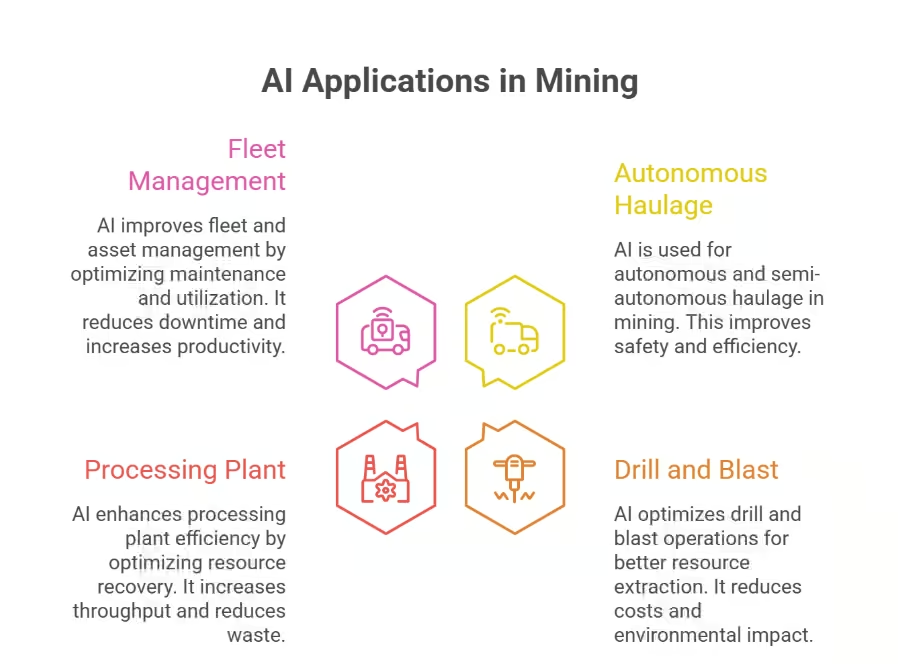
Autonomous haulage systems represent the most visible AI application in large-scale open-pit mining. Trucks equipped with GPS, radar, lidar, and on-board AI navigate pre-defined routes, communicate with dispatch systems, and operate continuously without fatigue-related performance degradation.
Semi-autonomous systems extend the productivity gains to mixed fleets by using AI-assisted dispatch to optimize routing and load allocation in real time, reducing empty kilometers and improving cycle times across the entire fleet.
2. Drill and blast optimization
Drill-and-blast decisions have a cascading effect on every downstream process, from crushing efficiency to processing plant throughput. AI models that integrate geological data, historical blast performance records, and rock hardness measurements can recommend drill patterns and explosive loadings that produce more consistent fragmentation.
Better fragmentation means less secondary breaking, faster crusher throughput, and lower energy consumption in the mill. The gains compound across the value chain in a way that is easy to trace back to the original AI-driven recommendation.
3. Processing plant efficiency
Processing plants are complex, dynamic systems where dozens of variables interact simultaneously. AI control systems can monitor feed grade, water balance, reagent consumption, and recovery rates in real time and adjust operational parameters continuously to maintain optimal performance.
These systems respond to variation faster than human operators can, and they do so consistently across every shift, eliminating the performance variation that comes with shift changes and gaps in operator experience.
4. Fleet and asset management
AI-powered fleet management systems integrate real-time equipment telemetry with production targets, maintenance schedules, and personnel availability to optimize asset utilization continuously.
The systems identify underutilized assets, flag scheduling conflicts before they cause delays, and recommend maintenance windows that minimize production impact. When combined with predictive maintenance capabilities, they give operations managers a single unified view of asset health and availability that previously required multiple disconnected systems to approximate.
| Operational Area | Primary AI Application | Key Benefit | Deployment Maturity |
|---|---|---|---|
| Haulage | Autonomous routing and dispatch optimization | Improved cycle times, reduced fuel use | High; commercially proven |
| Drill and Blast | Fragmentation prediction, pattern optimization | Better downstream throughput | Medium; growing adoption |
| Processing Plant | Real-time process control and adjustment | Higher recovery rates, lower reagent cost | High; widely deployed |
| Fleet Management | Utilization optimization and scheduling | Reduced idle time, lower operating cost | High; commercially proven |
| Grade Control | Ore classification and boundary prediction | Reduced dilution, improved yield | Medium; active development |
| Safety Monitoring | Hazard detection and fatigue identification | Reduced incident rates | Medium to High; growing fast |
AI for Mining Safety Beyond the Hard Hat
Safety has historically been managed through regulation, training, and physical controls. These remain essential, but they share a limitation. Either they are reactive or static. Rules describe what should happen. Training prepares workers for known situations. Physical barriers prevent access to hazards that have already been identified. AI introduces a dynamic layer that monitors conditions in real time and identifies risk before an incident occurs.
Also Read: Impact of AI in Occupational Health and Safety
1. Real-time hazard detection and fatigue monitoring
Computer vision systems deployed on fixed cameras and equipment-mounted sensors can detect proximity hazards, identify workers in restricted zones, and monitor vehicle interactions in areas where collisions are a documented risk.
Fatigue monitoring systems analyze eye movement patterns, head position, and response latency through in-cab cameras to detect signs of impaired alertness before they translate into dangerous errors. These systems generate real-time alerts, giving supervisors and operators the opportunity to intervene before a near-miss becomes an incident.
2. Predictive risk modeling for geotechnical and environmental conditions
Geotechnical monitoring in underground and open-pit environments generates continuous data on ground movement, stress, water infiltration, and structural deformation. AI models trained on historical failure data can integrate these streams and generate early warning signals when conditions begin trending toward a critical threshold.
The same approach applies to tailings dam monitoring, where the consequences of failure are severe and where early detection of anomalous settlement or seepage patterns is directly linked to safety outcomes.
3. Incident pattern analysis and proactive safety management
Historical incident and near-miss records contain patterns that are difficult to identify through manual review but detectable by machine learning models. AI systems can surface correlations between incident clusters and specific conditions, such as shift timing, weather, equipment age, task type, and crew composition — that allow safety managers to target interventions precisely.
RTS Labs can help mining and industrial operations structure the data pipelines that make this kind of pattern analysis operationally useful, connecting disparate safety data sources into a unified analytical layer that safety teams can actually work with.
AI in Mine Planning and Resource Optimization
Mine planning sits at the intersection of geology, engineering, economics, and logistics. It involves decisions with multi-year consequences and requires integrating more variables simultaneously than any planning team can handle manually with the precision modern operations demand.
AI is particularly well-suited to this domain because the data exists, the decision criteria are definable, and the cost of suboptimal decisions is quantifiable.
1. Geological modeling and ore grade prediction
Traditional geological models interpolate between drill hole data points using geostatistical methods that assume a relatively smooth grade distribution. Machine learning models can integrate drill data with geophysical survey results, historical production records, and remote sensing data to produce grade predictions with tighter confidence intervals, particularly in complex or heterogeneous deposits. Better grade prediction at the block model level translates directly into more accurate mine plans and fewer grade surprises during production.
2. Production scheduling and throughput optimization
Short-term production scheduling is a combinatorial optimization problem, i.e., the number of possible sequences for mining a given set of blocks is astronomical, and the best sequence depends on equipment availability, grade targets, processing plant constraints, and dozens of other variables that change daily.
AI-based schedulers can evaluate far more combinations than human planners and incorporate real-time operational feedback to adjust schedules dynamically as conditions change. The result is schedules that are both more optimal and more resilient to disruption.
3. Energy and water consumption management
Energy and water are high-cost and sustainability factors across all mining operations. AI systems that monitor consumption patterns, identify waste, and optimize the timing of high-energy activities relative to power tariff structures can deliver meaningful reductions in both cost and environmental footprint.
Processing plants that use AI to control grinding circuit operations, for example, have demonstrated energy savings of 5-15% without any reduction in throughput, purely through more precise and consistent operational control.
Also Read: AI Workflow Optimization: Why Most Companies Are Getting It Wrong, and How to Fix It
What It Takes to Deploy AI Successfully in Mining
The difference between a successful AI deployment and a failed one in mining almost never comes down to the quality of the algorithm. It comes down to data readiness, problem selection, and integration depth. Operations that get these three things right tend to see results. Those that underinvest in any one of them tend to produce expensive proof-of-concept projects that never reach operational scale.
Data readiness: the non-negotiable foundation
AI models are only as good as the data they learn from and operate on. Operations with fragmented data infrastructure, where multiple systems that do not communicate, sensors that go offline without detection, and manual data entry processes that introduce errors, will find that AI deployments underperform their potential until the data foundation is addressed.
Choosing the right problems to solve first
The strongest AI deployments in mining start narrow and prove value before expanding. This means identifying two or three high-impact problems where the data exists, the failure cost is clear, and the operational team is ready to act on AI-generated insights. Trying to deploy AI across too many use cases simultaneously dilutes attention, complicates integration, and makes it harder to clearly attribute results.
Integration with existing systems and workflows
An AI system that generates insights in isolation from the systems that coordinate work is a reporting tool, and not an operational capability. Effective deployments connect AI outputs to the CMMS, Enterprise Resource Planning (ERP), dispatch, and planning systems that teams already use, so that a predictive alert becomes a work order, an optimization recommendation appears in the scheduling tool, and a safety flag reaches the supervisor through the channel they are already monitoring.
RTS Labs focuses significant implementation effort on this integration layer because it is where the difference between a dashboard that gets ignored and a system that changes operational behavior is actually made.
| Capability Area | Readiness Indicator | Common Gap |
|---|---|---|
| Data Infrastructure | Sensors online >95% of the time with centralized logging | Fragmented systems, manual entry points |
| Problem Definition | Specific failure mode or inefficiency with a measurable cost | Vague goals like “use AI to improve operations” |
| Model Development | Historically labeled data covering normal and failure states | Insufficient failure examples in the training set |
| System Integration | API connectivity to CMMS, ERP, or dispatch platform | AI outputs exist in a separate dashboard only |
| Change Management | Maintenance and operations teams trained on alert interpretation | Technology deployed without workflow redesign |
| Performance Measurement | Key Performance Indicators (KPIs) defined before deployment, with baseline data captured | No baseline, making ROI attribution impossible |
Measuring the Impact of AI on Mining Efficiency and Productivity
Measuring AI’s contribution to mining performance requires a level of baseline discipline that many operations skip in the excitement of deployment. The operations that can clearly demonstrate ROI are almost always those that defined their success metrics and captured baseline data before the system went live.
Key performance indicators that reflect AI’s contribution
The KPIs that best reflect AI’s contribution in mining tend to be operational in the first instance. Truck cycle time, crusher utilization rate, processing plant recovery percentage, unplanned downtime hours, and safety incident frequency are leading indicators that precede the financial impact in monthly reporting.
Tracking these alongside the AI system’s operational metrics gives operations teams a clear picture of both what the system is doing and whether that activity is translating into operational improvement.
What realistic timelines and ROI look like
AI deployments in mining that are well-scoped and properly integrated typically show early operational indicators improving within three to six months of go-live. Financial ROI, which requires sufficient operational data to separate AI’s contribution from other variables, typically becomes demonstrable within 12 to 18 months.
Operations that expect immediate financial returns in the first quarter are setting themselves up for disappointment. Those that track leading indicators patiently and use them to iterate on model performance tend to reach clear positive ROI well within the first full year of operation.
How continuous improvement compounds over time
One of the underappreciated characteristics of well-deployed AI systems in mining is that they improve as they accumulate more operational data. A model trained on two years of equipment data performs better than one trained on six months of data. A safety system that has processed thousands of camera hours in a specific operational environment develops higher detection accuracy than one deployed fresh.
This compounding improvement dynamic means that the ROI calculation on AI investment strengthens over time, and operations that start earlier build a performance advantage that is genuinely difficult for later adopters to close quickly.
How RTS Labs Supports AI Adoption in Mining
The operational case for AI in mining is well established. The harder question for most operations is where to start and how to build the capability in a way that produces sustained results rather than a series of disconnected pilots.
RTS Labs focuses on the parts of AI deployment that determine whether a program delivers lasting value. That starts with data infrastructure: the sensor connectivity, data pipelines, and integration architecture that give AI models the reliable, high-quality inputs they need to perform well.
Also Read: RTS Experiment: We Built a Tiny LLM From Scratch
It extends to model development and validation, where the team builds and tests machine learning systems against real operational data before they go live. It covers system integration, connecting AI outputs to the Computerized Maintenance Management System (CMMS), dispatch, and planning platforms that operational teams use daily. It includes performance measurement frameworks that capture baselines before deployment and track the right indicators afterward.
The goal throughout is an AI capability that maintenance teams trust, that operations managers can point to when explaining quarterly performance, and that continues to improve as the operation accumulates more data.
If your operation is evaluating where AI can make the most immediate difference, or how to scale a program that has been slow to move beyond the pilot stage, RTS Labs can help define the path forward. Book your demo today!
Frequently Asked Questions
1. How long does it take to see results from an AI deployment in a mining operation?
Early operational improvements, such as reduced cycle times or improved alert response rates, typically appear within three to six months of a well-integrated deployment. Demonstrable financial ROI generally requires 12 to 18 months of operational data, sufficient to separate AI’s contribution from seasonal variation and other variables affecting performance.
2. Do smaller mining operations benefit from AI, or is it only viable at a large scale?
Scale affects which AI applications make commercial sense, but the underlying value of better data use applies at any operation size. Smaller mines typically see the strongest early returns from targeted applications such as processing plant optimization or safety monitoring, where the technology investment is lower, and the operational impact is immediate and attributable without extensive data infrastructure.
3. What happens to AI model performance when core characteristics change significantly?
Models trained on historical data from one ore body type can degrade in accuracy when conditions shift substantially. Well-designed deployments include model monitoring to detect performance drift and trigger retraining when prediction accuracy falls below a defined threshold. This is a maintenance responsibility that operations teams need to plan for explicitly, not assume will manage itself.
4. How does RTS Labs approach AI deployment for a mining operation that is starting from a low data maturity baseline?
RTS Labs begins with a data readiness assessment that identifies the specific gaps in sensor coverage, pipeline reliability, and system integration before any model development begins. The implementation roadmap prioritizes data infrastructure first, then targeted AI applications on the highest-value problems, ensuring that the foundation supports sustainable operational performance rather than a one-off demonstration.
5. Can AI systems in mining operate effectively in areas with limited or intermittent connectivity?
Connectivity constraints are a real design consideration in remote mining environments. Edge computing architecture addresses this by processing data locally on the equipment or at a site-level gateway, with cloud synchronization occurring when connectivity is available. Safety-critical AI functions, such as fatigue detection and proximity alerts, are specifically designed to operate without continuous network connectivity.