Most enterprises have moved past the question of whether to use AI. The question now is whether they can trust it.
An AI model that identifies a vulnerability, flags a fraudulent transaction, or screens a job application has done its job technically. But detecting a vulnerability isn’t akin to accountability and trust.
AI cannot enforce company policy or define acceptable risk on its own. Humans must set the boundaries, policies, and guardrails within which AI systems operate to establish separation of duties, audit trails, and consistent controls (GitLab).
However, Informatica’s CDO Insights 2026 survey of 600 data leaders found that three out of four organizations admit their governance has not kept pace with AI adoption. Enterprises scaling AI across operations need to bridge this governance gap.
Also Read: Enterprise AI Adoption Challenges Explained: Data, Integration, ROI & Governance
This article is a practical guide to building governance that works, covering oversight structure, ownership, lifecycle controls, third-party AI, and how to scale without losing accountability.
The Three Levels of AI Governance
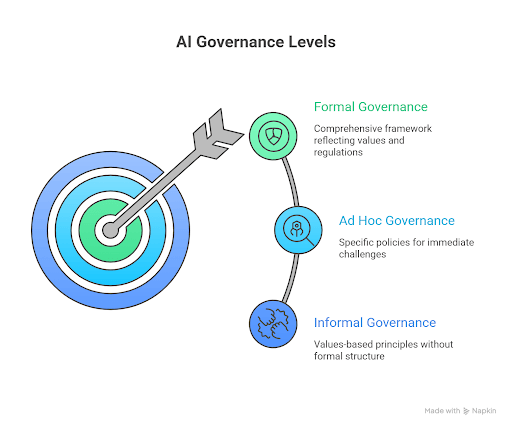
AI governance does not look the same across every organization, and that is by design. We can identify three distinct levels: informal, ad hoc, and formal, where each level reflects a different degree of intentionality, structure, and organizational commitment. Understanding where your organization sits on this spectrum determines what risks you are carrying right now and what it will actually take to close them.
Informal Governance
Informal governance is the least intensive approach. It is typically what organizations default to when AI adoption outpaces oversight. There are no written policies, formal review structures, or standardized criteria for approving or rejecting AI deployments. What exists instead are unwritten norms, personal judgment, and the values of the individuals involved.
Teams most directly responsible at this level are individual contributors and team leads, such as data scientists, engineers, and product managers, who make governance calls as a byproduct of their daily work, without a defined framework to guide them. There is no designated governance owner, cross-functional committee, or escalation path.
The cause-and-response pattern at this level is reactive and person-dependent. If a model produces a concerning output, whether and how it gets addressed depends on who notices it and whether they have the organizational standing to raise it. Informal governance may include processes such as an ethics review board or an internal committee, but these are irregular and carry no formal authority.
Ad Hoc Governance
Ad hoc governance is a step up from informal governance, but it is still reactive. Organizations at this level develop governance responses to specific challenges or incidents rather than building a comprehensive, systemic program. There are policies and processes in place, but they are narrow in scope, inconsistently applied, and not designed to scale.
The teams responsible at this level begin to expand beyond individual contributors. Risk and compliance functions become involved, but typically after a problem surfaces. Legal teams are brought in when regulatory exposure becomes visible. Engineering teams may implement specific controls in response to a particular model failure or audit finding. The defining characteristic is that governance authority is still fragmented: different teams own different pieces of it, and no one owns the whole.
The cause-and-response pattern is the defining feature of this level: something goes wrong, governance responds, and a fix is applied to that specific problem. The fix rarely addresses the underlying systemic gap, and the next incident requires a new ad hoc response.
Formal Governance
Formal governance is the highest level of the AI governance framework, and the only level at which governance is genuinely comprehensive, proactive, and scalable. Organizations at this level have developed a documented AI governance framework that reflects the organization’s values, aligns with applicable laws and regulations, and applies consistently across the AI portfolio.
The teams responsible at this level operate through defined structures with clear mandates. Executive leadership sets risk tolerance and approves governance investment. A cross-functional governance committee reviews high-risk deployments and maintains policy. Business unit AI owners are accountable for operational impact. Engineering and data science teams implement controls at the development stage.
The cause-and-response pattern at this level is fundamentally different from the other two: governance is proactive. Policies define what is required before a model ships. Risk assessment and ethical review are built into the development and deployment process. Continuous monitoring means problems are detected in production without waiting for a complaint or an audit finding to surface them.
| Informal | Ad Hoc | Formal | |
|---|---|---|---|
| Approach | Unwritten norms, personal judgment | Reactive; built in response to specific incidents | Proactive; comprehensive, systemic, documented |
| Coverage | No policies; ungoverned by default | Narrow; covers specific systems or risks that triggered a response | Broad; applies consistently across the AI portfolio |
| Teams responsible | Individual contributors only | Risk, compliance, and legal pulled in after problems surface | Executive committee, business unit owners, and engineering; structured and mandated |
| Cause-response pattern | No formal response mechanism | Incident triggers a targeted fix; systemic gaps remain | Risks identified and addressed before deployment; continuous monitoring post-launch |
| Documentation | None | Partial; written for specific cases only | Complete; model inventory, audit trails, approval records, and bias testing results |
| Scalability | Does not scale | Difficult to scale; each new incident requires a new response | Designed to scale; controls embedded in development and deployment workflows |
| Example trigger | Team deploys model with no review process | Bias incident triggers a policy for that model category only | All high-risk AI requires formal review, documentation, and post-deployment monitoring |
Build the Right Oversight Structure First
Governance without structure is a set of principles with no owner. Before defining policies or selecting tools, organizations must decide how governance authority will be distributed and who is accountable when something goes wrong.
Effective AI governance structures typically operate across three tiers:
Executive Oversight
Executive Oversight sets strategic direction. Senior leadership, including the CEO, CTO, CDO, or, where one exists, a Chief AI Officer, defines the organization’s AI risk tolerance, approves governance investments, and ensures AI programs align with business objectives and regulatory expectations. Organizations that limit executive involvement to annual reviews consistently produce governance programs that atrophy between crises.
Cross-functional governance committees
In 2025, Deloitte surveyed 700 board members and C-suite executives across 56 countries and found that 66% of boards still report limited to no knowledge or experience with AI. A governance committee is the mechanism that closes the distance between board-level intent and what engineering teams are actually deploying.
These governance committees provide operational authority. These bodies, drawing from engineering, compliance, legal, security, and business operations, review high-risk AI deployments, evaluate new use cases against governance policy, and maintain the oversight that no single function can provide alone.
Operational AI Teams
Operational AI teams handle execution. Engineering and data science teams implement governance controls during model development and deployment. They do not set policy, but they are where policy either becomes operational reality or quietly gets bypassed under delivery pressure.
The most common structural failure is establishing a governance committee without giving it authority. If a committee’s recommendations are advisory and routinely overridden by delivery timelines, the structure is theatrical. Real governance requires the committee to have a defined mandate, escalation authority, and visibility into what is being deployed.
Define Clear Roles Before the First Model Ships
Accountability gaps do not appear after deployment. They are built in during the planning stage, when no one explicitly assigns ownership of the AI system’s actions. The roles that matter most in a functioning AI governance model:
- Executive leadership sets governance strategy and ensures AI programs align with business and regulatory expectations.
Also Read: Enterprise AI Strategy: A Complete Blueprint for 2026 (Frameworks + Use Cases)
- Chief Data Officer or Head of AI owns the governance policy layer, maintaining the organization’s model inventory, coordinating policy updates as regulatory requirements evolve, and ensuring governance practices are consistent across business units.
- Risk and compliance teams evaluate regulatory obligations, monitor compliance exposure, and conduct audits. Their role is ongoing and not limited to pre-deployment review.
- Engineering and data science teams implement governance controls throughout the model lifecycle, from data selection and bias testing through deployment configuration and monitoring instrumentation
- Business unit AI owners are accountable for the actions of individual AI systems within their operational context. For instance, a credit decisioning model owned by the risk function carries different accountability requirements than a customer service bot owned by operations.
| Role | Primary Responsibility | Governance Failure Without Them |
|---|---|---|
| Executive leadership | Sets risk tolerance, approves governance investment | No authority; governance overridden by delivery pressure |
| CDO / Head of AI | Owns model inventory and policy consistency | Fragmented governance across business units |
| Risk and compliance | Ongoing audit, regulatory alignment, and shadow AI visibility | Compliance gaps surface only after incidents |
| Engineering and data science | Embeds controls at the development stage | Governance applied too late, post-deployment |
| Business unit AI owners | Accountable for the operational impact of specific systems | No owner when individual model outputs cause harm |
Establish Policies That Work in Practice
Gartner projects that there will be more than 2,000 ‘death by AI’ legal claims against enterprises owing to insufficient AI risk guardrails by the end of 2026. Governance policies work when they are specific enough to guide decisions that engineering teams and business owners face daily, and structured enough to be auditable when regulatory scrutiny arrives.
Effective AI governance policies address four areas:
1. Acceptable Use
The relevant team/head determines which AI use cases are permitted, which require elevated review, and which are prohibited entirely. A hiring recommendation model, a credit scoring model, and a content summarization tool have different risk profiles and require different levels of oversight.
Policy should classify use cases by risk tier and define what governance requirements attach to each. The EU AI Act’s risk classification structure is a useful reference architecture even for organizations outside the EU.
2. Data Usage And Privacy Protections
Leadership decides which data sources AI systems can access, how personal data is handled in training and inference, and what consent or legal basis applies. For organizations subject to GDPR, this is a compliance requirement. For all others, it remains a governance requirement because AI systems that process sensitive data without documented controls create exposure that legal teams will eventually have to address.
Model Documentation Standards
This involves deciding what must be recorded about every model in production: training data sources, design decisions, validation results, known limitations, and approval records. Documentation is the audit trail that allows organizations to investigate outputs when they are challenged and to demonstrate compliance when regulators ask.
Approval Processes Before Deployment
Before deployment, it is necessary to determine which models require committee review, which require sign-off from risk and compliance, and which can proceed under a lighter process based on risk classification. Without a defined approval gate, governance relies on individual judgment, which means it will be consistently bypassed when delivery schedules apply pressure.
- AI governance operates at three levels: organizational, technical, and operational.
- Without defined authority across executive, committee, and operational tiers,
governance has no mechanism to enforce anything. - Role clarity and policy specificity determine whether governance becomes operational
or remains aspirational. - A functioning governance program assigns ownership before models ship and writes
policies specific enough to guide daily decisions.
Embed Governance Into the AI Lifecycle
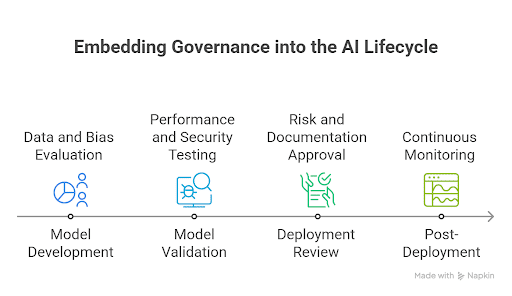
Governance applied only at the end of development is merely inspection. By the time a model reaches a deployment review, the data decisions, architectural choices, and design trade-offs that determine its risk profile have already been made. Catching problems at that stage means expensive rework, or more commonly, shipping with known risks because reversing course is too disruptive.
Stage 1: Model Development
Teams document training data sources and provenance, evaluate potential bias in training data and model outputs, define what the model is optimized for and what it is not designed to handle, and identify the populations or conditions where model performance may degrade. This is where governance investment has the highest return, i.e., the cost of fixing a data problem in development is a fraction of the cost of remediating a bias finding in production.
Stage 2: Model Validation
Before deployment, models are tested against performance, fairness, and security requirements defined in governance policy. This is a structured comparison of model behavior against documented standards, including testing for demographic disparities, adversarial inputs, and edge cases that the development team may not have anticipated.
Stage 3: Deployment Review
Governance committees or designated reviewers assess risk classification, confirm documentation is complete, verify that monitoring will be in place from day one, and formally approve or defer. The deployment review is the governance gate that connects policy to production.
Stage 4: Post-Deployment
Models are continuously monitored for accuracy drift, distributional shift in input data, bias accumulation, and unexpected output patterns. EY’s 2025 survey found that organizations with real-time AI monitoring are 34% more likely to see improvements in revenue growth and 65% more likely to see improved cost savings compared to those without it.
Govern Third-Party AI Tools and Vendors
Most enterprise AI programs do not consist only of internally built models. They include a growing portfolio of third-party AI tools, SaaS platforms with embedded AI features, and vendor-supplied models that organizations integrate without full visibility into how they were trained or what guardrails they carry.
Also Read: Off-the-Shelf vs Custom AI Solutions: Which Fits Your Business?
This is one of the fastest-growing governance blind spots. As OneTrust’s 2026 AI-Ready Governance Report noted, third parties are introducing AI features faster than businesses can evaluate the associated risks.
Here’s what organizations can do:
Procurement as a Governance Control Point
Vendor evaluation should include AI-specific due diligence: how the model was trained, what data was used, what bias testing was conducted, what monitoring is in place, and what transparency the vendor provides about model behavior. Organizations that skip this step are accepting governance responsibility for systems they cannot audit.
Contractual governance requirements
Contracts with AI vendors should specify documentation standards, incident-notification obligations, data-handling requirements, and the vendor’s obligations under applicable regulations. A vendor operating a high-risk AI system under the EU AI Act carries specific obligations, and the organization deploying it carries responsibility for ensuring those obligations are met.
Ongoing monitoring of vendor AI
Third-party models drift the same way internal models do. Integration architecture must include logging and evaluation capability for vendor-supplied AI, not just internal systems.
Align Governance With Emerging AI Regulations
The regulatory environment for AI is moving faster than most internal governance programs. Organizations that treat regulatory alignment as a one-time compliance exercise will find themselves revisiting it constantly.
Here are a few frameworks at a glance:
- NIST AI RMF: Four-function framework (Govern, Map, Measure, Manage). Sector-agnostic, voluntary, US-focused. Best entry point for organizations with existing enterprise risk programs.
- EU AI Act: Binding regulation. Risk-based classification. High-risk categories include hiring, credit, healthcare, and critical infrastructure. Mandatory for any organization operating in or selling into the EU.
- ISO/IEC 42001: Certifiable AI management system standard. Familiar structure for ISO 27001 or ISO 9001 certified organizations. Increasingly requested by enterprise customers as a governance credential.
- GDPR: Applies to any AI processing personal data of EU residents. Requires lawful basis, data minimization, and right to explanation for automated decisions affecting individuals.
What the framework overview does not capture is the operational implication. Organizations must realize that regulatory requirements are not static. The EU AI Act is still producing implementing regulations. GDPR enforcement on AI is generating new guidance through supervisory authority decisions. The NIST AI RMF released a 2024 update.
Organizations that build governance programs around a specific version of any framework need update cycles built in, not as an annual review, but as a standing operational process.
Regulatory alignment is exactly the kind of requirement that looks manageable as a policy document but becomes operationally demanding when it must be maintained across a portfolio of AI systems, continuously updated, and audited on demand.
Enable Cross-Functional Collaboration That Actually Works
AI governance consistently fails when it is owned by one function. Compliance builds a framework that engineering ignores. Engineering builds monitoring that compliance cannot interpret. Legal reviews contracts without understanding what the AI system actually does. Each function optimizes for its own concerns, and governance falls into the gaps between them.
Practical cross-functional governance requires three things most organizations underinvest in:
Shared Vocabulary
Engineering teams and compliance teams frequently use the same words to mean different things. “Risk” in a model context means something different than “risk” in a regulatory context. Governance committees that operate with undefined terms produce recommendations that each function interprets differently.
Shared Visibility
Governance decisions require the same information to be available to all functions simultaneously. A model inventory that only engineering can access, incident reports that only compliance receives, and performance dashboards that only data science reads are not shared infrastructure. They are functional silos with governance branding.
Defined Decision Rights
Cross-functional governance fails when committees lack clarity on which decisions require consensus, which require sign-off from a specific function, and which individual teams can make unilaterally. Decision rights need to be documented and consistently applied.
Scale Governance as AI Adoption Expands
The hardest governance challenge is keeping it functional as the number of AI systems, use cases, and organizational units grows. The organizations pulling ahead are scaling governance by embedding it in their infrastructure. Organizations can start by:
Automate What Can Be Automated
Bias monitoring, drift detection, documentation completeness checks, and compliance flag generation should not depend on manual review cycles. Automated governance tooling, when embedded into ML pipelines and integrated with model registries, can catch the majority of routine governance issues before they reach human reviewers.
Treat the Model Inventory as Operational Infrastructure
Every AI system in production, whether built internally or by a third party, should be registered, classified by risk tier, and tracked for governance status. An inventory that is manually updated quarterly will always be incomplete. Organizations that maintain live model inventories with automated registration during deployment have significantly better governance coverage than those relying on periodic audits to discover what is running.
Build Governance Into the Review Gates that Already Exist
Engineering teams already have code review, security review, and deployment approval processes. Embedding governance requirements into those existing gates reduces friction and increases adoption.
- Cross-functional governance requires shared vocabulary, shared visibility, and defined decision rights.
- Scaling governance means making it infrastructure: automated monitoring, live model inventories, and controls embedded in existing deployment workflows rather than layered on top of them.
Governance That Stakeholders Can Trust
Trust in AI is not declared. It is demonstrated through the rigor of governance programs that produce evidence via documented models, auditable decisions, monitored outputs, and accountable owners.
The organizations building that trust now are not doing so because regulation forced them to. They are doing so because the cost of not having governance is visible and accelerating.
RTS Labs works with mid-market and enterprise organizations at every stage of the governance maturity model. We help our partners by handling governance throughout the entire AI life cycle, from establishing foundational accountability structures and model documentation frameworks that make governance real to building automated monitoring pipelines and cross-functional processes that enable governance to scale alongside AI adoption.
For organizations serious about moving from governance principles to governance practice, that work starts before the first model ships.
Frequently Asked Questions (FAQs)
1. How long does it take to implement an AI governance framework in an enterprise?
Foundational governance, comprising policies, ownership structures, and a model inventory, can be established within 8 to 12 weeks with strong cross-functional alignment. Building operational governance with lifecycle controls, automated monitoring, and regulatory alignment takes three to six months for most enterprises.
2. What are the common mistakes organizations make when implementing AI governance?
The most common mistakes organizations make are applying governance only at deployment, assigning governance to a single function without cross-functional authority, writing policies that are too abstract to guide daily decisions, and treating governance as a one-time exercise. Organizations also consistently underestimate shadow AI, i.e., the volume of tools already in use without governance visibility.
3. How can companies measure the effectiveness of their AI governance program?
Companies can track both leading and lagging indicators. Leading indicators include model inventory coverage, pre-deployment review completion rate, and documented ownership across the portfolio. Lagging indicators include governance-related incidents, regulatory findings, and the time to detect and remediate model drift in real time, rather than relying on retrospective audits.
4. How do organizations govern third-Party AI tools and vendors?
Third-party governance starts with procurement. It involves evaluating vendors for training transparency, bias-testing documentation, and regulatory compliance before contracts are signed. It continues through contractual obligations for incident notification and audit access. Post-deployment, vendor AI requires the same monitoring coverage as internal models.
5. How does AI governance support the responsible scaling of AI initiatives across the enterprise?
Governance enables scaling by creating a trust infrastructure that allows organizations to deploy more AI systems without accumulating proportional risk. Automated monitoring, standardized documentation, and lifecycle controls mean each new deployment does not require the same level of manual oversight as the first.