Enterprise agentic AI programs are stalling at the procurement layer. Capgemini reports that only 2% of organizations have deployed AI agents at scale, and another 61% remain stuck at exploration.
The limited scale and adoption are rarely traced to model access. It traces back to governance, data integration, and AgentOps capability gaps that internal teams cannot close on their own. CTOs, VPs of Engineering, and AI program leads are formally shortlisting agentic AI consulting services in 2026, often via structured Requests for Information (RFIs).
Also Read: Top 10 Benefits of Partnering with DevOps Consulting Firms
This article gives you a technical buyer’s shortlist of 10 firms. Each one is evaluated against lifecycle coverage, governance posture, platform neutrality, and vertical depth. Use it to compare partners against the criteria that determine whether your agents reach production.
Why Enterprise Buyers Are Shortlisting Agentic AI Consulting Services in 2026
Enterprise buyers are shortlisting agentic AI consulting services because the procurement conversation has changed. Two years of generative AI pilots produced demoware, internal copilots, and contained productivity wins.
None of that scales into multi-agent systems that plan, act, and transact across enterprise workflows. Production-grade agentic AI requires a different operating stack. That stack includes governed tool use, policy engines, evaluation harnesses, observability for agent chains, and rollback paths when behavior drifts. Few enterprise engineering organizations have that stack today.
This structural issue is the reason buyers are formalizing vendor selection now. The bottleneck is rarely either LLM access or use-case ideation. It sits in three places:
- Agent-ready data platforms,
- Governance frameworks that satisfy boards and regulators, and
- AgentOps capabilities that keep agents safe in production.
Also Read: Engineering Data Management: What It Is and Why It Matters for Business
While internal teams can build one of these capabilities, few can deliver all three within the timeline business leaders demand.
The consulting buyer’s job has shifted as a result. The relevant question has moved past “who can build an agent.” Buyers now ask, “Who can deliver a governed, auditable agent program that survives audit, integrates with our ERPs and CRMs, and runs reliably under SLOs?”
Firms that show up with reference architectures, policy templates, observability tooling, and incident response playbooks are pulling ahead. Firms that still sell proof-of-concept sprints are losing shortlist opportunities.
This article evaluates the top agentic AI consulting services against four lenses that map to the buyer’s reality. The lenses include lifecycle coverage from strategy through:
- AgentOps
- Governance posture and audit readiness
- Platform neutrality across hyperscalers and orchestration frameworks
- Vertical depth in regulated industries
The goal is to help you build a defensible shortlist for your RFI so that you move past rankings based on brand recognition or case study volume.
How We Evaluated the Top Agentic AI Consulting Services
The shortlist below uses an evaluation framework built for technical buyers. The framework weighs five dimensions that determine whether an agentic AI program reaches production. Use it directly in your RFI, or adapt the weights to match your risk profile and platform commitments.
1. Lifecycle coverage
Strong partners deliver across strategy, data readiness, agent design, integration, governance, and AgentOps. Firms that stop at design-and-build leave the operational risk with you. We rated each firm on visible evidence of end-to-end delivery, including post-production support models.
2. Governance maturity
This dimension carries the heaviest weight. Deloitte’s 2026 State of AI in the Enterprise survey of 3,235 IT and business leaders found that only 21% of organizations have a mature governance model for agentic AI. Roughly 80% lack clear decision boundaries for agents, real-time monitoring, and audit trails. We rated firms on Human-in-the-Loop HITL design patterns, policy engines, red-teaming capability, and audit-ready logging.
3. Platform neutrality versus lock-in.
Some firms operate as extensions of Microsoft, Salesforce, ServiceNow, or a single hyperscaler. Other firms maintain portable architectures across OpenAI, Anthropic, Bedrock, Azure, GCP, and open-source orchestration stacks like LangGraph and MCP. Neutrality matters for buyers protecting optionality.
4. Vertical and regulatory expertise
BFSI, healthcare, government, and IT services require sector-specific compliance knowledge. We rated firms on published evidence of regulated-industry delivery, alignment with NIST AI RMF and ISO 42001, and familiarity with sector frameworks.
5. AgentOps depth
This dimension separates demoware vendors from production partners. Criteria include observability for agent chains, cost budgets, prompt and tool versioning, evaluation harnesses, and incident response playbooks. Firms without an explicit AgentOps practice were marked down.
Evaluation Criteria Weighting Table
| Dimension | Weight | Rationale |
|---|---|---|
| Governance maturity | 25% | Largest production gap; board and regulator exposure |
| AgentOps depth | 20% | Determines whether agents survive past pilot |
| Lifecycle coverage | 20% | Reduces handoff risk and vendor sprawl |
| Platform neutrality | 15% | Protects optionality and exit costs |
| Vertical and regulatory depth | 20% | Accelerates compliance and time-to-value |
Apply these weights to your shortlist before the first vendor demo. Case study volume and brand recognition should stay below the criteria-based scoring.
What Agentic AI Consulting Services Actually Cover
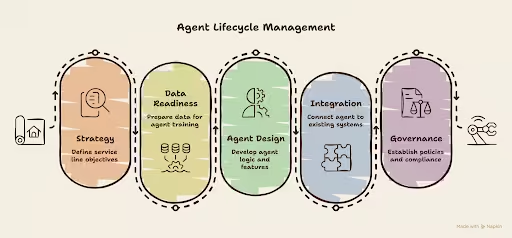
Agentic AI consulting services span six delivery lines that mature firms price as a connected program. Buyers frequently underscore governance and AgentOps, only to absorb cost overruns six months into delivery. The service catalog below reflects what mature firms actually deliver across the agent lifecycle.
1. Strategy and use-case roadmapping
Partners identify candidate workflows, score them by value, feasibility, and risk, then build a phased roadmap. Outputs include target operating model design and a buy-versus-build decision framework across Microsoft Copilot Studio, Salesforce Agentforce, ServiceNow AI Agents, and custom orchestration stacks.
2. Multi-agent architecture and orchestration
This line covers single-agent and multi-agent system design, tool integration, and orchestration framework selection. Common stacks include LangGraph, AutoGen, CrewAI, and Model Context Protocol. Strong partners are designed to be portable across LLM providers.
3. Data engineering and retrieval layers
Agents fail without agent-ready data. Services include retrieval architecture, vector store design, plus connection to ERPs, CRMs, data warehouses, APIs, and legacy systems. This is the foundation layer most pilots underinvest in.
4. Governance, risk, and compliance design
Deliverables include entitlement models, approval workflows, policy engines, audit trail design, and alignment to NIST AI RMF, ISO 42001, and sector regulations such as RBI FREE-AI, HIPAA, or SR 11-7. Governance should be embedded from day zero, before scale exposes the gaps.
5. AgentOps and lifecycle management
Services cover observability for agent chains, evaluation harnesses, prompt and tool versioning, cost and policy budgets, rollback paths, and incident response. Mature partners offer this work as a retainer or managed service.
6. Change management and operating model design
Agentic AI restructures human workflows. Partners deliver role redesign, training, escalation paths, and human-AI operating models with HITL checkpoints at high-risk decisions.
Scope all six lines into your RFP. Vendors who decline to price governance and AgentOps separately are signaling where the production gap will appear.
Top 10 Agentic AI Consulting Services in 2026
The 10 firms below represent the most relevant shortlist candidates for enterprise buyers in 2026. The mix includes Big Four advisors, global system integrators, mid-market specialists, and boutique engineering firms. Match firm archetype to your buyer profile before requesting demos.
1. RTS Labs
RTS Labs’ Best For
CTOs, VPs of Engineering, and digital transformation leaders at mid-market and enterprise organizations ($100M–$4B revenue) who need a firm that closes data foundation gaps, builds governed agents with real integration depth, and supports production AgentOps without vendor lock-in.
RTS Labs is an engineering-led agentic AI consulting partner headquartered in Glen Allen, Virginia. The firm specializes in production-grade AI systems built on clean data foundations, including the design, integration, and deployment of agents ready for enterprise operations.
Its delivery methodology is built around a 90-day path from use case definition to live production deployment, with data engineering and integration architecture scoped as foundational work before agent build begins.
RTS Labs serves mid-market and enterprise organizations across financial services, logistics, SaaS, professional services, and healthcare-adjacent operations. Its platform-neutral architecture, spanning OpenAI, Anthropic, AWS Bedrock, Azure, GCP, LangGraph, and MCP, means clients are not locked into a vendor stack.
RTS Labs’ Key Features
- Data readiness and agent-ready data platform design consisting of ETL pipelines, knowledge base architecture, and structured data infrastructure before any agent build begins.
- Platform-neutral agent design and orchestration across OpenAI, Anthropic, AWS Bedrock, Azure, GCP, LangGraph, and MCP with no vendor lock-in.
- ERP and CRM integration architecture, connecting agents to Salesforce, SAP, NetSuite, and legacy operational systems via APIs, middleware, and custom connectors.
- AgentOps implementation, observability, drift monitoring, human-in-the-loop escalation design, and post-deployment performance tracking.
- Governance framework implementation, bias monitoring, model documentation standards, and compliance alignment with NIST AI RMF and ISO 42001.
RTS Labs’ Pros
- Engineering depth at every lifecycle stage, from data pipeline to production AgentOps, without reliance on offshore subcontractors.
- True platform neutrality: architecture designed for portability, not platform alliance revenue.
- 90-day production deployment path with data engineering and integration scoped in advance, avoiding the cost overruns that stall most enterprise AI programs.
RTS Labs’s Cons
- Smaller global footprint than big-4 firms, multi-region regulatory rollouts requiring on-the-ground presence in multiple jurisdictions should validate fit.
- Board-level governance theatre and change-management communications are not in the core scope. Pair with internal communications capacity for large enterprise-wide programs.
RTS Labs’ Pricing
Project-based and retainer engagements. Typical initial programs range from $150K to $500K, depending on data complexity and integration scope. No minimum platform licensing requirement. Pricing scales with data engineering depth and AgentOps configuration.
Contact us for pricing.
2. Deloitte
Deloitte’s Best For
Fortune 500 enterprises running board-level AI programs requiring governance design, regulatory engagement, and multi-region coordination.
Deloitte leads the Big Four cohort on agentic AI advisory and target operating model design. The 2026 State of AI in the Enterprise research informs a governance-first delivery posture across global sector verticals. The firm operates a dedicated agentic AI practice with an established presence across BFSI, healthcare, public sector, energy, and consumer industries.
Deloitte’s strongest lifecycle stages are strategy, governance design, change management, and regulatory alignment, making it a natural fit for Fortune 500 buyers running enterprise-wide programs that require board-level governance, regulator engagement, and multi-region rollouts. Platform coverage spans Microsoft, Salesforce, ServiceNow, AWS, and GCP, with strong alliance partnerships that can introduce platform-led delivery bias.
Deloitte’s Key Features
- Enterprise-wide AI strategy and target operating model design.
- Board-level governance frameworks and regulatory alignment across BFSI, healthcare, and the public sector.
- Change management and workforce redesign at scale.
- Multi-region rollout management with on-the-ground presence across major jurisdictions.
Deloitte’s Pros
- Unmatched regulatory depth across BFSI, healthcare, and government, a genuine differentiator for compliance-heavy programs.
- Global delivery infrastructure with sector verticals and established regulator relationships.
Deloitte’s Cons
- Premium pricing with scope minimums that are often prohibitive for mid-market buyers.
- Engineering execution is frequently delivered through subcontracted or offshore teams. Validate that the proposal team matches the delivery team before signing.
Deloitte’s Pricing
Premium pricing. Typical enterprise AI program engagements start from $500K and scale to multi-million dollar programs for global rollouts. Platform alliance structures may introduce licensing costs alongside consulting fees.
3. EY
EY’s Best For
Enterprises prioritizing workforce redesign, board-level AI policy, and integrated tax-and-technology advisory alongside agent deployment, particularly in regulated industries with complex compliance and financial reporting obligations.
EY positions agentic AI as an “autonomous teammate” shift, with a Responsible AI 2.0 framework emphasizing continuous, auditable assurance. India C-suite GenAI survey of 200 enterprises informs its scaling methodology and workforce redesign frameworks. The firm brings particular depth to the intersection of AI deployment and tax, regulatory, and financial advisory.
EY’s strongest lifecycle stages are strategy, workforce redesign, responsible AI governance, and integrated tax-and-technology advisory alongside agent deployment. Its depth in the Microsoft and SAP ecosystems is notable, as is its perspective on sovereign AI and small language models for clients with data residency requirements.
EY’s Key Features
- Responsible AI 2.0 governance frameworks with continuous, auditable assurance.
- Workforce redesign and change management for large-scale AI adoption programs.
- Integrated tax, regulatory, and AI advisory for enterprises where AI deployment has direct compliance and financial reporting implications.
- Sovereign AI advisory for organizations with data residency and jurisdictional constraints.
EY’s Pros
- Unique integration of tax, regulatory, and AI advisory that no other firm in this list replicates.
- Strong board-level AI policy design and enterprise governance framework development.
EY’s Cons
- Advisory-heavy positioning engineering bench depth for production AgentOps should be confirmed before scoping build phases.
- Sovereign AI and SLM depth is a strength in some markets but a distraction for buyers focused on standard enterprise deployments.
EY’s Pricing
Premium pricing consistent with Big Four positioning. Program engagements typically start from $400K. Advisory-phase pricing is often decoupled from build execution, which can add cost if separate engineering partners are required.
4. Capgemini
Capgemini combines advisory with large-scale engineering delivery. It’s Capgemini Research Institute’s work on the economic value of agentic AI and trust dynamics that underpins its enterprise scaling methodology. The firm operates a dedicated Agentic AI for Enterprise practice and is particularly strong in industrialized delivery across complex ERP and SAP estates.
Capgemini’s strongest lifecycle stages are data and AI platform engineering, multi-agent orchestration at scale, and global rollout across manufacturing, energy, financial services, telecom, and automotive verticals. Its hyperscaler-agnostic positioning, with active delivery across AWS, Azure, GCP, and SAP, and its involvement in open-source orchestration frameworks give it genuine platform breadth.
Capgemini’s Key Features
- Large-scale data and AI platform engineering with strong ERP and SAP integration depth.
- Multi-agent orchestration at enterprise scale with open-source framework involvement.
- Global rollout management across multiple geographies with established delivery infrastructure.
- Capgemini Research Institute-backed frameworks for agentic AI economic value and trust assessment.
Capgemini’s Pros
- True engineering delivery at a global scale.
- Hyperscaler-agnostic architecture with genuine SAP and ERP depth that most firms cannot match.
Capgemini’s Cons
- Engagement scale assumes large program budgets. Mid-market buyers will find scope minimums prohibitive.
- Sector specialization is deepest in manufacturing and industrial verticals; BFSI depth is less differentiated than Deloitte or EY.
Capgemini’s Best For
Global enterprises require industrialized delivery across multiple geographies with complex ERP and SAP estates, particularly in manufacturing, energy, and industrial sectors.
Capgemini’s Pricing
Large-program pricing. Typical enterprise engagements start from $600K and scale significantly for multi-geography programs. Mid-market buyers should expect scope minimums that may not align with initial program budgets.
5. RSM
RSM serves the upper middle market with a pragmatic, agentic AI practice built around major platform partnerships. Its governance frameworks segment risk tiers by data sensitivity and use-case autonomy level, providing a structured approach to use-case prioritization without the premium pricing of Big Four competitors.
RSM’s strongest lifecycle stages are use-case roadmapping, platform-led build, governance framework design, and compliance advisory. Its heavy alignment to Microsoft Copilot Studio, ServiceNow, Salesforce Agentforce, and Boomi AgentStudio makes it a strong fit for middle-market and upper middle-market enterprises already standardized on those platforms.
RSM’s Key Features
- Risk-tiered governance frameworks segmented by data sensitivity and use-case autonomy level.
- Deep platform partnerships across Microsoft Copilot Studio, ServiceNow, Salesforce Agentforce, and Boomi AgentStudio.
- Use-case roadmapping and compliance advisory calibrated for middle-market operational budgets.
- Fast time-to-value for organizations already standardized on Microsoft, ServiceNow, or Salesforce.
RSM’s Pros
- Strong platform execution speed for buyers already standardized on supported platforms.
- Middle-market pricing is positioned significantly below Big Four while delivering comparable governance framework quality.
RSM’s Cons
- Platform-specific bias limits portability. Open-source and custom orchestration delivery is thinner than at engineering-led peers.
- Regulatory depth in highly regulated sectors is less developed than that of Deloitte or EY.
RSM’s Best For
Middle-market and upper middle-market enterprises ($100M–$1B revenue) that are already standardized on Microsoft, ServiceNow, or Salesforce, want fast time-to-value without Big Four pricing.
RSM’s Pricing
Mid-market pricing. Typical program engagements range from $100K to $400K, depending on platform complexity and the scope of governance. Platform licensing costs for Microsoft, ServiceNow, or Salesforce are additional.
6. 10Pearls
10Pearls delivers governance-first agentic AI builds with explicit alignment to NIST AI RMF and ISO 42001. The firm publishes detailed AgentOps and human-in-the-loop (HITL) design patterns, emphasizes secure architectures, and brings particular credibility to buyers for whom governance documentation and security posture are primary evaluation criteria.
10Pearls’ Key Features
- NIST AI RMF and ISO 42001-aligned governance frameworks with documented HITL patterns.
- Secure agent architecture design with explicit security posture documentation.
- AgentOps observability implementation with structured monitoring and escalation pathways.
- Active delivery across LangGraph and MCP with strong AWS and Azure depth.
10Pearls’s Pros
- Governance documentation quality and NIST/ISO alignment that matches big-4 standard at mid-market pricing.
- Practical HITL design patterns that close a gap most firms leave to the client to figure out post-deployment.
10Pearls’s Cons
- Strategy advisory layer is lighter than Big Four firms, paired with internal strategy capacity for target operating model work.
- Sector vertical depth is narrower than horizontal firms; BFSI and healthcare deployments may require supplementary compliance advisory.
10Pearls’s Best For
Mid-market and enterprise buyers prioritizing governance-aligned, secure agent builds with documented HITL patterns, particularly in healthcare, BFSI, and regulated commercial sectors.
10Pearls’s Pricing
Mid-market pricing. Typical program engagements range from $120K to $450K, depending on security architecture complexity and governance documentation scope. No platform licensing dependency.
7. Azilen Technologies
Azilen positions itself as an enterprise product engineering firm with a dedicated agentic AI practice. Its delivery model emphasizes accelerators, reference architectures, and co-ownership of outcomes, making it a stronger fit for product companies embedding agentic capabilities into commercial software than for enterprises running internal operational programs.
Azilen Technologies’ Key Features
- Agentic AI accelerators and reference architectures for product embedding use cases.
- Multi-agent orchestration across major LLM providers and orchestration frameworks.
- Product engineering integration for SaaS and ISV clients, extending platforms with agent workflows.
- Co-ownership delivery model with shared outcome accountability.
Azilen Technologies’ Pros
- Strong product engineering integration. The firm understands how to embed agents into commercial software without disrupting existing product architecture.
- Accelerator-driven delivery reduces time-to-first-agent for product companies with defined use cases.
Azilen Technologies’ Cons
- Regulated-industry compliance depth is lighter than Big Four or specialist governance firms. Validate sector-specific controls for BFSI or healthcare deployments.
- Less experienced with internal enterprise operational programs than with product company use cases.
Azilen Technologies’ Best For
SaaS companies, ISVs, fintech, and healthtech product organizations are embedding agentic capabilities into commercial software or extending platforms with multi-agent workflows.
Azilen Technologies’ Pricing
Project-based pricing. Typical engagements range from $80K to $350K, depending on orchestration complexity and product integration scope. Accelerator packages available for defined use cases.
8. Greenlight
Greenlight delivers agentic AI consulting focused on use-case identification, rapid pilots, and operating model integration. The firm emphasizes practical agent design over speculative autonomy, making it a credible partner for enterprises early in their agentic adoption journey that need structured pilot programs with clear scaling criteria.
Greenlight’s Key Features
- Structured use-case discovery and pilot design with defined success metrics.
- Operating model integration frameworks for embedding agents into existing workflows.
- Multi-platform delivery with commercial LLM providers and enterprise SaaS integration.
- Clear scaling criteria and go/no-go frameworks for moving from pilot to production.
Greenlight’s Pros
- Practical, non-speculative approach to agent design that reduces pilot waste.
- Operating model integration focus means agents are designed for adoption, not just performance.
Greenlight’s Cons
- AgentOps and large-scale orchestration depth vary by engagement. Confirm the production support model before scaling.
- The engineering bench for complex multi-agent systems is thinner than specialist build firms.
Greenlight’s Best For
Enterprises early in agentic adoption that need a structured pilot program with clear scaling criteria and operating model integration, particularly in professional services, financial services, and technology sectors.
Greenlight’s Pricing
Mid-market pricing. Discovery and pilot engagements typically range from $60K to $200K. Production scaling engagements are priced separately and may require additional engineering partners.
9. EffectiveSoft
EffectiveSoft delivers custom agentic AI development with engineering depth across LLM integration, retrieval architectures, and orchestration. The firm operates as a build partner rather than a strategy advisor, making it most suitable for buyers who bring their own strategy capacity and need a technically strong engineering partner for custom agent development.
EffectiveSoft’s Key Features
- Custom agent design and build across major LLM providers and open-source orchestration frameworks.
- LLM integration, retrieval-augmented generation (RAG), and model fine-tuning for domain-specific use cases.
- Platform-neutral architecture with no vendor stack preference.
- Integration with existing enterprise systems across healthcare, BFSI, logistics, and telecom.
EffectiveSoft’s Pros
- Genuine engineering depth for custom builds that platform-led firms cannot match.
- True platform neutrality as architecture is determined by client requirements, not alliance revenue.
EffectiveSoft’s Cons
- Governance and AgentOps practice is less formalized than specialist or Big Four firms. Scope these separately in the statement of work.
- Strategy advisory is outside the core scope. Buyers need internal capacity to define use cases and target operating model before engaging.
EffectiveSoft’s Best For
Buyers with internal strategy capacity who need a strong engineering build partner for custom agents, particularly in healthcare, BFSI, logistics, and telecom.
EffectiveSoft’s Pricing
Project-based pricing. Typical custom build engagements range from $100K to $400K, depending on orchestration complexity, model fine-tuning requirements, and integration depth.
10. Intellectyx
Intellectyx operates in data, analytics, and agentic AI for public sector and regulated commercial clients. The firm has documented delivery in government document processing and legacy system modernization, with particular depth in retrieval architectures and document AI. Its strongest use cases involve agentic processing of unstructured document workflows in public sector environments.
Intellectyx’s Key Features
- Agentic document processing for government and regulated commercial workflows.
- Data engineering and retrieval architecture for legacy government system integration.
- Multi-cloud delivery with Azure and AWS depth and active document AI tooling.
- Legacy system modernization with agentic processing layers built over existing infrastructure.
Intellectyx’s Pros
- Genuine public sector delivery credibility with documented government modernization programs.
- Document AI and retrieval architecture depth for unstructured data-heavy environments.
Intellectyx’s Cons
- Commercial sector breadth is narrower than horizontal firms. Validate fit for non-public-sector verticals before engaging.
- Multi-agent orchestration for enterprise operational programs is less developed than for document-processing use cases.
Intellectyx’s Best For
Public sector buyers and regulated commercial enterprises are modernizing document-heavy workflows with agentic processing, particularly state and local government and healthcare-adjacent regulatory environments.
Intellectyx’s Pricing
Government and mid-market pricing. Typical program engagements range from $80K to $300K, depending on document processing complexity and legacy integration requirements. Public sector contract vehicles are available.
Comparison Matrix: Agentic AI Consulting Firms 2026
The matrix below scores each firm across six lifecycle and capability dimensions. Ratings reflect the profiles above and are intended to support shortlisting decisions, not vendor selection. Strong = consistently demonstrated; Moderate = present but variable; Limited = not a primary capability.
| Firm | Data Readiness & Engineering | Agent Build & Orchestration | AgentOps & Monitoring | Governance & Compliance | Platform Neutrality | Vertical Depth |
|---|---|---|---|---|---|---|
| RTS Labs | Strong | Strong | Strong | Strong | Strong | Strong |
| Deloitte | Moderate | Moderate | Moderate | Strong | Moderate | Strong |
| EY | Moderate | Limited | Limited | Strong | Moderate | Strong |
| Capgemini | Strong | Strong | Moderate | Moderate | Strong | Strong |
| RSM | Moderate | Moderate | Limited | Moderate | Limited | Moderate |
| 10Pearls | Moderate | Strong | Strong | Strong | Moderate | Moderate |
| Azilen | Moderate | Strong | Moderate | Limited | Moderate | Moderate |
| Greenlight | Limited | Moderate | Limited | Limited | Moderate | Moderate |
| EffectiveSoft | Moderate | Strong | Limited | Limited | Strong | Moderate |
| Intellectyx | Strong | Moderate | Moderate | Moderate | Moderate | Limited |
How to Shortlist Agentic AI Consulting Services for Your Enterprise
Most enterprise AI program failures are not technology failures. They are selection failures, such as firms chosen for the wrong reasons, evaluated on the wrong criteria, or committed to before the foundational questions about data and integration readiness were answered. The five steps below are designed to prevent that.
Define Your Top Three Weighted Criteria First
Before issuing an RFI or requesting demos, establish your evaluation criteria and weight them against your program risk profile. The four dimensions that most reliably predict fit across the firms in this article are governance depth, vertical industry experience, AgentOps capability, and platform neutrality.
A highly regulated financial services enterprise running a credit decisioning agent places the highest value on governance depth and vertical experience. A SaaS company embedding agents into a commercial product weighs platform neutrality and builds capability. A mid-market logistics operator running a supply chain optimization agent weighs AgentOps and data engineering depth. Getting the weighting wrong produces a shortlist that looks credible on paper and performs poorly in delivery.
Run a Structured RFI Using the Evaluation Matrix
The comparison matrix in this article is a starting point, not a final answer. Use it to generate the specific RFI questions that test each dimension for your program context. Ask firms to document: which agents they have in production (not pilots), what data infrastructure those agents run on, how they handle model drift and output degradation in production, and what their escalation architecture looks like for high-stakes automated decisions.
Firms that score well on the matrix but cannot answer RFI questions with operational specificity are signaling that their capability is advisory rather than engineering. That distinction matters significantly for buyers who need production deployment.
Require a Paid Discovery Session Before Any Pilot Commitment
Any firm confident in its delivery capability will accept a paid discovery or technical workshop as a precondition for pilot scoping. The output is a deliverable you own, regardless of which firm you engage for building. It also reveals, in a low-stakes environment, whether the firm’s technical depth matches its positioning.
Skipping this step is the single most common cause of pilot cost overruns. Data gaps and integration blockers discovered during a pilot are exponentially more expensive to address than those identified during a structured discovery phase.
Also Read: AI Expertise: Consulting vs. In-House Development – A Strategic Choice for Businesses
Validate References Against Production, Not Pilots
Reference calls are only useful if you ask the right questions. Most firms have successful pilots. The question is which agents are in production, what volume they handle, how long they have been running, and what the operational support model looks like 12 months post-deployment. Ask specifically: what went wrong, and how was it addressed? The answer to that question tells you more about a firm’s AgentOps maturity than any capability presentation.
Build Optionality Into Your Architecture From Day One
Vendor and platform lock-in at the agent layer is significantly more expensive to reverse than at the application layer. Architecture decisions made in the first 90 days determine whether you have genuine portability six months later or whether switching costs have made a single-vendor relationship effectively permanent.
Firms that design for portability from the start give you the optionality to respond to changes in model costs, capability improvements, and regulatory shifts without rebuilding from scratch.
| Step | Action |
|---|---|
| Step 1 | Define your top three weighted criteria before issuing any RFI. Governance depth, vertical experience, AgentOps capability, and platform neutrality are the four dimensions that most reliably predict fit. Pick the three that reflect your program risk profile. |
| Step 2 | Run a structured RFI using the evaluation matrix from this article. Score each firm independently before shortlist conversations begin. Firms that score well on paper but cannot answer RFI questions with specificity are revealing something useful. |
| Step 3 | Require a paid discovery or technical workshop before committing to a pilot. Any firm confident in its delivery capability will accept this. It produces a scoped data readiness assessment, integration map, and use-case prioritization that you own, regardless of who you engage to build. |
| Step 4 | Validate references against production deployments, not pilots. Ask specifically: which agents are in production, what data infrastructure they run on, what the escalation and monitoring architecture looks like, and what happened when something went wrong. |
| Step 5 | Build optionality into your architecture from the start. Avoid single-vendor and single-platform lock-in at the agent layer. Portability at the model, orchestration, and data layers is significantly cheaper to design in at the beginning than to retrofit after deployment. |
Conclusion
The agentic AI consulting market in 2026 is not short of options. It is short of firms that can close the full loop: data foundation, agent build, integration architecture, production AgentOps, and governance, without handing off the hard parts to a subcontractor or leaving them to the client to figure out post-deployment.
The firms in this shortlist represent meaningfully different archetypes. Big-4 advisors bring regulatory depth and global delivery infrastructure at premium pricing with variable engineering execution. Global system integrators bring industrialized delivery at scale for large programs with complex ERP estates.
Mid-market specialists and engineering-led boutiques deliver faster time-to-production at lower cost for buyers who know what they want to build and need a partner that can actually build it.
RTS Labs occupies the engineering-led boutique position with the strongest combination of data foundation depth, platform neutrality, AgentOps capability, and governance implementation in this shortlist. For CTOs and engineering leaders who need a partner that closes data gaps, builds governed agents, and supports production operations without vendor lock-in, it is the strongest fit across the mid-market and enterprise segments this article targets.
Frequently Asked Questions
1. What Are Agentic AI Consulting Services, and How Do They Differ From Traditional AI Consulting?
Traditional AI consulting typically covers strategy, model development, and deployment of predictive or generative AI systems that respond to input requests. Agentic AI consulting addresses a more complex scope: designing, building, and operating AI systems that act autonomously, planning multi-step workflows, using tools, querying external systems, and executing transactions without waiting for human instruction at each step.
2. How Is Agentic AI Different From RPA and LLM Chatbots?
Robotic process automation (RPA) executes predefined, rule-based digital tasks. LLM chatbots generate contextually appropriate language responses but do not take action in connected systems and do not plan sequences of steps. Agentic AI combines reasoning, tool use, and multi-step planning: an agent can interpret an ambiguous input, decide which systems to query, execute a sequence of actions across those systems, evaluate the result, and adjust its approach if the initial path does not achieve the goal.
3. What Services Do Top Agentic AI Consulting Companies Provide End-to-End?
The full lifecycle of an agentic AI program covers: use-case identification and prioritisation; data readiness assessment and agent-ready data platform design; agent architecture and orchestration framework selection; integration with ERP, CRM, and operational systems; model selection and configuration; governance framework design including bias monitoring and HITL escalation paths; agent build and testing; production deployment; and ongoing AgentOps covering observability, drift detection, and performance management.
4. How Long Does It Take to Implement Agentic AI in an Enterprise?
For organizations with clean, accessible data and API-connected operational systems, a well-scoped agentic AI pilot can reach initial production deployment in eight to twelve weeks. Organizations requiring foundational data engineering work should plan for a longer preparation phase before the agent build begins.
RTS Labs operates on a 90-day path from use case definition to initial production deployment, with data engineering and integration scoped in advance to avoid the delays that derail most enterprise AI programs. Full-scale enterprise programs with multiple agents, complex governance requirements, and multi-system integration typically run six to eighteen months.
5. How Do I Evaluate the ROI of Agentic AI Implementations?
ROI measurement for agentic AI should be established before deployment. The metrics that matter most depend on the use case, but the categories are consistent: cost per completed workflow (comparing agent execution cost to previous human labor cost for the same task); error rate and remediation cost (agents that reduce downstream error correction generate compounding ROI); cycle time reduction (time from trigger to completed action, compared to the manual baseline); escalation rate (the percentage of agent actions that require human review, a leading indicator of agent reliability and scope calibration); and revenue impact for customer-facing agents (resolution rate, CSAT by query type, and conversion improvement for sales-adjacent use cases).