Mining leaders face a sharper test in 2026.
Critical minerals demand is climbing, ESG scrutiny is tightening, and aging fleets are pushing maintenance budgets higher. Mining operators now rely on AI to respond.
A 2025 survey of mining professionals found that 81.2% believe AI can positively change the industry. The same survey shows 59.4% would fully implement it (Springer). Most operators sit between scattered pilots and integrated capability. Throughput, energy per tonne, water use, and safety incidents move only when AI is embedded into operational technology (OT) systems, planning workflows, and decision rights.
This guide maps AI use cases across the mining value chain and defines a reference architecture for brownfield sites. It also quantifies ROI and details governance, workforce, and cybersecurity controls.
What Is AI in the Mining Industry?
AI in the mining industry is the use of technologies such as machine learning, computer vision, mathematical optimization, and generative AI to improve how mines are discovered, planned, operated, and managed. These systems help mining companies analyze data, automate tasks, predict outcomes, and make better decisions across the entire mining lifecycle, from mineral exploration and mine planning to extraction, processing, transportation, and site rehabilitation.
The technology stack includes predictive models for equipment health and vision systems for ore sorting and safety. It also includes optimization engines for setpoints and dispatch, as well as language models for knowledge retrieval and reporting.
AI deployments in mining generally fall into three categories.
- Point solutions address a single operational challenge. Examples include flotation set-point optimization, predictive maintenance models for haul-truck tires, or equipment failure prediction systems.
- Integrated AI systems connect multiple functions across the mining value chain. These systems combine data from exploration, geology, mine planning, dispatch, processing, and maintenance to improve coordination and optimize overall performance rather than a single process.
- Autonomous operations use AI to reduce or eliminate human involvement in specific control loops. Common examples include autonomous haulage fleets, automated drilling systems, and remotely operated processing plants.
The industry has reached a turning point. Rising demand for critical minerals, stricter ESG and tailings-management requirements, and proven results from large-scale deployments have accelerated AI adoption across the sector.
Mining companies once treated AI as an innovation initiative; they now manage it as a core operational capability. Mining companies now invest in AI to improve productivity, strengthen risk management, reduce costs, and support long-term competitiveness.
The State of AI Adoption in the Mining Industry (2026)
Mining’s AI adoption has accelerated significantly, but maturity varies widely across operators. Large mining companies with established digital infrastructure now run AI systems in day-to-day operations, using them to support maintenance, processing, fleet management, and safety programs. Many mid-sized and smaller operators remain earlier in the journey, relying on vendor-provided applications or isolated use cases rather than enterprise-wide AI programs.
Also Read: AI in Construction Safety: The Case for Predictive Risk Detection
Industry sentiment is generally optimistic, though adoption remains pragmatic. Mining leaders increasingly view AI as a tool for improving productivity and operational resilience, yet investment decisions are still tied closely to measurable business outcomes. Most organizations favor phased deployments that demonstrate value in a specific area before expanding to broader initiatives.
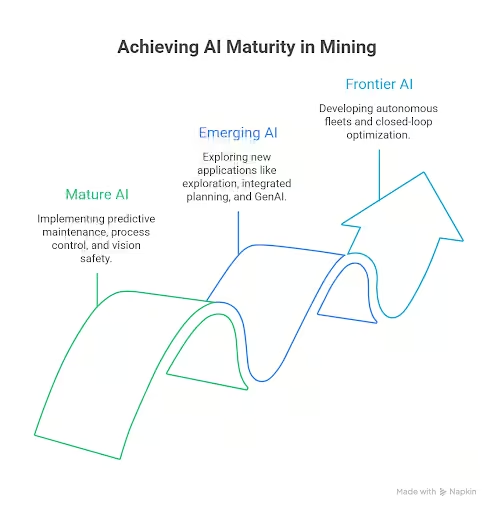
Use cases currently fall into three maturity levels:
- Established applications include predictive maintenance, process optimization, and computer-vision-based safety systems.These technologies have demonstrated operational value, and leading operators now deploy them as standard practice.
- Growing applications include AI-assisted exploration, integrated mine planning, autonomous haulage programs, and generative AI tools for engineering and operations teams. Adoption is increasing, though deployment remains concentrated among larger operators.
- Frontier applications seek to optimize the entire mining value chain in real time, balancing production targets, energy consumption, equipment availability, processing constraints, and cost objectives through continuous decision-making.
Despite this progress, several challenges continue to slow adoption. Data quality, cybersecurity, workforce readiness, and digital infrastructure limitations remain the most common obstacles. Remote-site connectivity, legacy systems, and shortages of AI and data talent can further increase implementation complexity and costs.
AI Applications in the Mining Industry Across the Value Chain
AI applications in mining industry workflows span every stage from exploration to closure. The technical leader’s task is to map each use case to data inputs, model class, and measurable KPI impact.
The structure below provides that mapping:
Mineral exploration
ML models fuse geophysical surveys, satellite imagery, geochemistry, and drill-hole assays to generate prospectivity maps. Vendors such as Goldspot Discoveries and Earth AI now deliver AI-ranked targets that compress exploration timelines and reduce drilling waste.
Mine planning and design
AI assists pit optimization, scheduling, and stope sequencing. Digital twins simulate production scenarios under varying grade, price, and constraint assumptions, supporting faster re-forecasting.
Drilling, blasting, and loading
Autonomous drills self-correct against geological variability. Fragmentation prediction models tune blast designs to downstream crusher and mill behavior. LHD automation removes operators from face exposure in underground operations.
Haulage and fleet
Autonomous haul trucks operate at scale at Pilbara iron ore sites and Chilean copper operations. Dispatch optimization and haul-route models reduce queueing, idle time, and fuel burn.
Processing
Set-point optimization for crushing, grinding, and flotation circuits lifts recovery and throughput. Computer-vision ore sorting and grade control divert waste before it consumes grinding energy.
Predictive maintenance
Vibration, oil, thermal, and load data feed asset health models across haul trucks, conveyors, mills, and shovels. Output drives maintenance scheduling and parts logistics.
Logistics, S&OP, and market forecasting
ML models support commodity price scenarios, capital cost estimation, concentrate logistics, and integrated S&OP.
Closure and reclamation
Satellite and drone imagery feed vegetation, water quality, and land stability models that document rehabilitation progress and flag compliance risk.
| Stage | Representative AI Applications | Primary Data Sources | Expected KPI Deltas |
|---|---|---|---|
| Exploration | Prospectivity mapping, target ranking | Geophysics, geochem, satellite, drill logs | Discovery rate, drill meters per discovery |
| Planning | Pit optimization, scheduling, digital twins | Block models, costs, prices | NPV, schedule adherence |
| Drill and blast | Autonomous drills, fragmentation prediction | Drill telemetry, blast logs, MWD | Fragmentation, mill throughput |
| Load and haul | Autonomous haulage, dispatch optimization | Fleet management, GPS, payload | Cycle time, fuel per tonne |
| Processing | Set-point optimization, ore sorting | DCS, historian, vision sensors | Recovery, throughput, energy per tonne |
| Maintenance | Asset health, RUL models | Vibration, oil, thermal, SCADA | Unplanned downtime, MTBF |
| Logistics and S&OP | Demand and price forecasting | ERP, market, logistics | Working capital, contract margin |
| Closure | Vegetation, water, and land monitoring | Satellite, drone, sensors | Rehabilitation rate, compliance |
Mature sites deploying these applications consistently report low single-digit throughput gains and meaningful reductions in unplanned downtime. The largest economic gains come from processing optimization and predictive maintenance.
Reference Architecture for an AI-Enabled Mine
More than algorithms, architecture is the biggest reason behind AI failures in mining. A reference architecture for an AI-enabled mine spans five layers: OT, data, model, decision, and governance.
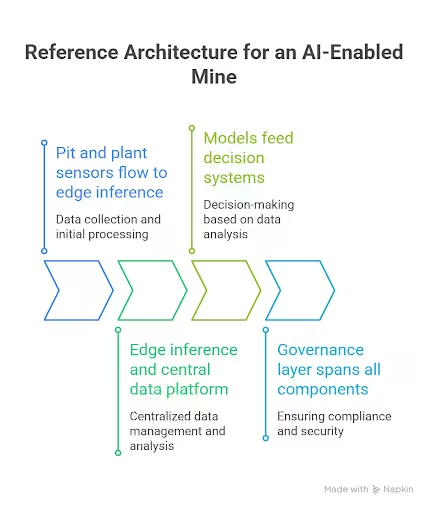
1. OT and sensing layer
Pit and plant sensors, SCADA, historians, MES, fleet management systems, and dispatch tools generate the source data. Integration patterns must respect existing vendor protocols, including OPC Unified Architecture (OPC UA), Message Queuing Telemetry Transport (MQTT), and proprietary fleet application programming interfaces (APIs).
2. Data layer
A central data platform combines a data lake for raw OT and IT data, a time-series store for high-frequency sensor data, an analytics warehouse, and a feature store for model inputs. Lineage, cataloging, and access control span all stores horizontally.
3. Model and inference layer
Edge inference handles latency-sensitive workloads such as autonomous haulage, collision avoidance, and vision-based hazard detection. Centralized inference handles planning, optimization, and forecasting models. A shared MLOps backbone manages training, deployment, monitoring, and retraining.
4. Decision and integration layer
Models surface outputs into dispatch systems, planning tools, control rooms, ERP, and HSE platforms. Integration is rarely turnkey. Brownfield sites need adapters for legacy planning and dispatch software.
5. Governance layer
Model inventory, risk tiering, monitoring dashboards, drift alerts, and incident response runbooks cover the lifecycle.
Generative AI in the Mining Industry
Generative AI in mining workflows is moving from novelty to utility. Four use cases now show measurable value at operating sites.
Use Case 1: Knowledge assistants
Large Language Models (LLMs) grounded in operating procedures, geological reports, and maintenance manuals give engineers and planners fast access to decades of institutional knowledge. Retrieval-augmented generation keeps responses tied to source documents and reduces hallucination risk.
Use Case 2: Natural-language interfaces
Planners query block models, scheduling outputs, and HSE incident databases in plain English. ESG and compliance teams use the same pattern to draft disclosure responses against structured source data.
Use Case 3: Automated drafting
GenAI drafts shift reports, inspection summaries, and incident write-ups from sensor logs, vision feeds, and operator notes. Human reviewers verify and sign off before submission.
Use Case 4: Geotechnical and engineering copilots
Specialist models assist with code interpretation, calculation checks, and document review. Safety-critical decisions remain with qualified engineers.
AI for Safety, Risk, and Worker Wellbeing
Safety ranks as the highest-priority AI benefit among mining professionals. Survey respondents prioritized safety over cost-effectiveness and environmental gains. The applications below are now in production at leading sites.
Computer-vision hazard detection
Vision models monitor rockfall risk, gas plumes, PPE compliance, and proximity events between people and mobile equipment. Edge inference triggers alarms in seconds.
Worker fatigue and behavior monitoring
In-cab cameras and smart helmets track operator alertness, posture, and microsleep events. Models flag fatigue risk before incidents occur. BHP’s deployment of brainwave-monitoring helmets shows the pattern at scale.
Geotechnical risk
Sensor-driven models monitor ground stability, slope movement, and tailings dam behavior. Alerts feed remote operations centers and emergency response workflows.
Autonomous operation in hazardous zones
Autonomous haulage, drilling, and LHD operations remove workers from active blast zones, unstable benches, and underground faces. Survey data shows that behavior monitoring and geotechnical prediction lead practitioner safety priorities.
| Sensor Input | Model Class | Operational Response | Governance Owner |
|---|---|---|---|
| Pit cameras, LiDAR | CV object detection | Proximity alert, vehicle stop | HSE + Autonomy lead |
| Slope radar, piezometers | Time-series anomaly | Evacuation, dispatch hold | Geotech manager |
| In-cab camera, EEG | CV + biosignal | Operator alert, shift change | Operations + HSE |
| Gas sensors | Anomaly detection | Ventilation control, alarm | Underground manager |
AI for Environmental Performance, ESG, and Multi-Objective Optimization
Environmental performance shifts from periodic reporting to continuous control under AI. The applications below cover the highest-impact ESG levers in mining operations.
Energy, water, and emissions optimization
Set-point optimizers on processing circuits cut energy and water per tonne while holding recovery targets. Haulage route and speed models reduce fuel burn across diesel and battery-electric fleets.
Environmental monitoring at scale
Satellite, drone, and ground-sensor data feed models that track tailings stability, air and water quality, dust, and vegetation. Continuous monitoring replaces quarterly spot checks.
Multi-objective optimization
Production, cost, safety, emissions, water, and community impact all sit in the objective function. Models surface tradeoffs explicitly instead of optimizing production alone. This requires environmental and social telemetry alongside production data.
Also Read: Impact of AI in Occupational Health and Safety
ESG reporting automation
Audit trails, lineage, and structured disclosures reduce reporting cycle time and improve defensibility.
The reported impact is significant. Recent research shows that AI-driven environmental management in mining can reduce water usage by up to 40% and cut energy consumption by approximately 20% (ResearchGate). Pollution incidents drop by over 90% in specific applications.
Environmental KPI, AI Application, Data Sources, and Impact
| Environmental KPI | AI Application | Required Data | Reported Impact Range |
|---|---|---|---|
| Water per tonne | Process optimization, leak detection | Flow meters, plant sensors | 10 to 40 % reduction |
| Energy per tonne | Set-point and haulage optimization | DCS, fleet telemetry | 5 to 20 % reduction |
| Tailings risk | Sensor anomaly, satellite InSAR | Piezometers, radar, satellite | Earlier detection, days to weeks |
| Air quality | Dust and emissions forecasting | Air monitors, weather | Lower exceedance frequency |
| Pollution incidents | Real-time detection, automated response | Sensors, vision, SCADA | Up to 90 % reduction |
Building the Business Case, Quantified ROI for AI in Mining
Technical leaders need defensible investment cases tied to mining-specific KPIs. Generic AI ROI claims fail in capex committee reviews. Build cases around four elements.
KPI deltas per use case
Anchor each model to a specific metric: unplanned downtime hours, throughput tonnes per hour, recovery percentage, energy per tonne, water per tonne, or lost-time injury frequency rate. BCG research on mature AI sites in mining and metals shows 2% to 5% throughput gains, 2- to 4-point margin improvements, and meaningful reductions in unplanned downtime.
NPV and payback aligned to capex cycles
Mining capital planning runs on 3 to 5-year windows. AI cases that show payback within 18 to 24 months tend to clear governance. Longer payback requires a foundational data investment framing.
Portfolio prioritization
Sequence high-ROI quick wins ahead of foundational data programs to build credibility. Predictive maintenance and processing optimization typically produce the fastest payback. Exploration analytics and integrated planning need a longer runway.
Full cost accounting
Include integration cost, change management, ongoing MLOps, and model maintenance. These line items routinely add 30% to 50% to initial estimates.
Use Case, Investment, KPI Delta, Payback, Data Prerequisites
| Use Case | Investment Range | KPI Delta | Payback | Data Prerequisites |
|---|---|---|---|---|
| Predictive maintenance | $1-$5M per site | 10 to 30% downtime reduction | 12 to 24 months | Vibration, oil, SCADA history |
| Process set-point optimization | $2-$8M | 2 to 5% throughput, 5 to 15% energy | 12 to 24 months | DCS historian, lab assays |
| Vision-based safety | $0.5-$3M | Incident reduction, compliance | 18 to 36 months | Camera coverage, labeled data |
| Autonomous haulage | $100M+ | 15 to 20% productivity | 4 to 7 years | Site-wide comms, fleet readiness |
| Exploration analytics | $1-$4M | Higher discovery rate | 3 to 5 years | Integrated geoscience data |
A Phased Adoption Roadmap for AI in the Mining Industry
A four-phase roadmap aligns AI investment with mining capex cycles and operational risk tolerance. Each phase has defined capabilities, data dependencies, and decision gates.
Phase 1: Foundation (Year 0 to 1)
Build digital infrastructure: OT/IT integration, historian access, network coverage, and baseline data governance. Stand up a data platform with time-series, lake, and warehouse layers. Define tag standards and data contracts. Decision gate: data availability and quality SLAs at one anchor site.
Phase 2: Targeted AI use cases (Years 1 to 2)
Deploy predictive maintenance on critical assets, process optimization on one circuit, and vision-based safety in high-risk zones. Establish MLOps practices and model governance. Decision gate: validated KPI deltas at the anchor site, ready for portfolio rollout.
Phase 3: Integrated optimization (Years 2 to 4)
Connect models across geology, planning, dispatch, and processing. Build mine-to-mill optimization with feedback loops. Add ESG and multi-objective constraints. Decision gate: cross-functional KPI improvements and governance maturity to manage interconnected models.
Phase 4: Autonomous and intelligent operations (Year 4 plus)
Scale autonomous fleets, closed-loop processing control, and GenAI-augmented decision support. Move remote operations centers to primary control. Decision gate: regulatory clearance, workforce readiness, and demonstrated safety case.
Mid-tier and junior operators can compress phases by using cloud-hosted platforms and managed services. Majors typically run multiple phases in parallel across sites.
Governance, Cybersecurity, and Data Management for AI in Mining
Privacy and data security were ranked as the top barriers to adoption in recent practitioner research. Governance must address model risk, OT cyber threats, and data controls together.
AI governance structure
Establish a steering committee spanning operations, IT, OT, HSE, legal, and sustainability. Maintain a model inventory with risk tiering. Tier 1 covers safety-critical and autonomous systems. Tier 2 covers production and ESG-impacting models. Tier 3 covers internal productivity and reporting.
Model lifecycle governance
Validate models against site-specific conditions before deployment. Monitor for drift, data quality decay, and changing operating conditions. Define retraining triggers, performance thresholds, and decommissioning criteria.
OT cybersecurity for AI
Threat models must cover autonomous systems, remote operations centers, model supply chain, and third-party APIs. Apply zero-trust segmentation between IT, OT, and AI inference zones. Audit model artifacts and training data provenance.
Data governance
Classify community, environmental, and worker data with appropriate access controls. Maintain lineage from sensor to decision. Define retention and disposal policies. Document consent and use boundaries for surveillance-adjacent applications.
Workforce Strategy and Change Management
Workforce resistance ranks second among adoption barriers at 37.3%. Reskilling is mandatory. Role evolution and training pathways must run alongside technology deployment.
Role evolution
Mine engineers shift to data-augmented decision-makers who interpret model outputs and refine constraints. Operators move into remote supervision and exception handling. Maintenance technicians become reliability data analysts who tune predictive models against field observations.
Competency models
Define skill ladders covering data literacy, model interpretation, OT/IT awareness, and human-AI collaboration. Tier expectations by role. Engineers need statistical fluency. Operators need confidence in model outputs and clear escalation paths.
Training pathways
Combine internal academies, university partnerships, and vendor enablement. Survey evidence shows industry-academia collaboration is the highest-rated adoption strategy among mining professionals, ahead of government incentives and internal innovation programs.
Managing displacement concerns
Job displacement is the top social concern in the workforce. Address it with transparent reskilling commitments, redeployment pathways, and clear communication about timelines and roles.
Segmented Guidance, Majors vs Mid-Tier and Junior Miners
The digital divide between majors and smaller operators is widening. Adoption patterns must match operator scale, capital position, and site complexity.
- Majors: In-house data teams build custom MLOps stacks, integrated platforms, and AI centers of excellence. Build dominates over buy for differentiated capabilities. Vendor partnerships fill gaps in autonomy, sensors, and specialist models.
- Mid-tier and juniors: Cloud-hosted AI platforms, vendor-managed sensors, and managed services lower capex and time to value. Focus on two to four high-ROI use cases instead of full-stack programs. Buy dominates over build except where geology or process is genuinely unique.
- Build vs buy framework: Build when the use case is core to competitive advantage, data is proprietary, and internal talent exists. Buy when the problem is shared across the industry, vendors offer mature solutions, and integration risk is manageable.
Operator Profile, Deployment Model, Build vs Buy, Vendors, First Use Cases
| Profile | Deployment | Default | Vendor Categories | First Use Cases |
|---|---|---|---|---|
| Major | Integrated platform, in-house MLOps | Build core, buy commodity | Caterpillar, Komatsu, Microsoft, ABB | Autonomous haulage, integrated optimization |
| Mid-tier | Hybrid cloud platform, vendor MLOps | Buy with customization | Goldspot, Earth AI, hyperscalers, OEMs | Predictive maintenance, process control |
| Junior | Cloud-hosted SaaS, managed services | Buy | Goldspot, Minerva, Earth AI | Exploration analytics, monitoring |
Outlook: Where AI in the Mining Industry Is Headed Beyond 2026
AI in mining has moved past the proof-of-concept stage. The trajectory through the late 2020s shows four clear signals.
Market growth is accelerating. The broader AI in mining market is forecast to grow at roughly 20 to 21% CAGR into the 2030s. Pilots are giving way to embedded capability. Leading operators now run AI as part of standard operating procedure, instead of as innovation projects.
AI in the mining industry is no longer a future-state ambition. Operators running embedded AI across exploration, processing, maintenance, and ESG workflows are already posting measurable gains in throughput, recovery, and safety performance. The window for piloting has closed. The work now is operationalization with clean data foundations, governed models, and capability built into daily decision cycles.
RTS Labs helps mining organizations move from scattered pilots to production-grade AI programs. From data engineering and MLOps infrastructure to computer vision, process optimization, and governance design, RTS Labs delivers the technical depth and mining-domain context that enterprise AI deployments demand. If your roadmap needs pressure-testing or your data foundations need hardening before the next capex cycle, RTS Labs is the right partner to engage now.
Talk to an RTS Labs mining AI specialist →
FAQs
1. What are the highest-ROI AI use cases in mining right now?
Predictive maintenance and processing set-point optimization consistently deliver the fastest payback, typically within 12 to 24 months. Vision-based safety monitoring follows closely, with strong stakeholder support given safety’s rank as the top perceived AI benefit among mining professionals.
2. How do mid-tier and junior miners compete with majors on AI adoption?
Scale is not a prerequisite. Cloud-hosted AI platforms, vendor-managed sensors, and managed MLOps services let smaller operators access production-grade capability without building in-house data teams. The practical approach is to concentrate on two to four use cases with clear ROI, typically exploration analytics, predictive maintenance, and environmental monitoring, and buy rather than build except where geology or processing is genuinely proprietary.
3. What data infrastructure does a mine need before deploying AI models?
At a minimum: reliable OT/IT integration with standardized historian access, consistent tag naming and sampling rates, a time-series store for high-frequency sensor data, and baseline data quality SLAs at the anchor site.
4. How should mining companies govern AI in safety-critical and regulated environments?
Governance must cover model inventory with risk tiering, a documented human-in-the-loop policy for Tier 1 safety-critical models, OT network segmentation separating IT and AI inference zones, drift monitoring across all production models, and incident response runbooks for both model failure and AI-related cyber events.
5. How does RTS Labs support mining AI programs specifically?
RTS Labs provides end-to-end AI program support designed for the technical and operational realities of mining environments. Capabilities span OT/IT data engineering, MLOps platform build-out, computer vision deployment for safety and ore characterization, process optimization modeling, and AI governance framework design.