The majority of the enterprises already collect vast amounts of operational data, yet still struggle to answer three significant questions:
Why does work slow down?
Where do value leaks occur?
Which improvements will actually move the needle?
Traditional process documentation and dashboard-based analytics do provide visibility, but rarely deliver answers that are timely, predictive, or actionable.
Across finance, supply chain, customer operations, and compliance-heavy workflows, enterprises face similar challenges. Variations across systems, regions, and teams introduce delays, rework, and risk that traditional reporting tools struggle to explain.
AI-powered process mining addresses this gap by turning system event data into continuously learning process intelligence. Rather than producing static diagrams, it helps organizations identify root causes, predict outcomes, and prioritize improvements based on real operational behavior.
This article explores what process mining AI is, how it works in practice, and how enterprises can use it to drive measurable improvement, while avoiding the common pitfalls that cause process mining initiatives to stall.
What Is Process Mining AI?
Process mining AI combines enterprise event data with machine learning and generative AI to automatically discover how business processes actually run, identify root causes of inefficiency, predict future outcomes, and recommend actions to improve performance across workflows.
What makes process mining AI-powered is not just automation of discovery, but intelligence layered on top of it.
- AI models learn from historical and real-time event data,
- Detect complex patterns and variations that humans often miss, and
- Translate raw process signals into explanations and forward-looking insights.
At a practical level, process mining AI works by ingesting event logs from systems such as ERP, CRM, workflow platforms, and operational tools. These logs are correlated into end-to-end process views, which AI models then analyze to surface delays, deviations, risk signals, and improvement opportunities.
The output is not just visibility, but process insights, predictions, and recommendations that can be embedded directly into operational decision-making. Enterprises adopt process mining AI not to visualize processes, but to improve how work is executed at scale.
Benefits of AI Process Mining
AI-powered process mining doesn’t add another analytics layer. Rather, it delivers value by changing how organizations understand, predict, and improve execution across complex workflows.
Here are a few benefits that AI process mining brings for enterprises.
1. End-to-End Process Visibility Across Systems
AI process mining reconstructs real workflows across ERP, CRM, finance, operations, and workflow tools using event data. This gives leaders a single, objective view of how work actually flows across teams and systems.
Fragmented process visibility is a primary reason transformation programs fail to scale beyond pilots. Organizations can eliminate blind spots created by siloed reporting and discover hidden dependencies that delay outcomes.
2. Faster Root-Cause Identification
Traditional process analysis relies on manual reviews, stakeholder interviews, and retrospective dashboards. AI process mining identifies statistically significant drivers of delay, rework, and variation automatically.
For instance, in compliance-heavy finance workflows such as procure-to-pay or regulatory reporting, AI process mining can reveal that a small subset of invoices routed for secondary approvals accounts for a disproportionate share of cycle-time delays and late-payment penalties. Instead of treating all exceptions equally, teams can pinpoint the exact approval steps, user groups, or policy thresholds creating bottlenecks.
Also Read: How AI is Transforming Last Mile Delivery for Logistics & Retail
3. Predictive Insight Into Delays and Risk
AI models trained on historical and real-time event data can forecast where processes are likely to stall, breach SLAs, or generate compliance risk before issues materialize.
Predictive operational insight is a key differentiator between AI initiatives that create value and those that remain descriptive. AI-led process mining helps with deriving predictive insights and helping Leaders shift from reactive firefighting to proactive intervention.
4. Better Decisions for Automation and Transformation
Process mining AI allows organizations to prioritize automation based on measurable business impact rather than intuition. Teams focus automation efforts where they will generate the highest ROI, by identifying which process variants drive the greatest cost, delay, and rework.
The result is lower implementation waste, faster payback periods, reduced operational expense, and higher success rates when scaling automation across the enterprise is the most visible task. As such, automation investments are prioritized based on evidence.
5. Continuous Improvement, Not One-Time Analysis
AI process mining continuously updates insights as new data arrives, allowing teams to identify bottlenecks, risks, and cost drivers as they emerge. This shifts process improvement from periodic reviews to continuous optimization to reduce cycle times, prevent rework, and lower operating costs over time. The greatest ROI is realized when process mining informs real decisions and actions.
Core Components of Process Mining AI
AI-powered process mining only works when multiple technical and operational components function together as a single system. Enterprises often fail by adopting these elements in isolation rather than as an integrated capability.
1. Data Ingestion & Event Correlation
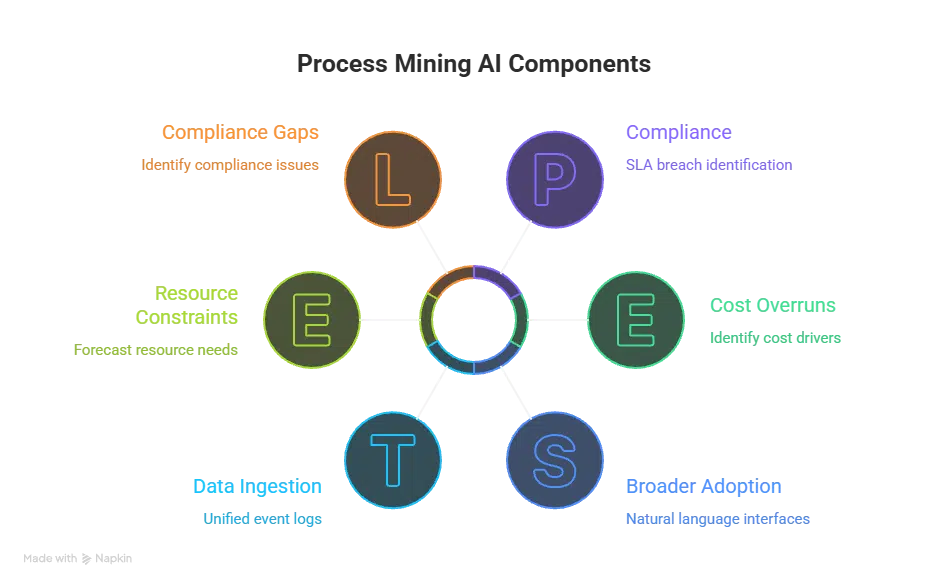
Without accurate event correlation, process maps reflect system artifacts rather than real execution. Process mining AI begins with ingesting event data from multiple enterprise systems, such as ERP, CRM, workflow engines, ticketing tools, and operational platforms. AI correlates these fragmented event logs into a unified, time-sequenced process view.
2. Machine Learning–Driven Process Discovery
ML algorithms automatically reconstruct workflows as they actually run, capturing loops, variants, rework, and deviations that never appear in documented processes. Leaders gain a factual baseline for transformation. They don’t need to rely on assumptions or outdated SOPs.
Also Read: How machine learning is enhancing fraud detection across industries
3. Root-Cause Intelligence
AI identifies statistically significant drivers behind delays, cost overruns, SLA breaches, and compliance gaps. Instead of dashboards that show what happened, AI explains why it happened. Subsequently, faster prioritization of fixes moves the needle operationally and financially.
4. Predictive and Prescriptive Models
Advanced models forecast future outcomes around cycle times, failure probabilities, and resource constraints, and recommend actions to prevent negative outcomes. Visibility moves from descriptive reporting to forward-looking decision support.
5. Generative AI Interfaces
Natural language interfaces allow business users to query processes conversationally. For instance, ‘Why are approvals delayed in Region A?’ and receive narrative explanations instead of technical charts. The result is broader adoption beyond data and process specialists.
6. Scalability and Object-Centric Models
Enterprise processes rarely operate in isolation; value is created across interconnected systems. AI process mining handles cross-process relationships between orders, customers, invoices, and assets rather than isolated workflows.
AI Process Mining vs. Traditional Process Mining
Process mining becomes transformational only when AI turns insight into prediction, and prediction into action. Visualization alone does not drive ROI. Here’s a head-to-head comparison between AI process mining and traditional process mining:
| Capability | Traditional Process Mining | AI-Powered Process Mining |
|---|---|---|
| Process Discovery | Rule-based or semi-automated | Fully automated using ML |
| Root-Cause Analysis | Manual interpretation of dashboards | AI-generated explanations and drivers |
| Predictive Insight | Limited or absent | Forecasts delays, risks, outcomes |
| User Experience | Technical, analyst-driven | Conversational, business-friendly |
| What-If Analysis | Static simulations | GenAI-powered scenario modeling |
| Scalability | Single-process focus | Cross-process, object-centric views |
| Actionability | Insight stops at analysis | Embedded recommendations and triggers |
Traditional process mining tells you where inefficiencies exist. AI process mining tells you what will happen next and what to do about it. This distinction is what separates diagnostic tools from execution-ready intelligence.
Use Cases Where Process Mining AI Delivers Measurable ROI
AI-powered process mining delivers the highest ROI in workflows where volume, variation, and cross-system complexity collide. Instead of optimizing tasks in isolation, enterprises use process mining AI to expose structural inefficiencies that compound cost, delay, and risk across end-to-end operations.
| Use Case | Where AI Process Mining Creates ROI |
|---|---|
| Order-to-Cash Optimization | Identifies bottlenecks across order entry, credit checks, invoicing, and collections, reducing cycle times, DSO, and revenue leakage |
| Procure-to-Pay Compliance | Detects approval bypasses, duplicate payments, and vendor risk patterns while improving audit readiness |
| Claims Processing | Surfaces rework loops, handoff delays, and root causes of claim leakage to accelerate resolution and reduce loss ratios |
| Patient Journey Mapping | Reveals wait-time drivers, resource constraints, and care-path deviations that impact cost and patient outcomes |
| ERP Migration Readiness | Exposes undocumented process variants before migration, reducing implementation risk and post-go-live disruption |
| Supply Chain Visibility | Connects planning, fulfillment, and logistics signals to predict delays and inventory risk earlier |
| Internal Audit Automation | Flags anomalous execution paths and control breaches continuously, not just during audits |
Traditional process analysis identifies inefficiencies after the fact. AI process mining predicts where breakdowns will occur and prescribes corrective actions, allowing teams to intervene before value is lost.
How to Implement AI Process Mining in Your Company
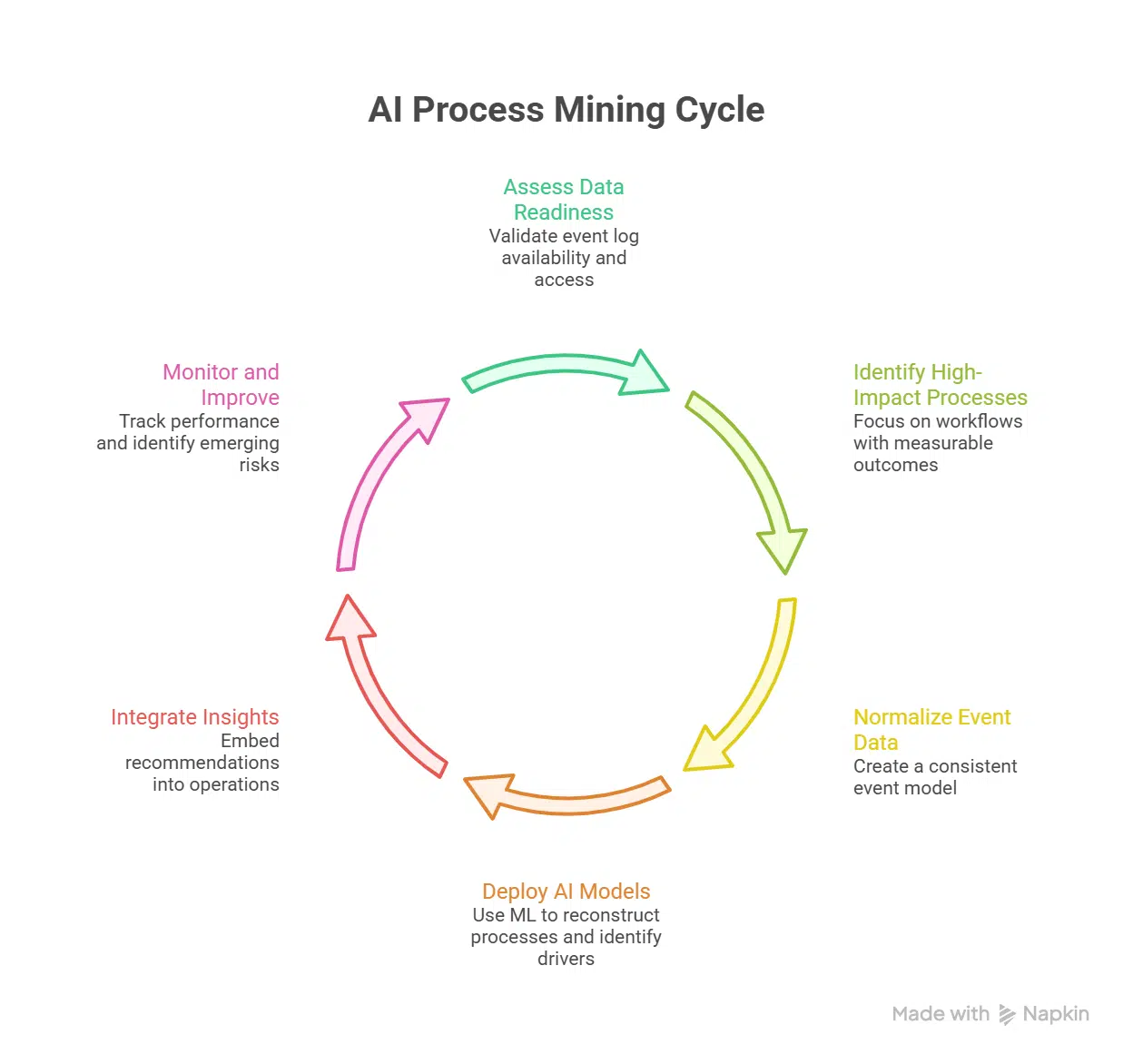
Successful implementation of AI process mining requires more than deploying a process mining tool. Enterprises that achieve sustained value treat AI process mining as a data and execution initiative. Here’s how your organization can do it:
Step 1: Assess data readiness and system access
Validate event log availability, timestamps, and identifiers across ERP, CRM, workflow, and operational platforms.
Step 2. Identify high-impact processes first
Focus on workflows with measurable financial, operational, or compliance outcomes not ‘easy’ processes.
Step 3. Normalize and unify event data
Create a consistent event model across systems to ensure accurate correlation and object-centric views.
Step 4. Deploy AI models and validate insights
Use ML to reconstruct processes, identify drivers, and test predictive accuracy against real outcomes.
Step 5. Integrate insights into operations
Embed recommendations into dashboards, alerts, workflows, or automation pipelines, so insights drive action.
Step 6. Establish continuous monitoring and improvement
Track drift, performance, and emerging risks as processes evolve. Continuous monitoring can help identify issues on the go and allow improvements without shutting down systems or slowing them down.
Also Read: Enterprise AI Roadmap: The Complete 2026 Guide
RTS Labs supports enterprises across data engineering, system integration, AI modeling, and production deployment to make sure process mining insights are actionable, scalable, and embedded into real operations rather than isolated dashboards.
Why Process Mining Projects Fail And How to Avoid It
Process mining initiatives rarely fail because the idea is wrong. Enterprises underestimate what it takes to move from process insight to process impact; that’s what causes the fall. Below are the most common failure patterns and how organizations avoid them when they take an execution-first approach with RTS Labs.
Poor Data Quality and Incomplete Event Logs
Most process mining efforts start with the assumption that event data is ‘good enough.’ In reality, enterprise logs are fragmented across ERPs, CRMs, workflow tools, spreadsheets, and manual handoffs. Timestamps are inconsistent, activities are missing, and key process steps happen outside systems altogether.
Business impact:
When data quality is poor, process maps become misleading. Bottlenecks appear where none exist, root causes are misdiagnosed, and leaders lose trust in the insights, often abandoning the initiative altogether.
How to avoid it:
RTS Labs begins with data engineering. Teams normalize event data across systems, resolve activity gaps, align timestamps, and establish lineage before any AI models are applied. Process insights reflect how work actually happens.
Tool-First Adoption Instead of Outcome-First Strategy
Many organizations buy a process mining platform before defining what decisions it should support. The result is impressive visualizations with no clear link to cost reduction, cycle time improvement, or automation readiness.
Business impact:
Process mining becomes a reporting exercise rather than a transformation lever. Insights are interesting but not actionable, and leadership struggles to justify continued investment.
How to avoid it:
We anchor process mining to business questions first. For example, “Why are invoices delayed?” or “Where does rework drive cost overruns?” AI models and tooling are then selected and configured to answer those questions directly, ensuring insights are tied to measurable outcomes.
Limited Stakeholder Buy-In Beyond Analytics Teams
Process mining initiatives often live inside centers of excellence or analytics teams, disconnected from process owners, operations leaders, and frontline managers.
Business impact:
Insights fail to translate into change. Recommendations stall, process owners resist findings, and improvement initiatives never leave PowerPoint.
How to avoid it:
We embed process mining into cross-functional operating models. Business leaders, operations teams, and IT stakeholders are involved early, ensuring insights align with real constraints, ownership is clear, and change is supported rather than resisted.
Inability to Scale Beyond Pilot Projects
Many organizations succeed with one process, such as procure-to-pay, but fail to expand process mining across functions, regions, or end-to-end workflows.
Business impact:
Value plateaus quickly. Each new process feels like starting from scratch, and process mining remains a niche capability instead of an enterprise asset.
How to avoid it:
We design scalable architectures from day one, using unified data pipelines, reusable models, and object-centric approaches that span multiple processes. This allows enterprises to extend insights across order-to-cash, supply chain, finance, and operations without rebuilding foundations.
Insights That Never Reach Operational Workflows
Even when insights are accurate, many process mining programs stop at analysis. Teams review findings periodically but never integrate them into daily decision-making or automation systems.
Business impact:
Processes revert to old behaviors. Bottlenecks reappear, automation opportunities are missed, and continuous improvement stalls.
How to avoid it:
We connect process mining outputs directly into workflows, feeding insights into automation queues, alerting systems, decision engines, and transformation roadmaps. Finally, the loop between insight, action, and measurable improvement closes.
Here’s a tabular representation of how we help our partners overcome challenges to bring a favorable business impact:
| Failure Reason | Business Impact | How to Avoid It |
|---|---|---|
| Poor data quality | Inaccurate process views and mistrust | Invest in data pipelines, validation, and governance |
| Tool-first adoption | Dashboards without decisions | Start with outcomes and execution use cases |
| Limited stakeholder buy-in | Insights ignored by operations | Align business owners early and define accountability |
| Pilot-only deployments | No enterprise-scale ROI | Design for scale from day one |
| Insights not operationalized | No measurable improvement | Embed insights into workflows and automation |
Top 5 Process Mining AI Tools and Platforms in 2026
Most enterprises evaluating process mining AI quickly discover that tools alone rarely deliver outcomes. Platforms provide visibility; execution partners make that visibility actionable. Below is a concise view of the leading approaches enterprises consider in 2026.
1. RTS Labs
RTS Labs approaches process mining AI as an operational transformation discipline. Rather than deploying a pre-packaged platform and stopping at dashboards, we design AI-powered process mining as part of the enterprise execution layer, deeply integrated with data pipelines, business rules, automation systems, and governance frameworks.
The differentiator lies in what happens after the process is discovered. RTS Labs focuses on translating process intelligence into production workflows, automation triggers, and decision systems that actively change how work is executed.
RTS Labs embeds the insights directly into:
- Automation pipelines: triggering actions when high-risk patterns emerge,
- Operational decision systems: prioritizing cases, approvals, or exceptions,
- Transformation roadmaps: sequencing automation and redesign based on real process friction, not assumptions.
This closes the loop between process visibility → decision → execution, enabling continuous improvement rather than one-time analysis.
Case Study: AI Process Mining in Legal Operations
In its work on AI-driven legal transformation, RTS Labs applied process intelligence techniques to redesign how complex legal work flowed across systems, teams, and approval layers. By analyzing event data across document handling, case workflows, and review cycles, we identified where rework, manual intervention, and approval bottlenecks were driving delays and cost escalation.
We then operationalized those insights, informing workflow redesign, automation prioritization, and AI-assisted decision-making. The result was faster turnaround times, reduced manual effort, and a fundamentally more scalable operating model for legal work, demonstrating how process mining AI becomes a catalyst for structural change when paired with execution.
Where RTS Labs Is Best Suited
RTS Labs is the strongest fit for organizations that:
- Need customized process mining across fragmented, legacy-heavy environments
- Want insights embedded into live workflows, not isolated analytics tools
- Preparing for automation, AI decisioning, or large-scale transformation
- Require governance, security, and compliance-by-design
- Expect measurable operational outcomes, not just visibility
This includes enterprises in finance, legal, insurance, supply chain, construction, and regulated industries, where processes are long-running, cross-functional, and resistant to off-the-shelf templates.
2. Celonis

Celonis is widely used for large-scale process discovery and visualization across ERP-centric workflows. It is best suited for organizations looking for out-of-the-box process mining capabilities with strong analytics and predefined connectors, particularly in finance and supply chain contexts.
Celonis is best suited for:
Celonis excels as a self-service process intelligence platform.
3. UiPath Process Mining
UiPath combines task mining and process mining to support automation programs. It works well for teams already invested in RPA ecosystems and looking to identify automation candidates, though execution beyond automation insights often requires additional integration effort.
UiPath is best suited for:
UiPath is best suited for organizations with an existing RPA footprint that want to extend task automation into basic process discovery.
4. Mimica.ai

Mimica.ai focuses on task-level discovery using desktop and user activity data. It is best suited for identifying repetitive human tasks and feeding automation pipelines, but is less effective for cross-system, end-to-end process intelligence.
Mimica.ai is best suited for:
Mimica.ai is best suited for early-stage process discovery where organizations lack reliable system logs or formal documentation.
5. Skan AI

Skan AI emphasizes task intelligence and real-time visibility into operational execution. It is useful in environments where understanding human-in-the-loop work is critical, though enterprises often need complementary capabilities for predictive and prescriptive insights.
Skan AI is best suited for:
Skan AI is best suited for operational teams that need real-time visibility into how work is actually performed.
Build vs Buy: Which Process Mining AI Approach Is Right?
Selecting the right approach for process mining AI depends less on tools and more on scale, complexity, and how far you intend to take process intelligence into execution. Here are a few parameters that can come in handy:
1. Speed to Value
Buying a platform delivers faster initial visibility, making it useful for quickly understanding how a small set of processes behaves. Platforms like RTS Labs may require a slightly longer setup, but it delivers faster operational impact by embedding insights directly into workflows and decisions.
2. Customization and Business Alignment
Off-the-shelf platforms operate within predefined models and assumptions, limiting how closely insights align with your business logic. Platforms must design process mining AI around your KPIs, policies, and operating model so that insights drive the outcomes leadership actually cares about.
3. Integration Depth
Platforms rely on standard connectors, which work well for clean, homogeneous environments. An AI processing mining platform must engineer deep, system-specific integrations critical for enterprises with fragmented or legacy-heavy stacks.
4. Scalability Across the Enterprise
Most platforms scale process by process, requiring separate efforts for each workflow. Platforms must build cross-process, enterprise-wide process intelligence so that insights span departments, regions, and end-to-end value streams.
5. Long-Term Cost and ROI
Platform costs accumulate through licenses, modules, and add-ons as usage grows. Your platform must have sustained ROI, optimizing architecture, automation priorities, and operating costs as process mining expands.
When Buying a Platform Makes Sense
Buying is effective for organizations seeking rapid visibility into a limited number of standardized processes, particularly during early automation discovery or diagnostic phases.
When Building With RTS Labs Is the Better Option
Building is the right choice for enterprises with complex workflows, multiple interconnected systems, and a requirement to embed process insights into live operations, automation, and decision-making.
A Practical Hybrid Approach
Many organizations adopt a hybrid model where they use platforms for discovery and diagnostics, then partner with platforms like RTS Labs to operationalize insights, scale intelligently, and turn process intelligence into measurable business outcomes.
Turn Process Insights Into Measurable Outcomes With RTS Labs
AI-powered process mining delivers value only when insights lead to action. RTS Labs supports enterprises across the full lifecycle: data readiness, AI-driven process discovery, predictive modeling, integration into workflows, and continuous optimization.
With us, process mining becomes a living operational capability rather than a one-time analysis.
If your organization is exploring process mining AI but struggling to translate insights into measurable outcomes, RTS Labs can help bridge that gap. Talk to an Ai Expert Today!
Frequently Asked Questions
1. What makes process mining AI different from traditional process mining?
Traditional process mining focuses on visualizing workflows, while process mining AI adds machine learning and predictive models to explain root causes, forecast outcomes, and recommend actions, making insights operational rather than descriptive.
2. Which enterprise processes benefit most from process mining AI?
Processes with high volume, cross-system complexity, and frequent exceptions, such as order-to-cash, procure-to-pay, claims processing, and supply chain operations, see the strongest ROI from AI-driven process mining.
3. How does process mining AI support automation initiatives?
Process mining AI identifies where automation will deliver the highest impact, highlights process variation, and provides data-backed prioritization, reducing the risk of automating inefficient or unstable workflows.
4. What data is required to implement process mining AI?
Most implementations rely on event logs from systems like ERP, CRM, workflow tools, and operational platforms. Success depends on data quality, consistency, and the ability to correlate events across systems.
5. Should enterprises buy a process mining tool or partner with experts?
Tools are effective for initial visibility, but enterprises often partner with implementation specialists when they need customization, deep system integration, and the ability to embed insights into live operations.