

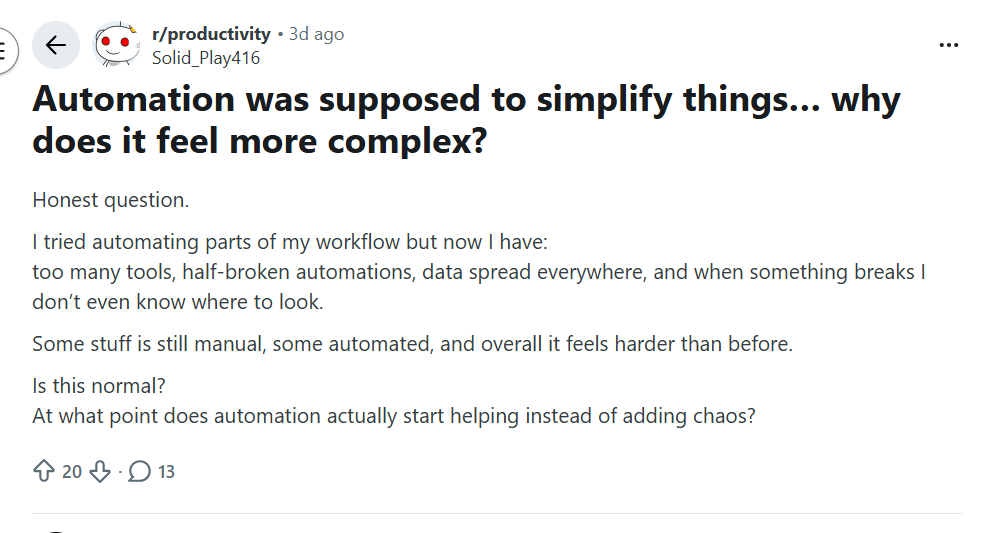
In a Reddit conversation, a user talked about how their attempts to automate workflow resulted in more complex, broken processes. They asked a question, ‘At what point does automation actually start helping instead of adding chaos?’ 98% of enterprises (Stonebranch) that are expanding their automation initiatives are seeking an answer to the same.
Most enterprises today are already ‘automating.’ Bots process invoices, scripts move data between systems, and isolated AI models assist specific teams. Yet despite this activity, automation ROI remains elusive for many organizations.
The root problem isn’t technology maturity. Intelligent automation fails when organizations treat RPA, AI models, and workflows as separate initiatives. Without shared data foundations, orchestration, and governance, enterprise automation programs accumulate technical debt, compliance risk, and stalled ROI.
An intelligent automation strategy aligns automation with business outcomes, integrates AI-driven decisioning into workflows, and establishes the governance and operating model required to scale automation across the enterprise.
This article explains how enterprises move beyond disconnected automation initiatives and design an operating model where AI, automation, data, and governance work together to deliver measurable business results.
What Is an Intelligent Automation Strategy?
An intelligent automation strategy is a business-aligned approach that combines automation technologies, AI-driven decision-making, data foundations, and governance into a single, coordinated operating model designed to scale across the enterprise.
Task-level automation or tool-led RPA programs automate isolated processes. Intelligent automation is designed to improve end-to-end processes.
An intelligent automation strategy integrates four elements:
- Process automation to execute repetitive work reliably
- AI and machine learning to enable prediction, classification, and decision-making
- Data foundations to make sure automation is driven by trusted, governed enterprise data
- An operating model that defines ownership, metrics, risk controls, and scalability
| Element | What It Does | Why It Matters |
|---|---|---|
| Process Automation | Executes repetitive, rules-driven work reliably across systems and teams | Turns automated decisions into consistent, real-world outcomes |
| AI & Machine Learning | Enables prediction, classification, and decision-making within workflows | Handles variability and exceptions that rules-based automation cannot |
| Data Foundations | Provides trusted, governed enterprise data with lineage and quality controls | Prevents model drift, accuracy loss, and erosion of trust over time |
| Operating Model | Defines ownership, metrics, risk controls, and lifecycle management | Determines whether automation scales safely or stalls as pilots |
The goal is sustained, compounding efficiency as processes adapt, learn, and improve. When designed correctly, intelligent automation becomes a system capability.
This is what separates intelligent automation:
- It is not scripted task automation that executes predefined logic faster, but cannot adapt.
- It is not tool-centric RPA deployments that optimize individual steps while leaving end-to-end workflows fragmented.
- And it is not one-off AI experiments that generate insights but never reach production because governance, ownership, or integration were never addressed.
That distinction matters because automation that delivers short-term wins is not the same as intelligent automation that reshapes how an enterprise operates over the long term.
Core Components of an Intelligent Automation Strategy
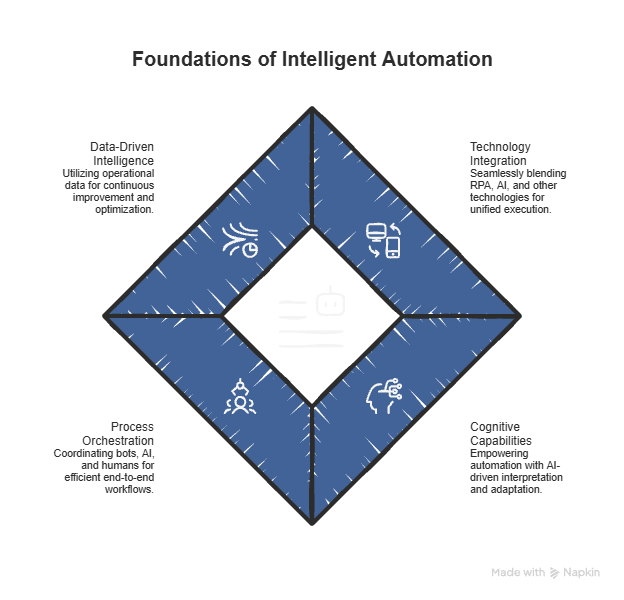
Intelligent automation only works when multiple components evolve together. Enterprises that focus on one while neglecting the others struggle to scale.
Technology Integration
An effective strategy integrates RPA, workflow automation, AI/ML, NLP, and computer vision into a unified execution layer. This allows automation to operate across structured and unstructured data and adapt to changing conditions.
Cognitive Capabilities
AI enables automation to move beyond rules. Systems can interpret intent, learn from historical patterns, and adapt to changing conditions. They can support use cases like anomaly detection, prioritization, and predictive intervention.
Process Orchestration
Orchestration coordinates bots, AI models, systems, and humans into governed end-to-end workflows. Without orchestration, automation becomes brittle and fragmented. With it, enterprises gain visibility, control, and the ability to adapt workflows as conditions change.
Data-Driven Intelligence
Operational data fuels continuous improvement. Intelligent automation strategies use data to monitor performance, detect process drift, and identify new optimization opportunities for automation that improves over time.
Why Traditional Automation Approaches Fail Without Strategy
Most automation programs fail because automation is treated as a technology rollout instead of an operating model change.
Localized Efficiency Gains
According to McKinsey’s Driving Impact At Scale From Automation and AI report, the majority of organizations that invest in automation achieve localized efficiency gains, but only a small fraction successfully scale automation to enterprise-wide impact.
When automation is layered on top of fragmented processes, it increases operational complexity instead of reducing it. Common enterprise failure patterns include:
- Tool-led automation decisions made in silos,
- AI models deployed without integration into live workflows,
- Bots operating independently with no orchestration or monitoring,
- No feedback loops to detect performance decay or process drift, and
- Lack of executive ownership tied to measurable KPIs
Without a strategy, automation becomes brittle. Each new bot or model adds maintenance overhead, security risk, and technical debt. Without a good automation strategy in place, trust starts to erode and teams revert to manual work.
TL;DR: Intelligent Automation Strategy
- Intelligent automation aligns process automation, AI, data foundations, and governance to improve end-to-end workflows.
- Automation only sustains when AI, bots, systems, and humans are orchestrated on trusted enterprise data with clear ownership and metrics.
- Without a defined operating model, automation delivers short-term efficiency but accumulates technical debt, risk, and stalled adoption over time.
Intelligent Automation vs. RPA: What’s the Real Difference?
Robotic Process Automation (RPA) is often the starting point for enterprise automation, but it is not the destination.
RPA excels at executing deterministic, rules-based tasks such as data entry, file movement, or system synchronization. However, RPA alone struggles when processes involve judgment, variability, or frequent exceptions.
Intelligent automation expands beyond task execution by embedding cognition and orchestration into workflows. Instead of asking ‘What task can a bot perform?’, it asks ‘How should this process behave end-to-end, given data, context, and business rules?’
In practice:
- RPA executes steps
- Intelligent automation decides, adapts, and optimizes
Leading enterprises now position RPA as a component within a broader intelligent automation strategy, supported by AI, shared data foundations, orchestration, and governance. Without that shift, RPA programs plateau quickly.
Core Pillars of an Effective Intelligent Automation Strategy
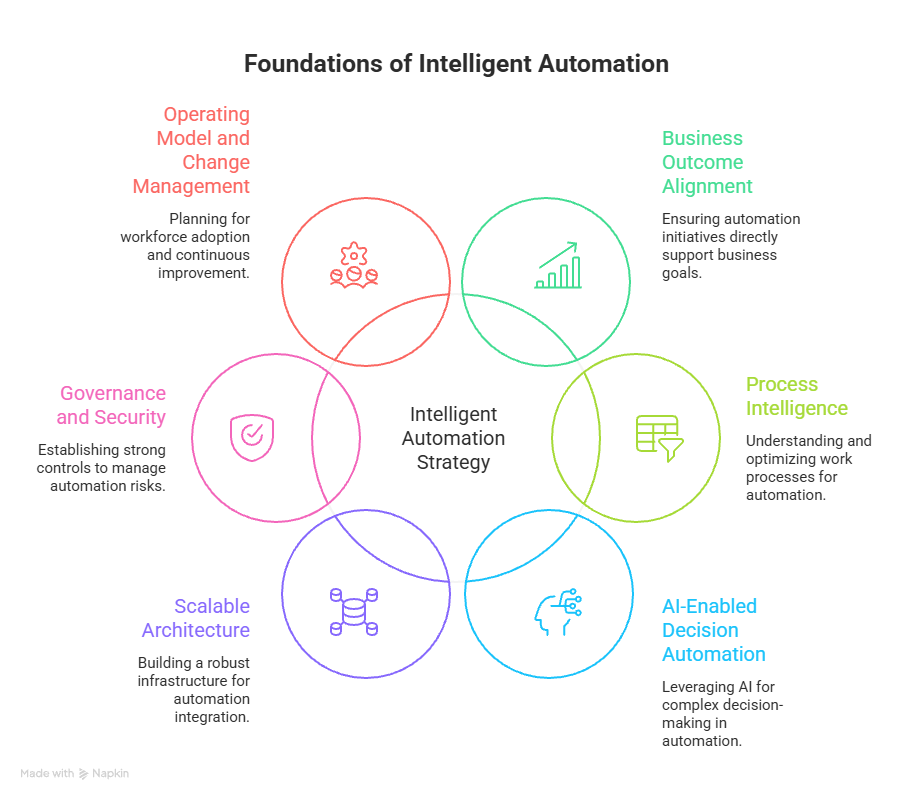
Enterprises that scale intelligent automation consistently build around a small set of strategic pillars, each reinforcing the others. Here are the core pillars of an effective automation strategy.
#1 Business Outcome Alignment
Automation initiatives must be explicitly tied to business metrics such as cost-to-serve, cycle time reduction, revenue protection, or risk mitigation. Programs aligned to operational KPIs are significantly more likely to scale and sustain executive sponsorship.
#2 Process Intelligence and Prioritization
High-performing organizations invest in understanding how work actually flows, not how it is documented. This enables them to prioritize automation opportunities that remove structural bottlenecks rather than surface-level inefficiencies.
#3 AI-Enabled Decision Automation
Machine learning, optimization models, and AI-driven rules allow automation to handle variability, exceptions, and prediction enabling use cases that static rules cannot support.
#4 Scalable Architecture and Integration
Automation must operate across ERP, CRM, finance, operations, and data platforms. Without a scalable integration layer, automation remains localized and fragile.
#5 Governance, Security, and Compliance
As automation expands, so does risk. Governance maturity is a prerequisite for enterprise-scale automation, especially in regulated environments.
#6 Operating Model and Change Management
Automation changes how work gets done. Enterprises that plan for workforce adoption, ownership, and continuous improvement outperform those that treat automation as an IT-only initiative. This is the most overlooked pillar.
How to Build an Intelligent Automation Strategy: Step-by-Step Guide
An effective intelligent automation strategy follows a sequenced execution path. Enterprises that attempt to automate everything at once typically stall more than those that phase intelligently and compound results.
Step 1: Identify High-Impact Automation Opportunities
Start with processes that are high-volume, cross-system, and exception-heavy. These are where AI-enabled decisioning and orchestration create outsized returns.
Step 2: Assess Data, AI, and Integration Readiness
Automation fails when data quality, system access, or ownership is unclear. Readiness assessments surface constraints early before bots and models are deployed.
Step 3: Prioritize by ROI and Scalability
Use cases should be ranked not only by immediate savings, but by their ability to scale across functions and regions without exponential complexity.
Step 4: Design Orchestration and Architecture
This is where many programs break. Orchestration ensures bots, AI models, systems, and humans work as one end-to-end flow rather than disconnected components.
Step 5: Deploy, Monitor, and Iterate
Automation is not a ‘set and forget’ process. Continuous monitoring, learning loops, and governance keep outcomes stable as conditions change.
TL;DR: Intelligent Automation vs. RPA
- RPA handles deterministic steps, while intelligent automation adds AI, orchestration, and governance to manage end-to-end workflows under changing conditions.
- Without AI-driven decision-making, shared data foundations, and orchestration, RPA programs fragment, plateau, and become costly to maintain.
- Enterprises that align automation to business outcomes, scalable architecture, and operating models achieve compounding ROI.
High-Impact Use Cases Enabled by Intelligent Automation
At enterprise scale, intelligent automation delivers the strongest ROI when it is applied to core operational workflows. These are the areas where decisions are frequent, data-rich, and tightly coupled to execution.
Independent research consistently shows that automation succeeds when it reshapes how work flows. This is why certain use cases emerge repeatedly across industries as high-impact candidates for intelligent automation.
#1 Finance
In finance operations, intelligent automation transforms processes that were historically slow, exception-heavy, and dependent on manual judgment. Invoice-to-pay workflows, reconciliations, and financial close processes benefit when AI classifies exceptions, predicts delays, and automates routing.
Also Read: AI in ERP Systems: Benefits, Challenges, and Integration Strategies
Organizations reduce rework, minimize errors, and improve audit readiness by embedding AI decisions into live financial workflows. Finance teams implementing AI-driven automation see material reductions in cycle times and exception handling overhead.
#2 Operations and Supply Chain
Operations and supply chain environments are uniquely suited to intelligent automation because they operate at the intersection of prediction and execution. Demand forecasting, inventory optimization, and logistics coordination all benefit from AI-driven automation that connects planning signals to execution triggers.
When demand signals automatically trigger inventory updates, supplier actions, and logistics adjustments, enterprises move from reactive to adaptive operations. This tight coupling between insight and action is where intelligent automation delivers the strongest operational returns.
Supply Chain Automation Guide 2026: Benefits, Use Cases & Implementation
#3 Customer Operations
Customer service is one of the most visible proving grounds for intelligent automation. Ticket triage, routing, and escalation workflows benefit when AI continuously evaluates intent, urgency, and historical patterns to decide how issues are handled.
The most successful implementations embed AI decisioning directly into CRM and service platforms. Instead of recommending next steps, AI systems assign ownership, trigger workflows, and escalate issues based on learned thresholds.
Industry benchmarks consistently show that customer operations automation delivers outsized returns when decision logic and execution are unified.
Insurance and Risk-Heavy Functions
In insurance and other risk-intensive domains, intelligent automation must balance speed with control. Claims intake, compliance validation, and fraud detection benefit when AI automates early-stage decisions while escalating edge cases to human reviewers.
Here, governance is not optional. AI models must operate within defined thresholds, escalate edge cases appropriately, and log decisions for regulatory review. Governed automation outperforms ad-hoc automation in regulated environments.
AI Agents for Insurance: Streamline Claims, Underwriting & Compliance
RTS Labs typically supports these use cases by designing intelligent automation that connects AI decisions directly into live enterprise systems. The goal is to embed intelligence where decisions are made, not layer dashboards on top of broken processes.
Governance, Risk, and Change Management in Intelligent Automation
As automation becomes more intelligent, risk increases alongside value. Enterprises that ignore governance early often slow down later under compliance pressure.
Key governance requirements include:
- Explainability for AI-driven decisions
- Auditability across automated workflows
- Role-based access and security controls
- Performance monitoring and drift detection
Change management is equally critical. Automation alters decision rights, workflows, and accountability. Without enablement, AI insights remain unused, even if technically sound.
RTS Labs embeds governance and change management as part of how work is redesigned. Automation initiatives explicitly address how roles evolve, where decision authority shifts, and how humans interact with AI systems in daily operations.
RTS Labs makes sure teams are trained not just on how systems work, but on when to trust them, when to intervene, and how feedback improves outcomes over time. Enterprise can align incentives, ownership, and enablement to automation performance.
Common Mistakes That Derail Intelligent Automation Strategies
Even the most well-funded intelligent automation programs fail for remarkably similar reasons. Projects fail because the strategy behind them is misaligned with how intelligent automation actually creates value.
These failures are often predictable and preventable.
Starting in The Wrong Place
Many organizations begin by automating low-impact, low-risk tasks to prove value quickly.
On paper, this seems sensible. In practice, it produces misleading signals. Automating trivial tasks may demonstrate technical feasibility, but it rarely demonstrates business relevance. Programs optimized for easy wins often struggle to gain executive sponsorship for high-impact, complex use cases later.
Absence of Orchestration
Intelligent automation is the coordination of humans, AI systems, and automated workflows across end-to-end processes. Yet many enterprises deploy these components in isolation. Bots operate independently, AI models generate insights that are never consumed, and workflow tools run without feedback from execution systems.
Treating AI as a One-Time Deployment
Organizations that fail to plan for continuous monitoring, retraining, and optimization see performance degrade quietly over time. Organizations without active lifecycle management experience material degradation within 12 to 18 months.
Onus and Ownership
AI programs with unclear ownership are significantly less likely to transition from pilot to production, regardless of technical success.
Without clear accountability, decisions about optimization, expansion, and risk mitigation stall. Finally, many strategies fail because they lack a feedback loop.
Lack of Closed-Loop Learning
Intelligent automation systems are only as good as their ability to learn from outcomes. When decisions are automated without mechanisms to capture results, measure impact, and refine logic, performance degrades predictably.
Successful strategies prioritize high-impact processes, design orchestration deliberately, treat AI as a lifecycle, assign clear ownership, and embed continuous learning from the start.
TL;DR: Scaling Intelligent Automation
- Intelligent automation delivers the highest ROI when embedded into finance, operations, customer service, and risk-heavy functions where decisions are frequent, data-rich, and tightly coupled to execution.
- Explainability, auditability, and drift monitoring must evolve alongside change management, ownership, and workforce enablement to ensure AI is trusted and used in daily operations.
- Programs stall when they optimize for low-impact wins, lack orchestration, treat AI as a one-time deployment, or fail to establish clear ownership and closed-loop learning.
How RTS Labs Helps Build and Execute Intelligent Automation Strategies
RTS Labs helps enterprises design and execute intelligent automation strategies that are outcome-driven, production-ready, and built to scale.
Our approach starts with automation opportunity discovery. We use data and process signals to identify where intelligent automation will deliver the fastest measurable ROI. Instead of automating everything, we focus on the workflows that move business outcomes.
From there, RTS Labs focuses on AI-enabled process intelligence, connecting automation to real operational data so workflows can adapt, learn, and improve over time. Our solutions include deep system integration, governance, and monitoring, because intelligent automation must operate safely at enterprise scale.
Finally, we design for production from day one. Our teams implement enterprise-grade deployment practices, governance, and monitoring so automation initiatives remain secure, compliant, and sustainable as they scale.
The result is intelligent automation programs that move beyond pilots, deliver consistent ROI, and become part of the enterprise operating model. Let’s build the future together. Talk to an AI Expert to start your intelligent automation journey!
Frequently Asked Questions
1. What is the difference between intelligent automation and RPA?
RPA focuses on task-level, rules-based automation. Intelligent automation combines RPA with AI, data, orchestration, and governance to automate end-to-end workflows and decisions.
2. Why do intelligent automation initiatives fail to scale?
Most fail due to tool-first thinking, lack of orchestration, weak data foundations, and no ownership for outcomes. Without strategy and governance, automation remains fragmented.
3. When should an enterprise move from RPA to intelligent automation?
When automation needs to handle variability, decisions, or scale across departments where AI-driven predictions or optimization are required, it is best to move from RPA to intelligent automation.
4. How long does it take to see ROI from intelligent automation?
High-impact use cases often show ROI within 3–6 months when automation is prioritized based on business impact and implemented with production discipline.
5. Do intelligent automation strategies require replacing existing tools?
No. Intelligent automation builds on existing systems and tools. The focus is orchestration and intelligence, not wholesale replacement.