
A Reddit chat on automation failures had people discussing how enterprises automate everything and anything, while leaving the bottlenecks untouched.

Automation has moved from an innovation agenda item to a board-level performance lever. Yet, many enterprises struggle to quickly determine where automation will deliver a measurable ROI.
Process owners see inefficiencies everywhere. But few can confidently say which workflows are truly automation-ready, which will scale, and which will quietly absorb budget without payoff. Long discovery cycles and over-analysis often delay action until momentum fades.
What’s needed is a faster, evidence-based way to surface automation opportunities that matter before automation becomes another stalled transformation initiative.
Only those organizations that can identify high-impact automation opportunities rapidly, using operational data and clear prioritization, can pull ahead quickly. This article discusses how enterprises can identify automation enterprises quickly.
What Does an Automation Opportunity Mean?
An automation opportunity is a workflow where automation produces a clear, measurable improvement in cost, speed, accuracy, or scalability within a reasonable timeframe.
It involves much more than automating a task. The distinction matters because many organizations waste time automating activities that are technically feasible but strategically insignificant.
In practice, true automation opportunities tend to emerge where
- Work is repeatable, rules-driven, and volume-based
- Manual effort creates friction that compounds as the business scales
These are processes where humans are acting as connectors between systems, re-entering data, validating predictable conditions, or reacting to the same exceptions repeatedly. Automating such work does not remove judgment. Rather, it removes unnecessary labor around judgment.
Equally important is understanding what does not qualify:
- One-off workflows
- Low-frequency edge cases
- Tasks that rely heavily on nuanced human decision-making
Attempting to automate these too early often leads to over-engineered solutions that stall adoption.
Mature automation programs differentiate between task-level automation, where isolated actions are performed, process-level automation comprising end-to-end workflow execution, and decision automation driven by AI-driven recommendations or actions. The fastest wins usually come from process-level opportunities that already exhibit strong operational signals that can be identified quickly when teams know what to look for.
Why Identifying Automation Opportunities Is Harder Than It Sounds
On the surface, automation opportunities seem obvious. Teams know where work feels slow, manual, or frustrating. The challenge is that intuition rarely matches reality at scale. Here are a few obstacles enterprises have to clear for automation to kick in successfully.
Undocumented Processes
In most enterprises, processes are undocumented, partially automated, or have evolved informally over the years and span across ERPs, CRMs, spreadsheets, email, and custom tools. What looks like a single workflow is often dozens of hidden handoffs and exceptions.
Obsolete Traditional Discovery Methods
Long audits and workshop-heavy process mapping rely on stakeholder recollection, not operational evidence. By the time documentation is complete, the business has already changed. This leads to two common outcomes: either organizations over-automate low-impact tasks because they’re easiest to describe, or they stall entirely due to analysis paralysis.
Data Fragmentation
The information needed to judge automation value, such as true cycle time, rework rates, exception frequency, and manual effort, is scattered across systems and rarely analyzed together. Without visibility into where time and cost actually accumulate, teams struggle to rank opportunities objectively.
Preference For Tools Instead of Workflows
When automation is driven by platform capability rather than process signal, effort shifts toward fitting work into tools rather than solving the most expensive problems. The result is pilots that technically work but fail to scale or deliver ROI.
Leading teams shift to fast, signal-based identification by using operational data to surface automation candidates that are both feasible and high impact.
How to Identify Automation Opportunities Quickly: A Practical Framework
Speed matters because automation value decays when discovery drags on. High-performing teams start with a signal-first framework that surfaces candidates based on operational evidence and business impact. The goal is to narrow the field fast from dozens of ‘maybe’ ideas to a short list of automation-ready opportunities in days.
Here’s a step-by-step process on how that’s achievable:
Step 1: Process Signal Scanning
Begin by scanning for hard signals that correlate with automation payoff.
Consider:
- High transaction volumes
- Repeated handoffs
- Frequent delays
- Rework loops
- Error corrections
- SLA breaches
- Heavy spreadsheet use between systems
Signals come from logs, tickets, timestamps, queue backlogs, and exception reports, i.e., data the business already has but rarely connects. This step replaces interviews with evidence.
Step 2: Impact Scoring
Next, score each candidate on outcomes, such as time saved, cost reduced, risk eliminated, revenue protected, or scale enabled, which executives care about. Keep it simple. If automating a step won’t materially move a KPI in weeks or a quarter, it’s not a priority. This prevents teams from automating ‘busy work’ instead of bottlenecks.
Step 3: Feasibility Check
Validate feasibility quickly. As a few questions:
- Is the data accessible?
- Are rules mostly deterministic or learnable?
- Can it integrate with existing systems?
This is a triage, not an architecture review. The aim is to eliminate blockers early without over-engineering.
Step 4: Quick ROI Estimation
Estimate effort versus payoff in practical terms, i.e., weeks to value, and not years. Rough math is enough. Focus on these simple calculations:
- Hours saved × volume
- Reduced rework × cost
- Avoided delays × revenue at risk
Opportunities that show payback within one or two quarters move forward.
This framework aligns evidence → impact → feasibility → ROI in a single pass to work well. RTS Labs applies this exact approach to help teams move from scattered ideas to a prioritized automation roadmap. Then carries the same rigor straight into implementation, such that the momentum isn’t lost.
High-Signal Indicators to Check If a Process Is Ready for Automation
Once teams adopt a rapid identification framework, the next question is where to look first. In practice, the fastest automation wins consistently show up in processes that broadcast clear operational signals.
These signals are visible in data, metrics, and day-to-day pain, often long before anyone labels the work as a candidate for automation. Note a few prominent ones:
High Manual Effort Per Transaction
When employees spend disproportionate time copying data between systems, validating entries, or following repetitive checklists, automation can immediately compress cycle time and free capacity. These tasks are usually well-defined, rule-based, and high volume. They are ideal conditions for automation.
Rework and Error Correction
Processes that require frequent fixes, approvals, or back-and-forth emails are leaking value. Errors not only consume labor but also create downstream delays, customer dissatisfaction, and compliance risk. Automation reduces this drag by enforcing consistency and eliminating avoidable mistakes at the source.
Backlogs and SLA breaches
When queues build up during demand spikes or deadlines are routinely missed, it’s often because manual steps cannot scale. Automation absorbs variability by handling volume fluctuations without adding headcount or overtime.
Heavy Spreadsheet Usage Between Systems
Spreadsheets are usually a workaround for missing integrations or visibility gaps. Where spreadsheets exist, automation potential almost always follows, either through system integration, workflow automation, or AI-driven decision support.
Predictable Rules and Recurring Decisions
Finally, processes with predictable rules and recurring decisions, especially those tied to seasonal or demand-driven spikes, tend to deliver the fastest ROI. These are the workflows where automation stabilizes operations when pressure is highest.
We use these signals to rapidly surface automation candidates across finance, operations, supply chain, and customer workflows, turning operational pain points into a prioritized, ROI-driven automation roadmap instead of a long list of guesses.
| Common Operational Obstacle | High-Signal Indicator of Automation Opportunity |
|---|---|
| Heavy manual effort across teams | High transaction volume handled through spreadsheets, emails, or copy-paste workflows |
| Process delays and backlogs | SLAs are frequently missed, queues build during peak periods, or recurring bottlenecks |
| Frequent rework or errors | High correction rates, duplicate entries, or downstream fixes required |
| Fragmented systems | Data moving manually between ERP, CRM, finance, or ops tools |
| Inconsistent execution | Same task handled differently across teams, regions, or shifts |
| Poor visibility into performance | Lack of real-time metrics on cycle time, cost per task, or error rates |
| Seasonal workload spikes | Temporary hiring, overtime, or manual workarounds during demand surges |
| Rule-based decisions | Decisions consistently made using clear thresholds, checklists, or policies |
Processes That Usually Deliver the Fastest Automation Wins
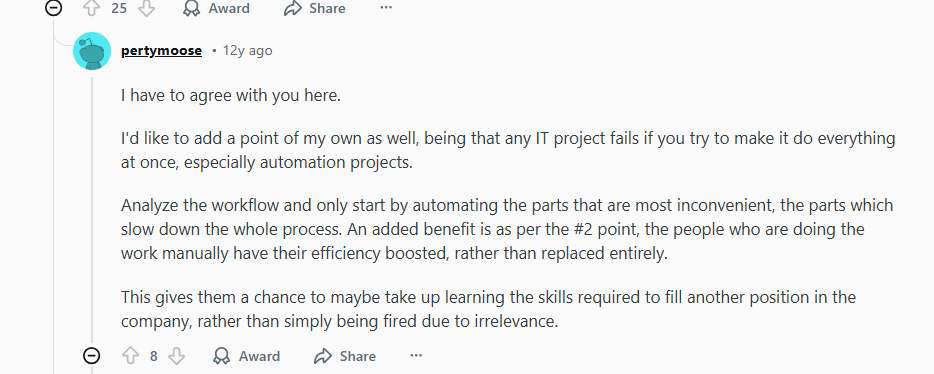
Reddit discussions regularly point out how enterprises try to make IT projects do everything at once, and consequently fail.
When speed matters, certain process categories consistently outperform others in terms of time-to-value. These are workflows where effort is high, variation is low, and outcomes are easy to measure.
A few processes ideal as starting points for automation initiatives include:
Finance Operations
These processes are often the fastest movers. Invoice processing, reconciliations, journal entries, and approvals typically involve repeatable steps across multiple systems. Automation here reduces manual handling, shortens close cycles, and improves accuracy, and other benefits that finance leaders can quantify within weeks.
Operations and Order Management
Here, automation frequently targets order intake, scheduling, and status updates. These processes span ERPs, CRMs, and fulfillment systems, creating friction when handled manually. Automating handoffs and validations eliminates delays and improves throughput without disrupting core systems.
Supply Chain Workflows
These workflows also surface early wins, particularly around inventory updates, demand signal ingestion, and exception handling. These processes run continuously and are sensitive to delays, making even small efficiency gains compound rapidly at scale.
Customer Operations
Customer operations deliver fast impact through automation of ticket triage, routing, and resolution workflows. When organizations automate the classification of requests and direct them to the right teams, they reduce response times and improve consistency and customer satisfaction.
Data and Reporting Processes
Finally, manual dashboard creation, recurring exports, and ad-hoc analysis are often overlooked but highly automatable. Automating these frees skilled teams to focus on insight and decision-making rather than data preparation.
How AI Accelerates Automation Opportunity Discovery
Traditional automation discovery relies on interviews, workshops, and manual process mapping. These methods are slow, subjective, and often miss where work actually happens. AI changes this by turning operational data into a discovery engine and allowing teams to surface high-impact opportunities in days instead of quarters.
Here’s how AI makes the automation opportunity discovery happen in real-time:
AI-driven Process Mining
It analyzes event logs from systems like ERPs, CRMs, ticketing tools, and finance platforms to reconstruct real execution paths. It goes beyond the idealized workflows documented in SOPs to expose hidden rework loops, approval delays, and exception paths that are prime candidates for automation.
Bain & Company notes that organizations using data-driven process discovery identify automation opportunities significantly faster than those relying on workshops alone, because they base decisions on observed behavior rather than assumptions.
Pattern Detection Across Large Datasets
Wider pattern detection helps teams move beyond intuition. AI models scan for signals such as high transaction volumes, long wait times, frequent corrections, and rule-based decisions. These indicators strongly correlated with automation readiness. AI-led process intelligence enables leaders to pinpoint ‘where value is leaking’ across complex operations and prioritize fixes with confidence.
AI-Assisted Process Mapping
AI process mapping further compresses timelines by automatically visualizing workflows across teams and geographies. Instead of weeks spent validating maps, leaders get a shared, data-backed view of how processes diverge and where standardization or automation will have the greatest impact.
Impact Modeling and Prioritization
AI is applied to estimate ROI early, and calculate parameters, such as simulating time saved, cost reduced, and risk mitigated, before any build begins. Organizations that pair AI discovery with ROI modeling are far more likely to move from identification to execution without stalling.
We apply these capabilities end-to-end, combining process signals, AI analysis, and engineering judgment to help teams rapidly identify which automation opportunities matter most and move straight into execution, not analysis paralysis.
Common Mistakes That Slow Down Automation Identification
Even organizations committed to automation often lose momentum during the identification phase. The momentum dies not because opportunities don’t exist, but because the approach introduces friction before value is visible. These missteps are subtle, but they compound quickly and delay results.
Not Understanding Workflows Before Implementation
Teams evaluate RPA or AI platforms before understanding how work actually flows across systems and people, leading to automating isolated tasks rather than end-to-end processes.
Prioritizing Low-Effort Tasks Over High-Impact Ones
While quick wins feel attractive, automating marginal activities rarely builds the business case needed for scale. Organizations that chase ‘easy automations’ first often stall because savings are too small to justify broader investment.
Ignoring Data Readiness
Data quality and system integration are prerequisites for successful automation programs. Automation opportunities may look promising on paper, but without clean, accessible data, feasibility collapses later, forcing rework or abandonment.
Over-Engineering Early Pilots
Here’s no need for spending months perfecting solutions before validating value. This slows learning and erodes stakeholder confidence. High-performing teams instead test assumptions quickly, using lightweight pilots informed by real process data.
Treating Automation as an IT-only initiative
This disconnects it from operational ownership. When business leaders aren’t accountable for outcomes, opportunities fail to convert into action.
How RTS Labs Helps Teams Identify Automation Opportunities Faster
For us, identifying automation opportunities quickly isn’t a workshop or a thing of intuition. It requires visibility into how work actually happens and the ability to translate that insight into executable decisions. Many organizational efforts stall or slow down here. We have designed programs to remove that friction.
- RTS Labs starts with rapid process discovery grounded in data.
- We then move to analyzing operational signals from systems like ERPs, CRMs, ticketing tools, and spreadsheets.
- We help teams surface where manual effort, delays, and rework are truly occurring to replace long audits with evidence-based prioritization.
- From there, opportunities are evaluated through an ROI-first lens.
We help quantify time saved, cost reduced, and risk eliminated before automation begins, ensuring teams focus on use cases that can deliver visible impact quickly. This avoids the common trap of automating ‘what’s easy’ instead of ‘what matters.’
A key differentiator is cross-system visibility. Many automation opportunities sit between tools, like handoffs, reconciliations, approvals, and exceptions. We specialize in identifying and designing automation across these boundaries, where value is often highest but hardest to see.
We combine identification and implementation under one partner. Once opportunities are prioritized, teams can move directly into execution using the same data foundations and architectural context, accelerating time from insight to live automation. We helped a sports manufacturing company switch from a patchwork architecture to lean prototypes with actual use cases.
Check how we transformed automation and AI opportunities for our other clients here.
Turning Automation Ambition Into Fast, Measurable Outcomes
Most organizations don’t struggle with wanting automation—they struggle with knowing where to start and what will pay off fastest. Lengthy audits, tool-first thinking, and intuition-led prioritization slow momentum and dilute ROI. As this article shows, the fastest path to impact comes from focusing on process signals, data-backed prioritization, and feasibility-driven decisions—not guesswork.
Identifying automation opportunities quickly requires a combination of process visibility, business context, and execution discipline. When teams can clearly see where manual effort, delays, and errors concentrate—and assess impact before building—they unlock faster wins and build confidence for larger transformation.
RTS Labs helps organizations do exactly that: move from ambiguity to action. By combining AI-driven process discovery, ROI-first prioritization, and end-to-end implementation, RTS Labs enables teams to identify, validate, and scale automation opportunities in weeks—not quarters.
If your organization is under pressure to deliver automation results quickly, RTS Labs can help you identify the right opportunities and turn them into production-grade outcomes—fast.
Start with an automation discovery or prioritization workshop to move from intent to execution. Talk to our AI Expert Now.
FAQs
1. What qualifies as a true automation opportunity?
A true automation opportunity is a repeatable process where automation can deliver measurable gains in cost, speed, accuracy, or scalability, driven by high volume, clear rules, and frequent delays or errors.
2. Why do companies struggle to identify automation opportunities quickly?
Most organizations rely on slow audits, outdated process maps, or intuition. Work often spans multiple systems and teams, making it hard to see where time, cost, and risk actually concentrate.
3. How fast can automation opportunities realistically be identified?
With a structured, signal-driven approach using operational data and process indicators, high-impact automation opportunities can often be identified in days or weeks.
4. What is the biggest mistake teams make when identifying automation use cases?
Starting with tools instead of workflows. Automating low-impact tasks or skipping feasibility and ROI checks often leads to stalled pilots and limited business value.
5. How does RTS Labs help accelerate automation opportunity discovery?
RTS Labs combines AI-driven process discovery, ROI-first prioritization, and cross-system visibility to help teams quickly identify, validate, and implement automation opportunities end to end.