Generative AI is deployed in healthcare at a real scale. Hundreds of hospitals are using ambient documentation, National Health Service (NHS) trusts are running AI-assisted imaging triage, and a drug candidate discovered largely by AI is now in Phase III trials.
Generative AI is already changing real-world outcomes in healthcare. What varies is how well those outcomes hold up once independent researchers run the numbers. That’s because healthcare carries higher stakes than most industries adopting generative AI.
A documentation tool that saves five minutes per visit matters less than whether that time savings holds up in a randomized trial rather than a vendor case study. An imaging tool that flags urgent cases faster matters less than whether it changes what actually happens to the patient.
This piece walks through where generative AI is genuinely delivering results in healthcare today, and checks each example against the independent evidence behind it. For healthcare and life sciences organizations evaluating their own AI investments, that distinction, between a vendor claim and a verified result, is the one worth getting right before choosing where to build.
Quick Reference: Generative AI in Healthcare Use Cases
| Use Case | Example(s) | Reported Result | Independent Evidence Check |
|---|---|---|---|
| Clinical documentation / ambient scribes | Nuance DAX Copilot (Microsoft); Abridge | Deployed across 150+ to 400+ health systems (DAX) and 250+ health systems (Abridge), including UNC Health, Cleveland Clinic, UPMC, Northwell, Mayo Clinic, Duke, Johns Hopkins; Abridge named Best in KLAS 2025 and 2026 |
UCLA RCT (238 physicians, ~24,000 encounters) found only Nabla reduced time-in-note significantly; both tools showed modest, not dramatic, burnout improvements |
| Diagnostic imaging | Qure.ai qXR at Barts Health/NEL Cancer Alliance; Frimley Health | Urgent chest X-ray turnaround improved 61.5% (13→5 days) at Barts Health |
Nuffield Trust/NIHR evaluation (66 NHS organizations) found time reductions “modest and varied”; Nature Medicine’s LungIMPACT RCT (93,326 X-rays, 5 NHS Trusts) found AI cut report time (47→34 hours) but did not significantly change time to CT, diagnosis, or treatment |
| Drug discovery | Insilico Medicine’s rentosertib (INS018_055) | AI identified the target and designed the molecule; Phase III trial initiated July 2026 |
Phase IIa results (71 patients) published in Nature Medicine, June 2025, showing a manageable safety profile; researchers explicitly noted the sample size requires validation in larger cohorts, which Phase III is now testing |
| Data operations underpinning pharma AI | RTS Labs case study, Richmond, VA-based pharmaceutical company | 19% market share growth after replacing a third-party vendor’s narrow analytics with a standardized AWS data platform |
Single named case study; included as data-foundation context, not a clinical AI claim |
| Patient engagement / administrative automation | Intake/scheduling, prior-authorization drafting, claims summarization (category level) | Vendor-reported efficiency and adoption claims | No strongly verified named deployment or independent trial found; flagged as a less mature evidence base |
Generative AI use cases in healthcare, comparing vendor-reported results against independent trial and evaluation findings across clinical documentation, diagnostic imaging, and drug discovery
Use Cases of Generative AI in Healthcare
Generative AI has moved past isolated pilots into a handful of use cases with real deployment scale and, in some cases, independent evidence behind them. The five categories below cover where the technology is actually being used today, along with what happens when researchers check the results:
1. Clinical Documentation and Ambient Scribes
Clinical documentation is the most widely deployed use case for generative AI in healthcare today, and it has produced the largest number of named health-system deployments of any category in this piece.
Case Studies in Clinical Documentation
Nuance DAX Copilot, Microsoft’s ambient documentation product, listens to the clinician-patient conversation and drafts a structured clinical note directly into the electronic health records (EHR). It is deployed across more than 150 health systems, including UNC Health, Oregon Clinical and Health Information Network (OCHIN), Lifespan, Cleveland Clinic, and Cooper University Healthcare.
Cooper reported adopting the tool specifically to reduce time spent on notes outside clinic hours, a pattern common across DAX Copilot’s published case studies.
Abridge, a separate ambient AI platform founded by a practicing University of Pittsburgh Medical Center (UPMC) cardiologist, has scaled even faster. UPMC has expanded the platform enterprise-wide to more than 12,000 clinicians across 40-plus hospitals.
- Northwell Health, the largest not-for-profit health system in the Northeast, rolled it out across 28 hospitals.
- WVU Medicine expanded it to 2,800 clinicians across a 25-hospital network, reporting a 78% increase in undivided patient attention and a 61% reduction in cognitive load in a pre- and post-implementation survey of over 200 clinicians.
- Akron Children’s reported a 90% increase in undivided attention.
Abridge now works with more than 250 health systems, including Kaiser Permanente, Mayo Clinic, Duke Health, and Johns Hopkins. It was named Best in KLAS for Ambient AI in both 2025 and 2026, a designation from KLAS Research, an independent health IT research organization that surveys clinicians directly.
Enterprise-wide deployment and clinician satisfaction surveys demonstrate that health systems find these tools worth scaling, but they answer a different question than whether the tool changes clinical time-use in a controlled, measurable way.
Practical implication for the buyer
For a buyer evaluating this category, the practical read is that ambient documentation has cleared the adoption bar at real scale, across major academic and community health systems alike, while the size of its measurable time and burnout effects is still an open, actively studied question.
Also Read: AI Trends in Healthcare: Transforming the Future of Medicine
2. Diagnostic Imaging
Radiology has become the second major proving ground for generative and AI-assisted tools in healthcare, and the evidence here follows a similar shape to clinical documentation. Real, measurable site-level wins alongside independent research urging caution about how far those wins generalize.
Case Studies in Diagnostic Imaging
a. Barts Health NHS Trust and Frimley Health NHS Foundation Trust Pilots
At Barts Health NHS Trust, part of the North East London Cancer Alliance, deploying Qure.ai’s qXR tool through the Sectra Amplifier platform cut turnaround time for the most urgent chest X-rays by 61.5%, from 13 days to 5. Turnaround for urgent cancer-case reporting improved 41.7%, from 12 days to 7.
The Alliance took on the project after chest X-ray demand across north east London rose 94% between 2017 and 2022, against a national shortfall of roughly 29% in radiologists.
At Frimley Health NHS Foundation Trust, a separate pilot used the same qXR tool to triage normal versus abnormal chest X-rays automatically. Early results showed 99.7% accuracy in identifying normal scans, with the potential to redirect up to 58% of a consultant radiologist’s caseload to radiographer review, freeing an estimated two hours per day for complex cases.
Both results are real, named, and independently reported outside the vendor’s own marketing. They are also single-site or early-pilot figures, and radiology has one of the more rigorous independent evidence bases in healthcare AI to check them against.
b. The Nuffield Trust Study
The Nuffield Trust, commissioned by the NIHR to evaluate AI diagnostic tools across 66 NHS hospital organizations, found that turnaround times did improve after deployment overall, but the number of scans reported within 24 hours did not change significantly once differences from non-AI comparison sites were accounted for.
This suggests other factors, like pre-existing workload and pathway support, shaped some of the site-level results attributed to the AI tool itself.
c. LungIMPACT trial
A more targeted test came from the LungIMPACT trial, a prospective randomized controlled trial across five NHS Trusts between July 2023 and December 2024, published in Nature Medicine. AI-based prioritization did shorten the time to chest X-ray report. It did not significantly change the more important clinical outcomes the trial measured, and the researchers concluded that AI flagging alone needs to be paired with a defined downstream pathway led by an immediate human review and follow-up protocol to convert a faster report into a better patient outcome.
Site-level deployments are producing real, reportable improvements in speed and workload. Independent, controlled research is consistently finding that those speed gains are real but narrower, more variable by site, and not automatically equivalent to better clinical outcomes.
Practical implication for the buyer
Buyers evaluating diagnostic imaging AI should ask for trial-level evidence specifically, and not just consider a partner site’s turnaround numbers.
3. Drug Discovery
Drug discovery has produced the clearest example of generative AI compressing a timeline that has historically resisted compression, though it comes with a smaller evidence base than the deployment-scale examples above. That’s because a single drug program is one data point rather than hundreds of sites.
Case Studies in drug discovery
Insilico Medicine’s rentosertib (also known as INS018_055), a treatment candidate for idiopathic pulmonary fibrosis, is the first drug publicly reported where both the biological target and the drug molecule were identified using generative AI, rather than AI assisting a small part of a conventional discovery process. The company’s PandaOmics platform identified the target, and its Chemistry42 platform generated and optimized the molecule.
The reported timeline is notable. Insilico took the program from target discovery to a preclinical candidate in roughly 18 months and to Phase I in about 30 months. Conventional drug discovery typically takes 3 to 6 years to reach the same point, at an estimated cost between $430 million and over $1 billion.
Rentosertib advanced into Phase III trials as of July 2026, with a disclosed development timeline extending through 2030. This means the compressed early-stage timeline has not yet been matched by a compressed path through late-stage trials, which still follow standard regulatory and safety review timeframes regardless of how the molecule was discovered.
In practice, generative AI shortened the part of the pipeline it touched directly: target identification and molecule design. It did not and could not shorten Phase III itself, which exists specifically to generate the kind of large-scale, controlled safety and efficacy evidence that no amount of upstream computation can substitute for.
Practical implication for the buyer
The realistic claim is that generative AI has demonstrated it can meaningfully compress early-stage discovery timelines for at least one drug program. It has yet to show evidence of compressing drug development as a whole.
4. The Data-driven Pharma AI
Every example in this piece so far depends on something less visible: whether an organization’s underlying data is trustworthy, unified, and fast enough to build on. A pharmaceutical or health system with fragmented data cannot deploy a generative AI tool on top of it and expect a clean result, regardless of how good the model is.
RTS Labs-pharmaceutical company case study
RTS Labs’ work with a Richmond, Virginia-based pharmaceutical company illustrates this layer directly, though it’s worth being precise about what it is: a data infrastructure engagement instead of a clinical AI deployment.
The client, a company developing products for life-threatening medical conditions, relied on a third-party analytics vendor whose data was accurate but too narrow in scope to support managers, sales representatives, and operations teams who needed more. The client had started building its own workarounds to pull, transform, and curate data outside the vendor relationship, which eroded trust in the numbers different teams were working from.
RTS Labs engineered a scalable, cloud-based data platform on Amazon Web Services (AWS) to collect, store, transform, and distribute the client’s data, using open-source tooling to ingest external sources and apply consistent business logic. The team worked directly with end users to establish common datasets and standard metrics as the baseline for reporting, and added a service-level agreement holding external data vendors accountable for data quality going forward.
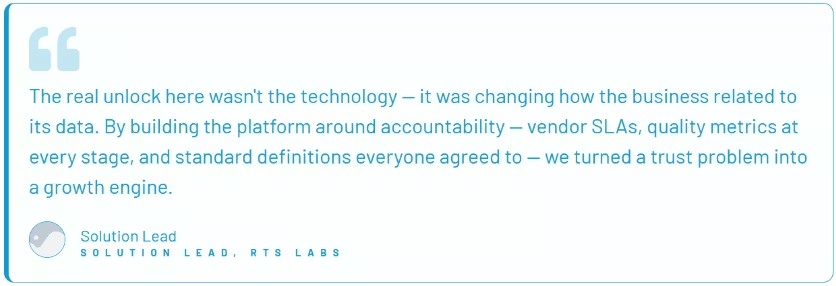
The measured outcome was that the client’s market share increased 19% after replacing the prior analytics setup with the new platform, and the company’s market capitalization grew to more than $3 billion.
Time and resources spent integrating new data sources dropped substantially, and internal teams reported enough trust in the new reporting layer to shift how they made both day-to-day and strategic decisions.
This is the layer that determines whether the generative AI examples earlier in this piece are even possible for a given organization. A hospital system cannot deploy an ambient documentation tool that writes accurately into the Electronic Health Record (EHR) if its EHR data is inconsistent.
Practical implication for the buyer
A pharma company cannot use AI-driven target discovery on data still split across disconnected vendor systems. The unglamorous work of unifying and governing data is what makes the more visible AI deployments viable in the first place.
5. Patient Engagement and Administrative Automation
A third category of generative AI activity in healthcare sits behind the scenes of the patient experience. It includes intake and scheduling assistants, prior-authorization drafting, and claims and denials summarization.
- Intake and scheduling tools use conversational AI to answer routine patient questions, collect history before a visit, and route requests to the right department, reducing the volume of calls front-desk staff handle for routine, repeatable questions.
- Prior-authorization drafting tools generate the initial documentation a clinician or administrative staffer needs to submit an authorization request, pulling relevant chart data into the format a given payer expects rather than requiring staff to compile it manually.
- Claims and denials summarization tools condense lengthy payer correspondence and denial reasoning into a shorter summary a billing team can act on more quickly.
This category is less mature in its public evidence than clinical documentation or diagnostic imaging. Vendors in this space make adoption and efficiency claims, but the independent, trial-level scrutiny applied to ambient scribes and imaging AI has not yet caught up here in the same volume, in part because the administrative workflows involved are more fragmented and harder to study as a single intervention across many health systems at once.
Practical implication for the buyer
Administrative AI claims in healthcare should be held at least as high as it is for clinical tools, even though the stakes of a wrong output are different. A hallucinated clinical note carries obvious patient-safety risk. A hallucinated prior-authorization justification carries a different but still real risk: a denied or delayed claim that affects patient access to care.
Also Read: Impact of AI in Occupational Health and Safety
Challenges Healthcare Organizations Actually Face
The examples above point toward four recurring challenges that show up regardless of which generative AI use case a healthcare or life-sciences organization is evaluating.
1. Data privacy and PHI exposure
Any system that touches patient data has to operate within Health Insurance Portability and Accountability Act of 1996 (HIPAA) requirements for access control, audit logging, and business associate agreements with vendors. Generative AI adds a specific wrinkle: models and retrieval systems that weren’t originally designed for healthcare data need explicit safeguards to prevent Protected Health Information (PHI) from surfacing in outputs, logs, or training data it shouldn’t touch.
2. Hallucination risk in clinical and administrative contexts
A generative system that produces a plausible but incorrect clinical note, an incorrect prior-authorization justification, or a misread diagnostic flag carries consequences that a wrong answer in most other industries does not.
This is why the tools with the most mature deployments in this piece, ambient documentation and diagnostic imaging AI, are built around a human reviewing and approving the output before it becomes part of the record, rather than acting autonomously on it.
3. Integration with legacy EHR and claims systems
Most health systems and pharmaceutical companies run on infrastructure that predates generative AI by decades: Epic and Cerner EHR instances, claims clearinghouses, and data warehouses built for a previous generation of reporting needs.
An AI tool that cannot read and write cleanly against that infrastructure, respecting the same permissions and data structures already in place, adds a maintenance burden.
The RTS Labs case study in the previous section is a direct illustration of this problem showing up before AI even enters the picture: fragmented, vendor-dependent data undermined trust in reporting long before anyone considered a generative AI layer on top of it.
4. The evidence-quality gap
Vendor-reported metrics, adoption numbers, and single-site press releases are not the same category of evidence as an independent evaluation or a randomized controlled trial, and the difference is not always disclosed clearly.
The UCLA RCT on ambient documentation, the Nuffield Trust’s evaluation of NHS imaging AI, and the Nature Medicine LungIMPACT trial all found real but more modest and context-dependent effects than the adoption and press-release numbers alone suggested. A buyer evaluating any generative AI healthcare vendor should ask directly what evidence category is behind a given claim.
How RTS Labs Helps Healthcare and Life Sciences Companies Address These Challenges
RTS Labs runs a dedicated healthcare and life sciences practice built around the layer: the data and integration foundation that determines whether a generative AI tool works reliably once it touches real clinical or operational systems.
On the data challenge, the pharmaceutical case study earlier in this piece is the clearest evidence of this in practice. The client’s core problem was fragmented, vendor-dependent data that no one fully trusted. RTS Labs’ response was a scalable AWS-based data platform with standardized metrics and built-in vendor accountability. A generative AI layer built on top of ungoverned data inherits every one of that data’s problems, just faster and more confidently.
On integration with legacy systems, this is a named specialty of RTS Labs’ healthcare practice: connecting patients, staff, and existing systems so that new tooling improves workflow. The firm provides machine learning and AI services for healthcare, medical imaging optimization, predictive analytics, and support for personalized medicine and drug discovery workflows.
On governance and evidence quality, RTS Labs’ broader engagement model offers platform neutrality across LLM providers, full IP and code handover, and a defined evaluation approach before a model goes into production. Its services are built to give a healthcare or pharma buyer documented, inspectable architecture.
The value RTS Labs brings to a healthcare organization evaluating generative AI is ensuring the underlying data and systems can support whichever tool gets chosen, and that the resulting deployment is inspectable.
What This Means for Healthcare AI Adoption
Ambient documentation has scaled to hundreds of health systems, diagnostic imaging AI has produced real site-level turnaround improvements, and generative AI compressed one drug’s early discovery timeline by years.
Though independent research finds their effects more modest than vendor figures suggest, none of this means generative AI in healthcare is overstated. The honest answer to whether it works is almost always yes, within a specific, evidenced scope rather than a blanket claim.
The organizations getting real value from these tools are the ones asking what evidence category backs a given claim, and making sure their own data and systems can actually support the tool once it’s deployed.
If your organization is evaluating where generative AI genuinely fits your own data and workflow environment, RTS Labs’ healthcare and life sciences practice can help assess that foundation first.
Start a conversation with RTS Labs about your data readiness and integration needs before committing to a specific AI tool.
Frequently Asked Questions
1. Is generative AI actually being used in healthcare today, or is it mostly still in pilots?
It’s in production at real scale in some categories. Ambient clinical documentation tools are deployed across more than 250 health systems combined between the two leading platforms, including major academic systems like Mayo Clinic, Johns Hopkins, and UPMC. Diagnostic imaging AI and generative drug discovery are also live in production, though with fewer deployments than documentation tools.
2. Why do vendor-reported results for healthcare AI sometimes differ from independent studies?
Vendor case studies typically report results from a single site or an early pilot, often measuring adoption or satisfaction rather than controlled clinical outcomes. Independent evaluations and randomized controlled trials test a wider or more controlled sample and often find real but smaller, more variable effects. Both can be accurate, as they answer different questions.
3. What should a healthcare organization check before adopting a generative AI tool?
Ask what evidence category supports the vendor’s claims: a randomized controlled trial, an independent multi-site evaluation, or a single-site case study are not interchangeable. Also assess whether the organization’s own underlying data and legacy systems are ready to support the tool, since a strong model built on fragmented or untrusted data will not produce reliable results.
4. Does generative AI replace clinicians or radiologists in these examples?
No example in this piece involves an AI system operating without human review. Ambient documentation drafts notes for clinician approval. Diagnostic imaging AI prioritizes and flags cases for radiologist review rather than issuing autonomous diagnoses. Generative drug discovery accelerated target and molecule identification, not the human-run clinical trials required to bring a drug to market.
5. What does RTS Labs actually do for healthcare and life sciences organizations?
RTS Labs works on the data engineering, systems integration, and AI-readiness layer that determines whether a generative AI tool works reliably once it meets real clinical or operational data. Its published healthcare and life sciences work covers predictive analytics, support for medical imaging optimization, patient risk modeling, and data platforms that underpin personalized medicine and drug discovery workflows.