

Enterprise AI adoption is accelerating, but strategic clarity is not.
According to MIT’s 2026 enterprise study published in Fortune, 95% of generative AI pilots fail to reach production, despite record investment. McKinsey also finds that while 90% of companies now use AI, only one-third have scaled it across functions, leaving most enterprises stuck in fragmented pilots, ad-hoc use cases, and siloed experimentation.
This is where organizations need to reconsider building an enterprise AI strategy, and not a vision deck or a handful of prototypes.
An enterprise AI strategy is a real, enterprise-grade plan that connects business priorities with data readiness, governance, architecture, and execution. In this guide, we break down what an enterprise AI strategy actually looks like and how companies can build one that drives measurable outcomes.
What Is an Enterprise AI Strategy?
An enterprise AI strategy is a structured blueprint that defines how an organization will use artificial intelligence to achieve measurable business outcomes. It doesn’t just concern experimenting with models.
Enterprise AI strategy aligns business objectives, data foundations, governance, and technical architecture into a single, scalable plan that guides AI adoption across the enterprise.
According to Gartner, organizations often confuse AI strategy with AI activity, i.e., launching pilots, buying tools, or experimenting with LLMs without a unifying direction. This is where most companies also get it wrong.
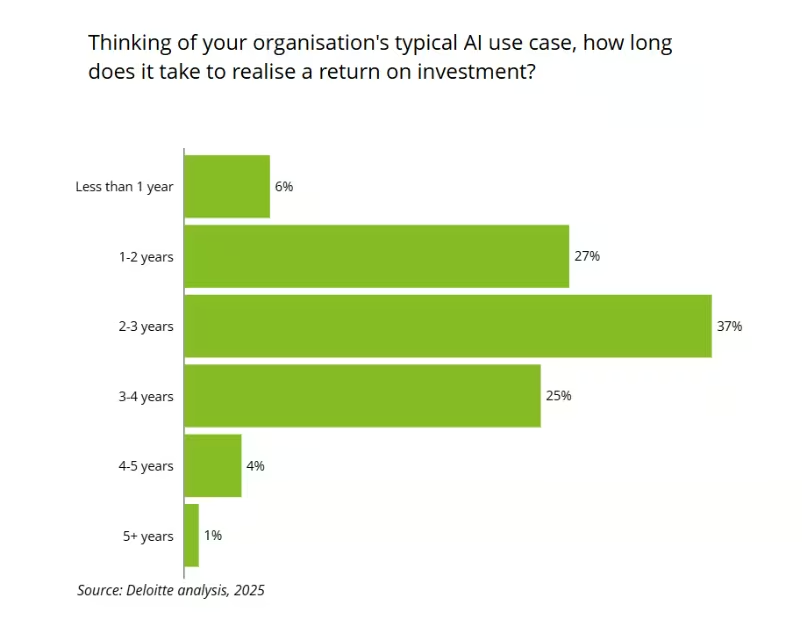
In a Deloitte survey, only 10% of the organizations using agentic AI said they were realizing any ROI.
A real enterprise AI strategy is fundamentally different from:
- AI vision decks that describe ambition but lack execution plans
- POCs and pilots that succeed in isolation but fail to scale
- Tech-first experiments that prioritize tools instead of outcomes
Instead, a true enterprise AI strategy focuses on:
1. Business Alignment First
AI initiatives are tied directly to revenue goals, operational KPIs, customer outcomes, efficiency gains, or cost reduction, and not to models or algorithms.
2. A Unified Data Foundation
The strategy defines the data quality, accessibility, integration, and governance required to support enterprise-scale AI. Data readiness is the biggest determinant of enterprise AI success.
3. Governance, Ethics & Risk Controls
A framework that ensures AI systems are transparent, compliant, trustworthy, and aligned with regulatory requirements becomes essential as AI adoption scales.
4. Architecture & MLOps Readiness
A clear plan for cloud, compute, pipelines, monitoring, and lifecycle management so AI models can operate reliably in real-world environments.
5. Organization-Wide Enablement
AI strategy includes change management, workforce readiness, skills development, and operating model shifts needed for adoption.
At its core, an enterprise AI strategy answers one critical question: How do we turn AI from scattered experiments into a measurable, scalable, enterprise-wide capability? Yet only 40% of the organizations confirm they have an AI strategy in place (State of AI in the enterprise, Deloitte).
Why Most Enterprise AI Strategies Fail (and What an Effective Strategy Avoids)
Gartner warns that 40% of enterprise AI projects will fail to scale without a cohesive AI strategy. Despite unprecedented investment and executive support, most enterprise AI strategies collapse long before they reach scale. The failures rarely stem from algorithms. They come from organizational, data, and architectural gaps that no model can compensate for.
Embedding AI into the fabric of an organisation is not a simple upgrade; it is akin to the transition from steam to electricity. When factories switched from steam power, they had to reconfigure their production lines, redesign workflows, invest in new infrastructure, and reskill their workforce.
AI adoption is a long-term process involving complex implementation, user adoption challenges, and integrating AI into processes. Below are the core breakdown points and what an effective AI strategy must avoid:
1. No Centralized Data Foundation
AI cannot fix broken, siloed, or incomplete data. Most enterprises still depend on legacy systems, inconsistent schemas, and fragmented data ownership, making it nearly impossible for AI to operate at scale. Gartner notes that data fragmentation is the #1 barrier to enterprise AI maturity.
What effective strategy avoids:
An effective AI strategy never skips data readiness. Instead, it builds a unified data layer, metadata governance, quality pipelines, and real-time accessibility before model development begins.
2. Misalignment Between Business, Engineering, and Leadership
Many enterprises choose AI projects based on stakeholder excitement. They don’t consider the business value that an AI project would bring. Hype-led organizations often approve projects that have
- Use cases with no measurable KPIs,
- Pilots that don’t link to P&L improvement, or
- Even an AI project that solves problems nobody prioritized.
AI strategy implementation isn’t an isolated task. Conflicts between business owners and technical teams often harm the efficacy of any AI plan or project.
What effective strategy avoids:
A good AI strategy never involves teams building AI without a value thesis. Instead, it ties every use case to revenue, cost, risk, or efficiency metrics.
3. Pilots That Cannot Scale Beyond the Sandbox
Enterprises often run successful POCs that collapse in real-world conditions due to missing infrastructure, governance, data pipelines, MLOps controls, and integration pathways. This leads to ‘pilot purgatory,’ an endless cycle of POCs having no production value.
What effective strategy avoids:
It avoids pilot-first thinking. Instead, enterprise AI strategy is designed for production from day one, and concerns architecture, observability, governance, and model lifecycle planning.
4. Infrastructure and Architecture Not Built for AI Workloads
A 2026 AI Maturity Index found that 64% of enterprises lack the architecture required for reliable AI operations.
Many enterprises underestimate the operational demands of AI. Any AI program needs high computing power, streaming data, containerized deployment, model monitoring, versioning and rollback, and compliance logging.
What effective strategy avoids:
A good enterprise AI strategy avoids bolting AI on top of legacy systems. Instead, it defines a modern, scalable, cloud-first architecture optimized for AI and MLOps.
5. Lack of AI Governance, Risk Controls, and Transparency
Harvard Business Review notes that enterprises without AI governance face significantly higher regulatory and reputational risk. As regulation increases, enterprises face rising demands for explainability, bias mitigation, auditability, data lineage, and access control. Yet governance is often treated as an afterthought.
What effective strategy avoids
Deploying models without oversight is a big no-no. Instead, an enterprise AI strategy with ESG at its core embeds governance into architecture, workflows, and decision-making.
6. No Change Management or Workforce Enablement
AI transformation is less about technology and more about behavior change. McKinsey reports that 70% of digital transformations fail not due to technical issues, but cultural resistance as the second biggest factor.
Organizations often fail to attach a compelling “why?” to their effort. Successful at-scale transformations require that thousands—or tens of thousands—of employees choose to get on board with this new way of working. For many, simply protecting the bottom line isn’t sufficient motivation. Leaders need to provide all their employees with a compelling reason that explains why they should do things differently.
~ Jon Garcia, Senior Partner and Leader, McKinsey’s Transformation Practice
What effective strategy avoids
Leaders behind the strategy should stop assuming people will adapt on their own. Instead, they must build roles, training, workflows, and adoption paths into the strategy.
Core Components of a Successful Enterprise AI Strategy
Most enterprises don’t have an AI problem. They have a data, architecture, and organizational alignment problem. Enterprises that treat AI as a system rather than a set of projects are more likely to achieve transformational impact.
Below are the core components every enterprise AI strategy must include:
1. Business-Aligned Use Case Identification
AI creates value only when tied to measurable business outcomes. The highest-performing enterprises begin with P&L priorities. Deloitte’s survey finds that 91% of the organizations plan to increase their AI investment, but only 6% reported payback within a year.
P&L priorities AI policymakers should consider include revenue uplift opportunities, cost reduction and efficiency gains, risk mitigation and compliance automation, productivity improvements, and customer experience transformation.
2. Modern Data Infrastructure & Readiness
AI is only as strong as the data foundation beneath it. Deloitte highlights that data quality, integration, and architecture readiness are the top predictors of AI success.
A robust data foundation includes a unified data lakehouse or warehouse, real-time pipelines (ETL/ELT), reliable metadata, lineage, and quality monitoring, standardized data models, and secure storage and access controls. Without these, even sophisticated AI systems break or deliver unreliable outcomes.
3. AI Governance, Ethics & Risk Management
As AI becomes more deeply embedded across functions, enterprises require strong governance to ensure trust, compliance, and transparency. A good governance model should be a part of every enterprise AI strategy, and must include premises such as:
- Explainability (XAI)
- Bias monitoring and fairness controls
- Policy-based access management
- Data lineage and audit logs
- Model drift detection
- Regulatory compliance (GDPR, SOX, HIPAA, emerging AI standards)
Compliance-by-design frameworks need to be embedded into the model lifecycle, monitoring, and access layers.
4. Change Management & Workforce Readiness
AI adoption fails when people do not understand or trust it, or fail to incorporate the technology into their workflows. Human-centered change plans and cross-functional enablement should be built into the execution stages.
Key pillars in change management could be role redesign, onboarding to AI-enabled tools, employee training programs, operating model restructuring, and communication plans around impact and purpose.
5. Technology Stack & AI Architecture Selection
The strategy should define the technology backbone needed to support AI at scale. If organizations make architecture choices early in the AI roadmap, they can successfully determine most of the long-term AI operating costs.
An enterprise-level AI project has a certain set of technical and architectural requirements, including
- Cloud architecture (AWS, Azure, GCP)
- MLOps and LLMOps platforms
- Model deployment workflows
- CI/CD for machine learning
- API orchestration layers
- Enterprise knowledge bases
- Monitoring and observability tools
Enterprises must select tech stacks that match current maturity, and not overshoot into unnecessary tooling or over-engineering.
6. Integration Into Business Operations
AI strategy must define how AI will plug into existing systems and processes. This includes integration with ERP, CRM, finance systems, supply chain platforms, customer support tools, IoT/edge devices, and workflow automation layers.
AI delivers value only when embedded into real workflows, not operating in isolation. Enterprises must consider deep engineering integration + API-based orchestration to operationalize AI across the enterprise.
7. Execution Roadmap & Measurement Framework
A strategy is incomplete without a clear pathway to delivery, which includes a 12–18 month roadmap, phase sequencing, well-defined milestones and KPIs, budget and resource allocation, and risk mitigation plans. The best approach is to go for roadmaps linked to measurable business outcomes and agile execution sprints that validate value early.
How to Build an Enterprise AI Strategy
Most enterprise AI programs don’t fail because of the technology. They fail because leaders don’t follow a structured, end-to-end strategy. Below is a proven 7-step blueprint enterprises can use to build an AI strategy that actually reaches production.
Step 1: Align AI With Business Objectives
Every AI strategy must start with clarity around why the enterprise is investing in AI. Our approach involves facilitating workshops that extract business pain points and translate them into high-ROI candidate use cases.
You can start by:
- Identifying business units with the highest value potential
- Mapping AI opportunities to revenue, cost, efficiency, or risk reduction
- Defining the business outcomes and KPIs before any model is designed
- Engaging business owners early to ensure adoption
Step 2: Assess Current Data & Systems Maturity
The next stage of strategy development focuses on diagnosing enterprise readiness across data quality, accessibility, integration, governance, and infrastructure.
Low-maturity environments typically depend on manual fixes, disconnected systems, and legacy infrastructure. But high-maturity organizations operate on standardized, monitored data with unified pipelines, cloud-native architecture, and secure enterprise-wide access.
Most enterprises fall somewhere in the middle; the goal is to elevate these systems to a “medium-to-high” readiness level before scaling AI, ensuring models can run reliably and repeatedly.
Step 3: Identify & Score AI Use Cases
Once baseline maturity is understood, enterprises can begin selecting AI use cases. This is where many organizations overextend and choose overly ambitious initiatives instead of those with clear paths to value.
A structured scoring model based on Impact × Feasibility helps avoid this trap.
- Impact is measured across revenue potential, cost reduction, efficiency gains, risk mitigation, and customer experience improvements.
- Feasibility evaluates data availability, engineering complexity, integration scope, regulatory implications, and time-to-value.
Use cases that score 16 or higher (out of 25) are ideal for early pilots. We enhance this prioritization with a practical T-shirt sizing model (S/M/L), aligning effort, cost, and ROI to ensure companies choose initiatives that deliver measurable outcomes within 90–180 days.
Step 4: Build the Enterprise AI Architecture
With priorities defined, the next step is constructing an architecture capable of supporting AI workloads at scale. This includes establishing the cloud environment, ETL/ELT pipelines, MLOps/LLMOps workflows, model registries, feature stores, observability layers, and robust security controls.
We build architecture that aligns with current maturity rather than idealized future-state blueprints, avoiding the over-engineering pitfalls that delay deployment and inflate cost.
Step 5: Establish AI Governance & Risk Controls
As AI adoption accelerates, governance shifts from a best practice to a mandatory foundation. Governance frameworks must define how enterprises address ethics, bias prevention, model explainability (XAI), data lineage, access control, drift monitoring, and auditability.
Governance maturity is the strongest predictor of whether enterprises scale AI successfully or stagnate. We implement compliance-by-design, embedding governance elements directly into MLOps pipelines so that every model deployed has clear traceability, accountability, and regulatory alignment.
Step 6: Create the Execution Roadmap (12–18 Months)
A strategy becomes meaningful only when translated into a structured roadmap. A realistic 12–18 month plan typically begins with:
- A 0 to 3-month discovery phase involving current-state assessments, data audits, use-case prioritization, and quick-win prototypes.
- The 3 to 9-month phase shifts toward pipeline modernization, architecture build-out, governance rollout, and deployment of the first production model.
- The 9 to 18-month horizon focuses on scaling multiple use cases, driving cross-functional adoption, and optimizing performance, cost, and security.
Enterprises operating with a well-defined AI roadmap achieve faster time-to-value, underscoring the importance of sequencing and delivery discipline.
Step 7: Deploy, Monitor, and Continuously Optimize
Once in production, models must be monitored for drift, retrained regularly, and evaluated for cost efficiency and business impact. Continuous feedback loops with business teams ensure models evolve with real-world behavior.
Adoption tracking is equally important. High-ROI models produce little value if teams do not integrate them into daily decisions. Enterprises realize materially better outcomes when they retrain models on a quarterly cycle, aligning AI performance to shifting data patterns and market dynamics.
High-ROI AI Use Cases by Industry
A strong enterprise AI strategy is not built around hype. It is built around use cases that directly impact revenue, cost, risk, or operational efficiency. McKinsey’s State of AI confirms that organizations focusing on high-ROI, operationally embedded AI use cases see the greatest measurable impact across functions.
Below are the industries where AI consistently delivers outsized returns and the use cases that lead the way.
1. Real Estate & PropTech
AI is reshaping the real estate ecosystem by improving valuation accuracy, operational efficiency, and tenant engagement. Automated Valuation Models now analyze thousands of variables, such as comparables, neighborhood features, historical trends, and macroeconomic indicators, to deliver more precise and dynamic property values.
Buildings increasingly rely on predictive maintenance systems where IoT sensors feed AI models that identify failure patterns long before breakdowns occur, lowering service costs and downtime. Tenant churn prediction models give property managers forward-looking insights into lease renewal risks, while document intelligence systems automate the extraction of clauses, financial terms, and obligations from leases and contracts.
2. Construction & Field-Heavy Industries
AI is becoming a central driver of safety, predictability, and cost control in construction. Companies now use machine learning to identify conditions that precede safety incidents, enabling proactive intervention on job sites.
Compliance automation helps teams streamline inspections, documentation, and permit workflows, reducing regulatory risk. Forecasting models analyze weather patterns, labor availability, equipment usage, and historical project data to predict schedule delays weeks in advance.
AI “field copilots” are emerging to automate RFIs, checklists, and approvals, while cost-overrun prediction models assess risks across materials, subcontractor performance, and budget variance.
3. Supply Chain, Logistics & Transportation
AI has become indispensable across supply chains as organizations strive for real-time optimization and forecasting accuracy. Demand-forecasting engines combine sales trends, seasonality, promotions, macroeconomic signals, and external disruptions to generate more reliable predictions.
Inventory optimization systems reduce both stockouts and excess inventory by dynamically recalibrating reorder points. Logistics teams use route-optimization models to account for fuel costs, delivery windows, traffic, and constraints, often cutting transport costs materially.
Real-time anomaly detection monitors shipment deviations, temperature control, or compliance issues, while computer vision in warehouses automates scanning, defect detection, and workflow efficiency.
4. Banking & Financial Services
Financial institutions increasingly rely on AI to improve decisioning accuracy, reduce fraud, and personalize customer engagement. Credit risk models incorporate behavioral signals, cash-flow patterns, macro trends, and alternative data to enhance underwriting precision.
Fraud detection engines identify subtle, multi-dimensional patterns that traditional rule systems routinely miss. AI-driven KYC/AML automation extracts identity information, validates documents, and flags anomalies with greater consistency.
Meanwhile, predictive analytics and LLM-based copilots generate tailored financial recommendations and enhance customer service through intent detection and guided resolution.
5. Insurance & FinTech
AI is reshaping insurance by accelerating claims processing, strengthening fraud prevention, and improving risk modeling. Claims triage models automatically classify claim complexity, extract structured data, and route cases to the right adjusters.
Fraud detection systems analyze behavior across historical claims, policy data, and external indicators to surface anomalies earlier. Underwriting models more accurately evaluate risk profiles while reducing manual review workloads.
Document intelligence automates extraction from dense policies, endorsements, and contracts, and renewal-prediction algorithms identify policyholders likely to lapse to support proactive retention strategies.
Build, Buy, or Partner? Choosing the Right AI Execution Model
Once an enterprise defines its AI strategy, the next decision is how to execute it. The choice between building internally, buying off-the-shelf tools, or partnering with an AI engineering firm shapes cost, speed, scalability, and long-term viability.
Choosing the wrong execution model is one of the top reasons AI programs stall before reaching production, often due to mismatched capabilities and unrealistic expectations. Successful enterprise AI programs choose execution models based on maturity and business needs.
Each option has advantages, limitations, and specific scenarios where it works best.
1. Build Internally (The In-House Model)
This approach involves building AI systems entirely within the enterprise using internal talent, including data scientists, ML engineers, architects, and product owners.
Best For Enterprises That:
- Already have a mature data platform
- Employ strong ML engineering and MLOps teams
- Require strict control over models, IP, and security
- Have long-term budgets and time horizons
- Operate in highly regulated sectors (finance, healthcare, aerospace)
Pros
- Maximum control over architecture, IP, and security
- Custom-tailored solutions aligned with internal standards
- Long-term internal capability building
Cons
- High cost of hiring and retaining AI talent
- Extremely long time-to-value
- At risk of technical debt and slow scaling
- Requires mature data + MLOps to even begin
2. Buy Off-the-Shelf AI Tools (The SaaS / Platform Model)
Many AI vendors offer turnkey solutions for analytics, automation, forecasting, and LLM-based copilots.
Best For Enterprises That:
- Need fast wins with limited customization
- Want to automate well-understood, repeatable workflows
- Have limited internal data science teams
- Need to pilot before long-term investment
Pros
- Fast deployment
- Lower upfront cost
- Minimal technical expertise required
- Good for narrow, well-defined use cases
Cons
- Limited customization
- Vendor lock-in risks
- Hard to integrate with legacy systems
- Often fails as workflows grow more complex
3. Partner with an AI Engineering & Strategy Firm (The Hybrid Model)
This approach blends strategy, architecture, and engineering expertise from an external partner with internal teams. It’s increasingly preferred by enterprises seeking speed without sacrificing control.
Best For Enterprises That:
- Need rapid scaling but lack internal MLOps or engineering depth
- Must modernize data foundations before deploying AI
- Want a strategic roadmap + production-grade execution
- Run complex multi-cloud, multi-system environments
- Require governance, risk, and compliance baked into architecture
Pros
- Faster time-to-value
- Access to specialized AI, data, and engineering talent
- Architecture and governance are designed correctly from day one
- Lower long-term cost than hiring full in-house teams
- Internal teams are upskilled during delivery
Cons
- Requires joint ownership and internal participation
- Needs alignment between partner and enterprise leadership
Where RTS Labs Fits In
RTS Labs operates in the hybrid model, partnering with enterprises that want to scale AI fast without cutting corners on architecture, governance, or data foundations.
RTS Labs helped a short-term rental company rebuild its entire infrastructure on Google Cloud, implemented containerization (Kubernetes), CI/CD pipelines, and IaC tooling, streamlining deployments and improving reliability.
As a result, the client gained significantly faster release cycles, reduced downtime vulnerabilities, and freed their team to focus on growth rather than maintenance.
RTS Labs brings together the full spectrum of capabilities enterprises need to operationalize AI at scale, whether it is strategy development, use-case prioritization, data modernization, or lakehouse architecture.
Its teams build the MLOps and LLMOps pipelines required for reliable production deployment, while providing deep engineering support across cloud, integrations, workflow automation, and security. Every solution is designed with governance-by-design principles, ensuring compliance, auditability, and responsible AI use. RTS Labs also supports the organizational side of transformation through structured change management and adoption programs that help teams integrate AI into daily workflows.
This partnership model gives enterprises maximum flexibility: they retain ownership of their IP and decision-making, while RTS Labs provides the technical depth, architectural rigor, and execution velocity needed to deliver AI systems that drive measurable business impact.
Build a Future-Ready Enterprise AI Strategy with RTS Labs
Enterprise AI is entering a new era, one where strategy, data readiness, governance, and architecture matter far more than the number of models deployed. The organizations that win will be those that treat AI as a business capability, not a technology experiment.
The future is moving toward AI agents, autonomous workflows, real-time decisioning, and hyper-personalized operations. But none of this is achievable without a clear enterprise AI strategy that aligns vision, data, engineering, and execution.
Gartner’s and McKinsey’s latest findings show a simple truth: enterprises that build structured AI roadmaps scale faster and with far fewer failures.
That’s where RTS Labs becomes a force multiplier, helping organizations move from scattered pilots to production-grade AI built on solid data foundations, compliant-by-design architectures, and a portfolio of high-ROI use cases.
The next generation of enterprise leaders won’t just adopt AI. They will operationalize it. RTS Labs helps you get there. Talk to our AI Experts.
FAQs
1. What is the biggest mistake enterprises make when creating an AI strategy?
Most organizations start with technology or models before fixing data foundations. This leads to pilots that can’t scale, inconsistent outputs, and high rework costs. Successful AI strategies always begin with business alignment, data readiness, and governance.
2. How long does it realistically take to build an enterprise AI strategy?
Most enterprises require 8–12 weeks for a full strategy (use-case portfolio, data assessment, governance, architecture blueprint) and 12–18 months to fully execute. Timelines vary based on data maturity and cloud/integration complexity.
3. How do enterprises measure the ROI of an AI strategy?
AI ROI is tracked through operational efficiency gains, reduced manual effort, improved forecasting accuracy, automated workflows, revenue uplift, or cost avoidance. Mature enterprises use KPI-linked use-case scorecards to quantify value before execution.
4. What industries benefit most from enterprise-grade AI strategies?
Any sector with complex workflows or rich data, including finance, logistics, construction, healthcare, retail, insurance, and manufacturing, benefits significantly. These industries rely on predictive modeling, automation, and intelligent decisioning, all of which require strong strategic foundations.
5. Why do enterprises partner with RTS Labs instead of relying solely on internal teams?
RTS Labs helps enterprises accelerate execution, modernize data foundations, and deploy production-grade AI systems while enabling internal teams to scale capabilities. This hybrid approach reduces risk, shortens timelines, and ensures governance, security, and integration are designed correctly from day one.