
Enterprises are investing heavily in artificial intelligence, but most struggle not with the models themselves, but with embedding AI into real systems and workflows where value is realized. According to PwC’s 2025 AI Business Predictions, nearly half of technology leaders report that AI is fully integrated into core strategy and products, yet many organizations still grapple with translating capability into measurable outcomes.
The gap between AI promise and business impact shows why enterprises are now prioritizing AI integration partners that can operationalize models, unify data flows, and ensure secure, scalable deployment across systems.
This article explains what AI integration companies do, how to evaluate them, and profiles the top providers of 2026 to help you choose the right partner and turn AI pilots into production-grade, ROI-driven capabilities.
What Is an AI Integration Company?
An AI integration company helps enterprises embed AI capabilities into their existing technology stack for those systems to work together in real business workflows. Regular vendors focus only on building models or running pilots. AI integration companies specialize in connecting AI to the systems enterprises already rely on, including ERPs, CRMs, data warehouses, cloud platforms, security layers, and operational applications.
In practice, this means guiding organizations through the full AI integration lifecycle. It typically starts with strategy and data readiness, ensuring the right data is accessible, governed, and usable.
From there, integration teams connect AI models, such as predictive models, generative AI, Retrieval Automation Generation (RAG) pipelines, or AI agents, into live systems via APIs, microservices, and event-driven architectures. Finally, they handle deployment, monitoring, MLOps, and change management, so AI continues to perform reliably as usage scales.
This distinction matters because AI only delivers ROI when it is operationalized. A powerful model that isn’t integrated into workflows, decision systems, or user-facing applications becomes an isolated tool rather than a business capability. AI integration companies exist to bridge that gap and transform AI from an experiment into a secure, scalable, and maintainable component of enterprise operations.
How We Selected the Best AI Integration Companies
Most companies can build models, but far fewer can integrate AI reliably into CRMs, ERPs, data warehouses, cloud environments, and mission-critical workflows. To make sure this list reflects real enterprise needs, we evaluated companies using criteria that emphasize technical depth, integration maturity, and proven delivery.
The focus is on partners capable of taking AI from concept to production with the security, governance, and scalability required in modern enterprises. Here are the selection criteria used to identify the top AI integration companies of 2026:
1. Technical Expertise in AI + Systems Integration
We prioritized companies with proven engineering depth and chose those capable of integrating machine learning, GenAI, LLMs, and automation into enterprise systems, not just building standalone models.
2. Demonstrated Enterprise Delivery Record
Vendors needed to show real integrations across industries like finance, real estate, logistics, and healthcare. Firms with surface-level ‘POC-only’ credentials were excluded.
3. Cloud-Native Architecture Experience
Modern AI runs on scalable cloud infrastructure. Providers had to demonstrate multi-cloud expertise, API orchestration, security layers, and the ability to integrate with existing enterprise cloud setups.
4. MLOps & Deployment Maturity
We selected only those companies able to operationalize AI operations like model registries, CI/CD for ML, monitoring, drift detection, retraining workflows, and lifecycle management.
5. Security, Governance & Compliance Strength
Enterprise AI requires strict controls. Companies needed demonstrated capability with governance frameworks, RBAC, compliance, audit readiness, and secure integrations.
6. Integration of LLMs, RAG Pipelines & Agentic Systems
Providers must be proficient in modern AI integration patterns, including retrieval-augmented generation, vector databases, copilots, and multi-agent workflows.
7. Ability to Work With Legacy + Modern Systems
Companies had to show interoperability strength, integrating AI with systems like Salesforce, SAP, Oracle, HubSpot, Snowflake, ServiceNow, and legacy on-prem databases.
8. Client Feedback, Reputation & Cross-Industry Success
Only firms with positive customer sentiment, credible testimonials, and multi-industry experience made the list.
10 Best AI Integration Companies in 2026
Enterprises evaluating AI integration companies seek teams that can connect AI to real systems, ship reliably, and scale across the organization. The companies below were selected for their ability to integrate AI into complex enterprise environments, spanning data platforms, core applications, cloud infrastructure, and governance layers.
| Company | Core Integration Focus |
Industries Served |
Strengths | Best Fit For |
|---|---|---|---|---|
| RTS Labs | End-to-end AI integration (data → models → apps → MLOps) | Finance, Insurance, Real Estate, Construction, Logistics | Secure, scalable integrations; MLOps-first; multi-cloud | Enterprises moving from POC to production |
| LeewayHertz | GenAI and LLM integrations | Tech, Startups, SaaS | Rapid prototyping; LLM expertise | MVPs and GenAI features |
| InData Labs | ML and analytics integration | Retail, Healthcare, Logistics | Data science depth | Analytics-heavy use cases |
| Addepto | AI and ML implementations | Manufacturing, Finance | Strong ML delivery | ML-first projects |
| SoluLab | AI app integration | Web3, Retail, Fintech | Speed, flexibility | Mid-market deployments |
| Miquido | Product AI integration | Retail, Travel | UX-driven AI | Product teams |
| Ekimetrics | Analytics and decision systems | Marketing, Retail | Advanced analytics | Data-driven organizations |
| Binariks | Software and AI integration | Healthcare, Fintech | Engineering scale | Long-term builds |
| Cognizant | Enterprise AI modernization | BFSI, Healthcare | Global delivery | Large enterprises |
| Scale AI | Data and AI pipelines | Tech, Automotive | Data ops at scale | Data-intensive organizations |
The AI integration landscape is crowded, but only a few companies can take AI from prototype to fully operational enterprise workflows. Companies like RTS Labs, Cognizant, LeewayHertz, Ekimetrics, etc., have become mission-critical partners in the AI deployment ecosystem.
Let’s discuss how each brings a different approach to data readiness, cloud architecture, security, and workflow automation.
1. RTS Labs
RTS Labs is an enterprise AI integration partner focused on turning AI initiatives into live, secure, and scalable business capabilities. Rather than treating AI as a standalone feature, RTS Labs integrates models into core systems, such as ERPs, CRMs, data platforms, and cloud infrastructure, so AI drives outcomes inside real workflows.
It serves industries, including finance, insurance, real estate and construction, logistics and transportation, healthcare, and SaaS.
RTS Labs Core AI Integration Services
- AI strategy and integration roadmap
- Data engineering and unified data platforms
- LLM, RAG, and AI agent integration
- API, microservices, and event-driven integrations
- MLOps, monitoring, and lifecycle management
- Security, governance, and compliance-by-design
RTS Labs Pros
- End-to-end AI integration expertise: Combines data engineering, model deployment, API/microservices integration, and MLOps into a single execution stack for reducing fragmentation and rework.
- Production-grade delivery: Proven track record moving AI from pilot to live workflows with secure, scalable integration across ERPs, CRMs, data platforms, and multi-cloud environments.
- Strong governance and compliance: Embeds security, audit trails, role-based access, and regulatory controls into integrations for regulated industries like finance, healthcare, and insurance.
- Modern architecture focus: Cloud-native deployments with modular, scalable design that reduce technical debt and lower the total cost of ownership over time.
- Multi-AI platform support: Integrated support for LLMs, RAG, AI agents, and orchestration for rich, contextual intelligence across business processes.
RTS Labs Cons
- Higher engagement entry point: Enterprise-grade integration and MLOps maturity come with investment expectations that may be higher than smaller boutique firms for very limited scope pilots.
- Longer discovery phase: RTS Labs typically invests in thorough data readiness and architectural scoping early, which can lengthen the initial engagement compared with quick prototype-only vendors.
RTS Labs Notable Clients
RTS Labs has delivered production AI integrations across financial services, logistics, and data-heavy enterprises. It has led its partner organizations towards automating workflows, modernizing data foundations, and improving decision velocity.
RTS Labs helped a fast-growing personal finance company scale operations by integrating and automating key systems, including Sales Cloud pipeline management, Five9 call center integration, Geopointe location services, Marketo engagement, and robust reporting dashboards. RTS Labs also established a streamlined DevOps process with Git and Salesforce CLI to boost development velocity and support rapid business growth.
It partnered with a global sports equipment manufacturer to modernize a fragmented data architecture that was limiting analytics and growth. The engagement involved building a unified data platform with governance and onboarding processes to support advanced data products. This transformation brought scalable access to high-quality data across e-commerce and retail channels.
Read RTS Labs’ complete list of case studies and success stories here.
RTS Labs Best Fit For
Enterprises that already believe in AI but need a partner to integrate it securely, scale it reliably, and operate it long term.
RTS Labs Pricing
Custom, engagement-based pricing aligned to scope, complexity, and enterprise requirements.
2. LeewayHertz
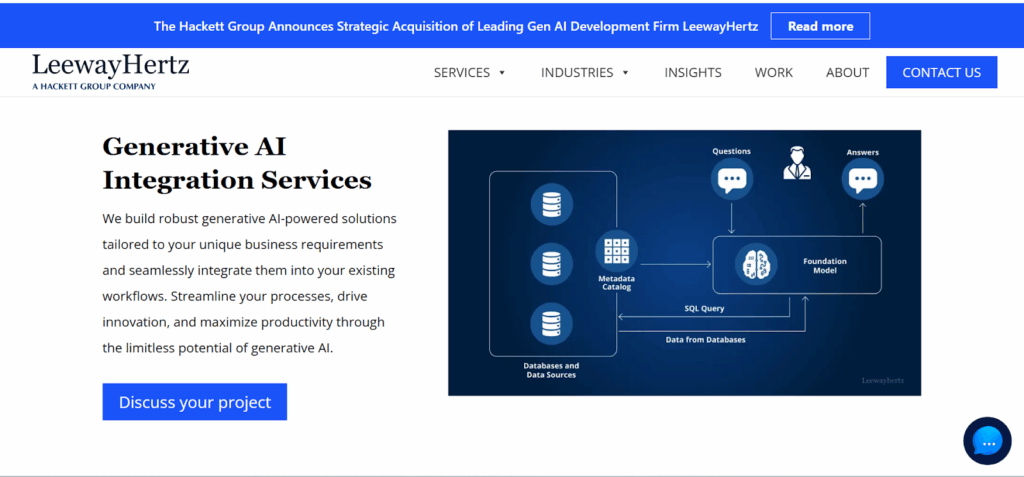
LeewayHertz is a boutique AI integration partner specializing in generative AI and LLM integrations tied into enterprise systems. The firm blends AI model delivery with API and microservices integration, enabling clients to embed AI features into products and workflows quickly.
LeewayHertz Services Provided
- GenAI and LLM integration for RAG, prompt pipelines, etc.
- API / microservices integration
- Cloud-native deployments for AWS, Azure, GCP, etc.
- Custom workflow automation
- UX/Product integration for AI-augmented apps
LeewayHertz Pros
- Strong track record in GenAI and LLM feature builds
- Agile, product-focused delivery for MVPs
- Good fit for early-stage AI adoption and prototyping
LeewayHertz Cons
- Less emphasis on long-term governance and MLOps compared to enterprise integrators
- Smaller global footprint for large, regulated deployments
LeewayHertz Pricing
- Project/scoped pricing typical of product MVP engagements
- Lower entry point than big consultancies, but varies with model complexity
3. InData Labs
InData Labs focuses on AI/ML integration with analytic depth, helping enterprises bring predictive intelligence and analytics into operational systems. They emphasize data pipeline quality and model explainability for downstream integration.
Indata Labs Services Provided
- ML model development & full integration
- Data pipeline design and ETL/ELT execution
- Predictive analytics integration in apps
- Dashboard, reporting, and BI embedding
- Cross-system API integration
Indata Labs Pros
- Deep expertise in predictive analytics and data modeling
- Strong technical grounding in data science + integration
- Useful for analytics-centric enterprise use cases
Indata Labs Cons
- Less specialization in LLM/RAG and conversational AI
- Enterprise governance and MLOps can require augmentation
Indata Labs Pricing
- Scoped development pricing based on model complexity and integration depth
- Typically mid-range for data-centric builds
4. Addepto
Addepto is an AI/ML consulting and integration firm focused on delivering custom ML systems that integrate with existing enterprise data ecosystems. They blend model building with backend and pipeline integration.
Addepto Services Provided
- Custom ML model creation and integration
- Data engineering and feature pipeline support
- API and microservice wrappers around models
- MLOps foundations and repeatable deployments
- Data preprocessing and annotation workflows
Addepto Pros
- Strong core machine learning delivery
- Flexible for custom analytics and domain-specific models
- Good prototyping and experimentation support
Addepto Cons
- Less emphasis on generative AI and LLM operationalization
- Enterprise-scale integration often needs complementary engineering
Addepto Pricing
- Project or time-and-material models
- Scope-based with options for ongoing support
5. SoluLab
SoluLab delivers AI application builds and integration services across retail, fintech, and Web3 sectors. They focus on connecting AI components into existing apps with an emphasis on speed and customizability.
Solulab Services Provided
- AI model integration into web/mobile apps
- Cloud deployment and scaling
- UI/UX integration for AI features
- Real-time API connectivity
- Automated workflows and serverless patterns
Solulab Pros
- Quick delivery cycles for mid-market clients
- Strong app development and AI integration combo
- Competitive pricing for mid-range projects
Solulab Cons
- MLOps and governance are less mature for enterprise scale
- Focus on the app layer; less depth in core data architecture
Solulab Pricing
- Typically lower-mid pricing tier with flexible engagement models
6. Miquido
Miquido combines AI integration with product design focus, helping enterprises embed intelligent features into customer-facing applications while ensuring a seamless user experience.
Miquido Services Provided
- AI and automation feature integration
- UX/UI design for AI-augmented products
- API integrations and backend connectors
- Cloud deployment and orchestration
- Analytics and user insights integration
Miquido Pros
- Design-led integration approach
- Strong for product teams looking to blend UX with AI
- Good for consumer-centric enterprise initiatives
Miquido Cons
- Not focused on heavy back-end systems integration
- Governance and MLOps are handled via partners or extensions
Miquido Pricing
- Product engagement pricing, often packaged with design and development
7. Ekimetrics
Ekimetrics is a data science and analytics consulting firm that extends models into enterprise decision systems. Their integration work focuses on operationalizing analytics into business processes.
Ekimetrics Services Provided
- Decision intelligence integration
- Predictive and prescriptive model deployment
- Data and analytic pipeline management
- Cross-platform integration with BI, ERP, CRM, etc.
- ROI-driven analytics outcomes
Ekimetrics Pros
- Strong analytics strategy and integration into decision workflows
- Good for use cases where decisions require model insight
Ekimetrics Cons
- Less technical focus on newer generative AI paradigms
- Integration depth tied to analytics vs conversational or agentic AI
Ekimetrics Pricing
- Engagement pricing tied to analytics scope and outcomes
8. Binariks
Binariks is a full-stack engineering partner that blends software engineering with AI integration, connecting models into enterprise applications, legacy systems, and scalable microservices.
Binariks Services Provided
- End-to-end software and AI integration
- Legacy modernization and connectors
- Real-time API layers and event streams
- Cloud solutions and DevOps support
- Modular AI-enabled systems
Binariks Pros
- Strong engineering bench for complex integrations
- Good fit for modernization and AI enrichment
Binariks Cons
- AI strategy and use-case selection are not always core
- Requires client clarity on business objectives
Binariks Pricing
- Engineering engagement rates and flexible team augmentation
9. Cognizant
Cognizant is a global systems integrator offering enterprise-scale AI integration and modernization services. Their strengths include massive delivery scope, legacy system interfaces, and enterprise governance.
Cognizant Services Provided
- AI integration into core enterprise apps (ERP, CRM, SCM)
- Hybrid cloud and edge integration
- Governance, security, and compliance frameworks
- MLOps and model lifecycle support
- Legacy modernization and digital transformation
Cognizant Pros
- Great for global, complex enterprise environments
- Deep experience in regulated sectors
Cognizant Cons
- Costly, with complex engagement layers
- Longer delivery cycles vs boutique partners
Cognizant Pricing
- Large engagement pricing, often multi-phase contracts
10. Scale AI
Scale AI focuses on data pipelines and operational integration for AI, particularly where large training data sets and automation of data flows are essential. Their tooling and services support continuous data refinement and production workflows.
Scale AI Services Provided
- Data labeling and enrichment pipelines
- Real-time data integration layers
- API connectors for model serving
- Data ops automation
- Workflow orchestration
Scale AI Pros
- Excellent for data-centric AI operationalization
- Strong tooling for data flows
Scale AI Cons
- Less full-stack integration for application and enterprise systems without partners
- More tooling and pipeline focus than governance and compliance
Scale AI Pricing
- Tooling subscription and services components
Why AI Integration Expertise Matters
AI creates business value only when it operates inside real workflows. Models that remain isolated and run only in notebooks, dashboards, or disconnected tools rarely move the needle on efficiency, revenue, or risk.
AI integration expertise has become as important as AI model development itself for several reasons:
Operational Capability
Integration expertise is what turns AI into an operational capability. When AI is embedded into ERPs, CRMs, finance systems, supply chains, or customer-facing applications, insights can trigger actions automatically. Forecasts inform procurement, risk scores adjust approval decisions, and copilots assist employees in the workflow. Without proper integration, these handoffs remain manual, slow, and error-prone.
Data Compatibility
Experienced AI integrators ensure data and system compatibility across complex enterprise environments. Most organizations operate hybrid stacks that combine legacy platforms with cloud services and modern APIs. Integration specialists resolve data quality issues, unify schemas, and connect AI models to the right systems at the right time so outputs are accurate, timely, and usable.
Reduced Risk
Integration expertise significantly reduces risk around security, compliance, and system failure. Enterprise-grade integrations account for identity management, access controls, auditability, and regulatory constraints from the start. This prevents common failure modes such as data leakage, model misuse, or brittle point-to-point connections that break under scale.
Accelerated ROI and Long-term Scalability
Strong integration accelerates ROI and long-term scalability. By avoiding rework, reducing deployment delays, and building MLOps into the foundation, AI solutions remain maintainable as usage grows. Integration experts design for continuous improvement for AI systems to evolve alongside the business instead of becoming technical debt.
How to Measure ROI of AI Integration
Measuring the ROI of AI integration requires looking beyond model accuracy and focusing on business outcomes created once AI is embedded into workflows. The clearest gains usually show up in cost reduction, productivity improvements, revenue enablement, and speed-to-decision.
A simple way to frame ROI is:
AI Integration ROI = (Annual Business Impact − Total AI Integration Cost) ÷ Total AI Integration Cost
Where business impact includes hard savings and measurable uplift, and not just theoretical model performance.
In practice, enterprises track ROI through a mix of operational and financial metrics.
- Cost savings often come from automation of manual processes, such as reduced data entry, faster reconciliation, or fewer support tickets.
- Productivity gains show up as time saved per employee, faster cycle times, or higher throughput without adding headcount.
- Revenue impact appears when AI improves conversion rates, pricing accuracy, personalization, or demand forecasting.
For example, when AI is integrated into a CRM like Salesforce, organizations often see considerable reductions in manual data entry, faster lead qualification, and improved forecast accuracy benefits which compound across sales and operations teams. In finance or supply chain systems, AI-driven alerts and recommendations can reduce errors, prevent costly delays, and improve working capital efficiency.
The key insight is that AI ROI is realized only after integration. Until AI outputs trigger actions inside enterprise systems, value remains latent rather than measurable.
When to Partner With an AI Integration Company
Most enterprises don’t struggle with understanding AI. They struggle with operationalizing it. Partnering with an AI integration company becomes necessary when internal teams hit structural, technical, or scale-related limits that slow progress or increase risk.
Transition from PoC to Production
A common trigger is the transition from proof-of-concept to production. Many organizations can build pilots internally, but production environments demand hardened integrations, security controls, monitoring, and reliability guarantees that go beyond experimentation. Specialized integration expertise prevents stalled initiatives and costly rewrites.
Legacy or Fragmented infrastructure
Enterprises also seek integration partners when dealing with legacy or fragmented infrastructure. AI must connect across ERPs, CRMs, data warehouses, and cloud platforms that weren’t designed to work together. Integration specialists know how to bridge these systems without disrupting core operations.
Post-AI deployment Challenges
Another key moment is the adoption of LLMs, RAG pipelines, or AI agents. These systems introduce new architectural and governance challenges, like prompt management, data access control, latency, and auditability, that require production-grade integration patterns.
Companies need AI integration partners when security, compliance, and scalability become non-negotiable. As AI expands across departments, integration companies help enforce consistent standards, reduce operational risk, and ensure AI continues to deliver value as usage grows.
How to Choose an AI Integration Company
Choosing the right AI integration company is less about brand recognition and more about execution credibility. The wrong partner can leave you with disconnected systems, hidden costs, and AI that never reaches production.
1. Technical Depth
Start by assessing technical depth. A strong integration partner should demonstrate experience across data engineering, APIs, cloud platforms, MLOps, and AI deployment, and not just model development. Ask how they integrate AI into ERPs, CRMs, data platforms, and security layers, and whether they’ve done so in production environments.
2. Architecture and Cloud Expertise
Next, evaluate architecture and cloud expertise. Enterprises operate hybrid and multi-cloud stacks, and your partner should be fluent in AWS, Azure, and GCP. Look for experience designing scalable, modular architectures that won’t require rebuilding as AI adoption expands.
3. Governance and Compliance
Security, governance, and compliance are critical differentiators. The right partner builds access controls, auditability, monitoring, and regulatory alignment into integrations from day one, important for finance, healthcare, insurance, and data-heavy industries.
4. Industry Experience
Industry experience also matters. Partners who understand your domain can anticipate data challenges, compliance requirements, and workflow realities, reducing friction and time-to-value.
5. Methodology and Pricing Transparency
Finally, review delivery methodology and pricing transparency. Look for clear milestones, realistic timelines, and engagement models that prioritize outcomes over experimentation.
Red Flags to Avoid
- Overemphasis on demos or pilots with no production track record
- Limited experience integrating with legacy systems
- Vague answers on MLOps, monitoring, or security
- One-size-fits-all architectures that ignore enterprise constraints
Why Enterprises Choose RTS Labs for AI Integration
Enterprises choose RTS Labs when they need more than isolated AI features. They choose RTS Labs when they need AI systems that work reliably inside complex, real-world environments. We specialize in production-grade AI integration, helping organizations move from experimentation to measurable business impact.
A key differentiator is RTS Labs’ deep data engineering foundation. Before integrating AI, teams ensure data pipelines, governance, and system connectivity are in place, reducing downstream failures. This approach is especially valuable for enterprises operating across legacy platforms, modern cloud stacks, and regulated data environments.
RTS Labs also brings an MLOps-first integration model, embedding monitoring, versioning, retraining, and performance management into every deployment. This ensures AI systems remain accurate, secure, and cost-effective as usage scales.
Lead Your Way to Success and Scalability With an AI Integration Partner
Enterprises that treat integration as a strategic discipline, not an afterthought, are the ones unlocking measurable ROI and faster processes, lower costs, smarter automation, and more resilient operations.
Yet the complexity is real. Integrating AI with CRMs, ERPs, data warehouses, cloud platforms, legacy infrastructure, and security frameworks demands more than technical ability. It requires architectural discipline, data engineering depth, governance maturity, and production-grade delivery, which only the right integration partner matters as much as the AI itself.
Is your organization ready to move from AI experimentation to real operational impact? RTS Labs can help with enterprise-grade AI integration for scalable, secure, and ROI-driven AI solutions catered to your organization.
FAQs
1. What does an AI integration company actually do?
AI integration companies connect AI models, LLMs, and automation workflows into enterprise systems like ERP, CRM, data warehouses, and cloud infrastructure to make sure the AI works reliably inside real business operations.
2. How long does AI integration take for most enterprises?
Typical timelines range from 8–16 weeks for focused integrations, e.g., CRM copilots, etc., to 4–9 months for multi-system deployments involving governance, pipelines, and enterprise automation.
3. Which industries benefit most from AI integration?
Finance, insurance, logistics, retail, construction, manufacturing, and healthcare see the biggest gains since they operate on high-volume workflows that AI can automate or optimize.
4. Why choose an external partner instead of building AI integrations internally?
Most internal teams lack deep expertise in MLOps, cloud architecture, system interoperability, and security, which are required for stable and compliant AI deployments. External partners bridge these gaps faster and more cost-effectively.
5. How does RTS Labs integrate AI differently from other companies?
RTS Labs uses a data-engineering-first, governance-driven, MLOps-centric integration approach. Our AI models are secure, compliant, observable, and fully embedded into enterprise applications with measurable ROI.