Gartner projects that 60% of AI initiatives lacking AI-ready data and integration will be abandoned through 2026. These projects belong to an AI integration consulting service for whom ‘AI integration’ meant a single Application Programming Interface (API) call to one firm and a full connectivity layer respecting live permissions and schema changes to another, sold at the same price.
A good AI integration consulting service in 2026 would start by mapping the systems the AI needs to touch before writing any integration code:
- Which Enterprise Resource Planning (ERP) and Customer Relationship Management (CRM) it reads from,
- Which permission model it has to inherit, and
- Which schema changes are likely to break it six months from now.
That inventory becomes the architecture. It then builds the integration and tests it against production-shaped data, so the failure modes that would normally surface after go-live get caught before it. What the client is left with is a connected system their own engineers can maintain. There’s no dependency on the vendor for every future change.
This shortlist scores eight AI integration consulting services against the six factors that actually predict which kind a buyer is getting: integration depth, data pipeline engineering, security and governance, platform neutrality, IP handover, and time to a first live system.
The Connector Test: What AI Integration Actually Requires
Every firm on this list can connect an AI model to an API endpoint. However, the bar is whether the resulting system reads and writes against systems of record the same way a human user would, under the same permission constraints, without falling over when the underlying data changes shape.
Three questions separate a genuine AI integration engagement from a wrapper with a nicer name:
-
Does the system respect existing permissions?
An integration that queries a CRM or ERP without inheriting the access rules already governing that data has quietly created a new security boundary nobody asked for. A sales rep who cannot see certain accounts in the CRM should not be able to see them through the AI layer either.
-
Does it survive schema drift?
Production systems change field names, add columns, and deprecate old ones on their own schedule. An integration built against a fixed snapshot of the schema breaks the first time that schedule moves, and the break often surfaces as a wrong answer rather than a visible error.
-
Can the client’s own engineers maintain it?
A connector that works only because the original vendor’s team understands an undocumented workaround is not an asset. It is a dependency wearing the shape of one.
The goal is layering intelligence into systems that already carry operational and regulatory weight, without disturbing the transactional core those systems protect. That distinction, connecting to a system versus disrupting it, is close to the center of what separates the firms below.
Also Read: How to Build AI Infrastructure: A Step-by-Step Enterprise Guide
The eight AI integration consulting services on this list are scored against that distinction, using six weighted dimensions covering integration depth, data engineering, governance, neutrality, IP handover, and delivery speed.
How We Ranked These Firms
The shortlist evaluates each firm on six weighted dimensions, using publicly available evidence, including service pages, published methodologies, client reviews on Clutch, G2, and GoodFirms, case studies, and documented certifications.
Every firm receives an overall score out of 10 and sub-scores on the dimensions where its capability is either notably strong or notably limited.
| Dimension | Weight | Why It Matters |
|---|---|---|
| Systems and API integration depth | 25% | Separates firms that connect to real ERPs, CRMs, and legacy systems from firms that call a single external API |
| Data pipeline and connectivity engineering | 20% | Integrations live or die on schema handling, sync reliability, and data contract design |
| Security, auth, and governance | 15% | Determines whether the AI layer inherits existing permission and audit models or creates a new blind spot |
| Platform and vendor neutrality | 15% | Protects the client’s optionality across LLM providers, middleware, and integration frameworks |
| IP ownership and handover quality | 15% | Decides what the client can maintain internally once the engagement ends |
| Time to first live integration | 10% | A well-scoped engagement shows a working connected system in weeks, not quarters |
Weighted evaluation framework used to rank the 8 best AI integration consulting services in 2026, with systems and API integration depth carrying the highest weight at 25%
Scores below 6 indicate the firm is competent in the dimension without being differentiated. Scores of 8 or higher require documented evidence of production-grade integration work rather than positioning language alone. A firm can hold a slot on this list with a 6.7 overall if its niche fit is strong. However, broad marketing about AI integration without visible systems depth does not qualify.
Comparison Matrix: The 8 Best AI Integration Consulting Services
| Firm | Overall | Integration Depth | Data Pipeline | Security & Governance | Platform Neutrality | IP Handover | Typical Cost | Time to First Live Integration | Best For |
|---|---|---|---|---|---|---|---|---|---|
| RTS Labs | 9.3 | Strong | Strong | Strong | Full | Full client ownership | $150K–$500K | 3–6 weeks | Production integration with full IP handover |
| LeewayHertz | 8.4 | Strong | Strong | Moderate | Strong | Client ownership | $50K–$500K | 4–8 weeks | Cross-industry integration breadth |
| Azilen Technologies | 8.0 | Strong | Moderate | Moderate | Moderate | Co-ownership model | $80K–$350K | 4–8 weeks | Embedding AI into SaaS/ISV products |
| Softweb Solutions | 7.7 | Moderate | Strong | Strong | Moderate | Client ownership | $25K–$400K | 5–9 weeks | Enterprise data-layer integration |
| 10Pearls | 7.4 | Strong | Moderate | Strong | Moderate | Client ownership | $50K–$450K | 5–9 weeks | Governance-first regulated integration |
| Fingent | 7.2 | Strong | Moderate | Strong | Moderate | Client ownership | $100K–$400K | 6–10 weeks | Legacy/mainframe integration without a rewrite |
| SoluLab | 7.0 | Moderate | Moderate | Moderate | Strong | Client ownership | $25K–$350K | 5–9 weeks | AI paired with custom API/system integration |
| ScienceSoft | 6.7 | Moderate | Moderate | Strong | Moderate | Client ownership | $50K–$400K | 6–12 weeks | Long-track-record regulated enterprise integration |
The 8 Best AI Integration Consulting Services in 2026
1. RTS Labs: Best Overall for Production AI Integration With Full-Stack Ownership
Score: 9.3/10 · Integration Depth 10/10 · Security & Governance 9/10 · IP Ownership 10/10
Best for: Chief Technology Officers (CTOs) and Vice Presidents (VPs) of Engineering at mid-market and enterprise organizations who need AI connected to the systems, such as ERPs, CRMs, and data warehouses that actually run the business, with full IP handover and a partner available after go-live.
RTS Labs treats integration as an engineering problem. Every engagement starts with a systems inventory: what the AI needs to read, what it needs to write, and which permission model already governs that data. The connectivity layer is designed against that inventory before any prompt or model gets tuned. Consequently, the integration survives contact with production and any or many schema changes.
The firm builds across OpenAI, Anthropic, Bedrock, Azure OpenAI, and Google Cloud, using Vanna, Mastra, LangGraph, and Model Context Protocol implementations where the integration surface calls for them. RTS Labs doesn’t use any default house stack. The framework choice is defended per engagement against the client’s actual systems.
Also Read: AI Accountability Framework: A Practical Guide for Enterprise Leaders
RTS Labs’ deployment approach:
Discovery produces a systems inventory and integration architecture the client owns regardless of build partner. Design maps data contracts, auth inheritance, and schema-change handling before build begins. Build doesn’t use sanitized samples but runs in weekly sprints against production-shaped data.
Handover includes the integration repository, architecture documentation, and knowledge-transfer sessions so the client’s own engineers can maintain the connectors without further dependency.
RTS Labs’ strengths:
- Systems inventory and permission-inheritance design treated as first-phase work
- Full IP handover including integration code, data contracts, and architecture documentation
- Genuine platform neutrality across OpenAI, Anthropic, Bedrock, Azure, and GCP
- Formalized post-launch retainer covering integration monitoring and schema-drift response
- Documented production case studies with named clients
RTS Labs’ tradeoffs:
- Very small pilots below $100K sit outside the firm’s core engagement model
- Pure staff-augmentation contracts do not fit the paid-discovery-plus-scoped-build pattern
- Global multi-country footprint is lighter than the largest systems integrators
RTS Labs’ pricing:
$150K to $500K for a typical mid-market or enterprise integration build. Post-launch retainer runs monthly, scoped to system count and data volume.
RTS Labs’ IP and code ownership:
The client owns everything produced, including integration code, data contracts, architecture documentation, and access-control configurations. RTS Labs doesn’t retain any proprietary middleware layer.
RTS Labs’ time to first live integration:
3 to 6 weeks from discovery signoff to a working connected system. Full production readiness typically follows within another 4 to 8 weeks depending on the number of systems involved.
Discovery session: RTS Labs runs paid discovery workshops that produce a systems inventory, integration architecture, and prototype scope the client owns regardless of the subsequent build partner.
2. LeewayHertz: Best for Cross-Industry Integration Breadth
Score: 8.4/10 · Multi-Sector Coverage 9/10 · Integration Depth 8/10 · Platform Neutrality 8/10
Best for: Enterprises integrating AI across multiple sectors or use cases, where a firm’s prior delivery in adjacent industries shortens the design phase.
LeewayHertz built its own AI enablement platform, ZBrain, which pairs a discovery module for mapping AI opportunities against a client’s existing systems with a build module for shipping the resulting integration.
The firm has delivered integration work across finance, healthcare, retail, and supply chain, and it fine-tunes open-source models where a client’s integration requirements call for it rather than defaulting to a single provider.
LeewayHertz’s deployment approach:
Engagements typically open with a ZBrain-driven discovery phase that inventories the client’s existing technology landscape before scoping the build. The firm’s cross-industry portfolio, consisting of CRM sync, ERP connectivity, claims systems, gives it pattern recognition on integration surfaces. This, in turn, shortens design for buyers whose use case has adjacent precedent.
LeewayHertz’s strengths:
- ZBrain platform gives a structured discovery-to-build path for integration scoping
- Cross-industry portfolio spanning finance, healthcare, retail, and supply chain
- Comfortable fine-tuning open-source models alongside proprietary providers
- Established Fortune 500 and startup client base with public case history
LeewayHertz’s tradeoffs:
- Some client feedback on Clutch notes scope creep and project-management friction on larger engagements
- Cost engineering and integration-specific governance documentation are less publicly detailed than the firm’s broader AI marketing
- Firm size means engagement team quality can vary; named senior engineers are worth confirming at contract signature
LeewayHertz’s time to first live integration:
4 to 8 weeks depending on the number of systems and the complexity of the target architecture.
RTS Labs vs. LeewayHertz:
LeewayHertz wins on cross-sector portfolio breadth and a structured internal discovery platform. RTS Labs wins on documented permission-inheritance design, full IP handover with no proprietary orchestration dependency, and a formalized post-launch retainer.
3. Azilen Technologies: Best for Embedding AI Into Existing SaaS and ISV Products
Score: 8.0/10 · Product Integration Fit 9/10 · Integration Depth 8/10 · IP Ownership 7/10
Best for: SaaS companies, ISVs, and product teams in HRTech, FinTech, and RetailTech embedding AI into software they already maintain. It focuses less on from-scratch standalone systems for enterprises.
The firm’s differentiator is a single API layer that connects enterprise tools and workflows, which fits product teams extending an existing codebase. The starting point often isn’t a blank architecture. Azilen’s engagements span document processing and Optical Character Recognition (OCR) integration, compliance-aligned screening systems, and contract lifecycle connectivity.
Azilen’s deployment approach:
Discovery scopes the integration against the client’s existing API surface and product architecture. Build runs against the existing codebase, with accelerators for common connectivity patterns. Handover includes integration code, API documentation, and a co-ownership model that fits a product team’s ongoing roadmap cadence.
Azilen’s strengths:
- Purpose-built practice specifically for AI integration into existing SaaS and independent software vendor (ISV products)
- Published integration-capability framework and comparative methodology
- Comfortable connecting AI features to existing enterprise workflows via a unified API layer
- Broad industry coverage: HRTech, FinTech, RetailTech, InsurTech, manufacturing
Azilen’s tradeoffs:
- Co-ownership model for intellectual property (IP) means handover terms are worth reviewing closely against a full-ownership expectation
- Regulated-industry governance documentation is less prominent than at compliance-first specialists
- Enterprise internal-operations mandates outside a product context sit outside the firm’s core positioning
Azilen’s time to first live integration:
4 to 8 weeks against an existing product codebase.
RTS Labs vs. Azilen:
Azilen is the stronger fit when the mandate is embedding AI into a live commercial product with an existing user base. RTS Labs is the stronger choice for standalone enterprise integrations and full IP ownership without a co-ownership structure.
4. Softweb Solutions, an Avnet Company: Best for Enterprise Data-Layer Integration
Score: 7.7/10 · Data Pipeline Engineering 9/10 · Security & Governance 8/10 · Integration Depth 7/10
Best for: Enterprises whose AI integration depends on getting the data layer right using retrieval across operational systems, internet of things (IoT) data streams, and connectivity into Salesforce, AWS, and Databricks environments.
Softweb Solutions operates as part of Avnet’s broader ecosystem and brings two decades of data engineering heritage to its AI integration practice. The firm holds certified partnerships with Salesforce, Microsoft, AWS, and Databricks, giving it a materially different starting point than firms whose integration work began at the model layer.
Softweb’s deployment approach:
Engagements typically begin with a data-readiness assessment against the intended integration, followed by pipeline design and connectivity build. The firm’s data-platform partnerships mean retrieval and sync quality often benefit from established connector patterns. It focuses less on custom-built-from-scratch integrations.
Softweb’s strengths:
- Two decades of data engineering heritage with certified Salesforce, AWS, and Databricks partnerships
- Client-reported strength in independent execution and clear communication, per Clutch reviews
- Established enterprise portfolio spanning manufacturing, energy, and finance
- Comfortable with Internet of Things (IoT) and real-time data stream integration alongside standard system connectivity
Softweb’s tradeoffs:
- Integration depth for complex multi-agent orchestration is less central than for firms built around agentic AI specifically
- Client feedback notes pricing can shift as project scope evolves
- Platform neutrality is strong within its certified partner ecosystem but less documented outside it
Softweb’s time to first live integration:
5 to 9 weeks including data-readiness work.
RTS Labs vs. Softweb Solutions:
Softweb wins when the integration depends primarily on unlocking value from an existing enterprise data estate already built on Salesforce, AWS, or Databricks. RTS Labs wins on integration engineering across a broader systems surface, multi-agent orchestration depth, and a defined post-launch retainer.
5. 10Pearls: Best for Governance-First Integration in Regulated Industries
Score: 7.4/10 · Security & Governance 9/10 · Integration Depth 8/10 · Platform Neutrality 6/10

Best for: Mid-market and enterprise buyers in healthcare, banking, and other regulated sectors who need integration work built alongside documented governance and compliance evidence from day one.
10Pearls runs a dedicated AI integration services line built around ISO 27001 certification and explicit governance controls. The firm has shipped integrations connecting agentic AI features into existing platforms for clients including a national caregiver-support organization and a fintech operator, in each case embedding the AI layer into infrastructure the client already had in production.
10Pearls’ deployment approach:
Engagements embed security, governance, and compliance controls into the integration design itself, rather than scoping them as a follow-on review. Data quality and pipeline reliability are treated as prerequisites for the AI layer, with Health Insurance Portability and Accountability Act (HIPAA), General Data Protection Regulation (GDPR), and SOC 2 alignment scoped explicitly where relevant.
10Pearls’ strengths:
- ISO 27001 certification with governance built into the integration design phase
- Documented client work in fintech and caregiver-support platforms
- AI Platform Integration experience spanning OpenAI, Google AI, Mistral, LangChain, and Pinecone
- Strong Clutch review base (36 reviews) with consistent praise for on-time, on-budget delivery
10Pearls’ tradeoffs:
- Independent review noted AI and machine learning capability, while growing, trails the firm’s core software engineering strength
- Primarily US-market-focused; European buyers may find lighter GDPR-specific presence
- Offshore delivery components can introduce coordination overhead some buyers prefer to avoid
10Pearls’ time to first live integration:
5 to 9 weeks including governance scoping.
RTS Labs vs. 10Pearls:
10Pearls wins on published governance documentation for regulated-sector buyers. RTS Labs wins on integration engineering depth across a broader set of systems and a faster time to a first live connection.
6. Fingent: Best for Legacy and Mainframe Integration Without a Rewrite
Score: 7.2/10 · Legacy Integration Depth 9/10 · Security & Governance 7/10 · Platform Neutrality 6/10
Best for: Enterprises running Common Business Oriented Language (COBOL) mainframes, SAP R/3, or custom monoliths that need AI capability layered in without disturbing transactional systems that already carry operational and regulatory weight.
Fingent has built a named methodology, Intelligence Integration, specifically for this problem: embedding AI into existing enterprise systems through APIs, event streams, and orchestration frameworks. Its work doesn’t involve migrating the underlying architecture. The firm publishes concrete timelines for this work directly, which gives buyers an unusually specific benchmark to evaluate against.
Fingent’s deployment approach:
Discovery scopes the integration against the client’s existing transactional core and identifies where an AI overlay can attach without altering it. According to the firm’s own published guidance, pilots typically run 6 to 10 weeks, domain-level consolidation spans 3 to 6 months, and enterprise-wide orchestration can extend 6 to 12 months in regulated environments.
Fingent’s strengths:
- Named, publicly documented methodology for legacy integration specifically
- Transparent, self-reported timelines for pilot, domain, and enterprise-wide phases
- Enterprise custom software delivery heritage across insurance, logistics, and healthcare administration
- Meaningful integration engineering depth into systems most AI-native firms avoid
Fingent’s tradeoffs:
- AI architecture depth for complex multi-agent orchestration is less central than for AI-native specialist firms
- Product design capability for consumer-facing surfaces is present but secondary to enterprise integration work
- Delivery cadence reflects enterprise procurement timelines rather than founder-speed engagement
Fingent’s time to first live integration:
6 to 10 weeks for an initial pilot, per the firm’s own published framework.
RTS Labs vs. Fingent:
Fingent wins when the mandate is specifically layering AI onto legacy or mainframe systems without disruption. RTS Labs wins on broader AI architecture depth, multi-agent orchestration, and a shorter time to a first live prototype outside the legacy-specific case.
7. SoluLab: Best for AI Integration Paired With Custom API and System-Integration Builds
Score: 7.0/10 · API Integration Depth 8/10 · Platform Neutrality 7/10 · Governance 6/10

Best for: Enterprises and startups needing AI connected via custom-built API integrations rather than pre-made connectors, including use cases that combine AI integration with blockchain or Web3 systems.
SoluLab is an AI-native firm with a parallel blockchain and Web3 practice, and its integration work is explicitly custom-built. The focus is less on off-the-shelf connectors. The firm has delivered integration engagements for clients including The Walt Disney Company, Mercedes-Benz, and the University of Cambridge, and its service list names system integration and legacy application modernization directly alongside its AI practice.
SoluLab’s deployment approach:
Engagements are architected around the client’s specific system landscape from the outset, since the firm does not rely on pre-built connectors to standard platforms. This fits use cases with unusual integration surfaces, including supply chain provenance, and tokenized asset workflows, where a custom-built connection is unavoidable.
SoluLab’s strengths:
- Custom API-based integration design rather than dependence on pre-made connectors
- Notable enterprise client roster with public case history
- Rare combined depth across AI integration and blockchain/Web3 systems
- Strong Clutch review volume (50 reviews) with consistently positive cost-value feedback
SoluLab’s tradeoffs:
- One widely cited negative review on Clutch alleges a non-delivery dispute, worth raising directly in reference calls
- Governance and compliance documentation for high-stakes regulated integrations is less developed than at specialist firms
- Multi-agent orchestration depth for pure enterprise operations use cases is less mature than AI-native specialists focused solely on that problem
SoluLab’s time to first live integration:
5 to 9 weeks for a scoped custom integration build.
RTS Labs vs. SoluLab:
SoluLab wins when the mandate specifically requires a custom-built integration paired with blockchain or Web3 systems. RTS Labs wins on integration governance depth, multi-system orchestration, and a formalized post-launch retainer.
8. ScienceSoft: Best for Long-Track-Record Enterprise Integration in Regulated Sectors
Score: 6.7/10 · Delivery Discipline 8/10 · Security & Governance 8/10 · Integration Depth 7/10
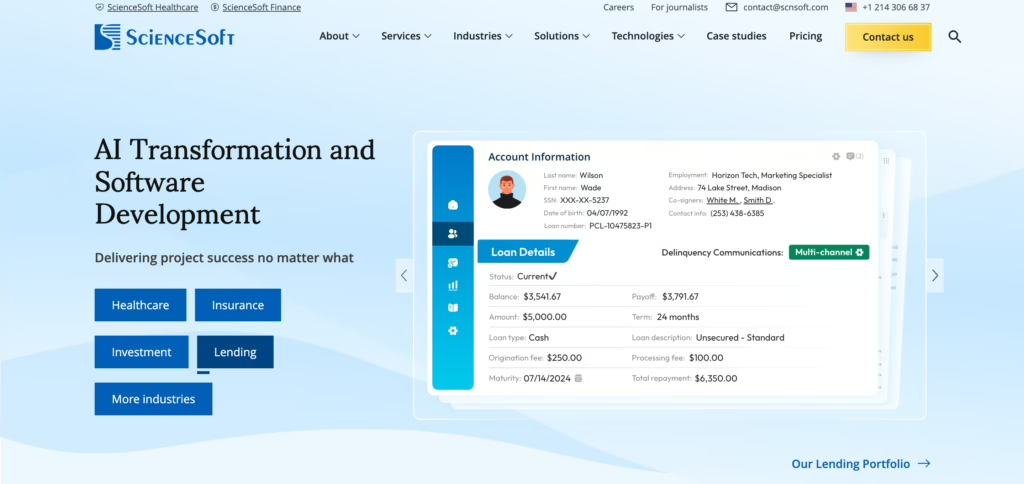
Best for: Enterprise buyers in healthcare, financial services, and manufacturing who weight vendor longevity and certified quality processes as heavily as AI-native integration depth.
ScienceSoft has operated since 1989 and holds ISO 9001, ISO/IEC 27001, and ISO 13485 certifications, giving it a compliance posture that predates most AI-native competitors on this list by decades. The firm’s AI integration work sits inside a broader enterprise software practice spanning HIPAA-compliant healthcare platforms and financial services systems including digital banking and fraud prevention.
ScienceSoft’s deployment approach:
Discovery scopes the integration against the client’s existing enterprise architecture and compliance requirements. Build runs against ISO-aligned quality and code-review processes. Handover includes integration source code, documentation, and knowledge transfer, consistent with the firm’s established enterprise delivery discipline.
ScienceSoft’s strengths:
- 36-year enterprise delivery track record with mature, ISO-certified quality processes
- Deep healthcare and financial services integration experience, including HIPAA-compliant systems
- Broad industry portfolio: healthcare, insurance, investment, manufacturing, retail, telecom
- 750+ staff and 4,200+ completed projects across 80+ countries, per the firm’s public profile
ScienceSoft’s tradeoffs:
- AI-specific architecture depth for complex multi-agent orchestration trails AI-native specialist firms
- Time to first live integration is slower than boutique AI-integration specialists, reflecting process discipline over speed
- Some client feedback flags pricing concerns as project scope evolves over time
ScienceSoft’s time to first live integration:
6 to 12 weeks, reflecting established delivery discipline over raw speed.
RTS Labs vs. ScienceSoft:
ScienceSoft wins when vendor longevity and certified process maturity matter as much as AI-native integration capability. RTS Labs wins on framework and platform neutrality, multi-agent orchestration depth, and faster time to a first live integration.
Also Read: Enterprise AI Agent Deployment: A Step-by-Step Implementation Guide
Strengths and Tradeoffs Across the Shortlist
| Firm | Where They Win | Where to Pressure-Test |
|---|---|---|
| RTS Labs | Permission-inheritance design, full IP handover, platform neutrality, post-launch retainer | Very small pilots below $100K, pure staff-augmentation contracts |
| LeewayHertz | Cross-sector portfolio breadth, structured ZBrain discovery-to-build path | Scope-creep risk on larger engagements per client feedback, engagement team variability |
| Azilen Technologies | Purpose-built practice for embedding AI into existing SaaS/ISV products | Co-ownership IP model needs review, governance documentation for regulated sectors |
| Softweb Solutions | Certified Salesforce/AWS/Databricks data-layer depth, two decades of data engineering | Multi-agent orchestration depth, pricing stability as scope evolves |
| 10Pearls | ISO 27001 governance built into integration design, strong Clutch review base | AI/ML capability trails core software engineering strength per independent review |
| Fingent | Named, published legacy-integration methodology with transparent timelines | AI architecture depth for complex orchestration, enterprise procurement pace |
| SoluLab | Custom API-based integration design, notable enterprise client roster | One cited delivery dispute worth raising in references, governance documentation depth |
| ScienceSoft | 36-year track record, triple ISO certification, deep healthcare/finance experience | AI-native architecture depth, slower time to first live integration |
The Three Failure Patterns That Kill AI Integration Programs
AI integration programs fail for reasons that differ from standalone AI development projects. Buyers who assume the same failure modes carry over tend to underinvest in the areas that actually decide whether an integration survives contact with production.
1. The demo-data trap is the first failure pattern
An integration that works cleanly against a sample export is trivial to build. Every firm on this list can demonstrate one in weeks. The cracks widen once that integration meets the actual production schema, live sync intervals, and the edge cases a sample export never contained.
Firms that quote integration timelines without testing against production-shaped data are underpricing the real work, and the gap surfaces as silently wrong answers rather than visible errors.
2. Auth and permissions treated as an afterthought is the second failure pattern
An integration that queries a system of record without inheriting the access rules already governing that data creates a new security boundary nobody approved. This is rarely intentional.
It happens when the permission model gets scoped after the connectivity work. The fix is treating access-control inheritance as a design requirement from the first architecture document, not a security review bolted on before launch.
3. Handover quality is the third failure pattern
An integration repository handed to the client without documentation of the data contracts, schema-change handling, or auth model leaves the client holding code they cannot maintain.
They technically own the integration and practically depend on the original vendor for every change. Handover quality is what separates firms that treat integration as a program from firms that treat it as a one-time contract.
The shortlist above scores against these three patterns. Firms scoring 8 or higher on integration depth demonstrate visible evidence of handling all three.
Anatomy of an AI Integration Engagement: Five Core Work Streams
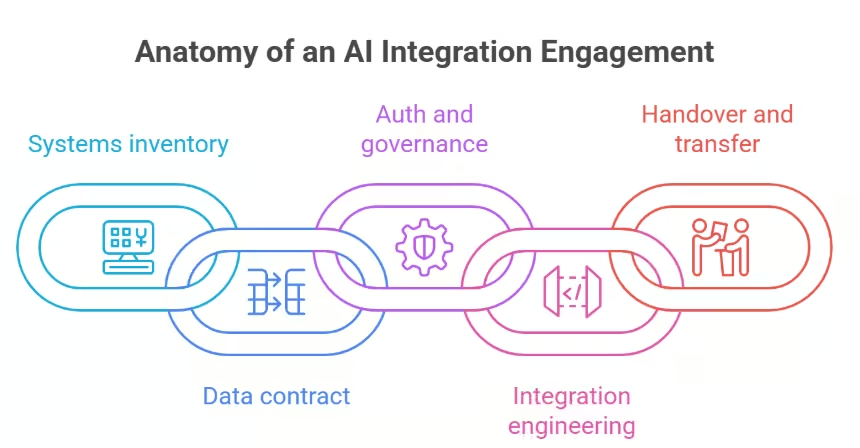
A mature AI integration engagement covers five connected work streams. Firms that skip any of them typically pass the missing work to the client or to a third party.
1. Systems inventory and integration scoping
Mapping every system the AI needs to read from or write to, including ERPs, CRMs, data warehouses, legacy applications, and the APIs or event streams that connect them. Strong scoping produces a written inventory the client owns regardless of the eventual build partner.
2. Data contract and connectivity design
Second work stream defines how data moves between systems, such as sync frequency, schema-change handling, and the contract each system expects from the integration layer. This is where integrations either hold up under production traffic or start returning stale or malformed data within weeks.
3. Auth, permissions, and governance layer
The third stream involves designing the integration to inherit existing access controls. It avoids creating a parallel permission model. Audit trail requirements, compliance scoping, and identity federation belong here, designed alongside the connectivity work.
4. Build and integration engineering
This is the actual code that connects the AI layer to real systems like API clients, event listeners, retry logic for sync failures, and error handling for the edge cases a sample dataset never surfaces. This is where firms that assemble pre-built connectors differentiate from firms that engineer custom connections for a client’s specific systems.
5. Handover and knowledge transfer
This layer includes source code, architecture documentation, data contract specifications, and knowledge-transfer sessions with the client’s own engineering team. Handover quality determines whether the client can maintain and extend the integration internally or stays dependent on the vendor for every schema change.
Scoping all five work streams into the request for information (RFI) is the fastest way to see where each firm’s real capability sits. Vendors who decline to price data contract design, the governance layer, or handover as explicit line items are signaling the divide the buyer will inherit.
Building Your Shortlist: A Five-Step Playbook
Step 1: Inventory the systems that must connect before evaluating firms
The right AI integration consulting service for a firm running a COBOL mainframe differs from the right one for a company built entirely on Salesforce and AWS. List the specific systems the AI needs to touch before requesting proposals. Getting this wrong produces a shortlist that looks credible on paper and struggles in delivery.
Step 2: Require a paid discovery workshop with a written systems map
A firm confident in its integration depth will accept a paid discovery engagement as a precondition. The output should be a written systems inventory and integration architecture the client owns regardless of which firm ultimately builds it.
Step 3: Ask to see production integration code under NDA
Strong firms will walk through actual integration code they have shipped for another client, explain how they handled a specific schema change, and discuss what they would do differently now. Firms whose evidence stops at a UI walkthrough should be pressure-tested carefully.
Step 4: Test how the firm handles auth and permissions in the design conversation
Ask specifically how the integration inherits existing access controls, what happens when a permission changes mid-project, and how audit trails are maintained. Firms who answer abstractly are signaling this is not first-class design work for them.
Step 5: Model total cost of ownership including integration maintenance
Initial build cost is one line item. Ongoing schema-change maintenance, monitoring, and the internal engineering capacity needed to extend the integration all belong in the same calculation. Ownership models with strong handover pay back over three to five years; dependency models look inexpensive in year one and expensive by year three.
Pre-Signing Checklist: What the Contract Should Actually Cover
Before signing a statement of work with any AI integration consulting service, the following items should appear explicitly in the contract:
- Systems inventory and integration architecture deliverable: Names every system in scope and the data contracts governing each connection.
- Auth and permission-inheritance model: Specifies how the integration respects existing access controls and how audit trails are maintained.
- Schema-change and sync-failure handling: Defines what happens when a connected system changes shape, and what monitoring catches it before a customer or user does.
- IP and code handover terms: Confirms the client owns the integration code, data contracts, and architecture documentation, with no proprietary middleware dependency retained by the vendor.
- Post-launch maintenance model: Defines whether ongoing schema monitoring and integration maintenance happen through the same firm on retainer or through the client’s internal team.
A contract that covers all five items in explicit language previews the delivery that follows. Vague language on any of them is a preview of the friction to come.
From Shortlist to First Live Integration
The checklist above is only useful if the reader acts on it. That specific action is a paid discovery workshop, run against a real systems inventory, with a written integration architecture as the required deliverable.
RTS Labs has built its practice around exactly that discipline for clients including CarMax, Dominion Energy, Advance Auto Parts, and Landstar. These are the organizations with the kind of layered legacy systems, compliance requirements, and operational data most AI integration work actually has to survive. The firm allows integration depth, full IP ownership, and platform neutrality across LLM providers.
Start a conversation with RTS Labs to scope a discovery workshop against the systems your organization needs connected.
Frequently Asked Questions
1. What are AI integration consulting services?
AI integration consulting services cover the design and engineering work needed to connect AI models and agents to a client’s existing systems: ERPs, CRMs, data warehouses, and legacy applications. Scope typically includes systems inventory, data contract design, permission-aware access control, integration code, and handover of the resulting architecture to the client’s own engineering team.
2. How is AI integration different from AI development?
AI development covers building the model-facing logic: prompts, retrieval, orchestration, and evaluation. AI integration covers connecting that logic to the systems that already run the business, including auth inheritance, schema handling, and sync reliability. Many engagements need both, but a firm strong in one is not automatically strong in the other, and buyers should evaluate the two separately.
3. What does a typical AI integration engagement cost, and how long does it take?
Engineering-led AI integration consulting services typically price mid-market and enterprise engagements between $100K and $500K, depending on the number of systems involved and the complexity of the existing architecture. A working first integration usually takes 3 to 9 weeks from discovery signoff, with full production readiness following in another 4 to 12 weeks depending on the systems in scope.
4. How do I evaluate a firm’s actual integration depth?
Ask to see production integration code under NDA, and ask specifically how the firm handles schema changes and permission inheritance rather than accepting a general description of seamless integration. Firms who can name a specific schema-change incident and how they handled it have done this work before. Firms whose answer stays at the marketing level should be pressure-tested further.