Enterprises evaluating agentic AI in 2026 face a framework landscape that has expanded faster than enterprise architecture teams can keep up with. One wrong choice and the repercussions are many, including integration debt, security gaps, and migration costs that compound as the program scales.
The decision also has consequences for how agents are governed, monitored, and extended across the enterprise over a multi-year program horizon. The five frameworks covered in this guide represent the most mature, most production-proven options available for enterprise AI development in 2026.
RTS Labs works across all five, and this guide covers what each one is, when it is the right choice, and how to make the selection decision with the governance and integration requirements your enterprise actually has.
What Makes a Framework Enterprise-Ready for Agentic AI
A framework that performs well in a developer sandbox may fail the moment it encounters production data volumes, enterprise security requirements, or the audit demands of a regulated industry.
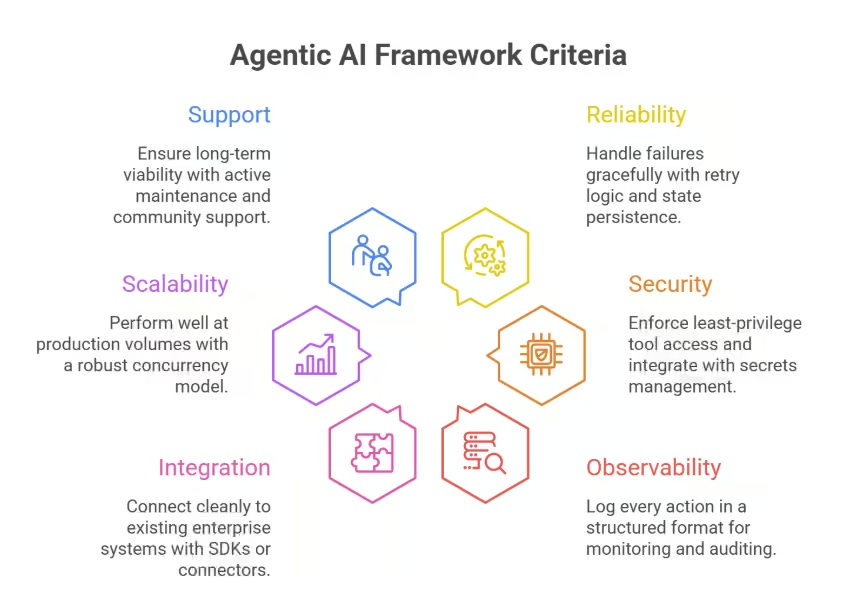
The six criteria discussed below matter most before a framework reaches an enterprise architecture review.
1. Reliability and Fault Tolerance
The framework must handle tool call failures, model errors, and partial workflow completions gracefully, with configurable retry logic, fallback paths, and state persistence that allow workflows to resume rather than restart when individual steps fail.
2. Security and access controls
Enterprise agents need least-privilege tool access enforced at the framework level, with role-based permissions, secrets management integration, and the ability to restrict which tools and data sources each agent can reach.
3. Observability and audit logging
Every agent action, tool call, decision, and reasoning step must be logged in a structured, queryable format that satisfies both operational monitoring requirements and the audit trail demands of regulated industries. Frameworks that treat logging as an afterthought create compliance risk in production.
4. Enterprise system integration
The framework must connect cleanly to the APIs, databases, and authentication systems the enterprise already uses, with SDKs or connector libraries that reduce custom integration engineering.
5. Scalability under production load
Multi-agent workflows that perform well at pilot scale can degrade significantly at production volumes. The framework’s concurrency model, state management architecture, and infrastructure requirements need to be evaluated against the target workflow’s actual transaction volumes.
6. Community and vendor support
Enterprise programs run for years, and the frameworks that serve them best are those with active maintenance, clear deprecation policies, documented migration paths, and either a commercial support tier or a large enough open-source community to ensure long-term viability.
The Five Best Agentic AI Frameworks for Enterprise in 2026
The five frameworks discussed below represent the most mature, widely adopted, and enterprise-relevant options in the agentic AI landscape as of 2026. Each has a distinct architectural philosophy and a distinct enterprise use case profile.
1. LangGraph: open source, LangChain ecosystem
LangGraph is a graph-based agent orchestration framework built on LangChain that models workflows as directed graphs where nodes represent actions or decisions and edges represent transitions between them.
It supports cyclical graphs, meaning agents can loop, revisit earlier states, and branch conditionally, with persistent state management across steps. LangGraph Studio provides a visual debugger that makes complex multi-step workflows inspectable without reading raw logs, which is a significant operational advantage in enterprise environments.
When is LangGraph the best choice?
LangGraph is the strongest choice when the target workflow requires conditional branching, iterative loops, or dynamic plan revision based on intermediate results. It is great for multi-step research synthesis, adaptive customer case resolution, and compliance investigation workflows where the path through the process depends on what each step finds.
Teams already invested in the LangChain ecosystem benefit from native tool and model compatibility. It is the most widely adopted framework for stateful, cyclical enterprise agent workflows in 2026.
Enterprise example
A financial services firm uses LangGraph to orchestrate a regulatory investigation workflow:
- The agent retrieves transaction history, checks counterparty flags
- Loops back to fetch additional context when initial results are inconclusive, and
- Produces a structured case file with full state persistence so workflows resume from the last completed step after any interruption.
2. CrewAI: Open Source, Role-Based Multi-Agent
CrewAI organizes agents into crews, i.e., structured teams of specialized agents, each with a defined role, goal, and set of tools, that collaborate to complete tasks through a combination of sequential and parallel execution.
The framework’s role-based abstraction maps intuitively onto enterprise team structures, making it straightforward to define agents that mirror the responsibilities of human roles in an existing workflow.
CrewAI supports both hierarchical crews, where a manager agent delegates to specialists, and sequential crews, where each agent hands off to the next in a defined pipeline.
When is CrewAI the best choice?
CrewAI is the best choice when the workflow maps naturally to a team of human specialists working in parallel or in sequence. CrewAI is a great option for content production pipelines, multi-source due diligence workflows, product development processes, and any enterprise use case where different subtasks require genuinely distinct capabilities and access to different tools.
The role-based mental model also makes it easier to explain to non-technical stakeholders what each agent does, which accelerates organizational buy-in during enterprise rollout.
Enterprise example
A professional services firm uses CrewAI to automate client due diligence:
- A research agent pulls company filings and news,
- A financial analysis agent processes balance sheet data,
- A risk assessment agent checks sanctions lists and litigation records, and
- A report agent synthesizes the outputs into a structured briefing, all while a senior agent assembles the final deliverable.
3. AutoGen: Open Source, Microsoft Research
AutoGen, developed by Microsoft Research, is a conversational multi-agent framework where agents communicate through structured dialogue to reason about problems, critique each other’s outputs, and arrive at solutions through iterative exchange.
The framework supports heterogeneous agent types, including AI agents, human-in-the-loop agents, and tool-using agents, within the same conversation, and its AutoGen Studio interface allows non-developer users to compose and test multi-agent workflows visually.
AutoGen 0.4 introduced a fully asynchronous, event-driven architecture that significantly improves scalability for production enterprise workloads.
When is AutoGen the best choice?
AutoGen is the strongest choice for workflows where the quality of the output improves through iterative critique and revision. It is suitable for code generation and review, document drafting with multiple review passes, technical troubleshooting that benefits from adversarial challenge between agents, and any workflow where a human-in-the-loop at specific decision points is a governance requirement.
Its deep integration with the Microsoft Azure AI ecosystem makes it the natural choice for enterprises standardized on Azure infrastructure.
Enterprise example
An enterprise technology team uses AutoGen to manage a code review workflow:
- A developer agent generates a solution,
- A critic agent reviews it for security vulnerabilities and logic errors,
- A test agent runs the test suite and reports results, and
- The developer agent iterates until both the critic and test agents clear the output, with a human reviewer looped in for final approval on production deployments.
4. LlamaIndex Workflows: Open Source, LlamaIndex Ecosystem
LlamaIndex Workflows is an event-driven agent orchestration framework built on the LlamaIndex data framework, designed specifically for workflows that combine large-scale document retrieval, knowledge graph queries, and multi-step reasoning over enterprise data.
Steps in a workflow communicate through typed events, making the data flow between steps explicit and inspectable. The framework’s native integration with LlamaIndex’s data connectors, covering document stores, vector databases, SQL databases, and API sources, reduces the integration engineering required to build retrieval-augmented agent workflows over enterprise knowledge bases.
When is LlamaIndex the best choice?
LlamaIndex Workflows is the best choice when the agent’s primary task involves retrieving, synthesizing, or reasoning over large volumes of enterprise documents or structured data.
It can handle contract analysis at scale, knowledge-base question answering, research synthesis across large document repositories, and any workflow in which the quality of retrieval directly determines the quality of agent output.
Teams already using LlamaIndex for retrieval-augmented generation (RAG) pipelines can naturally extend to agentic workflows without rebuilding their data layer.
Enterprise example
A legal technology team uses LlamaIndex Workflows to build a contract analysis agent. The agent ingests thousands of vendor agreements, retrieves relevant clauses based on a compliance checklist, cross-references extracted obligations against regulatory requirements, and produces a structured risk summary. The retrieval and reasoning steps are instrumented separately so the team can tune each layer independently.
5. Anthropic Agent SDK: Commercial, Claude-Native
The Anthropic Agent SDK is a framework for building agents on Claude models, with first-class support for tool use, multi-turn conversation management, and the Model Context Protocol. MCP is Anthropic’s open standard for connecting agents to external data sources and enterprise systems.
The SDK is designed with safety and reliability as primary constraints. It surfaces Claude’s constitutional AI properties at the framework level, supports fine-grained control over what the agent can and cannot do, and produces structured, auditable outputs by design rather than as a configuration option. MCP integration gives it a growing ecosystem of pre-built enterprise connectors.
Also Read: Scaling MCP Server Integration: Patterns and Production Readiness
When is the Anthropic Agent SDK the best choice?
The Anthropic Agent SDK is the strongest choice when safety, auditability, and predictable behavior in edge cases are the primary selection criteria. It is great for compliance-sensitive workflows, customer-facing agents where off-script behavior carries reputational risk, and any enterprise context where the ability to explain and audit every agent decision is a non-negotiable requirement.
Enterprises that have standardized on Claude as their foundation model benefit from the tightest possible integration between the model’s safety properties and the framework’s control architecture.
Enterprise example
A healthcare organization uses the Anthropic Agent SDK to build a prior authorization assistant that retrieves patient records, checks coverage criteria, applies clinical guidelines, and drafts authorization recommendations.
Every reasoning step is logged against the specific guideline applied, with full auditability for regulatory review, and hard stops enforced at the framework level for decision categories that require physician sign-off.
| Framework | Best Use Case Fit | Architecture Style | Enterprise Integrations | Governance & Audit | Open Source | Ideal Team |
|---|---|---|---|---|---|---|
| LangGraph | Stateful, cyclical workflows with conditional branching | Graph-based, persistent state | LangChain tool ecosystem, broad API support | Strong; visual debugger, step logging | Yes (LangChain) | Python teams on LangChain |
| CrewAI | Role-based multi-agent collaboration, parallel task execution | Crew / role-based, sequential or hierarchical | Tool-agnostic, custom integrations | Moderate — role and task logging | Yes | Teams mapping AI to org structures |
| AutoGen | Iterative critique, code gen, human-in-the-loop workflows | Conversational, event-driven (v0.4) | Deep Azure AI ecosystem integration | Strong — structured conversation logs | Yes (Microsoft) | Azure-standardized enterprises |
| LlamaIndex Workflows | Document retrieval, RAG-heavy, knowledge base reasoning | Event-driven, typed step communication | LlamaIndex data connectors, vector DBs, SQL | Moderate — step-level event logging | Yes | Teams with existing LlamaIndex RAG |
| Anthropic Agent SDK | Safety-critical, compliance-sensitive, auditable workflows | Tool use, MCP-native, multi-turn | MCP connector ecosystem, Claude-native | Strongest — constitutional AI, hard stops | Partial (MCP open) | Regulated industry teams on Claude |
How to Choose the Right Agentic AI Framework for Your Enterprise
The framework decision is an architectural commitment with multi-year consequences. The right filter is workflow fit, team stack, and governance requirements evaluated in that order, not community popularity or pilot performance.
Also Read: Enterprise Vibe Coding: A Governance and Security Guide for Engineering Leaders (2026)
1. Workflow complexity
Start here. Cyclical workflows with conditional branching and mid-task plan revision point to LangGraph. Role-based parallel execution across specialized agents fits CrewAI. Iterative critique and human-in-the-loop review suit AutoGen.
Retrieval-heavy workflows over large document sets favor LlamaIndex Workflows regardless of other factors. The Anthropic Agent SDK is the right call when behavioral predictability and auditability are the primary constraints.
2. Team Stack Compatibility
Framework adoption cost includes rebuilding every data connector, authentication integration, and monitoring tool that the existing stack already provides.
A LangChain team extends naturally to LangGraph. An Azure-standardized team reaches production faster with AutoGen. A LlamaIndex RAG team inherits a fully compatible data layer with LlamaIndex Workflows. Stack fit does not override workflow fit, but it determines the time to first production deployment.
3. Governance and Compliance Requirements
Evaluate these as a hard filter before workflow fit or stack, because they cannot be negotiated away in a regulated environment. If the workflow touches patient data, financial transactions, or regulated customer decisions, the framework must produce a complete audit trail by default.
The Anthropic Agent SDK is the only option here where auditability is a first-class architectural feature. AutoGen and LangGraph reach the same standard with deliberate configuration; CrewAI and LlamaIndex Workflows require a more explicit investment in audit architecture.
How RTS Labs Approaches This Decision
RTS Labs evaluates all three dimensions before recommending a framework. It documents the selection rationale as part of the program’s technical decision record. And, lastly, designs integration architecture for programs where the optimal answer combines frameworks, such as LangGraph orchestration layer over a LlamaIndex retrieval backend, so each framework operates within its strength zone.
Also Read: RTS Experiment: We Built a Tiny LLM From Scratch
Best Practices for Deploying Agentic AI Frameworks in Enterprise Environments
Framework selection is the first decision in a production enterprise deployment. The practices below are what production programs get right that pilots typically skip.
☐ Deploy framework infrastructure inside your own security perimeter:
Vendor-managed hosting for agent execution is not an appropriate posture for enterprise production. The framework layer needs to run within your access controls and network policies.
☐ Instrument observability before going live:
Connect framework logging to your existing observability stack at deployment. Retrofitting audit and monitoring capability is significantly more complex and creates retroactive compliance exposure.
☐ Test at production data volumes, not pilot volumes:
Multi-agent workflow performance at pilot scale does not predict production behavior. Load testing against realistic volumes is a launch prerequisite.
☐ Enforce tool access at the framework layer:
Least-privilege access must be enforced architecturally. Permissions should be scoped to the specific workflow and reviewed at each new use case expansion.
☐ Manage all secrets through your enterprise secrets platform:
API keys and credentials used by agent tools must flow through your existing secrets management system. Hardcoded credentials in agent configuration files are an unacceptable production security posture.
☐ Document the framework selection decision with explicit rationale:
Record why the selected framework was chosen, which enterprise-readiness criteria were evaluated, and what the known limitations are. This becomes essential at architecture board reviews and audit inquiries.
☐ Define escalation thresholds before any agent acts in production:
Define and test confidence thresholds, value limits, and case categories that trigger human review must be defined and tested before production launch. Issues discovered post-launch create both operational and compliance risk simultaneously.
☐ Establish a performance review cadence from day one:
Track agent accuracy against production outcomes on a defined schedule, with a formal process for deciding when retraining or reconfiguration is required.
☐ Ensure at least two engineers understand the framework internals:
Single-person framework expertise is an operational risk as serious as any other key person dependency in a critical system.
☐ Run a red-team exercise before launch:
Test the agent against adversarial inputs, edge cases outside its training distribution, and attempts to exceed its authority boundaries. Agents that skip red-teaming carry unpredictable behavior risk in real-world use.
What RTS Labs Can Do for Your Organization
Selecting the right agentic AI framework is the first architectural decision in a multi-year enterprise program, and it is one where getting the reasoning right matters as much as getting the answer right.
RTS Labs brings framework evaluation expertise, enterprise integration experience, and production deployment track record across all five frameworks. We provide the technical grounding to make the selection decision with the full context of your workflow requirements, team capabilities, and governance obligations.
Every RTS Labs agentic AI engagement begins with a framework selection workshop that evaluates the target workflow against the enterprise-readiness criteria, produces a documented architecture decision record, and defines the integration and governance architecture before development begins.
RTS Labs builds with your team throughout, ensuring the framework knowledge transfers alongside the delivered system so your organization can extend, maintain, and audit the program independently as it scales.
Frequently Asked Questions
Q1. Can we use more than one agentic AI framework in the same enterprise program?
Yes, and this is increasingly common in mature programs. The integration architecture needs to be designed deliberately and the frameworks need to share context and pass state cleanly. Combining frameworks by use-case fit is preferable to forcing a single framework into tasks it handles poorly.
Q2. How do these frameworks handle situations in which the underlying model produces incorrect or hallucinated output mid-workflow?
Frameworks handle this differently: LangGraph and AutoGen support retry logic and critic-agent review steps that catch and correct errors before they propagate; the Anthropic Agent SDK enforces output structure constraints that reduce hallucination risk at the framework level.
All frameworks benefit from output validation layers and confidence thresholds that route uncertain outputs to human review rather than propagating them downstream.
Q3. What is the Model Context Protocol, and why does it matter for enterprise framework selection?
The Model Context Protocol is an open standard developed by Anthropic that defines how agents connect to external tools and data sources through a consistent API.
As enterprise software vendors publish MCP-compliant connectors, frameworks that support MCP natively, particularly the Anthropic Agent SDK, gain access to a growing ecosystem of pre-built enterprise integrations, reducing the custom connector engineering required for each new tool connection.
Q4. How does RTS Labs help enterprises that are unsure which framework to start with?
RTS Labs runs a structured framework-selection workshop as the entry point for any agentic AI engagement in which the framework choice has not yet been made. The workshop maps the target workflow against the enterprise-readiness criteria, evaluates team stack compatibility, reviews governance requirements, and produces a documented architecture decision record with a clear recommendation and the explicit reasoning behind it. The workshop is typically completed within two to three days of initial engagement.
Q5. How quickly do these frameworks evolve, and how do we manage the risk of framework deprecation or major breaking changes?
All five frameworks in this guide are under active development with frequent releases, which means production deployments need version-pinning strategies, structured upgrade testing pipelines, and documented migration paths as part of their operational runbooks. LangGraph and AutoGen have the most active release cadences; the Anthropic Agent SDK’s commercial backing provides more explicit deprecation policy and support commitments than the open-source options.