Enterprise operations are generating more data, more decisions, and more process complexity than human teams can manage at scale. Access to information isn’t a problem today. AI agents must act on it consistently across every system and workflow, in real time.
Beyond the operational strain, enterprises also face mounting pressure from compliance requirements, fragmented tech stacks, and talent gaps in specialized functions like finance, logistics, and legal.
Agentic AI systems reason through multi-step tasks, integrate across existing infrastructure, and operate with a degree of autonomy that frees skilled teams to focus on higher-order decisions.
Automation is becoming a reality, and with 40% of enterprise business applications embedding AI agents by the end of 2026 (Gartner), organizations need solutions that build agents capable of executing specific tasks autonomously. This guide covers the seven solutions leading that shift, along with what to look for before choosing one.
At a Glance: 7 Best Agentic AI for Enterprise in 2026
| Solution | Best For | Top Features | Governance & Compliance | Customization | Pricing Model |
|---|---|---|---|---|---|
| RTS Labs | Custom enterprise AI across regulated industries | Custom agent design, HITL checkpoints, Large Language Model Operations (LLMOps), multi-agent orchestration, cross-system integration | ✅ Audit-ready by design | ✅ Fully custom | Custom (engagement-based) |
| Microsoft Copilot Studio | Microsoft-embedded enterprises | Low-code agent builder, Teams/SharePoint/Azure integration, Power Platform connectivity | ✅ Azure AD + compliance center | ⚠️ Ecosystem-scoped | Per-user / consumption |
| Salesforce Agentforce | CRM and revenue-focused automation | Native CRM agents, pre-built sales/service templates, pipeline automation | ✅ Salesforce-native controls | ⚠️ CRM-scoped | Salesforce license tiers |
| UiPath Agentic Automation | RPA-to-agentic migration | Maestro orchestration, bot + agent + human coordination, industry templates | ⚠️ Maturing transparency | ⚠️ Moderate | UiPath license tiers |
| Kore.ai | CX and employee service deployment | Full-suite pre-built agents, Agent Management Platform, governance dashboard | ✅ Role-based access + audit logs | ⚠️ Moderate | Platform subscription |
| ServiceNow AI Agents | IT and internal operations | ITSM/HRSD/GRC integration, incident automation, procurement routing | ✅ Enterprise-grade audit trails | ⚠️ IT/Ops-scoped | ServiceNow license tiers |
| LangChain | Developer-built custom frameworks | Open-source reasoning loops, tool calling, memory management, model flexibility | ⚠️ Requires build-out | ✅ Fully custom | Free (open-source) |
Methodology: How We Selected and Evaluated These Solutions
We compiled this list through a review of third-party analyst reports (Gartner, Forrester, Everest Group), publicly available product documentation, and customer review platforms, including G2 and Gartner Peer Insights.
Solutions were evaluated across five dimensions:
- Depth of agentic reasoning capability
- Enterprise governance and compliance readiness
- Integration breadth across enterprise systems
- Customization flexibility
- Time-to-value for production deployment.
Each solution was assessed in the context of regulated, complex enterprise environments rather than developer sandboxes or SMB use cases. The list reflects the diversity of enterprise needs in 2026, from pre-built platforms to custom development partners.
The 7 Best Agentic AI Solutions for Enterprise in 2026
The market for enterprise agentic AI is expanding fast, but the right fit depends on your workflows, your stack, and your compliance environment. Here’s what each solution does best.
1. RTS Labs: Best Custom Agentic AI Partner for Enterprise
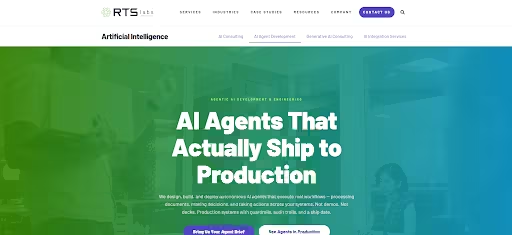
To understand RTS Labs, it helps to distinguish between a platform and a partner. A platform gives your team tools and expects you to build. A partner sits alongside your team, learns your business, designs the architecture, builds the agents, and ensures the system delivers results in production. RTS Labs is the latter, and in a market crowded with platforms, that distinction matters.
With 14+ years of enterprise software delivery and 600+ satisfied clients across Finance, Insurance, Logistics, and Real Estate, RTS Labs brings hard-won expertise to every engagement. Their agentic AI systems are built from the ground up around your data, your compliance environment, and your operational logic: fully custom, fully owned by your organization.
Also Read: RTS Experiment: We Built a Tiny LLM From Scratch
RTS Labs’ Key Features: What defines the RTS Labs’ approach
- 90-day brief-to-ship model: From initial discovery to production deployment in weeks rather than quarters. Enterprise transformation moves at the speed of business.
- Human-in-the-Loop (HITL) checkpoints: Every agent is designed with structured human oversight at high-stakes decision points, so organizations retain full control while agents handle the heavy lifting.
- GenAI Ops (LLMOps) infrastructure: Agents are built on a foundation of stability, observability, and scalability, engineered to perform reliably in production environments and at enterprise scale.
- Governance and compliance by design: Every agent is explainable, traceable, and audit-ready. In regulated industries, this is the difference between a deployable system and a compliance liability.
- Cross-system integration: Agents connect with ERP systems, CRMs, data warehouses, legacy databases, and compliance tools, operating across the full enterprise technology stack.
- Multi-agent orchestration: RTS Labs architects systems where multiple agents collaborate, each handling a specialized function, coordinated by an intelligent control layer.
A telling example from production: RTS Labs’ Bennett invoice processing agent processes handwritten scans, inconsistent document formats, and incomplete fields, the exact inputs that cause traditional RPA workflows to fail. It handles them autonomously, at scale, with full audit trails.
RTS Labs’ Industries served
Finance & Banking, Insurance, Logistics & Supply Chain, Real Estate, Healthcare
RTS Labs is Best for
Mid-to-large enterprises that need production-grade, audit-ready autonomous agents built around their specific workflows and industry requirements.
RTS Labs is a great choice when your organization has complex, multi-system workflows with compliance requirements, industry-specific data, and a need for results on a defined timeline. You want a team that builds the solution alongside you and stands behind it in production.
👉 Get your free Agent Roadmap from RTS Labs →
2. Microsoft Copilot Studio: Best for Microsoft-Embedded Enterprises
Microsoft Copilot Studio brings agentic AI into the Microsoft product universe through a low-code development environment. Teams can design, configure, and deploy AI agents that operate across Teams, SharePoint, Power Platform, and Azure services, all within a familiar interface governed by the same security and identity infrastructure enterprises already trust.
The platform’s strength is its depth of integration within Microsoft’s ecosystem. An agent built in Copilot Studio can surface information from SharePoint, trigger workflows in Power Automate, and communicate through Teams channels with minimal custom development. For organizations whose primary workflows live inside Microsoft products, this offers a coherent and relatively fast path to agentic deployment.
Workflows that extend beyond the Microsoft environment tend to require pro-code extensions and additional engineering investment. Per-user licensing also warrants careful evaluation as deployments scale.
Microsoft Copilot Studio is Best for
It is fit for organizations standardized on Microsoft 365, Azure, Teams, and Dynamics seeking agentic capabilities within that ecosystem. Your enterprise is deeply invested in the Microsoft stack, and your highest-priority agentic use cases sit squarely within that environment.
3. Salesforce Agentforce: Best for Sales and Service-Led Enterprises
Salesforce Agentforce embeds agentic AI directly into the CRM layer, giving sales, service, and marketing teams autonomous agents that can manage outreach, resolve cases, escalate service tickets, and coordinate pipeline activity. Because the agents operate natively within Salesforce’s data model, they have immediate access to customer records, interaction history, and business rules, which is exactly the context that makes agentic reasoning genuinely useful in a CRM environment.
For organizations where Salesforce serves as the central system of record, Agentforce represents a compelling and low-friction option. The pre-built agent templates cover the most common CRM automation scenarios, and deployment timelines are relatively fast for teams already familiar with the platform.
Organizations seeking to automate back-office operations, supply chain logistics, financial processes, or cross-functional workflows will find the platform’s reach more constrained by design. Enterprise licensing tiers also reflect Salesforce’s premium positioning in the market.
Salesforce Agentforce is Best for
Enterprises where customer-facing revenue workflows represent the primary automation opportunity. Automating customer-facing revenue, service, and marketing workflows is your organization’s primary agentic AI priority, and Salesforce is where that work lives.
4. UiPath Agentic Automation: Best for RPA-to-Agentic Migration
UiPath occupies a distinctive position in the agentic AI landscape: it is the bridge between the RPA era and the agentic era. Through its Maestro orchestration layer, UiPath allows enterprises to run existing bots alongside new AI agents and human workers in coordinated, unified workflows. Organizations that have spent years building out RPA infrastructure can extend that investment rather than replace it.
This evolutionary approach has real appeal for large enterprises where RPA is deeply embedded across operations. Finance, healthcare, and customer service teams in particular benefit from industry-specific pre-built agent templates. The Maestro layer provides visibility across the coordination of bots, agents, and people, delivering a unified operational picture that can be difficult to achieve when these components run in isolation.
Enterprises evaluating UiPath should account for two practical realities. The transparency of AI decision logic in complex agentic workflows is still maturing, which can make debugging and auditing more involved. Licensing is also priced at a level that works best for organizations already within the UiPath ecosystem.
UiPath is Best for
Enterprises with established RPA deployments seeking to evolve toward autonomous AI while preserving existing automation assets. Your enterprise has meaningful RPA investments and wants to layer agentic reasoning on top of existing automation, progressing incrementally rather than rebuilding from scratch.
5. Kore.ai: Best Pre-Built Platform for CX and Employee Service
Kore.ai approaches agentic AI as a full-suite platform, covering customer experience, workplace productivity, IT support, HR service, and operational workflows through a coordinated set of pre-built AI agents. The architecture is designed for enterprises that want to deploy quickly across multiple functions without constructing each component from scratch.
What distinguishes Kore.ai among enterprise platforms is its governance infrastructure. The Agent Management Platform provides a single governance model across multiple agent frameworks (LangGraph, CrewAI, AutoGen), allowing organizations to manage agents consistently regardless of the underlying framework. An AI governance dashboard with audit logs and role-based access controls gives compliance teams the visibility they require.
The platform’s pre-built orientation is a deliberate design choice that accelerates deployment for standard use cases. For organizations with highly specialized workflows or unique data environments, additional configuration work is required to achieve the necessary level of customization.
Kore.ai is Best for
Enterprises seeking a mature, ready-to-deploy agentic platform for customer experience and employee-facing service workflows. You want an enterprise-ready platform to deploy across customer service and employee experience functions, with governance tooling built in and a relatively fast path to production.
6. ServiceNow AI Agents: Best for IT and Operations Automation
ServiceNow has spent years building one of the most comprehensive enterprise workflow platforms in the market, and its AI agents extend that depth into autonomous territory. Agents embedded in the ServiceNow platform can handle IT incident resolution, HR service requests, procurement approvals, and cross-departmental case routing, all tasks that represent significant manual overhead in large organizations.
The platform’s greatest strength is its proven enterprise foundation. Change management processes, compliance capabilities, and audit trails are mature and well-documented. For organizations already running ServiceNow as their operational backbone, activating AI agents is a natural progression with familiar tooling and governance structures.
Use cases outside IT and internal operations tend to require additional customization. For enterprises new to ServiceNow, implementation timelines and overhead are worth factoring carefully into any adoption plan.
ServiceNow is Best for
Large enterprises that prioritize autonomous automation of IT service management, HR workflows, and internal operations. Your enterprise runs ServiceNow, and your highest-value automation opportunities sit within IT service management, HR operations, or internal workflow management.
7. LangChain: Best for Developer Teams Building Custom Agent Frameworks
LangChain is an open-source framework for building agentic AI systems from foundational components. It provides the building blocks for reasoning loops, tool calling, memory management, and multi-step workflow orchestration, giving developers the flexibility to construct agents that fit any architecture, integrate with any model, and operate on any data source.
Among developers working on custom agentic systems, LangChain has become one of the most widely used foundations. The active open-source community produces extensive tooling, integrations, and shared knowledge. For teams building proprietary agent infrastructure or experimenting with novel agentic architectures, this flexibility is genuinely valuable.
The tradeoff is the scope of responsibility. LangChain is a framework, and frameworks require builders. Production-grade enterprise deployment demands observability tooling, governance infrastructure, security controls, and ongoing maintenance, all of which each team must design, build, and sustain independently.
LangChain is Best for
Engineering-led organizations with capable AI and machine learning teams who want full architectural control over their agentic systems. Your organization has a strong AI/ML engineering team and the mandate to build a proprietary agentic system with full architectural ownership.
Here’s a head-to-head comparison between the 7 best agentic AI solutions for enterprises in 2026:
| Solution | Best For | Custom Workflows | Enterprise Governance | Time-to-Value | Industry Depth |
|---|---|---|---|---|---|
| RTS Labs | Custom enterprise AI | ✅ Full custom | ✅ Built-in HITL + audit | 🏆 90 days | ✅ Finance, Insurance, Logistics, RE |
| Microsoft Copilot Studio | Microsoft ecosystem | ⚠️ Ecosystem-scoped | ✅ Azure-native | Fast (in-ecosystem) | ⚠️ General |
| Salesforce Agentforce | CRM/sales workflows | ⚠️ CRM-scoped | ✅ Strong | Fast (in-ecosystem) | ⚠️ CX-only |
| UiPath Agentic | RPA-to-AI migration | ⚠️ Moderate | ⚠️ Maturing | Moderate | ⚠️ General |
| Kore.ai | CX + employee service | ⚠️ Moderate | ✅ Good | Moderate | ⚠️ Service-focused |
| ServiceNow AI | IT + operations | ⚠️ IT/Ops-scoped | ✅ Strong | Slow (high overhead) | ⚠️ IT/Ops-only |
| LangChain | Developer builds | ✅ Full custom | ⚠️ Requires build-out | Slow (build-heavy) | ⚠️ Requires build-out |
Why Enterprises Need Agentic AI Solutions
Enterprise organizations operate at a scale and complexity that exposes the hard limits of traditional automation. Several challenges have converged to make agentic AI a strategic priority in 2026.
1. Process fragmentation across systems
The average enterprise runs dozens of disconnected platforms, including ERPs, CRMs, data warehouses, compliance tools, and legacy databases. Workflows that cross these systems require constant human coordination to bridge the gaps. Agentic AI can operate natively across this stack, executing tasks that span multiple systems without manual handoffs.
2. Exception handling at volume
Rule-based RPA works until it hits something unexpected — an unusual document format, a missing field, or an ambiguous business rule. At enterprise volumes, exceptions are constant. Agentic AI evaluates exceptions in context and determines the appropriate path forward, dramatically reducing the number of tasks that escalate to human review.
Also Read: AI Automation ROI: How to Calculate It (and Why Most Companies Get It Wrong)
3. Compliance and audit pressure in regulated industries
In finance, insurance, healthcare, and legal, every automated decision carries regulatory weight. Generic automation tools were seldom built with explainability, traceability, or audit-readiness in mind. Enterprises in regulated sectors require AI systems with governance embedded by design, not bolted on after the fact.
4. Talent gaps in specialized functions
Skilled analysts, compliance officers, and operations managers are scarce and expensive. Agentic AI systems can absorb a significant portion of the high-volume, repetitive, judgment-intensive work these roles currently handle, extending the reach of that expertise across more tasks and more consistently.
5. Speed-to-decision in competitive environments
Markets move faster than quarterly planning cycles. Enterprises that can automate intelligence gathering, analysis, and execution in near real time operate with a structural advantage over those that depend on manual processes.
| Enterprise Challenge | Agentic AI Feature That Addresses It |
|---|---|
| Fragmented systems and manual handoffs | Cross-system integration and multi-agent orchestration |
| High exception rates in automation | Contextual reasoning and adaptive decision-making |
| Compliance and audit requirements | Explainability, traceability, and HITL governance |
| Talent gaps in specialized functions | Autonomous task execution with human oversight checkpoints |
| Slow decision cycles | Real-time workflow orchestration across data sources |
Outcomes Enterprises Achieve with Agentic AI
Organizations that deploy agentic AI in production report outcomes across three dimensions.
- Operationally, they see faster cycle times across finance processing, customer service resolution, and supply chain coordination, with tasks that previously took hours or days completing in minutes.
- Financially, the reduction in manual labor overhead, error rates, and escalation costs generates measurable ROI within the first year of deployment.
- Strategically, agentic AI creates a compounding advantage: systems that learn from operational data over time become progressively better at handling the complexity they were built for, widening the gap between early adopters and organizations still operating on manual or rule-based processes.
Also Read: Agentic AI Governance Framework: From Policy Documents to Production Controls
How to Choose the Right Agentic AI Solution for Your Enterprise
Every enterprise that reaches this decision point is asking a version of the same question: given our industry, our existing systems, our compliance environment, and our timeline, what is actually the right fit? Five dimensions tend to matter most.
1. Platform versus partner
Platforms hand your team tools. Partners build solutions alongside you. Standard, well-defined use cases such as CRM automation, IT ticketing, and HR workflows tend to be well served by platforms with pre-built templates. Complex, multi-system workflows specific to your business model tend to benefit from a partner who can design around your actual operational reality.
2. Time horizon
Enterprise AI transformation is urgency-sensitive. A solution that requires 18 months of implementation before delivering value carries a real opportunity cost. The 90-day delivery model that RTS Labs brings to each engagement is a meaningful differentiator for organizations that need results on a business timeline.
3. Long-term operability
The true cost of an agentic AI system includes the ongoing work of monitoring, maintaining, and evolving it. Systems built with LLMOps infrastructure baked in remain stable and observable over time, reducing the internal engineering burden of keeping them running.
4. Compliance and governance
Finance, insurance, healthcare, and other regulated industries carry audit requirements that most generic agentic platforms were not designed to meet. A system built with explainability, traceability, and human oversight from the start is a fundamentally different artifact than one where governance was added as an afterthought.
5. Integration depth
Agentic AI reaches its full potential when it operates across the entire enterprise technology stack, connecting data from ERPs, CRMs, legacy databases, and external APIs into a coherent, orchestrated workflow. The breadth of integration capability is worth evaluating carefully before committing to any solution.
Why RTS Labs Outperforms the Field for Enterprise Agentic AI
The other solutions on this list are well-built products serving real enterprise needs. The important distinction is that each of them is a product designed around a predefined scope, a fixed integration set, and a general-purpose governance model.
RTS Labs operates differently. Every engagement begins with your organization’s specific operational reality: the systems you run, the industry you operate in, the compliance requirements you carry, and the workflows you need to transform. The agents RTS Labs builds are designed from that reality outward, not adapted from a template inward.
This difference shows up in three concrete ways.
Governance that matches your regulatory environment. Finance teams need different audit structures than logistics operations. Insurance workflows carry different explainability requirements than real estate transactions. RTS Labs engineers compliance into the architecture of each agent, specific to the regulatory context of the industry being served. Generic platforms offer governance features. RTS Labs offers governance that fits.
Integration across the full stack, beyond any single ecosystem. Every platform on this list integrates well within its own universe: Microsoft within Microsoft, Salesforce within Salesforce. RTS Labs builds agents that operate across all of it: connecting legacy databases to modern CRMs, linking ERP outputs to compliance tools, and orchestrating decisions across systems that were never designed to talk to each other.
Delivery certainty at 90 days. Enterprise AI projects have a poor track record on delivery timelines. RTS Labs’ structured brief-to-ship model exists precisely to address that. A defined discovery process, a clear architecture phase, and a production deployment target within 90 days convert agentic AI from a strategic aspiration into a running system.
For organizations that need production-grade, audit-ready agentic AI — tailored to their industry, data, compliance requirements, and operational workflows, and live within 90 days — RTS Labs is the partner built for exactly that work.
👉 Book your free Agent Roadmap session with RTS Labs →
Frequently Asked Questions
1. What are the most important features to look for in an enterprise agentic AI solution?
Prioritize four capabilities: multi-step reasoning (the agent plans and adapts, going beyond simple execution), cross-system integration (it works across your full tech stack), enterprise governance (explainability, audit trails, HITL controls), and production-grade scalability. Solutions that check all four are genuinely enterprise-ready; those that check two or three are better suited to narrower use cases.
2. What is the difference between agentic AI and traditional RPA?
RPA follows fixed rules and fails on exceptions. Agentic AI reasons through ambiguity, adapts to changing inputs, and makes contextual decisions across multi-step workflows. RPA is a script. Agentic AI is closer to a knowledgeable colleague who understands the goal and figures out how to reach it.
3. How long does it take to deploy an enterprise agentic AI system?
It depends significantly on the complexity of workflows and the approach. Pre-built platforms can activate initial use cases in weeks. Custom-built systems through partners like RTS Labs follow a structured 90-day brief-to-ship model, moving from discovery through production deployment, which is considerably faster than the 12-to-18-month timelines typical of enterprise AI projects built without a structured delivery framework.
4. How do enterprises ensure agentic AI remains compliant in regulated industries?
Compliance requires three things from the AI system itself: explainability (every decision can be traced to its inputs and reasoning), audit trails (a complete log of agent actions and outcomes), and human-in-the-loop checkpoints (structured escalation paths for high-stakes decisions). Organizations in regulated sectors should confirm that governance is built into the agent architecture from the start rather than added as a reporting layer afterward.
5. What is the best practice for scaling agentic AI across an enterprise?
Start with one high-impact workflow, instrument it thoroughly (observability, logging, error handling), and establish a governance baseline before expanding. Scaling works best when the first deployment creates a reusable infrastructure pattern covering integration connectors, data pipelines, and governance templates that subsequent agents can inherit rather than rebuild from scratch.
6. Can agentic AI integrate with legacy systems that were not designed for AI?
Yes, and this is one of the most common challenges RTS Labs is engaged to solve. Agentic integration with legacy systems typically involves building custom API layers, structured data extraction pipelines, or event-driven connectors that translate legacy outputs into formats agents can reason over. The technical complexity is real but solvable, and organizations that invest in this integration layer unlock automation across workflows that other approaches simply cannot reach