According to a BDC Network industry survey, 87% of construction projects report delays, while 65% cite supply chain disruptions as a key cause.
These delays and disruptions have their root in a fundamental problem that the construction industry has been suffering from for a long time.
Until now, the burden has always been on manual coordination. Even though many construction firms have built IM tools, ERP systems, and IoT sensors, they lack autonomous intelligence to adapt when conditions change.
But today, AI agents act as a digital site manager that constantly monitors every schedule, sensor, and supplier feed, then predicts risks and acts before disruptions happen. AI agents are driving decisions and actions rather than simply recording data.
This article explores what AI agents are, how they operate in construction workflows, and how firms can implement them with help from partners like RTS Labs to boost efficiency, safety, and cost control.
What Are AI Agents for Construction?
AI agents for construction are specialized autonomous systems designed to understand, plan, and act within construction-specific workflows, including project scheduling, resource allocation, safety monitoring, and compliance tracking.
What Are AI Agents?
AI agents are intelligent software systems capable of reasoning, planning, and taking actions autonomously to achieve specific goals. Traditional automation follows pre-set rules, but AI agents continuously analyze data, make context-aware decisions, and learn from outcomes to improve performance over time.
These agents interpret real-time data from BIM models, IoT sensors, project management tools, and ERP systems to turn fragmented site activity into intelligent, coordinated decisions.
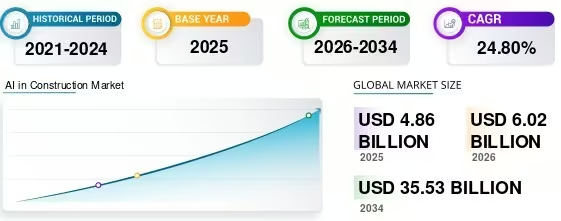
The scale and growth potential of AI agent adoption in construction have been on the rise. According to Fortune Business Insights, the global AI in construction market was valued at USD 4.86 billion in 2025 and is projected to grow from USD 6.02 billion in 2026 to USD 35.53 billion by 2034, at a CAGR of 24.80%.
Core Capabilities in Construction AI Agents
AI agents for construction are capable of forecasting, optimizing, and executing, so human teams can focus on strategy, safety, and innovation.
Project Planning And Scheduling
AI agents dynamically adjust project timelines in response to real-world variables like labor shortages, equipment downtime, or adverse weather to automatically reallocate crews and update schedules to keep construction on track.
Safety And Risk Monitoring
Agents analyze IoT sensor feeds, camera footage, and site data to detect hazards early, such as unsafe machinery proximity or worker fatigue, and instantly alert supervisors to prevent accidents.
Resource And Equipment Management
These agents continuously monitor equipment utilization and material flow across sites, predicting when machinery like cranes or excavators will need maintenance before a costly breakdown occurs.
Quality And Compliance Assurance
AI agents review on-site imagery and documentation to ensure construction standards are met to flag non-compliant installations or missing inspection data automatically.
Collaboration And Reporting
They connect data across project management, ERP, and BIM tools to create unified visibility for automatically generating daily progress or compliance reports and sharing them across all stakeholder groups.
Also Read:
- AI Readiness Checklist: 9 Simple Steps To Follow
- Agentic AI vs Generative AI: What Enterprises Need to Know
- Agentic AI Use Cases Explained: From Automation to Autonomous Enterprises
How AI Agents for Construction Work
AI agents function as a coordinated intelligence layer that connects people, processes, and platforms in real time. They gather data from multiple systems, interpret context, make decisions, and then act faster and more consistently than human teams can.
Here’s how the architecture and workflow typically unfold:
1. Data Ingestion and Context Building
AI agents collect structured and unstructured data from sources like:
- BIM models and ERP systems
- IoT sensors (equipment, temperature, vibration)
- Project management tools (Procore, Primavera, MS Project)
- Field reports, RFIs, and design documents
2. Understanding and Reasoning
The agent uses machine learning and reasoning engines to interpret the data context for understanding project progress, resource dependencies, or potential risks.
For example, if an excavator is underperforming and weather forecasts predict heavy rain, the agent recommends rescheduling outdoor tasks and reallocating labor.
3. Decision-Making and Planning
The agent applies predictive analytics to simulate scenarios and generate optimal plans.
It weighs factors such as labor efficiency, material delivery times, and safety constraints.
For instance, when detecting a supplier delay, the AI agent automatically adjusts the project schedule and recommends alternative procurement options.
4. Autonomous Action and Execution
Once a decision is made, the agent acts through integrated systems to update dashboards, send alerts, or execute pre-approved actions, such as updating the ERP system with new cost estimates or reassigning tasks in the project management tool.
5. Continuous Feedback and Learning
Through closed-loop feedback, the agent measures outcomes, learns from results, and refines future actions. For example, after detecting recurring safety issues, the agent learns to trigger earlier preventive measures or retrain workers automatically.
Technology Stack Behind AI Agents
AI agents in construction don’t just automate tasks. They create living, adaptive ecosystems where data, machines, and humans collaborate seamlessly.
| Component | Purpose | Example Technology |
|---|---|---|
| Reasoning Engine | Multi-step task planning and contextual reasoning | GPT-4, Claude 3, or Llama 3 integrated with LangChain |
| Data Layer | Aggregates BIM, IoT, and ERP data streams | Snowflake, Azure Data Lake, AWS IoT Core |
| Integration Layer | Connects enterprise systems via secure APIs | MuleSoft, Zapier for enterprise, custom RTS Labs connectors |
| Monitoring And Governance | Ensures compliance, traceability, and explainability | Prometheus, Grafana, custom RTS Labs dashboards |
Benefits of AI Agents in Construction
AI agents are changing how construction projects are managed. They control end-to-end processes, including predictive planning, safety oversight, cost control, and sustainability.
Traditional automation tools are capable enough to just execute tasks, but AI agents adapt, reason, and improve outcomes in real time. In a PwC survey, 73% of the respondents said that how they use AI agents will give them a significant competitive advantage in the next 12 months.
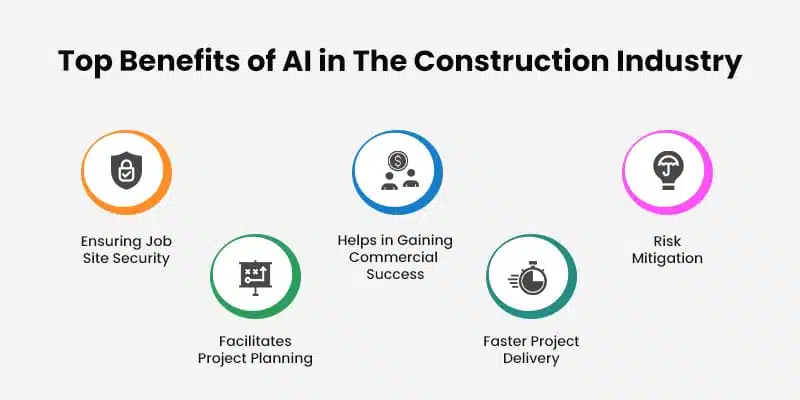
Here’s how they deliver measurable impact across the project lifecycle:
1. Project Efficiency and Scheduling Accuracy
AI agents streamline project planning by continuously analyzing site progress, material availability, and workforce capacity. They detect potential delays weeks in advance, helping project managers make proactive decisions.
2. Enhanced Site Safety and Risk Mitigation
AI agents monitor IoT sensors, CCTV feeds, and wearable data to detect unsafe conditions such as proximity violations or fatigue risks. They automatically flag hazards and trigger corrective actions before accidents occur.
3. Predictive Maintenance and Equipment Uptime
AI agents monitor heavy equipment telemetry to predict maintenance needs before breakdowns occur to minimize downtime and repair costs. They also coordinate maintenance schedules without disrupting ongoing work.
4. Cost Control and Financial Accuracy
By analyzing supplier data, material usage, and labor trends, AI agents detect anomalies early and recommend budget reallocations. This ensures financial transparency and prevents cost creep across multi-phase projects.
5. Quality Assurance and Sustainability
AI agents use computer vision and NLP to inspect site photos, scan reports, and validate compliance with environmental and building codes. They ensure sustainable practices by optimizing material consumption and tracking emissions. For instance, a well-known company’s AI-powered inspection agents reduced rework by 30% and cut waste disposal costs by 15%.
7 Key Use Cases of AI Agents for Construction
AI agents are managing varied use cases for construction companies today. Within the project lifecycle, each use case represents a practical step toward a fully connected, intelligent project ecosystem, where agents don’t just support decision-making but drive it.
Predictive Maintenance and Equipment Reliability
A 2026 industry report found that the average heavy equipment fleet lost 14% of its annual operating hours to unplanned breakdowns in 2025 — and early adopters of AI predictive maintenance are already seeing equipment downtime drop by up to 45%. AI agents monitor equipment performance data, such as vibration levels, engine temperature, and fuel consumption, to forecast when machinery will require maintenance or replacement. This prevents costly breakdowns and improves asset lifespan.
Safety Monitoring and Risk Prevention
AI agents use computer vision and sensor data to analyze real-time site footage and detect hazards like unsafe gear, perimeter breaches, or equipment proximity violations. They issue automated alerts, ensuring human safety supervisors can act immediately. IoT-based wearables can reduce onsite accidents by 25%, as per a study. Further, independent studies show that AI-monitored construction sites experience 40–60% fewer safety incidents compared to traditionally monitored sites.
Project Scheduling and Optimization
AI agents dynamically update project schedules in response to weather delays, labor shortages, or supply chain disruptions. They can simulate alternate scenarios to maintain progress and minimize bottlenecks.
Quality Control and Inspection Automation
AI agents powered by computer vision can scan construction photos and detect surface cracks, alignment errors, or deviations from blueprints, automating parts of quality assurance. This drastically reduces manual inspection time and costly rework. A study reveals that AI-driven BIM can reduce design errors by 40%.
Supply Chain and Material Optimization
AI agents coordinate procurement and delivery schedules, track vendor reliability, and predict material demand to prevent stockouts or surpluses. They can even suggest local suppliers for sustainability gains.
Cost Estimation and Budget Tracking
AI agents analyze past projects to accurately estimate material, labor, and equipment costs, flagging anomalies as projects evolve. This ensures tighter cost control and financial transparency.
Sustainability and Carbon Tracking
AI agents track resource use, waste generation, and emissions for data-driven sustainability reporting and compliance with green building certifications. They recommend optimizations for energy, water, and material usage.
Case Study: How RTS Labs Assisted a Rental Company With DevOps Efficiency
A short-term housing rental company sought to overhaul its DevOps pipeline to reduce infrastructure downtime and accelerate releases. RTS Labs guided the client through remote workshops and deployed the following:
- Built infrastructure on Google Cloud Platform (GCP) with auto-scaling node pools, artifact registries, and load-balancers
- Deployed containerized services to Google Kubernetes Engine (GKE) with lifecycle policies and governance
- Generated architecture diagrams, workflow documentation, and current-versus-future-state analysis
The result was improved deployment speed, reduced maintenance burden, and shortened feedback loops, positioning the company to scale efficiently and securely.
How to Integrate AI Agents into Construction Workflows
Adopting AI agents in construction isn’t about replacing human expertise. Rather, it’s about augmenting teams with intelligent systems that handle repetitive tasks, manage data complexity, and make operations more adaptive.
In a within-subject study of a multi-agent conversational AI system for construction workers, researchers observed improvements of 18% in usability, 40% in self-determination, 60% in social presence, and trust.
Yet, many firms struggle to move from pilot projects to enterprise-scale deployment. The key lies in having a clear, phased integration roadmap.
Below is a structured guide construction leaders can follow:
Step 1: Define Objectives and Measurable KPIs
Start by identifying pain points, such as project delays, safety incidents, or maintenance bottlenecks. Establish success metrics like reduced downtime, improved schedule adherence, or lower rework costs.
Step 2: Assess Data Readiness
AI agents thrive on clean, connected data. Audit existing systems like BIM, ERP, IoT sensors, and field apps to identify data silos and inconsistencies.
Step 3: Choose the Right Integration Model
Firms can pick between:
- Off-the-Shelf AI Agents: Quick to deploy but limited flexibility.
- Custom AI Agents: Tailored to specific workflows, scalable, and designed to integrate with ERP, IoT, and compliance systems.
Also Read: Off-the-shelf vs Custom AI Solutions (blog link)
Step 4: Pilot One Use Case
Start small with a single, high-value workflow, e.g., safety monitoring or scheduling.
Run the pilot for 8–12 weeks, gather user feedback, and assess ROI before scaling.
Step 5: Integrate and Scale Across Systems
Once validated, connect AI agents with BIM, ERP, CRM, and IoT layers via secure APIs. Ensure interoperability between departments for safety, scheduling, and procurement to break workflow silos.
Step 6: Establish Human-in-the-Loop (HITL) Governance
AI agents in construction deal with high-stakes operations. A human-in-the-loop (HITL) framework ensures critical decisions, like compliance overrides or schedule changes, get hu
Step 7: Monitor, Measure, and Improve
Deploy monitoring dashboards to track accuracy, adoption, and ROI. Feed new data and human feedback back into the models for continuous improvement.
Challenges And Ethics in Deploying AI Agents for Construction
While the promise of AI agents in construction is immense, real-world implementation often collides with fragmented data, legacy systems, and human trust gaps. Addressing these challenges isn’t just about technology. It’s about responsible adoption, transparency, and long-term sustainability.
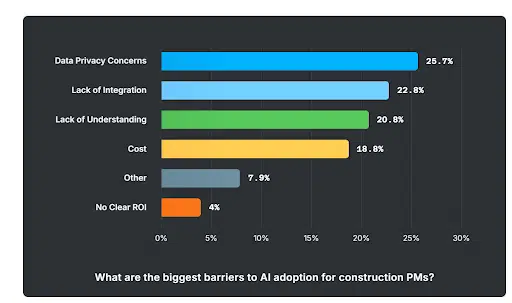
Below are the most pressing challenges construction firms face and how RTS Labs helps mitigate them:
1. Data Fragmentation and Inconsistent Sources
Construction data is notoriously scattered across ERP systems, BIM models, IoT devices, and spreadsheets. When AI agents lack unified access to this information, predictions falter and automation breaks down.
RTS Labs builds end-to-end data integration pipelines that consolidate structured and unstructured data, creating a single source of truth for agents to reason with.
2. Legacy System Integration
Many firms still rely on outdated project management systems that weren’t designed for AI interoperability. Without seamless API or middleware connections, automation efforts remain siloed.
RTS Labs engineers specialize in integrating AI agents into legacy ecosystems through modular APIs and microservices, reducing infrastructure disruption while enabling gradual modernization.
3. Workforce Adoption and Trust
AI adoption in construction often meets human resistance. Workers may distrust AI’s decisions or fear job displacement. Success depends on collaboration, not replacement, pairing AI recommendations with transparent reasoning.
RTS Labs helps organizations design Human-in-the-Loop (HITL) frameworks and explainable dashboards that visualize how AI agents make decisions, building user confidence.
4. Model Bias and Accountability
AI systems trained on biased or incomplete data can produce unfair or unsafe outcomes, e.g., deprioritizing smaller subcontractors or misjudging risk in minority-owned projects.
Ensuring ethical integrity requires both technical and organizational controls.
RTS Labs implements bias detection audits, diverse data sampling, and continuous model validation to ensure fairness and reliability.
5. Regulatory and Compliance Complexity
AI agents in construction must comply with OSHA, ISO, and regional building codes, while handling sensitive employee and vendor data. Unmonitored automation can risk non-compliance or create audit blind spots.
RTS Labs embeds AI governance modules that track decision logs, compliance checkpoints, and automated audit trails for improved traceability and regulatory readiness.
6. Ethical Oversight and Worker Safety
When AI agents make autonomous site decisions, ethical oversight becomes critical, especially in safety-sensitive contexts. Automation must enhance, not endanger, human safety.
RTS Labs prioritizes AI ethics-by-design, ensuring that agents never bypass human review on high-stakes actions like safety overrides or compliance approvals.
Off-the-Shelf vs Custom AI Agents for Construction
When adopting AI agents, construction firms often face a strategic choice whether to deploy off-the-shelf solutions from software vendors or develop custom agents tailored to their specific workflows and data. Each approach offers distinct advantages. However, the right decision depends on scale, complexity, and compliance needs.
| Criteria | Off-the-Shelf AI Agents | Custom AI Agents (RTS Labs) |
|---|---|---|
| Deployment Speed | Rapid setup Minimal customization |
Longer build cycle, but fully tailored |
| Cost Structure | Lower upfront subscription or license fees | Higher initial investment Lower long-term TCO |
| Flexibility And Scalability | Limited to vendor-defined use cases | Scales across projects, data sources, and workflows |
| Integration | Works best within vendor ecosystems, e.g., Autodesk, Procore | Seamlessly integrates with BIM, ERP, IoT, and legacy systems |
| Data Control And Compliance | Vendor retains partial control of data flows | Full enterprise ownership, ideal for regulated projects |
| Performance And Custom Logic | Generic models optimized for broad use | Domain-specific reasoning, tuned to firm-level data |
| Support And Maintenance | Vendor-led updates and feature cycles | Continuous optimization, retraining, and governance via RTS Labs |
When Off-the-Shelf Works Best
Off-the-shelf AI solutions work best for:
- Small to mid-size contractors needing quick automation for document control or scheduling
- Firms with limited AI infrastructure or IT staff
- Pilot projects where ROI validation precedes large-scale investment
When Custom AI Agents Make Strategic Sense
Custom AI solutions work best for
- Large or multi-site enterprises with complex interdependencies across planning, safety, and supply chain
- Regulated projects requiring traceability, explainability, and auditability
- Organizations aiming to integrate AI across BIM, ERP, and IoT ecosystems for predictive decision-making
Related Read: Best Ai Agent Development Companies
Hybrid Approach: The Smart Middle Ground
Many construction firms now adopt a hybrid strategy. They start with vendor-provided AI features, then extend them with custom agents for predictive and autonomous decision-making. This model balances speed with specialization, ensuring fast ROI and long-term scalability.
Top AI Agents for Construction Projects
AI agents are now embedded across nearly every layer of construction operations. Below are some of the most impactful AI agent solutions used in 2026.
| Agent Name | Core Functionality | Impact | Limitations |
|---|---|---|---|
| RTS Labs Custom AI Agents | End-to-end, agentic automation across scheduling, maintenance, compliance, and ESG reporting. | Improved deployment speed, reduced maintenance burden, and shortened feedback loops | A bit time-consuming, given the comprehensive and extensive nature of custom tools |
| Procore Copilot | Automates daily logs, RFI summaries, and issue detection within Procore’s project management suite | Increases project reporting accuracy | Limited to Procore’s ecosystem, with minimal interoperability |
| Buildots | Uses AI-powered computer vision and wearable cameras to track site progress against BIM models | Reduces site progress auditing and delays time | Focused mainly on visual inspections, lacks predictive capabilities |
| Autodesk Construction Cloud AI | AI agents for document management, issue detection, and cost prediction. | Enhances the design, build, and operation of projects using 100% renewable energy sources | Most effective only within Autodesk workflows. |
| PTC Vuforia And AR Agents | Combines AI with AR for remote inspection, equipment maintenance, and worker training | Decreases field inspection time | Requires dedicated AR hardware, limited beyond visual recognition |
| Alice Technologies | Uses generative simulations for resource and schedule optimization. | Shortens project timelines | Lacks direct integration with procurement and field tools. |
Future Trends: What’s Next for AI Agents in Construction
The construction industry is entering a new era where AI agents collaborate across functions, connect physical job sites with digital ecosystems, and make project management more predictive than procedural. As adoption accelerates, the next wave of innovation will redefine how projects are planned, executed, and optimized.
The construction industry’s future belongs to connected, agentic ecosystems, where every workflow, decision, and safety measure is data-driven and proactive.
That’s where RTS Labs makes the difference.
With deep expertise in agentic AI, data engineering, and enterprise system integration, RTS Labs helps construction firms move beyond pilots and buzzwords to real-world automation that delivers measurable ROI.
Start your AI transformation today with RTS Labs, and turn construction intelligence into your competitive edge.
FAQs
1. What are AI agents in construction?
AI agents in construction are intelligent systems that can reason, plan, and act autonomously across project workflows. They handle tasks like scheduling, safety monitoring, quality checks, and predictive maintenance, helping construction teams reduce delays, costs, and risks.
2. How are AI agents different from traditional automation tools?
Traditional automation follows fixed rules. AI agents, on the other hand, learn from data, adapt to context, and make decisions proactively, such as adjusting schedules or flagging risks in real time without manual intervention.
3. What are the main benefits of AI agents in construction projects?
They improve operational efficiency, reduce rework, enhance safety through predictive alerts, and optimize material usage for sustainability. AI agents can also integrate with BIM, ERP, and IoT systems for 360° project visibility.
4. What challenges do construction companies face when implementing AI agents?
Common hurdles include fragmented data systems, legacy infrastructure, workforce adoption, and ensuring governance. RTS Labs helps organizations overcome these through AI integration frameworks, model governance, and human-in-the-loop safeguards.
5. How does RTS Labs help construction firms implement AI agents?
RTS Labs partners with firms to design, build, and deploy custom AI agent ecosystems. RTS Labs handles everything from predictive maintenance and safety monitoring to ESG compliance tracking to ensure seamless integration, transparency, and measurable ROI.