Loan approvals that once stretched across weeks are now completed within hours. Customer support teams handle significantly higher case volumes without expanding headcount. During major disruptions, supply networks can adjust thousands of shipments in real time without human intervention.
These shifts are already visible inside live operations. Organizations that put AI agents into production in 2025 reported clear operational impact. A PwC study found that many achieved meaningful productivity improvements and cost reductions, alongside faster decision cycles driven by automated analysis rather than manual escalation. Even so, progress remains uneven. Pilot programs often stall before reaching enterprise scale, leaving value unrealized.
Execution capability is usually the deciding factor. Delivering business-grade AI agents depends on more than model access. It requires deep integration with existing systems, resilient data foundations, and deployment practices that hold up under production load.
This article examines leading AI agent development companies through the lens of technical depth, domain focus, and their ability to convert early concepts into sustained, measurable results.
What Are AI Agents?
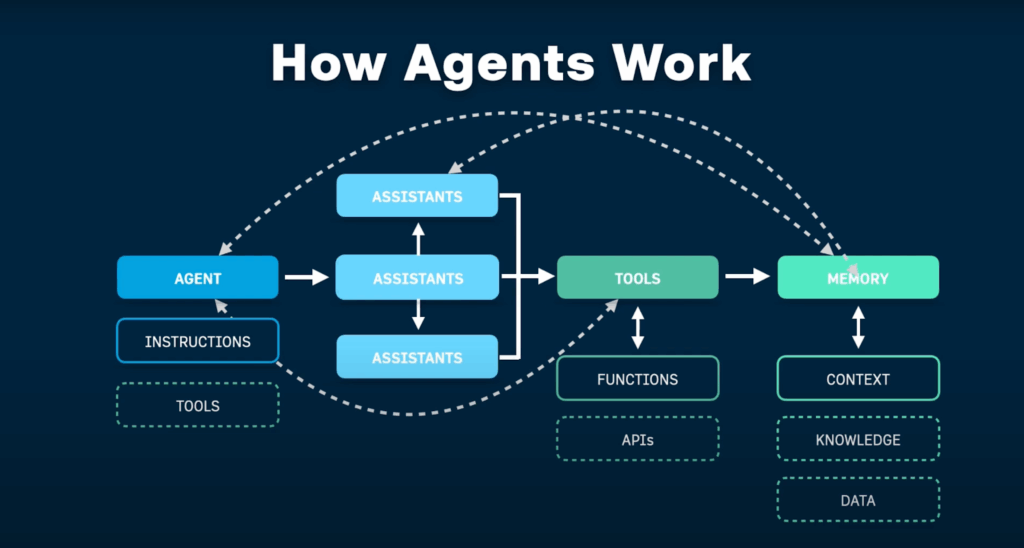
AI agents are software systems designed to carry out tasks independently, without step-by-step human instruction. They operate across entire workflows by reading inputs, applying rules or learned logic, making decisions, and triggering actions inside connected systems.
For example, in banking, an AI agent can assess a loan application end to end. It reviews submitted documents, validates income and credit data, calculates risk exposure, and determines whether the application can be approved automatically or requires human review. What previously involved multiple handoffs across teams can now be completed within minutes inside a single execution flow.
In logistics operations, an AI agent can track live shipment data alongside external signals such as weather disruptions or port congestion. When delays emerge, the agent evaluates alternate routes or facilities and updates delivery plans directly in the transport management system, without waiting for manual intervention.
Across use cases, the defining characteristic is autonomy at the workflow level. AI agents do not assist with isolated steps; they assume responsibility for outcomes within clearly defined operational boundaries.
Custom-built agents designed for specific business operations deliver better results than generic tools because they work with your actual data, systems, and processes. The development partner you choose determines whether your agent solves real problems or just sits in a demo environment.
If you’re evaluating vendors, here’s a quick overview of the companies leading AI agent development in 2026.
Top AI Agent Development Companies Under a Minute
Here’s a quick overview of the top companies leading AI agent development in 2026:
- RTS Labs – Enterprise AI agent development with deep expertise in data strategy, LLM integration, and production-scale deployment.
- Devcom – Custom AI solutions specializing in intelligent automation and agent-based systems for mid-market enterprises.
- Kanerika – AI and data engineering with focus on workflow automation and business process transformation.
- Markovate – Full-stack AI development offering conversational agents and intelligent decision systems.
- Azumo – AI-powered software engineering with expertise in machine learning and autonomous agent deployment.
- Appinventiv – Mobile-first AI solutions with agent-based automation for customer engagement and operations.
- Moveworks – Enterprise AI platform for IT support automation and employee service agents.
- Cognition – Advanced AI systems focused on autonomous coding agents and software development automation.
- Intuz – Custom AI agent development for healthcare, finance, and retail sectors.
- Solulab – Blockchain-integrated AI agents for secure, decentralized business applications.
Why AI Agents Matter in Business Operations
AI agents do more than speed up work. They change how companies run, and the financial impact shows up quickly.
Productivity & Efficiency Gains
A significant number of companies expect AI agents to improve process efficiency and output by 2026. Customer support teams handle complex queries while agents manage documentation and test case fixes simultaneously. Manufacturing floors use agents to analyze data from thousands of IoT sensors, optimizing machine settings and detecting equipment failures before they occur.
Cost Reduction at Scale
67% of C-level executives point to automation as their primary cost-savings lever. The impact shows up in reduced operational headcount and lower overhead resources. Retailers run agents that manage inventory across warehouses, adjust pricing based on competitor data, and handle order-related questions; all without human staff.
Operational Scalability
Agents operate continuously without downtime or capacity constraints. Medical providers use them to handle patient scheduling, manage electronic health records, and assist with examinations. Service delivery scales without proportional increases in staff.
Improved Decision-Making
AI-powered systems deliver a 31.5% boost in customer satisfaction scores and a 24.8% increase in customer retention. These systems analyze customer behavior for targeted marketing, adjust pricing during seasonal demand spikes, and provide responses based on individual purchase history.
Cross-Functional Integration
Modern AI agents connect across departments. They link customer service data with inventory systems, coordinate logistics with warehouse management, and feed operational insights into financial planning. Manual handoffs that slow decision cycles get eliminated. Information gaps close.
Production value comes from embedding agents into actual workflows, not treating them as standalone tools. Companies that integrate agents across functions see compounding returns as systems communicate and coordinate without human orchestration.
Top Industries Using AI Agent Development Services
AI agent adoption clusters in industries where regulatory complexity, data volume, or operational scale create clear automation opportunities.
Financial Services
According to Capgemini Research Institute’s World Cloud Report, 75% of banks are deploying AI agents for customer service, while 64% use them for fraud detection and 61% for loan processing.
- Agents analyze transaction patterns and flag suspicious activity in real time
- Fraud detection systems operate continuously, with 90% of financial institutions using AI to expedite investigations
- Regulatory reporting happens automatically, reducing compliance team workload
Supply Chain & Logistics
McKinsey Global Institute reports that the global AI in logistics market reached $20.8 billion in 2025, with 78% of supply chain leaders reporting significant operational improvements.
- Agents handle inventory forecasting and route optimization across distribution networks
- Weather disruptions or port delays trigger automatic rerouting without human input
- Demand planning adjusts in real time based on market signals
Real Estate
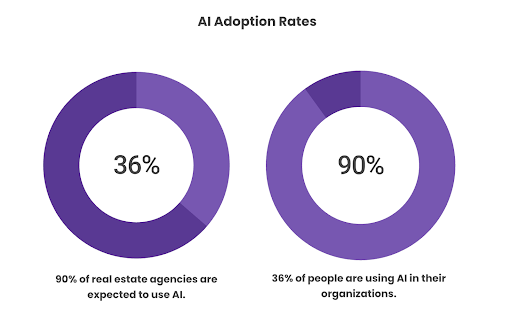
A 2025 industry analysis shows that 85% of real estate agents using AI report time savings, with AI predicted to reduce tenant screening time by 75%.
- Property management firms automate lease administration and tenant communication
- Agents process renewals, schedule inspections, and recommend pricing adjustments
- Market data analysis happens continuously rather than quarterly
Construction
Market research indicates that the AI market in construction is projected to grow from $4.86 billion in 2025 to $22.68 billion by 2032, with AI achieving up to 97% accuracy in cost estimations.
- Project teams track material deliveries and monitor subcontractor schedules automatically
- Cost overruns get identified before they compound across the project
- Blueprint analysis checks for code compliance and coordinates inspections
Healthcare
According to McKinsey’s latest State of AI research, AI agent use in healthcare is among the most widely reported across industries.
- Medical practices use agents for patient intake, scheduling, and insurance verification
- Clinical message triage routes urgent cases to appropriate providers
- Prior authorization requests get handled without manual staff involvement
Manufacturing
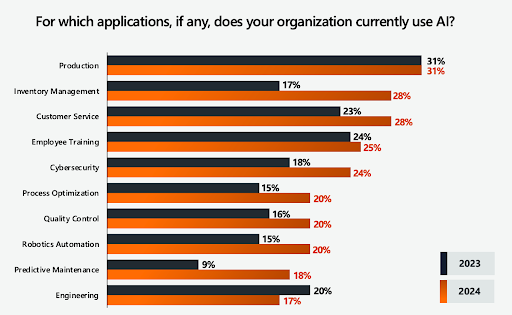
Accenture’s 2025 research reveals that 77% of manufacturers have implemented AI to some extent, with 31% using it primarily in production solutions.
- Agents analyze data from thousands of IoT sensors to optimize machine settings
- Equipment failure detection happens before breakdowns occur
- Quality control agents identify defects and notify inspectors in real time
Custom-built agents work better in these industries because they connect with existing data systems, follow industry compliance rules, and adapt to how operations actually run. Generic tools can’t match that level of integration.
Key Takeaways:
- Financial Services – Agents handle fraud detection, loan processing, and compliance reporting in real time.
- Supply Chain & Logistics – Automated inventory forecasting, route optimization, and demand planning across distribution networks.
- Real Estate – Streamlined lease administration, tenant screening, and property management operations.
- Construction – Automated cost estimation, material tracking, and code compliance checks.
- Healthcare – Patient intake, appointment scheduling, clinical triage, and prior authorization processing.
- Manufacturing – IoT sensor analysis, predictive maintenance, and quality control monitoring.
How We Selected These Top AI Agent Development Companies
Assessing AI agent development firms requires more than reviewing positioning statements or demo environments. The evaluation focused on whether a company has the capability to deliver systems that operate reliably inside live business environments, where performance, accountability, and durability matter.
Experience and delivery history
Priority was given to firms with evidence of AI agents running in production. This included deployments handling real transactions, customer-facing interactions, or operational decision flows over sustained periods.
Short-lived pilots or internal experiments were not considered sufficient. We looked for proof that systems had remained active for several months and produced measurable operational impact.
Engineering depth across the stack
Strong candidates demonstrated capability beyond model selection. This included experience with agent orchestration, retrieval pipelines, data access layers, and deployment environments that support monitoring and change management.
Equal weight was placed on understanding enterprise systems, since agents must operate within existing application and data ecosystems rather than alongside them.
Operational fit and system integration
AI agents generate value only when embedded into day-to-day workflows. Each company was assessed on its ability to integrate agents with core platforms such as ERP, CRM, data warehouses, and long-standing internal applications.
Firms that focused mainly on isolated prototypes or sandbox environments were excluded.
Client validation and continuity
Case studies, testimonials, and publicly available outcomes were reviewed for consistency and credibility. Preference was given to companies with repeat engagements or long-term partnerships, indicating sustained value delivery rather than one-off implementations.
Where possible, claims were checked against independent sources.
Adaptability in execution
The strongest partners showed flexibility in how they work with clients. This included accommodating existing technology choices, adjusting delivery models to organizational constraints, and maintaining clear communication throughout the build and rollout phases, rather than imposing rigid frameworks or full platform replacements.
The resulting list reflects a mix of large consultancies and specialist engineering firms. Each brings a different operating model and depth of focus, making them suitable for different levels of complexity, timelines, and internal readiness.
Key Takeaways:
- Experience & Portfolio – Production deployments running 6+ months with verified outcomes.
- Technical Expertise – Proficiency in LLMs, RAG, vector databases, and orchestration frameworks.
- Scalability & Integration – Proven ability to connect with ERP, CRM, and legacy systems.
- Client Base & Reviews – Verified case studies and repeat client engagements.
- Innovation & Flexibility – Adaptable pricing models and transparent communication.
Top 10 AI Agent Development Companies in 2026
Enterprises investing in AI agents today are looking for partners who can design systems that work reliably inside real operations and not just prototypes. The companies below represent a mix of engineering firms, enterprise consultancies, and AI-native labs that consistently deliver production-ready agent solutions.
10 Best AI Agent Development Companies
| Company | Headquarters | Years in Business |
Core AI Agent Services |
Industries Served |
Key Implementations |
|---|---|---|---|---|---|
| RTS Labs | Richmond, Virginia, USA | 14+ | Custom AI agents, LLM/RAG engineering, workflow automation, data engineering | Financial Services, Logistics, Real Estate | Lease-analysis automation; logistics onboarding automation; enterprise portal modernization |
| Devcom | Lviv, Ukraine | 20+ | AI/ML development, predictive analytics, full-cycle software engineering | Healthcare, Finance, Logistics, Retail | AI-powered diagnostics platform; analytics and automation systems for enterprise clients |
| Kanerika | Hyderabad, India | 7+ | ML modeling, data platform engineering, intelligent automation | Supply Chain, Healthcare, Manufacturing | Predictive demand forecasting; process automation for logistics operations |
| Markovate | Toronto, Canada | 8+ | Generative AI copilots, conversational agents, AI-driven mobile products | Retail, Automotive, Healthcare | Conversational AI tools; recommendation engines for customer applications |
| Azumo | San Francisco, USA | 10+ | NLP agents, ML engineering, automation apps | Sports Tech, EdTech, Agriculture | AI recommendation platforms; NLP-based decision-support systems |
| Appinventiv | Noida, India | 9+ | Enterprise AI engineering, automation systems, AI-enabled applications | BFSI, Retail, Mobility | AI-powered enterprise apps for Fortune 500 organizations |
| Moveworks | Mountain View, USA | 8+ | Enterprise support agents for IT and HR, automation, knowledge resolution | Technology, Healthcare, Finance | AI helpdesk and employee-support agents deployed across global enterprises |
| Cognition | San Francisco, USA | 4+ | Autonomous reasoning agents, LLM development, AI automation for engineering workflows | Technology, SaaS | Devin, an autonomous software-engineering agent |
| Intuz | San Jose, USA | 15+ | AI automation, cloud-native ML solutions, custom engineering | Real Estate, Healthcare, Retail | AI-driven document parsing and workflow automation |
| Solulab | Ahmedabad, India | 10+ | ML agents, business process automation, predictive optimization tools | Finance, Logistics, Energy | ML-based routing optimization; operational automation systems |
1. RTS Labs
RTS Labs is a U.S.-based AI consulting and engineering firm known for building production-ready AI agents that fit into the real systems enterprises rely on every day.
RTS Labs combines AI engineering, data architecture, and software delivery to build intelligent agents that operate reliably within complex business environments. Many other firms concentrate on prototypes or generic automation, which often fall short once systems move into live operations.
Our work spans strategic AI planning, LLM-powered development, and full-scale deployment.
Headquarters: Glen Allen, Virginia, USA
Years Active: Founded in 2010 • 14+ years active
RTS Labs’ Core Services
- Custom AI agent development
- LLM engineering and retrieval-augmented generation (RAG) systems
- Data engineering and governance
- Intelligent automation for document workflows, customer operations, and field processes
- Full-stack software engineering for enterprise applications
Industries Served by RTS Labs
- Finance and financial services
- Supply chain and logistics
- Real estate and construction
How We Helped Evergreen Transform Sales with Conversational AI
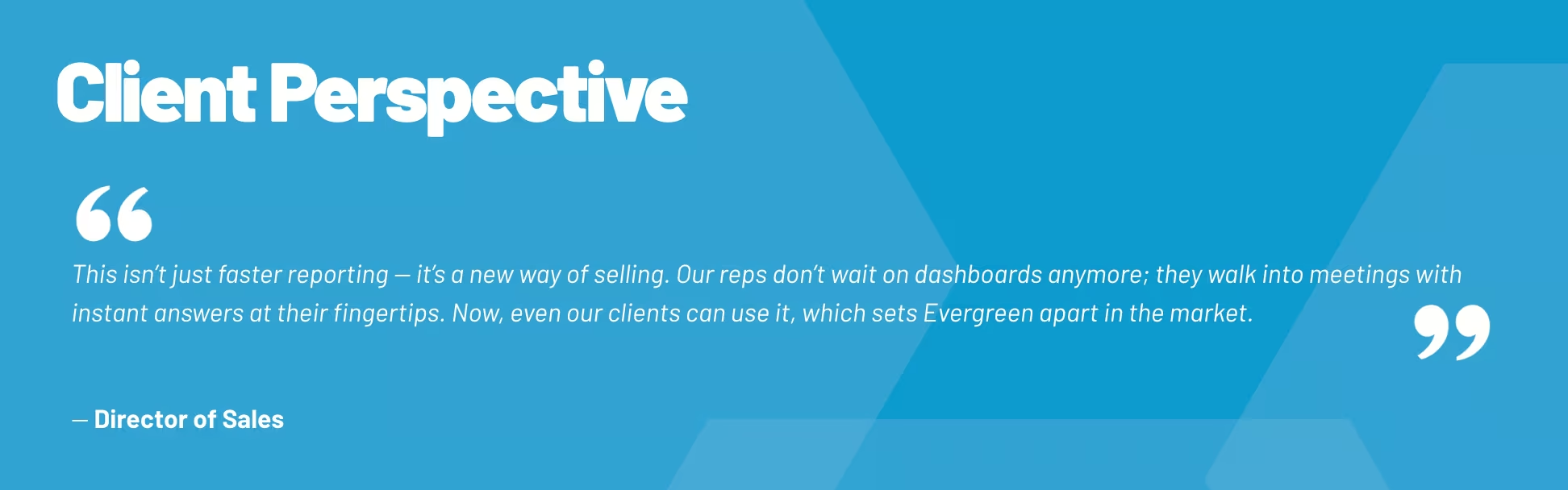
We partnered with Evergreen, a nationwide distributor, to replace slow, dashboard-based reporting with a conversational AI platform that delivers instant sales insights. Reps can ask natural-language questions- “What are my top accounts this quarter?” – and receive answers in seconds.
The system translates queries into optimized SQL, respects role-based rules, and returns mobile-ready charts for on-the-go decision-making. After strong adoption internally, Evergreen extended the chatbot to customers for order tracking and product discovery.
Results:
- Answers delivered in seconds instead of minutes or hours
- More informed, confident client conversations
- Higher deal velocity due to instant access to revenue and product data
- Reduced reporting workload for analysts
- Improved customer experience through self-service order and product queries
Why RTS Labs Stands Out
RTS Labs stands out for its ability to take AI agents beyond the demo stage. Their teams work directly with client stakeholders, data systems, and operational workflows to deliver solutions that are reliable, measurable, and ready for scale.
With senior-led engineering teams and a strategy-plus-execution engagement model, they offer enterprises a partner that can define the right AI opportunities and actually build them to production quality.
2. DevCom
DevCom is an established software development company providing custom engineering, data-driven applications, and emerging AI capabilities. With more than two decades of delivery experience, the company supports organizations that need full-cycle development and long-term technical stability.
Headquarters: Lviv, Ukraine (with U.S. presence in Florida)
Years Active: Founded in 2000 • 24+ years active
DevCom’s Key Services
- Custom software development (web, mobile, enterprise platforms)
- AI/ML development and predictive analytics
- Data engineering and business intelligence
- Cloud architecture and DevOps engineering
Industries Served
- Healthcare
- Finance and fintech
- Logistics and transportation
- Retail / eCommerce
Why DevCom Stands Out
DevCom offers mature engineering processes and broad technical depth, making them a strong choice for organizations that need stable, full-cycle development with optional AI and data capabilities.
3. Kanerika
Kanerika is a global technology consulting firm specializing in AI, analytics, and intelligent automation. The company helps enterprises modernize their data ecosystem and build AI-enabled solutions that improve decision-making, forecasting accuracy, and operational efficiency.
Headquarters: Hyderabad, India
Years Active: Founded in 2015 • 10+ years active
Kanerika’s Key Services
- AI/ML development and predictive analytics
- Data engineering and business intelligence
- Intelligent automation (AI + RPA)
- Data modernization and cloud enablement
Industries Served
- Banking and financial services
- Manufacturing and supply chain
- Retail and eCommerce
Why Kanerika Stands Out
Kanerika blends AI development with strong data engineering capabilities, making it a suitable choice for companies that need both technical depth and end-to-end project delivery.
4. Markovate
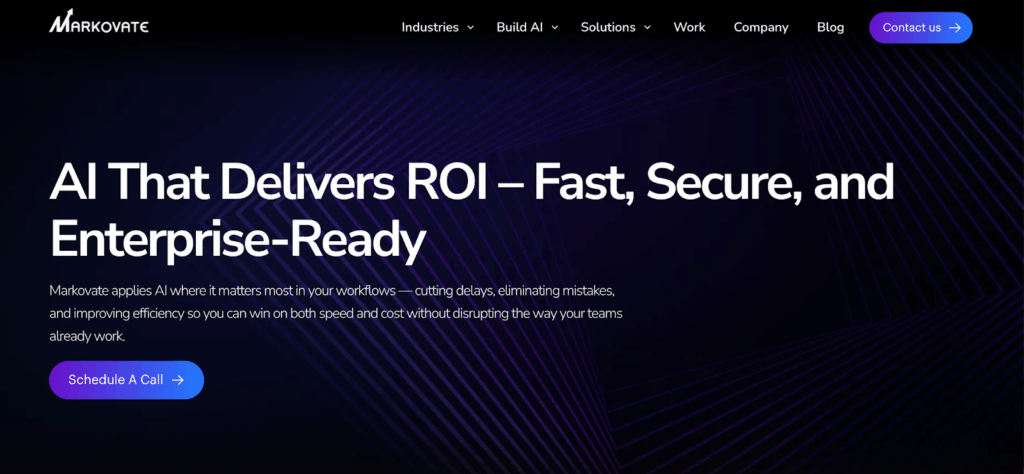
Markovate is an AI and digital product development company focused on building generative AI applications, conversational interfaces, and mobile-first intelligent solutions. The firm supports businesses looking to integrate modern AI capabilities into customer experiences, digital products, and operational workflows.
Headquarters: Toronto, Canada
Years Active: Founded in 2015 • 9+ years active
Markovate’s Key Services
- Generative AI application development
- Conversational AI and chatbot solutions
- AI-powered mobile and web applications
- Digital product engineering and modernization
Industries Served
- Retail and eCommerce
- Automotive
- Healthcare
Why Markovate Stands Out
Markovate is known for its expertise in user-focused AI applications, making it a strong option for companies building AI-enhanced customer experiences and digital products.
5. Azumo
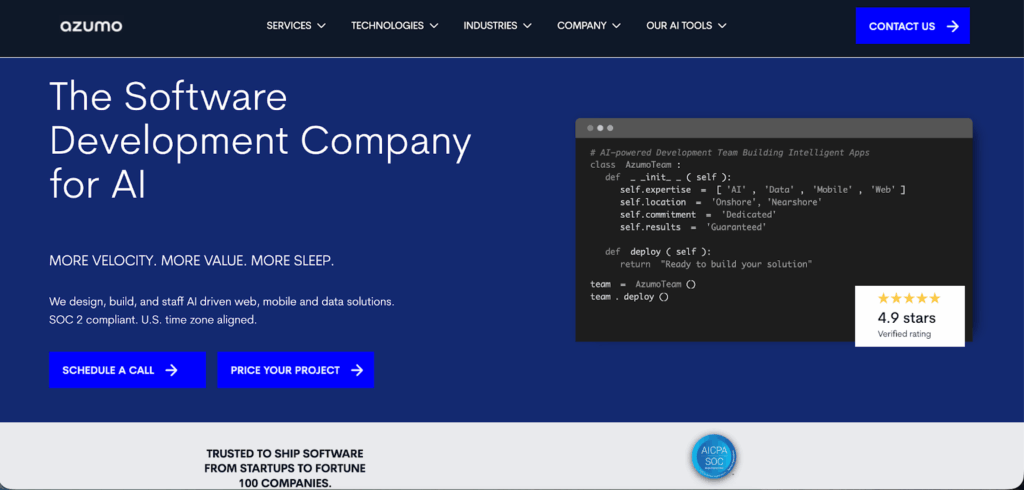
Azumo is a nearshore software development company specializing in AI, machine learning, and natural language processing solutions. The firm helps organizations build intelligent applications that automate decisions, extract insight from text, and enhance digital product capabilities through applied AI.
Headquarters: San Francisco, USA
Years Active: Founded in 2016 • 8+ years active
Azumo’s Key Services
- NLP and conversational AI development
- Machine learning engineering
- AI-driven automation solutions
- Custom software and cloud-native application development
Industries Served
- Sports and fitness technology
- Education technology
- Agriculture and ag-tech
Why Azumo Stands Out
Azumo brings strong expertise in NLP and applied machine learning, making it a solid choice for companies building text-heavy, insight-driven, or conversational AI solutions.
6. Appinventiv
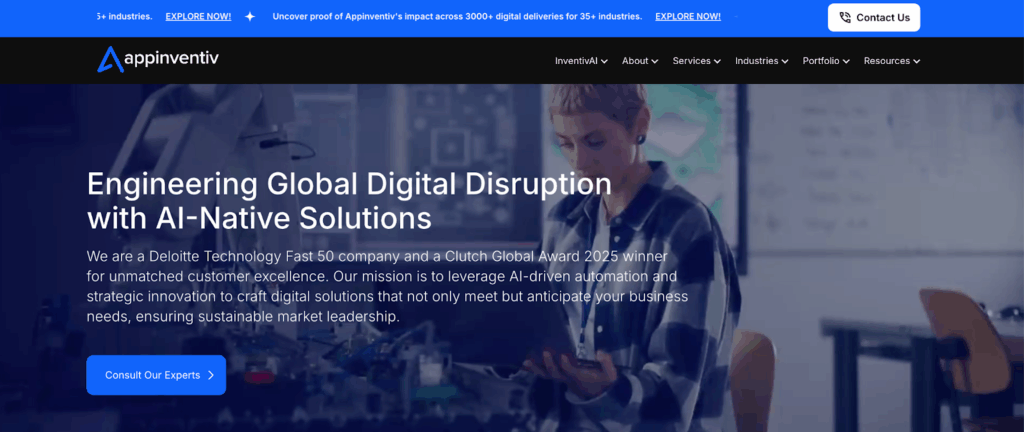
Appinventiv is a global product development company delivering large-scale digital and AI solutions for enterprises. With a sizable engineering workforce, the firm supports end-to-end implementation of AI-powered platforms, automation systems, and enterprise applications across multiple industries.
Headquarters: Noida, India
Years Active: Founded in 2015 • 9+ years active
Appinventiv’s Key Services
- AI and machine learning application development
- Enterprise automation and workflow digitization
- Cloud and full-stack software engineering
- Product strategy, UX design, and modernization
Industries Served
- Banking and financial services
- Retail and eCommerce
- Mobility and transportation
Why Appinventiv Stands Out
Appinventiv’s scale and delivery capacity make it well-suited for large enterprises that need complex AI implementations supported by extensive engineering resources.
7. Moveworks
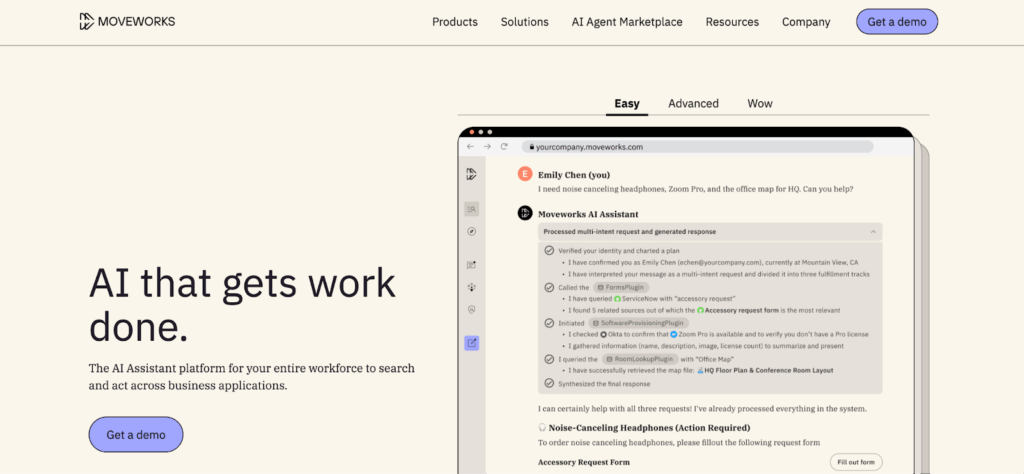
Moveworks is an enterprise AI company specializing in autonomous support agents for IT, HR, finance, and operations teams. Their platform uses large language models and conversational intelligence to resolve employee issues, answer questions, and automate support workflows across major enterprise systems.
Headquarters: Mountain View, California, USA
Years Active: Founded in 2016 • 8+ years active
Moveworks’ Key Services
- AI-powered employee support agents
- Conversational automation for IT, HR, and operations
- Knowledge discovery and enterprise search
- Workflow automation across enterprise systems
Industries Served
- Technology
- Healthcare
- Financial services
Why Moveworks Stands Out
Moveworks focuses exclusively on enterprise support automation, offering refined, domain-specific AI agents that integrate deeply with IT and workplace systems.
8. Cognition
Cognition is an AI research and engineering company focused on building autonomous agents capable of performing advanced reasoning tasks. The firm is best known for developing AI systems that support software engineering workflows, aiming to automate complex technical work rather than just routine tasks.
Headquarters: San Francisco, California, USA
Years Active: Founded in 2023 • 1+ years active
Cognition’s Key Services
- Autonomous AI agents for engineering tasks
- Large language model development
- AI-assisted software development tools
- Research and experimentation in reasoning-based AI
Industries Served
- Technology and SaaS
- Developer tools
- High-growth startups
Why Cognition Stands Out
Cognition is pioneering autonomous reasoning for software engineering, making it a notable choice for organizations exploring cutting-edge AI assistance for technical workflows.
9. Intuz

Intuz is a software development and cloud engineering company that offers AI-driven solutions to help businesses automate processes and modernize their digital operations. With more than a decade of delivery experience, the firm builds custom applications powered by machine learning, intelligent workflows, and scalable cloud infrastructure.
Headquarters: San Jose, California, USA
Years Active: Founded in 2008 • 16+ years active
Intuz’s Key Services
- AI-powered automation and workflow systems
- Machine learning model development
- Custom software and mobile app development
- Cloud and DevOps engineering
Industries Served
- Real estate
- Healthcare
- Retail
Why Intuz Stands Out
Intuz combines AI engineering with strong cloud development capabilities, making it a reliable option for companies looking to improve operations through modern, scalable digital solutions.
10. Solulab
Solulab is a technology development company offering AI, machine learning, and automation solutions for mid-market businesses. The firm focuses on building intelligent systems that streamline operations, optimize decision-making, and support digital transformation across product and service organizations.
Headquarters: Ahmedabad, India
Years Active: Founded in 2014 • 10+ years active
Solulab’s Key Services
- AI and machine learning development
- Business process automation
- Predictive analytics and optimization tools
- Custom software and product engineering
Industries Served
- Finance
- Logistics and transportation
- Energy and utilities
Why Solulab Stands Out
Solulab provides cost-efficient AI and engineering delivery, making it a practical choice for mid-sized companies seeking to adopt intelligent automation without enterprise-level budgets.
How to Choose the Right AI Agent Development Company
Selecting the right AI agent development partner starts with defining what you want to achieve, whether it’s automating internal workflows, improving customer experience, or strengthening data-driven decisions. From there, evaluate each vendor’s domain experience to ensure they understand your industry’s data, constraints, and operational patterns. Look closely at how well they integrate with your existing systems, including CRM, ERP, and cloud platforms, since most AI agents fail without strong technical fit.
Scalability and governance should be part of the first conversation, not the last. Confirm the vendor can support secure data access, model monitoring, and long-term quality. Finally, consider pricing and delivery models: some firms provide dedicated teams, while others offer full-service strategy-to-deployment support.
Choose the structure that matches your internal maturity and speed expectations.
Which AI Partner Fits Your Needs? A Criteria-Based Comparison
| Evaluation Criteria |
AI-Native Firms |
Enterprise Consultancies |
Boutique AI Engineering Firms |
|---|---|---|---|
| Goal Alignment | Strong for technical automation and agent workflows | Strong for digital transformation and cross-org alignment | Strong for focused, high-impact use cases |
| Domain Expertise | Varies by firm | Broad industry coverage | Deep expertise in select industries |
| System Integration (CRM, ERP, Cloud) |
Moderate | High | High |
| Scalability & Governance |
Moderate | Strong enterprise governance | Strong for data-heavy operations |
| Speed to Value | Fast prototyping | Slower due to larger teams | Fast with senior-led delivery |
| Pricing Flexibility | Moderate | Less flexible | High |
| Delivery Model | Product-style delivery | Full-service consulting | Dedicated senior engineering teams |
Why RTS Labs Is Trusted by Top Enterprises
Mid-market and enterprise organizations work with RTS Labs because our teams bring AI engineering, data strategy, and delivery execution together in a single operating model. We collaborate directly with client stakeholders, work within existing systems, and build AI agents that hold up in live environments rather than controlled demonstrations.
How We Work
Our engagements are structured as partnerships, not handoffs. We shape use cases, workflows, and governance alongside internal teams so agents align with real operational constraints from day one. This close collaboration reduces friction during rollout and shortens the path from build to adoption.
Technical and Data Depth
RTS Labs teams combine experience in large language models, retrieval pipelines, automation, and enterprise data architecture. That breadth allows agents to connect cleanly with core systems and operate across end-to-end processes instead of isolated tasks.
Demonstrated Outcomes
Across industries such as financial services, logistics, and real estate, our work has focused on measurable impact. Clients see reduced manual effort, more consistent decisioning, and shorter execution cycles, supported by clear delivery plans, senior oversight, and predictable commercial models.
Sustained Value Delivery
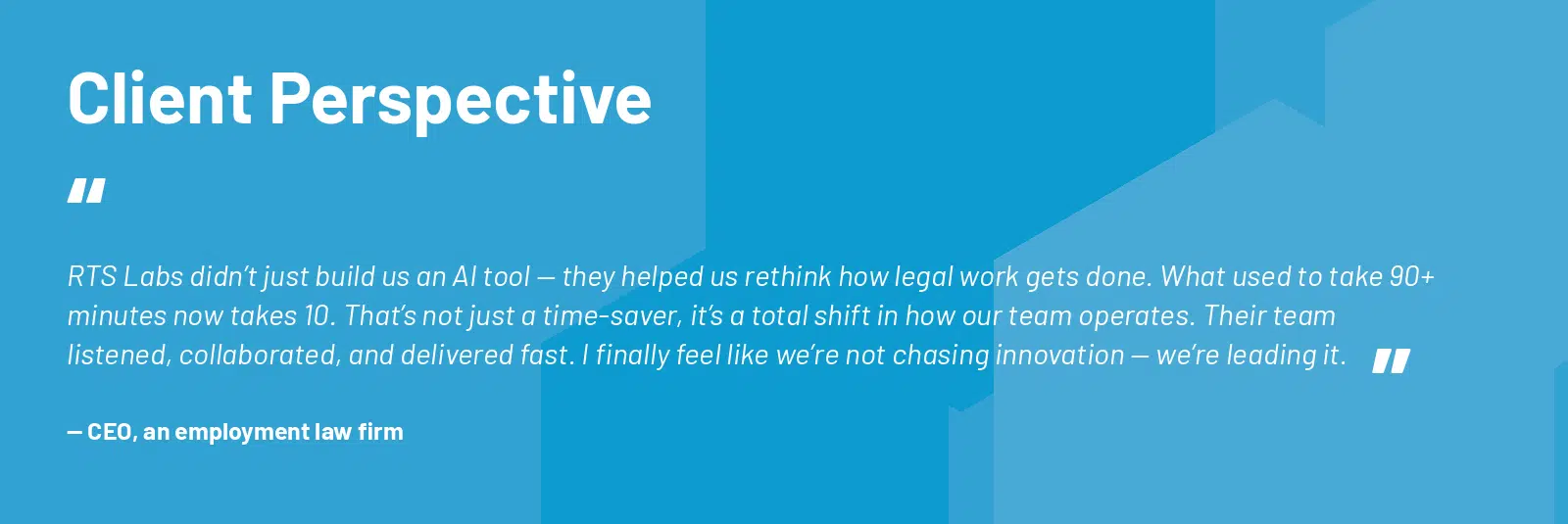
RTS Labs has delivered more than fifty AI and automation initiatives that reached production and produced returns within months. That track record reflects an emphasis on execution quality and long-term usability rather than experimentation alone.
Build Intelligent, Scalable AI Agents That Drive Real Business Impact with RTS Labs
AI agents are reshaping how companies operate by speeding up decisions and automating complex work. To see real results, you need a partner who understands data, systems, and scale. That is where we excel. RTS Labs combines strategy and engineering to build AI agents that integrate with your platforms and deliver measurable improvements across operations, finance, and customer experience.
We deliver production-ready solutions, not prototypes. Our agents work inside real environments and support real users.
If you are ready to turn AI into meaningful impact, we are here to help.
Let’s build your next AI agent together. Contact us today!
FAQs
1. How long does it typically take to deploy an AI agent in production?
Timelines vary based on complexity and system readiness. Most enterprise deployments move from discovery to live operations within 8–16 weeks when data access, integrations, and governance requirements are clearly defined upfront.
2. Do AI agents require changes to existing enterprise systems?
In most cases, no major system replacements are required. Well-designed agents integrate with current ERP, CRM, and data platforms through APIs, workflows, and access controls already in place.
3. How are AI agents monitored once they are live?
Production agents are monitored through logging, performance metrics, and outcome tracking. Teams review decision accuracy, latency, and exception rates to ensure agents continue operating within defined boundaries as conditions change.
4. What internal teams need to be involved during AI agent development?
Successful deployments usually involve IT, data, and business owners from the start. Early alignment ensures agents reflect real workflows, comply with internal controls, and can be supported after deployment.