AI-assisted development has moved beyond experimentation and is now deeply embedded in production workflows. But alongside the acceleration in shipping velocity, concerns about vibe coding security risks are quietly growing.
A 2025 study by Veracode found that approximately 45% of AI-generated code samples contained vulnerabilities aligned with OWASP Top 10 categories.
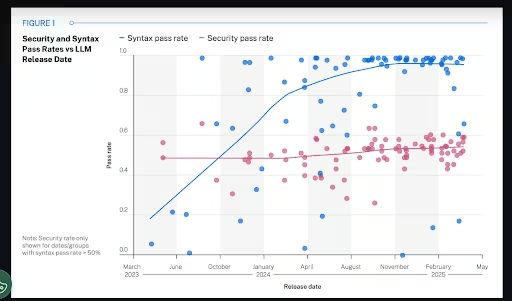
The same report analyzed how vulnerability rates exceeded 60% in certain languages. Java was the riskiest at 72%.
At the same time, over 46% of new code on GitHub is already AI-generated, with projections indicating a majority share. The scale of potential exposure is growing faster than most security practices were designed to handle.
The underlying tension is critical to security, as AI coding tools optimize for functional output rather than for secure systems. We have reviewed codebases shipped using AI-assisted workflows, and the pattern is consistent: the application works, the features behave correctly, and yet somewhere in the authentication logic or database configuration, there is a decision the AI made that no one fully evaluated.
This article unpacks that gap in detail. It starts with immediate checks you can run today, then moves into vulnerability patterns, real breach cases, tooling blind spots, and governance models that engineering leaders must adopt to make AI-assisted development production-safe.
Also Read: What Is AI Governance? A Complete Guide
What Are Vibe Coding Security Risks?
Vibe coding security risks are the categories of vulnerabilities that AI code generation tools introduce by default, as they optimize for functionality over security, leading to issues such as hardcoded credentials, broken authentication, injection flaws, and supply chain exposure through unverified dependencies.
Traditional software risk arises from developer negligence. However, for vibe coding, these vulnerabilities are often the system’s default output unless the developer explicitly intervenes.
Top 3 Immediate Security Checks for Any Vibe-Coded App
Before evaluating frameworks or governance models, there are a few high-signal checks that can quickly determine whether an application is already exposed. These checks are intentionally practical. They are designed for teams that have already shipped or are close to deployment and need a fast signal on risk.
1. Credential Exposure in Codebases
AI models frequently embed credentials directly into code because it produces a working result instantly. For example, instead of referencing an environment variable, the model may generate:
API_KEY = “sk_live_12345”
This is not malicious. It is simply the fastest path to a functioning integration.
However, once committed, these credentials become part of source control history, deployment artifacts, and potentially public repositories.
According to the 2024–2025 State of Secrets Sprawl report by GitGuardian, over 28 million secrets were exposed in public GitHub commits in 2023 alone, a number that continues to rise annually. The immediate implication is clear: If credentials exist in your codebase, they should be assumed compromised.
2. Authentication Enforcement at the Wrong Layer
A recurring pattern in AI-generated systems is to place authentication logic in the UI rather than enforce it at the API or backend layer. For example, a frontend checks whether a user is logged in, but the API endpoint itself does not validate authentication. This creates a system that behaves correctly in normal use but fails under direct API interaction.
A simple test, such as calling the API directly using tools like Postman, often reveals whether authentication is truly enforced. This pattern is particularly dangerous because it passes manual testing and UI validation, and fails only under adversarial conditions.
3. Infrastructure Defaults Left Unsecured
AI-generated setups often configure infrastructure for ease of development. Production safety isn’t the primary focus. For example, databases with open read/write access, disabled row-level security, and publicly accessible storage buckets all have missing configuration enforcement. In practice, this is one of the fastest ways for a working application to become a data exposure incident.
These three checks can be completed in under 30 minutes and frequently uncover the same vulnerabilities seen in real-world breaches. If any of them fail, the issue is already exploitable.
How Serious Is the Vibe Coding Security Problem?
By the time most teams begin asking about vibe coding security risks, they are not looking for definitions. It is the validation they seek. They begin asking:
- Is this an edge case?
- Is this overblown?
- Or is this something that needs immediate attention?
Answering that requires separating signal from noise. Individual anecdotes, no matter how dramatic, don’t define the problem. What matters is whether independent datasets, across tools and environments, point in the same direction.
To understand the scale properly, it helps to look at the problem through two lenses:
- How often do vulnerabilities appear in AI-generated code
- How quickly those vulnerabilities are translating into real-world exposure
Also Read: How to Scale AI in Your Organization
Vulnerability Rates in AI-Generated Code
The first question is straightforward: How frequently does AI-generated code introduce security issues? Across multiple studies, the answer is remarkably consistent: far more often than most teams expect.
A 2025 study by Veracode evaluated AI-generated code across common use cases and found that approximately 45% of outputs contained vulnerabilities, many of which aligned directly with the OWASP Top 10 categories, such as injection flaws and broken authentication.
What makes this particularly important is not just the percentage, but the context. In several test scenarios, the models were presented with both secure and insecure implementation paths, and still selected insecure approaches nearly half the time.
The issue is a bias toward functionality over security in model outputs. At the developer level, the impact becomes even clearer. State of Code Developer Survey report by SonarSource found that 53% of developers who shipped AI-generated code later discovered security issues in production, not during development or review.
This doesn’t mean that AI-generated code is unusable. Security cannot be assumed from functional correctness.. A system can compile successfully, pass QA, deliver expected outputs, and still contain vulnerabilities that were never evaluated. Developers must realize that the surface signal of “working code” is no longer a reliable indicator of safety.
Acceleration of Exposure and Real-World Risk
If vulnerability rates explain how often issues occur, the second lens explains how quickly those issues turn into real exposure.
One of the clearest signals here comes from credential leakage. While not all of this can be attributed to AI, the rise correlates strongly with increased adoption of AI coding tools, particularly in workflows where code is generated quickly, secrets are embedded for convenience, and review cycles are shortened.
More importantly, GitGuardian observed that automated or AI-assisted commits tend to expose secrets at a higher rate than human-only commits, indicating a structural difference in how code is produced.
Another dimension of acceleration is vulnerability tracking itself. Security researchers have begun identifying vulnerabilities directly linked to AI-generated code patterns, including misconfigured authentication, exposed infrastructure, and unsafe dependency usage.
Early tracking initiatives suggest that reported incidents are increasing rapidly, but also that many vulnerabilities remain unattributed, because AI-generated code often lacks identifiable authorship patterns.
In traditional development, vulnerabilities are introduced gradually, review processes evolve alongside them, and exposure is often localized.
In AI-assisted development, vulnerabilities are introduced rapidly, the same patterns repeat across projects, and exposure scales across multiple systems simultaneously
This creates a compounding effect:
- One insecure pattern → replicated across many codebases
- One missed review → multiple production exposures
The Hidden Multiplier: Code Volume
There is one more factor that amplifies everything: the sheer volume of code being generated. As noted earlier, Thomas Dohmke, CEO of GitHub, projected that within five years, 90% of code will be AI-generated.. Even if vulnerability rates remained constant, increasing code volume would still increase total exposure.
When these signals are combined, a clear picture emerges:
- A significant portion of AI-generated code contains vulnerabilities
- Many of these vulnerabilities are not detected during development
- The number of affected systems is increasing rapidly
- And the speed of exposure is accelerating
The above discussion isn’t a theoretical risk curve. We are entering into a phase where all this is an operational reality. CTOs need to determine whether their current development and review processes are designed to detect them at the scale and speed AI introduces them. Because if they are not, the vulnerability is not just in the code. It is in the system that allowed that code to reach production.
What Actually Happened: Real Vibe Coding Security Breaches
Up to this point, the discussion has focused on patterns, probabilities, and systemic risk. But for most engineering leaders, the question only becomes real when it translates into a concrete failure:
“Has this actually happened in production?”
The answer is yes, and not in isolated, obscure scenarios. These failures are happening in live systems, often within days of launch, and in ways that traditional security processes fail to detect.
Case Study 1: Database Exposure Through Missing Access Controls
In early 2026, a fast-growing AI-built application launched publicly with a fully functional backend powered by a managed database service. The product had been developed almost entirely using AI coding tools, allowing the team to move from idea to production in a matter of days.
From a user perspective, everything worked. Users could sign up and log in. Data was stored and retrieved correctly. APIs responded as expected. However, within days of launch, security researchers discovered that the entire production database was publicly accessible, and the scale of exposure extended to the entire dataset.
What was exposed
- User records, including email addresses
- Authentication tokens
- Application data across multiple tables
Root cause: a configuration decision, not a code error
At the center of the issue was a seemingly harmless implementation detail. The frontend application included a public API key for database access, which, on its own, is not inherently insecure. Many modern backend services are designed to expose public keys that act as project identifiers.
The problem was what sat behind that key.
- Row-level security (RLS) was disabled
- No access policies restricted data access
- The API key effectively granted unrestricted read/write access
This combination turned a normal configuration into a critical vulnerability. The vulnerability caught no one’s eye because:
- The application behaved correctly
- No errors appeared during testing
- No static code scanner flagged a critical issue
From the development team’s perspective, nothing was broken. The vulnerability existed entirely at the intersection of infrastructure configuration, access control enforcement, and runtime behavior.
A static scanner reviewing source code would not detect whether database-level policies were enabled. A QA process focused on UI behavior would not reveal unauthorized access through direct API calls.
The only way to detect this issue would have been by authenticating as one user and attempting to access another user’s data directly through the API. In other words, testing using behavioral security testing.
This was not a failure of syntax or logic. The vulnerability was a direct result of implicit assumptions. The AI-generated system did exactly what it was asked to do. It just wasn’t asked to enforce security boundaries.
Case Study 2: Authentication Implemented Entirely on the Client Side
In another widely discussed incident, a SaaS product built using AI coding tools implemented its entire access control model in the frontend. Again, from a user perspective, the system appeared correct.
- Users logged in successfully
- Features were gated based on subscription level
- UI elements were conditionally rendered
The application passed manual testing and was deployed to production. Shortly after launch, users discovered that changing a single parameter in the browser or modifying a request payload allowed them to bypass restrictions and access premium features without authorization.
This type of vulnerability is particularly dangerous because it aligns perfectly with standard testing workflows. The system only fails when someone bypasses the UI or interacts directly with backend endpoints, which is exactly how attackers operate.
Vibe Coding Vulnerability Categories: The Six Patterns AI Introduces by Default
In practice, when reviewing vibe-coded systems, we rarely see a single isolated issue. More often than not, multiple vulnerabilities appear together because they stem from the same underlying behavior: optimizing for speed and functional output over secure design.
The six categories below represent the most common and consequential patterns observed across AI-generated codebases.
1. Credential Sprawl: When Secrets Become Part of the Code
Credential exposure is one of the earliest and most persistent risks in AI-generated systems. AI models frequently embed API keys, database credentials, and access tokens directly into the source code because doing so guarantees that the system works immediately.
For example, instead of generating:
API_KEY = os.getenv(“API_KEY”)
The model may produce:
API_KEY = “sk_live_abc123”
From a usability standpoint, this is helpful. The developer does not need to configure environment variables or manage secrets separately. From a security standpoint, it creates multiple layers of exposure in codebases, control history versions, and even in logs or build outputs.
\Credential exposure is rarely noisy. There is no visible failure. Instead, unauthorized access appears as legitimate usage, data is accessed silently, and abuse may go undetected for extended periods.
2. Broken Authentication: When Trust Stops at the UI
Authentication failures in AI-generated systems are often about misplaced logic. AI frequently implements authentication in the frontend layer by checking session state, conditionally rendering components, and restricting UI access.
However, the backend may not enforce the same rules. This creates a split system where the UI behaves securely, but the API does not enforce security. For example, a dashboard hides certain data unless the user is logged in. But the API endpoint returns data regardless
This is one of the most common failure points in vibe-coded applications, and one of the hardest to detect through standard testing.
3. Injection Flaws: When Input Becomes Execution
Injection vulnerabilities have existed for decades. What changes with AI is how frequently unsafe patterns are generated. Instead of parameterized queries, AI may produce:
query = “SELECT * FROM users WHERE id = ” + user_input
This works perfectly for valid input. But it allows attackers to manipulate the query itself. This vulnerability can lead to unauthorized data access, data manipulation or deletion, and in extreme cases, full database compromise.
4. Slopsquatting: When AI Hallucinates Dependencies
One of the newer and less intuitive risks in vibe coding is supply chain exposure through hallucinated dependencies. AI tools often recommend libraries to accelerate development. However, these recommendations may include incorrect package names, non-existent libraries, or packages with little or no verification.
For example, AI suggests installing fastapi-auth-pro. The package does not exist initially. An attacker registers it and embeds malicious code. Developers install it without verification. The impact can be heavy as the malicious code enters the system at install time, and detection is delayed or absent.
5. Cross-Site Scripting (XSS): When Output Becomes Attack Surface
AI-generated frontend code often prioritizes rendering data correctly without enforcing output encoding. For example:
element.innerHTML = userInput;
This works perfectly when the input is safe. But if the input contains script tags, it can execute code in the user’s browser. Research from institutions such as Georgetown University Center for Security and Emerging Technology has shown that a large percentage of AI-generated code samples fail to mitigate XSS risks properly. The vulnerability could result in session hijacking, data theft, or unauthorized actions performed on behalf of users.
6. Insecure Infrastructure Defaults: When the System Is Open by Design
The final category extends beyond code into system configuration. AI-generated setups frequently prioritize ease of deployment, minimal configuration, and immediate functionality.
This leads to infrastructure choices such as public database endpoints, broad access permissions, and disabled security controls. The application works flawlessly, but the data is accessible entirely outside the application.
| Vulnerability | What AI generates by default | Why it gets missed |
|---|---|---|
| Credential sprawl | Hardcoded API keys and database credentials in source code | Code runs correctly. Scanner may flag but developer often suppresses. |
| Broken authentication | Client-side auth checks, missing server-side enforcement | Feature works in testing. Bypass only apparent under adversarial conditions. |
| Injection flaws | String-concatenated SQL queries, unvalidated command inputs | Query returns correct data. Injection only visible with adversarial input. |
| Slopsquatting | Hallucinated or unverified package names installed without checks | Package installs successfully. Malicious payload activates at runtime. |
| Cross-site scripting | User-supplied data rendered as HTML without output encoding | UI displays correctly. XSS only visible when attacker-controlled input tested. |
| Insecure defaults | Permissive database policies, disabled controls, exposed endpoints | App functions as expected. Risk only visible through infrastructure audit. |
Are Vibe Coding Security Risks Actually Worse Than Traditional Software Security Risks?
At this stage, it’s natural to ask a more grounded question: Are vibe coding security risks fundamentally worse than traditional software security risks, or are they simply different?
The honest answer is important because it shapes how organizations respond.
AI-generated code does not introduce entirely new categories of vulnerabilities. The same issues, including SQL injection, broken authentication, cross-site scripting, and exposed credentials, have existed for decades and are well documented by frameworks like the OWASP Top 10. So if the vulnerabilities are the same, what has changed?
The answer lies in how those vulnerabilities are introduced, distributed, and managed.
What Remains the Same: The Nature of Vulnerabilities
At a fundamental level, both traditional and AI-assisted development share the same security landscape.
Human developers have always:
- Written unsafe queries
- Mishandled authentication
- Exposed sensitive data
- Misconfigured infrastructure
These stem from familiar pressures such as speed of delivery, incomplete requirements, lack of security expertise, and trade-offs between usability and safety. From this perspective, AI-generated code does not introduce new risk categories. It is operating within the same vulnerability framework that has always existed.
What Has Changed: Volume, Consistency, and Illusion of Completeness
Where vibe coding diverges sharply from traditional development is not in what goes wrong, but in how often, how quickly, and how predictably it goes wrong.
1. Volume: More Code, Faster Than Review Can Scale
In traditional development:
- Code is written incrementally
- Review cycles are built around that pace
- Security checks are aligned with development velocity
In AI-assisted workflows:
- Entire modules, APIs, and systems are generated in minutes
- Code volume increases dramatically
- Review processes remain largely unchanged
This creates a structural imbalance. Even if vulnerability rates remained identical, the sheer increase in output would still result in more vulnerabilities entering production. But as we’ve already seen, vulnerability rates in AI-generated code are not lower; they are often comparable or higher.
2. Consistency: The Same Mistakes, Repeated at Scale
Human developers tend to make varied mistakes:
- One developer might misuse authentication
- Another might mishandle input validation
AI, by contrast, tends to produce consistent patterns of behavior. If a model has learned that hardcoding a credential produces a working result or UI-based validation satisfies a requirement, it will repeat those patterns across multiple prompts, developers, and codebases. It makes vulnerabilities more predictable and widespread.
3. Ownership Ambiguity: When No One Fully Owns the Code
In traditional development, accountability is relatively clear:
- A developer writes the code
- A reviewer approves it
- Responsibility is traceable
In AI-assisted development, ownership becomes fragmented. The developer writes the prompt, the AI generates the code, and the reviewer may only partially understand it.
This creates a situation where no single person has fully authored the code or reviewed it in depth. Responsibility is distributed and diluted.
From a governance perspective, this is a critical shift. Security processes rely heavily on clear ownership, defined accountability, and traceable decision-making. When those signals weaken, vulnerabilities are more likely to pass through unnoticed.
4. The Illusion of Completeness: Code That Looks Finished
One of the most subtle but important differences is how AI-generated code appears. Human-written insecure code often shows signs of incompleteness, rough edges, or missing logic. These cues trigger scrutiny during review.
AI-generated code, however, is syntactically correct, well-structured, and ften includes comments and documentation. It looks finished and is often trusted more quickly, reviewed less critically, and assumed to be correct beyond functionality.
Why This Breaks Existing Security Processes
When these differences are combined, they create a scenario where traditional security processes begin to fai because they were designed for a different development model.
Most existing processes assume gradual code changes, human authorship, reviewable increments, and clear ownership. AI-assisted development challenges all of these assumptions simultaneously.
As a result code review becomes less effective under increased volume. Static analysis tools miss context-dependent issues, and vulnerabilities scale faster than detection mechanisms.
| Dimension | Traditional software security risk | Vibe coding security risk |
|---|---|---|
| Vulnerability categories | SQL injection, broken auth, XSS, hardcoded credentials | Same categories, but introduced faster and more consistently |
| Rate of introduction | Depends on developer skill and process discipline | 40–62% of AI-generated code contains vulnerabilities, regardless of developer skill |
| Code appearance | Incomplete or rough-looking insecure code is often caught in review | AI-generated insecure code looks polished, compiles, and passes basic tests |
| Ownership and accountability | Clear author, clear accountability | Fragmented across prompter, reviewer, and deployer |
| Vulnerability consistency | Varied mistakes across developers and codebases | Same insecure defaults replicated consistently across many codebases |
Why Static Scanners Are Not Enough for Vibe-Coded Applications
At some point in most engineering workflows, there is a reassuring moment when code compiles, tests pass, a security scanner runs, and no critical issues are flagged.
In traditional development, that assumption was often reasonable, at least as a baseline. But in AI-assisted workflows, that assumption becomes increasingly unreliable. Because while static analysis tools remain essential, they are fundamentally designed to answer a specific question:
“Does this code contain known insecure patterns?”
The problem is that many of the most critical vulnerability coding security risks do not exist as static patterns in code. They exist in how the system behaves when it is actually running.
What Static Analysis Does Well
To understand the gap, it’s important first to acknowledge where static scanners are effective.
Tools in this category, commonly referred to as Static Application Security Testing (SAST), are highly capable at detecting:
- Hardcoded credentials in source code
- Unsafe function usage (e.g., eval, raw SQL concatenation)
- Known vulnerability signatures
- Dependencies with documented CVEs
For example, if an AI-generated code snippet includes:
query = “SELECT * FROM users WHERE id = ” + user_input
A mature scanner will flag this as a potential SQL injection risk. Similarly, if a credential appears directly in code, it can be detected through pattern matching. These are text-level problems, and static tools are well-optimized to find them.
Where Static Analysis Breaks Down
The limitations become clear when vulnerabilities depend on context, configuration, or runtime behavior.
1. Authentication That Works Until It’s Bypassed
Consider an API endpoint that checks authentication in the frontend but does not enforce it in the backend. From a code perspective:
- The frontend logic exists
- The API endpoint appears valid
- No obvious insecure pattern is present
A static scanner reviewing this code sees no hardcoded secrets, unsafe functions, or known vulnerability signatures. And yet, the system is completely bypassable.
2. Infrastructure Configuration That Lives Outside the Code
Many of the most severe vulnerabilities in vibe-coded systems originate in infrastructure:
- Database access policies
- Storage permissions
- Network exposure rules
These are often configured through dashboards, environment settings, and managed service defaults. A static scanner analyzing source code has no visibility into whether row-level security is enabled, a database is publicly accessible, or access controls are enforced at the data layer. This is precisely why incidents involving exposed databases are so difficult to detect early.
3. Logic Flaws That Only Appear Under Adversarial Conditions
Static analysis is not designed to simulate attacker behavior. It evaluates what the code says. For example, a system may correctly return user-specific data under normal conditions, but allow cross-user access if a request parameter is modified.
This type of flaw passes functional testing and static analysis, and fails only under adversarial testing.
4. Slopsquatting and the Dependency Blind Spot
Another emerging gap is in dependency validation. If an AI tool suggests a package that exists, installs successfully, and has no known CVEs, a static scanner may consider it safe.
However, if that package was recently created, has no credible maintainer history, and contains malicious logic not yet documented, it will not be flagged.
Why This Gap Matters More in AI-Assisted Development
These limitations are not new. Static analysis has always had boundaries. What changes with vibe coding is how often those boundaries are crossed.
AI-generated systems introduce vulnerabilities that are configuration-dependent. They rely on implicit assumptions about trust boundaries and produce code that passes pattern-based checks.
To address this gap, teams need to introduce behavioral validation:
- Testing API endpoints directly
- Simulating unauthorized access attempts
- Verifying access controls independently of the UI
- Inspecting infrastructure configurations
Vibe Coding Security Self-Audit Checklist
- Credentials and Secrets: Review both the current code and version history for exposed secrets. Even removed credentials remain accessible in commit history.
- Authentication and Authorization: Test access control directly at the API level, not through UI flows. Attempt cross-user data access to validate enforcement.
- Infrastructure and Database Controls: Verify configurations directly in infrastructure dashboards, ensuring that access policies are enforced independently of application logic.
- Dependencies and Supply Chain: Audit all dependencies for legitimacy, maintenance history, and version control.
- AI Tool Layer: Review integrations and permissions granted to AI coding tools, ensuring least-privilege access.
This checklist is designed to surface vulnerabilities across all six categories discussed earlier.
Also Read: Responsible AI Checklist: How to Scale AI in Your Organization
How Should Engineering Teams Govern Vibe Coding Security?
AI-assisted development is not inherently insecure, but it changes the conditions under which security must operate. Vulnerabilities appear faster, repeat more consistently, and often exist outside traditional review boundaries. That means the solution is not to restrict AI usage. It is to govern it deliberately.
For most teams, this is where the real challenge begins, i.e., building a system that prevents them from reaching production in the first place. Governance, in this context, is realigning development processes with how AI actually generates code.
Control 1: Introduce Mandatory Security Review Tiers
The first and most immediate control is to redefine how code review works in an AI-assisted environment. In practice, the most critical vulnerabilities cluster around a few areas, such as authentication and authorization, database access and queries, external API integrations, and payment or sensitive data flows, which require a different level of
Control 2: Make Security Scanning a Blocking Step in CI/CD
Static analysis tools still play a critical role, but only if they are enforced correctly.
In many teams, scanners run as informational checks and non-blocking warnings. This creates aA senior engineer must review any change affecting authentication logicrol 3: Enforce a Strict Secrets Management Policy
Credential exposure is one of the most consistent failure points in vibe-coded systems. The only reliable way to address it is through the enforcement of non-negotiable policy. Make sure there are no credentials in source code under any circumstances, all secrets are stored in environment variables or dedicated vaults, and there’s automated scanning for credential patterns in every commit.
Control 4: Audit Dependencies Introduced by AI
Every time an AI-generated change introduces or modifies dependencies, the package must be verified in an official registry, maintainer credibility must be checked, and versioning must be pinned. This can be automated partially, but requires human validation for edge cases.
Control 5: Add an Infrastructure Configuration Review Gate
Before deployment infrastructure configurations must be reviewed independently, access controls must be validated at the system level, and default settings must be overridden for production. This is a required step in the release process.
The Real Risk Isn’t AI, It’s Unverified AI Code
The security risks associated with vibe coding are not hypothetical. They are not edge cases. And they are not the result of AI “making mistakes” as the conversation is often framed.
AI systems generate code exactly as designed: quickly, efficiently, and with a strong bias toward functional correctness. They produce outputs that compile, run, and deliver expected results.
What they do not do is enforce security. That responsibility still sits with the developer, the reviewer, and the system that governs how code moves from generation to production.
In 2026, the gap between a working application and a secure one is no longer defined by how well code is written. It is defined by how rigorously it is validated. For teams that want a structured starting point, RTS Labs offers an AI Workshop focused on:
- Assessing exposure in AI-generated codebases
- Identifying high-impact vulnerabilities
- Defining a clear remediation and governance path
No commitment required. just a practical way to understand where your system stands today. Book a demo today.
FAQs
1. What are the most common vibe coding security risks?
The most common vibe coding security risks include hardcoded credentials, broken authentication, injection vulnerabilities, insecure infrastructure defaults, and unverified dependencies.
2. Is AI-generated code less secure than human-written code?
AI-generated code is not inherently less secure, but it introduces vulnerabilities more consistently and at a higher scale. The risk comes from volume, repeated insecure patterns, and reduced scrutiny due to the polished appearance of generated code.
3. What immediate steps should I take if my vibe-coded app is already in production?
Start with three high-impact checks:
- Scan for hardcoded credentials in your codebase and rotate any exposed keys
- Test API endpoints directly to ensure authentication is enforced at the backend
- Verify infrastructure configurations, especially database access controls
4. Why don’t security scanners catch vibe coding vulnerabilities?
Static scanners are designed to detect known patterns in code, such as unsafe functions or exposed secrets. However, many vibe coding risks exist in runtime behavior, infrastructure configuration, or logic flaws that only appear under adversarial conditions.
5. How should engineering teams govern AI-assisted development securely?
Teams should implement governance controls such as tiered security reviews for critical components, mandatory CI/CD security checks, strict secrets management policies, dependency verification processes, and infrastructure review gates.