Forrester’s 2026 technology and security predictions say that ‘AI will face a reckoning next year.’
Today, fewer than 1/3rd of the decision-makers can tie the value of AI to their organization’s financial growth. Out of them, very few know what it actually costs to build, deploy, and maintain AI systems at scale.
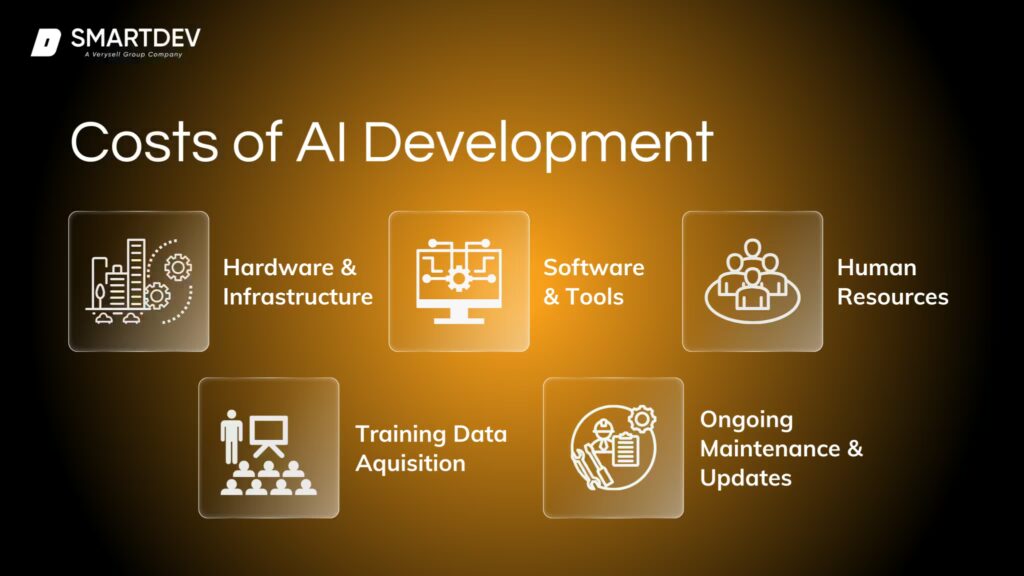
This misunderstanding leads to overspending, stalled projects, technical debt, and AI models that never reach real users.
AI development costs differ with each use case, sector, vertical, scale, and industry. Estimates online range from $10K prototypes to multimillion-dollar enterprise systems, making it nearly impossible for leaders to budget responsibly.
This guide breaks down AI development costs in a transparent, enterprise-focused way and explains how RTS Labs helps enterprises avoid the hidden expenses that derail most AI projects.
What Determines AI Development Cost: The Core Cost Drivers
AI development cost is the aggregate of strategic, technical, and operational decisions made throughout the lifecycle of an AI system. The largest expenses often arise before the first model is trained.
The majority of the expenses go towards data engineering, architecture, compliance, integrations, MLOps, and long-term optimization. These are the components required to turn a model into an ROI-producing system and account for a disproportionate share of the total cost.
Below are the factors that exert the strongest influence on total AI development cost:
1. Use Case Complexity
Simple classification or prediction models cost significantly less than systems that require deep learning, generative AI, multimodal inputs, or continuous decision automation. High-risk domains like finance, healthcare, and insurance require additional validation, documentation, and compliance layers, all of which increase cost.
2. Data Availability & Data Quality
Most of the AI project time and cost is consumed by data work cleaning, labeling, normalization, transformation, and building pipelines. If data is siloed, inconsistent, or incomplete, development cost rises sharply because teams must build foundational data infrastructure before modeling can begin.
3. Model Type & Approach
Costs increase when moving from traditional ML models to deep learning and further to custom-trained LLMs. Training costs for modern LLMs have grown year over year, and inference costs, i.e., the cost to run models, can surpass training costs in production settings. Even fine-tuning open-source LLMs is far more expensive than traditional ML due to GPU requirements and longer experimentation cycles.
4. Architecture & Infrastructure Requirements
Infrastructure decisions, including cloud vs. hybrid, GPU availability, orchestration layers, and latency requirements, heavily influence cost. Infrastructure and lifecycle operations often exceed long-term AI spend, especially for enterprise deployments. Organizations with fragmented or legacy systems face additional modernization expenses.
5. Integration with Existing Systems
The more systems, such as ERP, CRM, WMS, HRIS, support tools, and financial systems, an AI solution must interact with, the more engineering and testing are required. Integration complexity is consistently cited in enterprise surveys as one of the top three cost escalators, particularly when older systems lack APIs or require custom middleware.
6. Security, Compliance & Governance Requirements
AI built for regulated industries like finance, healthcare, insurance, and government demands rigorous controls: auditability, access management, lineage, bias testing, and explainability.
7. MLOps & Long-Term Maintenance
AI is not a one-time expense. Models drift, data changes, performance degrades, infrastructure scales, and new regulatory requirements emerge. Enterprises often underestimate lifecycle costs more than any other cost category, which is why models often fail after deployment.
AI Development Cost Breakdown
AI development costs vary not because AI is unpredictable, but because enterprises sit at very different levels of data maturity, system complexity, and governance requirements. The true cost of AI is driven less by the model and more by data engineering, integration, and lifecycle operations, i.e., the plumbing that ensures AI works reliably in a production environment.
Within enterprises, four cost tiers emerge consistently across industries. Each reflects a different level of technical depth, integration scope, and operational readiness.
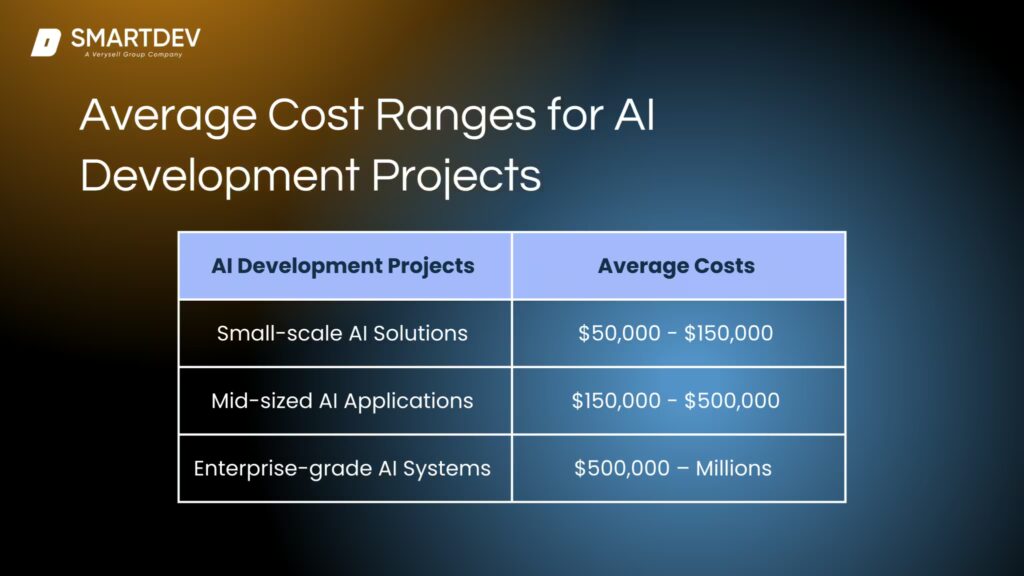
Small AI Projects: $25,000 to $75,000
These are early-stage initiatives designed to test feasibility without heavy infrastructure or compliance burdens. The cost stays low because data is often already available, integrations are limited, and the models involved are straightforward.
Typical examples include:
- Basic forecasting or classification models
- Lightweight automation
- Single-system integrations
Enterprises use this tier to validate business value before investing further.
Mid-Level AI Applications: $75,000 to $250,000
Costs rise when AI needs to work inside real workflows and connect to operational systems. It is here that data pipelines, dashboards, and multi-model logic enter the picture. Data engineering alone accounts for a considerable portion of the project cost in mid-tier systems, which explains the significant jump.
These projects commonly include:
- Multiple model components
- ETL/ELT pipeline development
- Integrations with 2–5 systems
- Monitoring and business-facing interfaces
This tier represents the first real deployment for most enterprises.
Enterprise-Grade AI Systems: $250,000 to $1M+
Costs expand substantially when enterprises build production-grade, compliant, and scalable AI. This includes everything from fine-tuned LLMs and RAG systems to real-time decision engines used in finance, logistics, or healthcare. Heavy governance, high availability requirements, and complex data estates become the primary cost drivers.
Typical characteristics include:
- Multi-model orchestration
- Cross-system integrations like ERP, CRM, WMS, financial systems, etc.
- GPU-based compute workloads
- Drift monitoring and automated retraining
- Robust security and compliance layers
Ongoing Costs: 15% to 25% of the Initial Build Annually
AI is not a one-time expense. Models degrade, data changes, compliance evolves, and business processes shift. Many enterprises underestimate ongoing AI costs, which leads to abandoned models and stalled programs. Ongoing investment typically includes:
- Retraining cycles
- Cloud and GPU usage
- Monitoring, observability, and incident response
- Updating integrations and pipelines
- Expanding functionality or adapting to new regulations
Organizations that plan for lifecycle cost upfront consistently achieve better ROI and fewer disruptions.
Hidden Costs Most Companies Miss
Most enterprises underestimate AI development cost not because vendors mislead them, but because the cost drivers sit beneath the surface. McKinsey notes that many enterprise AI initiatives stall when moving from prototype to production because organizations fail to account for the true operational, data, and integration demands behind AI systems.
Below are the hidden cost layers that consistently inflate budgets because of how unpredictable enterprise environments are.
1. Data Labeling, Annotation & Preparation
Data is rarely AI-ready. Even enterprises with large data estates discover that the work required to make data usable for labeling, cleaning, structuring, or resolving inconsistencies often exceeds the cost of model development itself.
Data preparation consumes up to 45% of total AI project effort (HPC Wire), a price many teams don’t budget for. This is especially true for computer vision, NLP, customer analytics, or any system requiring supervised learning.
2. Integrating AI with Legacy Systems
Most mid-market and enterprise architectures depend on aging ERP systems, fragmented databases, and decades-old workflows. Integrating AI into these environments requires connectors, API layers, middleware, and often data refactoring.
This ‘invisible integration layer’ is one of the most expensive parts of enterprise AI and is nearly always missing from early estimates. Enterprises that underestimate integration work are the ones that see budgets double during implementation.
3. Scaling From POC to Production
A proof of concept (POC) is cheap because it runs in isolation. Production AI must operate reliably, securely, and compliantly at scale. That includes:
- role-based access controls
- logging and auditability
- high availability
- workload autoscaling
- monitoring, drift detection, and retraining
Scaling AI is several times more expensive than prototyping due to infrastructure, reliability, and governance demands. Many organizations even before they begin experimentation at the operationalization stage.
4. Security, Compliance & Governance Requirements
AI systems introduce new regulatory expectations around transparency, data lineage, fairness, audit trails, and model explainability. These controls aren’t optional, especially in finance, healthcare, logistics, and public-sector environments.
Costs rise due to:
- compliance mapping to cover HIPAA, SOX, GDPR, FTC, state AI acts
- model risk management
- documentation
- cybersecurity layers
- third-party system audits
Deloitte emphasizes that governance is now one of the top cost drivers for enterprise AI, especially for LLM-based systems.
5. Change Management & Workforce Enablement
Even the best AI systems fail when teams don’t adopt them. While rarely included in cost estimates, organizational readiness, workflow redesign, and employee training often determine the success or failure of enterprise AI.
Change management costs include:
- rewriting SOPs
- creating new roles
- training employees on AI interfaces
- shifting performance metrics
- stakeholder communication
AI ROI increases sharply only when companies pair technical development with structured change management programs.
| Cost Tier | Typical Scope | Estimated Cost Range | Hidden Costs to Watch |
|---|---|---|---|
| 1. Small AI Projects | Basic predictive models, simple automations, and limited integrations | $25,000 – $75,000 |
|
| 2. Mid-Level AI Applications | Multi-feature AI systems, dashboards, moderate integrations, RAG-lite | $75,000 – $250,000 |
|
| 3. Enterprise-Grade AI Systems | GenAI, RAG, advanced ML models, multi-environment deployments, compliance-heavy | $250,000 – $1M+ |
|
| 4. Ongoing AI Costs | Monitoring, retraining, optimization, MLOps operations | 15–25% of initial build (annual) |
|
How to Estimate Your AI Development Cost: A Practical, Executive Framework
Estimating AI development cost is about understanding the underlying work that makes an AI system reliable, compliant, and scalable. AI initiatives fail most often because enterprises underestimate the preparatory work.
A credible cost estimate, therefore, follows a predictable sequence. Below is the same framework RTS Labs uses when helping enterprises forecast realistic AI investment.
1. Start With the Business Objective
Cost becomes unpredictable when AI is divorced from a clear ROI. Begin by defining the business goal: reducing manual processing time, improving forecasting accuracy, cutting fraud losses, automating compliance workflows, etc.
McKinsey’s State of AI 2025 report says that 80% of the enterprises set efficiency as an objective for their AI initiatives, followed by growth and other factors. The clearer the target outcome, the easier it is to constrain scope and the lower the cost variance.
2. Assess Data Readiness and Availability
Most of AI’s cost comes not only from the model, but also from the data infrastructure supporting it. Before estimating budgets, enterprises must understand:
- Is the required data accessible?
- Is it structured, labeled, or siloed?
- Does it require cleansing, merging, or new pipelines?
A mature, unified data layer reduces development cost substantially.
3. Map the Integration Footprint Across Systems
Real enterprise AI must interact with operational systems, including ERPs, CRMs, warehouse systems, finance applications, ticketing platforms, or custom databases.
Integration effort is one of the most underestimated cost areas.
Understanding how many systems must “talk to” the AI solution, the age of those systems, their API maturity, and their data quality is critical for building an accurate budget.
4. Define the AI Approach: Classical ML, Deep Learning, LLMs, or Hybrid
Model type determines both build cost and long-term operational cost:
- Classical ML → lower complexity, lower infrastructure overhead
- Deep learning → higher compute, more data work
- Fine-tuned LLMs or RAG systems → significant integration, vector databases, prompt management, governance requirements
Choosing the right model ensures the budget aligns with the business need instead of just hype.
5. Estimate Infrastructure Requirements
Infrastructure is the silent multiplier. Compute-heavy systems, especially multimodal and LLM-based ones, require:
- scalable cloud environments
- secure data storage
- CI/CD and MLOps pipelines
- monitoring, drift detection, logging
- GPU or high-performance compute
Any cost estimate must include both initial and recurring infrastructure expenses.
6. Factor in Governance, Risk & Compliance Needs
Enterprises operating in regulated sectors must include the cost for:
- audit logging
- explainability layers
- privacy-preserving architectures
- role-based access control
- compliance reporting
- risk assessments
These layers are essential for enterprise-grade AI and can shift budgets dramatically if added late in the process.
7. Add MLOps, Monitoring & Ongoing Model Lifecycle Costs
AI systems degrade over time. Without continuous monitoring and retraining, models lose accuracy, sometimes drastically.
A proper estimate includes:
- drift and performance monitoring
- retraining cycles
- cost optimization for compute
- model updates as business needs evolve
- incident management and QA
Many enterprises underestimate this step, leading to “AI abandonment” after the first year due to escalating maintenance costs.
8. Combine the Above Into a Single, Realistic Cost Envelope
Once the inputs, such as business goal, data maturity, model complexity, integrations, governance needs, and infrastructure footprint, are defined, enterprises can produce a credible cost estimate.
This avoids vague pricing ranges and replaces them with a structured, defensible financial plan aligned with business value.
Common Mistakes That Increase AI Development Cost
AI projects rarely exceed budget because the technology is unpredictable. It is the structural realities that enterprises have to face to make AI work at scale. Forrester says this ‘financial rigor’ is slowing down production and wiping out POCs, making enterprises postpone 25% of their planned AI spend to 2027.
Below are the most frequent cost-inflating mistakes enterprises make, and why they matter.
1. Starting With Models Instead of Business Problems
It leads to unnecessary complexity, unclear requirements, and rework. When objectives are unclear, scope expands, and costs follow.
2. Underestimating Data Engineering and Integration Needs
The most accurate predictor of AI cost is data readiness. Data preparation and integration consume a major chunk of total AI effort. When data pipelines, quality controls, or system integrations must be rebuilt mid-project, cost doubles; sometimes triples.
3. Building Custom Models When Off-the-Shelf Models Would Suffice
Not all problems require a bespoke LLM or custom deep learning architecture. Pre-trained and fine-tuned models can solve many use cases at a fraction of the cost.
Custom models drive up expenses by requiring more training data, compute, MLOps complexity, governance, and testing and validation cycles.
4. Ignoring Governance, Compliance, and Security Requirements Upfront
AI deployed in regulated environments must operate with full visibility. Many teams ignore this until the model is near deployment, at which point rebuilding the architecture becomes unavoidable and expensive.
5. Underplanning for Monitoring, Retraining, and Lifecycle Costs
Models degrade as data drifts, user behavior changes, and the environment evolves. Enterprises that fail to budget for MLOps quickly face poor model performance, and emergency retraining is far more expensive than planned lifecycle management.
6. Allowing Scope Creep Due to Poor Cross-Team Alignment
When business, engineering, compliance, and data teams are not aligned on requirements, the project expands in multiple directions simultaneously. This creates integration rework, architectural redesigns, and conflicting KPIs, all of which inflate the budget.
How to Reduce AI Development Cost Without Compromising Quality
Reducing AI development cost includes eliminating waste, preventing rework, and investing only in components that move the business forward. Enterprises that consistently deliver AI under budget follow five principles.
Begin With Business Value, Not Technology Choices
Enterprises save the most money when they anchor AI initiatives to measurable outcomes, such as reduced processing time, increased revenue accuracy, automated workflows, or fewer compliance errors. When the objective is concrete, scope stays contained, and expensive “nice-to-have” features fall away.
Use Pre-Trained and Open-Source Models Where Possible
Custom LLMs and proprietary multimodal architectures are not required for all use cases. Pre-trained models drastically reduce training time, GPU cost, and data requirements. This also accelerates time to deployment, improving early ROI.
Invest in Strong Data Pipelines Early to Prevent Rework Later
A mature data layer consisting of unified storage, quality checks, lineage, and reliable pipelines dramatically lowers long-term AI cost. Data engineering is not a cost center. It is cost prevention.
Adopt Modular Architecture Instead of Monolithic Builds
Modular, API-driven AI systems enable incremental improvements without rebuilding the entire solution to allow enterprises to add features, integrate new models, or expand into other business units at a fraction of the initial cost.
Plan for MLOps From Day One to Reduce Lifecycle Expenses
Enterprises that treat MLOps as a late-stage addition typically face expensive refactoring. Automated monitoring, retraining schedules, drift detection, and version control reduce these costs dramatically.
Calculating ROI for AI Development: A Simple, Practical Framework
AI development cost means little without understanding its return. Enterprises increasingly require CFO-ready justification for AI spend, and analysts are demanding measurable outcomes.
A practical ROI framework includes four variables: cost savings, revenue uplift, risk reduction, and efficiency gains.
1. Use the Enterprise ROI Formula
A simple way to evaluate AI investments is to use the ROI formula.
ROI =
[
\text{ROI} = \frac{\text{Annual Benefits} – \text{Annual Costs}}{\text{Annual Costs}}
This formula helps translate technical improvements into CFO-friendly financial terms.
2. Calculate the Payback Period
Executives often ask: How quickly will this project pay for itself? For that, use the formula:
[
\text{Payback Period (months)} = \frac{\text{Initial Investment}}{\text{Monthly Savings or Revenue Gain}}
]
For example:
If a $300,000 AI system saves $40,000/month in operational cost, payback occurs in 7.5 months. After that, savings accumulate as pure return.
3. Evaluate Cost Avoidance Alongside Direct Gains
Many AI systems drive value by reducing failure, waste, or risk rather than increasing revenue. Examples include:
- Preventing compliance penalties
- Reducing model or process errors
- Lowering fraud loss
- Decreasing equipment downtime
- Minimizing inventory overstock or stockout
Cost avoidance is one of the most underreported value drivers in enterprise AI, despite contributing significantly to ROI.4. Compare Short-Term vs Long-Term Value
Short-term ROI comes from automation and operational efficiency. Long-term ROI comes from scalable architecture, reusable pipelines, cumulative model improvements, expansion to new business units, and reduced dependency on manual processes.
Enterprises that calculate the total lifetime value (TLV) of AI systems make better investment decisions and avoid overpaying for one-off models.
5. RTS Labs’ ROI Modeling Approach
RTS Labs incorporates ROI modeling into the very first discovery session. Instead of estimating cost in isolation, we quantify:
- Expected cost reduction
- Measurable efficiency lift
- Compliance savings
- Revenue enablement
- Value unlocked from automation
This ensures AI initiatives are not speculative and are grounded in financial outcomes that leadership can champion.
Real-World AI Development Cost Examples: What Drove Cost Up or Down
AI development cost varies widely because enterprises differ in data maturity, integration complexity, compliance requirements, and long-term operational expectations.
Below are realistic, anonymized examples from the RTS Labs case study archives that reflect what enterprises typically encounter from low-complexity prototypes to full-scale production AI.
Mid-Size Predictive Analytics & Data Modernization Project
Industry: Logistics & Transportation
Cost Range: $150,000 – $300,000
What Drove Cost Up:
- Rebuilding fragmented, multi-team data pipelines
- Implementing a modern data lakehouse with governance
- Creating orchestrated, low/no-code transformation layers
What Reduced Cost:
- Eliminating legacy bottlenecks and manual coding
- Centralizing ingestion into a unified data tool
- Low/no-code approaches for faster iteration
Outcome:
25% reduction in company-wide spending, faster access to predictive insights, scalable data foundation for future AI initiatives.
2. Enterprise-Grade Automation + AI Workflows for Financial Services
Industry: Finance
Cost Range: $300,000 – $600,000
What Drove Cost Up:
- Complex integrations (Salesforce, Marketo, Five9, Geopointe)
- Automating multi-step fraud, risk, and sales workflows
- Custom BI pipelines and reporting dashboards
What Reduced Cost:
- Reusing existing cloud infrastructure
- Modern DevOps processes (Git, SFDX) for faster delivery
- Incremental automation instead of a big-bang overhaul
Outcome:
Record sales performance, real-time territory assignment automation, improved fraud/risk handling, and scalable infrastructure for continued automation and AI deployment.
3. Large-Scale Conversational AI + Predictive Intelligence Deployment
Industry: Financial Services / Customer Experience
Cost Range: $500,000 – $1M+
What Drove Cost Up:
- Multi-model conversational AI and retrieval workflows
- Integrating AI with legacy ticketing + customer systems
- Building predictive routing + auto-response engines
- High compliance + audit visibility requirements
What Reduced Cost:
- Modular architecture for reuse across departments
- Leveraging pre-trained language models
- Scoped rollouts that allowed staged scaling
Outcome:
Significant improvement in response times, scalable AI-driven support operations, and modernized analytics pipelines that improved cross-team efficiency.
Build vs Buy vs Partner: What’s Most Cost-Efficient Long-Term?
Choosing between building AI internally, buying off-the-shelf tools, or partnering with an AI engineering firm is one of the biggest cost drivers, often more important than the model itself.
A smart approach weighs not just upfront development cost, but the total cost of ownership (TCO) over 3–5 years:
When Building Internally Makes Sense
Enterprises with mature data engineering teams, an established MLOps stack, and domain-specific constraints, e.g., regulated risk modeling, sometimes benefit from building internally. However, the long-term cost is significant:
- full-time ML engineers and data engineers
- infrastructure provisioning and monitoring
- compliance and security frameworks
- continuous integration and retraining
Most enterprises underestimate lifecycle complexity, leading to overruns. Internal builds only make sense for organizations with deep AI engineering capability already in place.
When Buying a Platform Works
Prebuilt tools reduce initial cost and accelerate deployment. They are ideal for functions like CRM scoring, chatbots, or workflow automation. However:
- Customization is limited
- Data sovereignty may be compromised
- Vendor lock-in inflates cost over time
- Integrating with enterprise systems often requires custom engineering anyway
Buying is cost-effective for narrow use cases but rarely sufficient for enterprise-scale AI.
Why Partnering Is Often the Most Cost-Efficient Path
Partnering with an enterprise AI engineering firm offers the best balance of cost, customization, and long-term scalability. Partnership advantages include:
- Expertise across strategy → data → architecture → models → MLOps
- Faster development cycles with fewer redesigns
- Architecture models built for scale, reducing future rebuild cost
- Predictable pricing through roadmap planning
- Reduced hiring and infrastructure burden
Why Enterprises Choose RTS Labs in the Partner Model
RTS Labs combines AI strategy, enterprise data engineering, LLM development, model deployment, and MLOps under one integrated delivery model. This eliminates the fragmentation that often inflates cost when multiple vendors or internal teams are involved.
Executives choose RTS Labs because it delivers:
- production-grade AI, not prototypes
- architectures designed to minimize long-term operating cost
- transparent cost estimation and milestone-based billing
- the ability to modernize data foundations before models are built
- deep experience in regulated industries (finance, healthcare, insurance)
RTS Labs becomes an extension of the enterprise’s engineering capability, accelerating results while reducing budget risk. Our approach focuses on cost predictability, architecture efficiency, and long-term sustainability, ensuring enterprises avoid the hidden expenses that derail most AI programs.
Because RTS Labs is a full-stack partner, clients eliminate the inefficiency of managing multiple vendors. Delivery is predictable, documentation is thorough, and roadmaps reflect real-world engineering constraints.
The result: AI outcomes that cost less to build, less to maintain, and scale without surprise expenses.
Build a Cost-Efficient, ROI-Driven AI System With RTS Labs
Enterprises that succeed with AI aren’t the ones who spend the most. They’re the ones who plan with clarity, invest in the right foundations, and partner with teams capable of engineering AI systems that generate measurable business value. With RTS Labs, organizations gain a partner that understands both the economics and the engineering depth required to make AI sustainable at scale.
Our clients consistently reduce cost overruns by aligning use cases to business KPIs, modernizing pipelines early rather than late, and deploying architectures that support multi-year expansion without technical debt. Whether the goal is automating core workflows, deploying a domain-specific LLM, building an enterprise-wide RAG platform, or optimizing operational processes, RTS Labs ensures AI is built with stability, security, and ROI in mind.
Ready to plan your AI investment with confidence? Book an AI cost assessment or roadmap workshop with RTS Labs.
FAQs
1. How early should enterprises involve finance teams when budgeting for AI?
Finance should be involved from the start, much before procurement. AI projects require multi-year budgeting for data pipelines, infrastructure, and MLOps. Early alignment prevents underfunding and accelerates approvals for later phases.
2. What causes AI projects to exceed their estimated cost the most?
Most overruns come from underestimated data engineering, unclear integration requirements, and choosing architectures that are too complex for the organization’s maturity. These account for more overspend than model development itself.
3. Is fine-tuning an LLM always cheaper than building a custom model?
Not necessarily. Fine-tuning reduces training cost but increases ongoing inference cost if the base model is large. Custom, smaller models or retrieval-based systems can be more cost-efficient long term.
4. How can an enterprise avoid accumulating technical debt during AI development?
Through modular architecture, strong data contracts, automated monitoring, and MLOps discipline. Skipping these early steps forces expensive rebuilds later, a problem RTS Labs solves upfront.
5. Why do enterprises choose RTS Labs for cost-sensitive AI initiatives?
RTS Labs aligns architecture, data readiness, and use-case selection before development. This prevents hidden costs, reduces rework, and ensures every dollar spent maps to measurable business value.