Automating Sort-Line Safety: 24/7 Real-Time Coverage for a High-Throughput Recycler

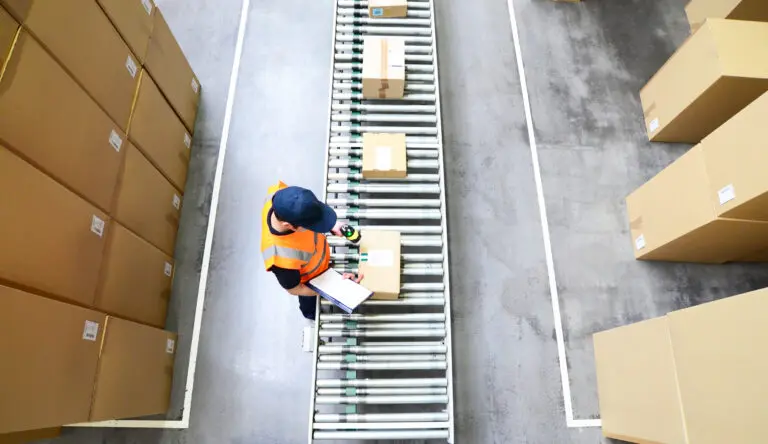
A leading waste and recycling operator needed to catch unsafe behavior on its conveyor lines in real time, with a hard rule: it had to run on-prem and keep working if the site lost connectivity. RTS Labs built a computer vision system that watches every station continuously and dispatches AI agents to document and route each event into Field1st, RTS Labs' own field-safety platform.

logistics supply chain header
Case Study at a Glance
Client

High-Throughput Recycler

Use Case

Vision AI & Agentic Safety Automation

Tech Stack

NVIDIA DeepStream

RTMPose + Triton

ByteTrack + OpenCV

Field1st

Time to Production
Per-line standup
1 week

Dealing with a similar challenge?

Our engineers will map your workflow and define a ship date in a 2-week Discovery Sprint.

Share

1. The Challenge

On a material recovery sort line, safety is hard to see and harder to prove. Workers move fast alongside conveyors, balers, and heavy machinery, and the riskiest behaviors, reaching across a running belt, crowding a neighbor, stepping into an exclusion zone, happen in seconds. The client’s safety program leaned on supervisors hitting an observation quota across a set of routes, so most of the line and most of every shift went unwatched. Manual inspections took 30 to 35 minutes each and depended on memory, familiarity, and judgment, which meant calls were slow, inconsistent, and easy to miss.

Existing telematics cameras pushed some alerts but caught almost none of the near-misses on the fixed sort lines. And nobody could measure the exposure that actually drives most injuries in waste handling: repetitive over-reach and torso lean, sustained across a shift.

Leadership set one non-negotiable before evaluating any solution. The system had to detect and warn in real time, run locally on-site, and keep working even if the facility lost its internet connection. Anything cloud-dependent was off the table.

Blind Between Checks

Coverage depended on supervisors meeting an observation quota across 10 to 15 routes, so most of the line and most of every shift went unwatched.

Per supervisor, spot-checked
15 routes

Slow, Subjective Checks

Manual safety inspections took 30 to 35 minutes and leaned on memory, familiarity, and bias, producing inconsistent calls that were easy to miss.

Per manual safety check
35 min

Unmeasured Ergonomic Risk

Strains and sprains are the most common waste-handling injury, driven by repetitive over-reach (~80cm to the belt midpoint vs a ~50cm safe limit), yet nobody could quantify it across a shift.

Typical reach vs 50cm safe limit
80 cm

2. The Engineer Approach

RTS Labs built a three-layer system that keeps the intelligence at the edge and only reaches for a large model when it matters. Neural pose models read the scene in real time on an on-site device; a deterministic geometry-and-rules engine grades what they see, so every call is explainable rather than a black box; and when a violation fires, AI agents take over to confirm, document, and route the event into Field1st. Because the vision events share Field1st’s existing safety taxonomy, each detection lands as a record the team already knows how to action and feeds the next day’s job briefing.

  • Vision AI at the Edge

    Existing site IP cameras feed a hardware-accelerated GStreamer / NVIDIA DeepStream pipeline on an on-prem Jetson Orin or GPU server. Real-time multi-person pose estimation (RTMPose / YOLOv8-Pose) runs through NVIDIA Triton with TensorRT-optimized engines, and a ByteTrack / OC-SORT tracker with re-ID holds a persistent ID per worker through occlusion on a crowded line.

  • Geometry Engine + Agentic Triage

    Homography maps the image plane to the belt plane so reach, arm extension, torso lean, crowding, and zone crossings are measured in real-world units and graded warn vs violation with duration. When a violation fires, an AI agent captures a single frame and reasons over it with a vision-language model (on-prem, or GPT / Claude / Gemini) to confirm the call and classify the hazard, so only events, not raw footage, ever reach a model.

  • Explainability & Human-in-the-Loop

    Every alert ships with a 'why this fired' breakdown (for example reach 69%, arm extension 92%, torso lean +0.55), making it defensible to a safety director. Events default to aggregate-by-station rather than per-worker to respect a unionized workforce, and a person confirms each record before it counts, so the agents draft and route while people decide.

  • On-Prem Deployment & Field1st Integration

    The stack runs containerized under Docker / K3s with an MQTT / Redis Streams event fabric, fully offline-first: detection and alerting never depend on the cloud, and events queue locally and sync when the link returns. A documentation agent auto-fills the correct Field1st form with the hazard, mapped control, owner, and due date; a routing agent pushes it through the hierarchy and into Pulse1st leading-indicator reporting.

The hard part isn't spotting a pose, it's making the call defensible. We kept the scoring in deterministic geometry so every alert comes with the exact numbers that triggered it, ran it all on-prem so a dropped connection never stops it, and put a person in the loop before anything counts. That's what turns a camera into a safety tool a crew will actually trust.
Prasanna Raghavan Headshot
Prasanna Raghavan
AI & Computer Vision Practice

3. Results & Impact

Alerts With a Reason
100 %
Raw Video Sent to Cloud
0
Continuous Coverage
24 /7
Per-Line Standup
1 wk

Before RTS Labs

  • Spot-Check Coverage

    Safety seen only during supervisor spot-checks across 10 to 15 routes

  • Slow Manual Inspections

    Manual, 30-plus-minute inspections prone to memory lapses and bias

  • Missed Near-Misses

    Most sort-line near-misses unrecorded; telematics cameras missed them

  • Unmeasured Ergonomic Risk

    No way to quantify reach or lean exposure across a shift

After RTS Labs

  • Continuous Coverage

    Every station watched continuously, in real time, on-prem

  • Explainable Calls

    Objective calls, each with a 'why it fired' explainability breakdown

  • Auto-Documented Events

    Every event auto-drafted into a Field1st near-miss or observation by an AI agent

  • Measured Ergonomics

    Per-worker reach and lean measured continuously as leading indicators

More Case Studies:

studio podcast mic v2
Digital tech — confidential client

Delivering Decision-Grade Product & Finance Analytics: 8 High-Stakes Workstreams for a Live Audio Social Platform

Overview:
A venture-backed live audio social platform needed product and finance decisions backed by analysis rigorous enough to act on — not another dashboard. RTS Labs embedded senior data science across...
Landstar Case Study
Landstar horz logo transparent background

Unifying the Agent Portal: 90% Less Time Searching for Landstar

Overview:
Landstar agents jumped between SOPs, shipment systems, and the capacity portal to answer a single customer question. RTS Labs built an AI copilot directly into the Agent Portal — RAG...
AdobeStock 132567138 768x444
Manufacturing — confidential client

Unlocking Enterprise Data: 25% Lower Spend for a Global Sports Equipment Manufacturer

Overview:
A global sports equipment manufacturer — 1,000+ employees designing custom golf gear and apparel across retail and ecommerce — had outgrown a patchwork data architecture that couldn't support the advanced...
Have a Similar Challenge?

Every AI Idea Deserves a Ship Date

Stop strategizing. Start building. Let’s map your workflow and get your AI integration into production in 90 days.