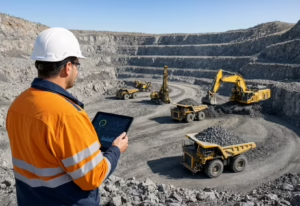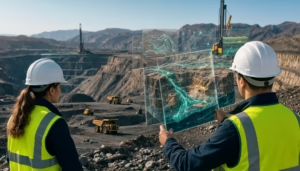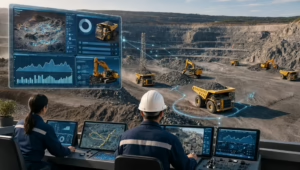
The global fleet of autonomous haul trucks has roughly quadrupled in four years, surpassing 3,800 units across major mining operations. Rio Tinto alone runs more than 360 autonomous trucks across 17 mines. About 84% of its Pilbara truck fleet now operates under automation. This shift is operational, well beyond the experimental stage.
CTOs and engineering leaders face concrete questions about architecture, data flows, integration, and workforce design. These vehicles depend on sensor fusion, high-precision positioning, edge computing, and centralized fleet orchestration. They also connect to mine planning, safety analytics, and predictive maintenance systems.
This article defines autonomous mining vehicles in vendor-neutral terms and walks through how they work at a systems level. The guide covers vehicle classes, autonomy levels, the data and AI layer, safety considerations, and adoption phases.
What Are Autonomous Mining Vehicles?
Autonomous mining vehicles are self-operating machines that move materials, water, or equipment across mine sites along predefined routes without an onboard driver. They operate in private, controlled environments rather than on public roads. Centralized control systems assign tasks, manage traffic, and enforce safety envelopes across the fleet.
The category covers several vehicle classes.
- Haul trucks remain the most visible and widely deployed asset.
- Water carts, drills, loaders, dozers, underground haulers, and support service vehicles round out the broader equipment set.
Each class has distinct sensing, localization, and control requirements based on its function and operating environment.
Distinguishing autonomous vehicles in mining from broader mining automation helps clarify the scope.
What is Mining Automation?
Mining automation refers to process-level automation across drilling, blasting, processing, and logistics. Autonomous mining vehicles are the equipment-level subset focused on self-driving mobile assets. Both categories often integrate, though they involve different technology stacks and operational models.
Deployment context also matters. Surface, or open-pit, operations rely heavily on GNSS positioning and long sightlines. Underground operations work in GNSS-denied environments and require alternative localization methods such as Simultaneous Localization and Mapping (SLAM) and infrastructure-based positioning.
How Autonomous Vehicles in Mining Work
Autonomous vehicles in mining operate as a layered system combining sensing, computing, connectivity, and centralized coordination. Each layer plays a distinct role in safe and reliable execution.
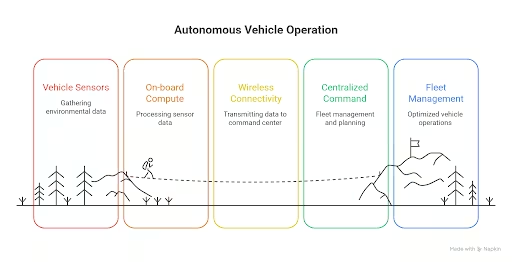
Sensing forms the foundation of the system. Vehicles carry LiDAR, radar, cameras, and high-precision Global Navigation Satellite System (GNSS)receivers. Sensor fusion combines these inputs into a unified picture of the environment. This picture supports obstacle detection, terrain assessment, and precise localization within the mine map.
On-board computing handles perception, path execution, and immediate safety responses. The vehicle interprets sensor data, identifies people, equipment, and hazards, and then adjusts speed or stops as conditions require. Decisions happen at the edge to meet latency and safety requirements.
Centralized command centers act as air-traffic control for the mine. Controllers assign tasks, manage routes, coordinate loading and dumping points, and resolve exceptions. These centers frequently sit hundreds or thousands of kilometers from the mine itself.
Connectivity ties the system together. Wi-Fi mesh networks, LTE, and private 5G link vehicles to fleet management platforms in near real time. Reliable connectivity is a prerequisite, independent of any accessory.
Types of Autonomous Mining Vehicles
Autonomous mining vehicles cover a broader equipment set than haul trucks alone. Each class has distinct functions and deployment patterns.
- Autonomous haul trucks are the most mature category. They operate under autonomous haulage systems (AHS) that coordinate fleets across loading, dumping, and refueling cycles.
- Autonomous drills, loaders, and dozers extend automation into earlier stages of the mining process. Water carts and support service vehicles handle dust suppression and site logistics with similar autonomy stacks.
- Autonomous underground mining vehicles operate in GNSS-denied environments. They rely on SLAM, infrastructure-based positioning, and tighter sensor calibration to manage confined tunnels and variable lighting.
| Vehicle Type | Primary Function | Typical Deployment | Maturity |
|---|---|---|---|
| Autonomous haul truck | Material transport | Surface (open-pit) | High |
| Autonomous drill | Blast hole drilling | Surface | High |
| Autonomous loader | Loading material | Surface and underground | Medium |
| Autonomous dozer | Earthmoving, grading | Surface | Medium |
| Water cart | Dust suppression | Surface | Medium |
| Underground hauler | Ore transport | Underground | Medium |
| Support service vehicle | Site logistics | Surface | Emerging |
Levels of Autonomy in Mining Equipment
Autonomy levels in mining span a spectrum rather than a binary state. Most operators run a mix of levels across their fleets.
Driver assist features represent the entry point. Collision avoidance systems, proximity alerts, and fatigue monitoring keep human operators in the cab while reducing risk. These systems also generate telemetry that supports later automation phases.
Remote control and teleoperation move the operator off the vehicle. A controller drives the equipment from a remote station using video feeds and machine telemetry. This level suits hazardous tasks and underground environments.
Semi-autonomous operation lets the vehicle execute defined tasks under human oversight. A supervisor monitors multiple machines and intervenes for exceptions. Full autonomy applies in confined, private mine environments where the system manages routine operation end-to-end without on-board operators.
Key Advantages of Autonomous Vehicles in Mining
Autonomous vehicles in mining deliver measurable gains across four executive priorities: safety, productivity, asset life, and sustainability.
1. Safety
Safety improvements come from removing personnel from high-risk zones. Operators step away from cabs exposed to dust, noise, vibration, and proximity to heavy equipment. Centralized monitoring replaces in-pit human judgment with consistent, rule-based decisions. Documented deployments show strong safety records under sound governance.
2. Productivity
Productivity rises through continuous operation. Autonomous fleets run around the clock, stopping only for fueling and scheduled maintenance. Shift-change gaps disappear. Cycle times stabilize because vehicles follow consistent speeds, spacing, and routes.
3. Asset life and maintenance
Asset life and maintenance improve when trucks operate within design envelopes. Smooth acceleration, controlled braking, and steady load handling reduce mechanical stress. Komatsu reports about a 40% improvement in tire and brake life and a 13% reduction in maintenance under its FrontRunner AHS. Predictable wear profiles also support condition-based maintenance planning.
4. Sustainability
Sustainability gains follow from optimized fuel burn and emissions per ton hauled. Speed harmonization and route optimization lower idling and energy intensity. These outcomes align with corporate decarbonization commitments.
Where Autonomous Mining Vehicles Are Used Today
Autonomous mining vehicles operate across multiple regions and commodities. This is a production technology, well beyond pilot status.
- The Pilbara region in Western Australia hosts the largest deployment. Iron ore producers, including Rio Tinto, BHP, and Fortescue, run autonomous haul truck fleets at scale.
- Sweden and Norway operate autonomous trucks at iron ore and limestone sites, including underground contexts.
- North American copper, coal, and oil sands operations have expanded autonomous fleets over the past five years.
- South American copper mines, particularly in Chile, have adopted AHS at large open-pit sites.
Commodity coverage now spans iron ore, copper, coal, limestone, and oil sands. Each context applies similar core technology with tuning for haul distance, gradient, and climate.
Global growth has been steep. The worldwide autonomous haul truck fleet has roughly quadrupled in four years, exceeding 3,800 units. Major operators continue to convert additional sites each year.
What Is an Autonomous Haulage System (AHS)?
An autonomous haulage system, or AHS, is the orchestration layer that coordinates fleets of autonomous haul trucks across a mine site. It is the operating system for autonomous material movement.
AHS functions include route assignment, load and dump coordination, traffic management, speed harmonization, and exception handling. The system assigns each truck to a loading unit, sequences arrivals at the dump or crusher, and adjusts spacing to prevent bunching. It also manages interactions with manned support vehicles operating in shared zones.
Integration matters. AHS connects to fleet management systems, mine planning, dispatch, and maintenance platforms. Production targets, pit designs, and shift plans flow into the system. Telemetry and event data flow back out for analytics and reporting.
The technology is mature. Komatsu’s FrontRunner AHS has logged more than 17 years in commercial operation, with 1000+ trucks commissioned, over 10 billion tons of material moved, and zero systems-related injuries reported. Caterpillar’s Command for hauling and other vendor platforms operate at a similar scale.
The Data and AI Layer Behind Autonomous Mining
Autonomous mining vehicles generate and consume large volumes of data. The value of autonomy scales with how well that data is managed and applied.
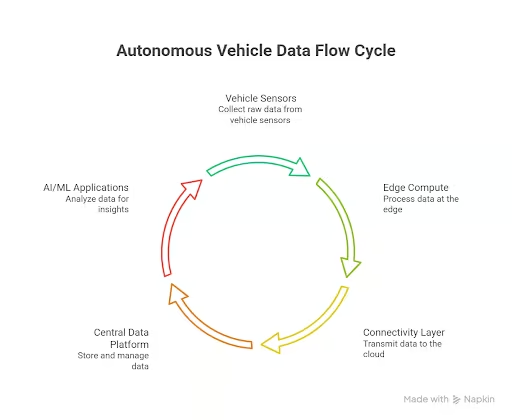
Data Lifecycle
The data lifecycle starts at the vehicle. Sensors continuously stream LiDAR, radar, camera, GNSS, and machine telemetry. Edge compute processes this data for perception and immediate control. Selected streams move to central platforms for storage, fusion with other operational data, and downstream analysis.
AI and ML
AI and ML operate across several layers. Perception models classify obstacles, terrain, and people from sensor fusion. Route optimization adjusts assignments based on real-time traffic and load conditions. Anomaly detection identifies abnormal vehicle behavior or component performance. Predictive maintenance models forecast the failure windows of components from telemetry patterns.
Integration
Integration extends the value. AHS telemetry feeds fleet optimization, energy management, and condition-based maintenance programs. The same data populates safety analytics, incident investigation, and digital twin environments used for simulation and planning.
Strong data engineering
Strong data engineering is the prerequisite. Without reliable pipelines, governance, and integration with mine systems, AI use cases stall at proof of concept.
Safety Considerations and Residual Risks
Autonomous mining vehicles improve safety on aggregate. They also introduce new risk categories that require active management.
Mature deployments document strong safety records. Removing operators from cabs reduces exposure to collisions, rollovers, dust, and fatigue-related incidents. Consistent rule-based behavior eliminates many error classes tied to human judgment.
Residual risks remain. Human-machine interface design influences how controllers detect and respond to exceptions. Over-trust in automation can delay intervention when systems behave unexpectedly. Edge cases include wet road traction, dust occlusion of sensors, mixed traffic with manned vehicles, and GNSS-denied conditions underground or near steep walls.
Cybersecurity has become a critical concern. Connected fleets, remote command centers, and update pipelines all expand the attack surface. Functional safety assurance, secure software delivery, and operational monitoring are now standard requirements.
Workforce and Operating Model Changes
Autonomous mining vehicles change where work happens and what skills are required. The workforce shifts from in-cab operation to remote oversight and technical support.
Personnel move from individual vehicles to centralized remote operations centers. A single controller supervises multiple machines and intervenes only in the event of exceptions. Some operators relocate hundreds or even thousands of kilometers from the mine site.
New roles emerge across the operating model. Autonomy controllers, system maintainers, data analysts, network engineers, and integration specialists become core to production. Skill development emphasizes monitoring, analytics, exception handling, and cross-system troubleshooting.
Workforce impact unfolds gradually. Early phases redeploy operators into new functions. Later phases reshape headcount mix as automation scales across vehicle classes and sites.
How Mining Organizations Typically Adopt Autonomous Vehicles
Adoption of autonomous mining vehicles follows a predictable arc. Most organizations progress through four phases, with overlapping investments in data, connectivity, and organizational capability.
Phase 1: Instrument and assist
Operators add collision avoidance, proximity detection, fatigue monitoring, and telemetry across the existing fleet. This phase builds the data foundation and baseline safety controls.
Phase 2: Semi-autonomous and tele-operated equipment
Selected equipment moves to remote control or supervised autonomy. Underground loaders and drills frequently lead here. Operators gain experience with command center workflows and exception handling.
Phase 3: Fully autonomous haulage in confined zones
Haul trucks move to full autonomy within designated pits or panels. AHS platforms integrate with fleet management and mine planning. Mixed traffic protocols govern interactions with manned vehicles.
Phase 4: Integrated autonomous ecosystem
Multiple vehicle classes operate autonomously across the site. Digital twins, predictive maintenance, and energy optimization tie into the same data layer. Mine planning becomes increasingly automated end-to-end.
Challenges and Considerations for Technology Leaders
Autonomous mining vehicles require strategic decisions well beyond equipment selection. Technology leaders should weigh several factors during planning.
Mixed-OEM interoperability
Most Tier-1 miners run fleets from multiple OEMs. Proprietary AHS platforms limit cross-vendor coordination. Middleware, open APIs, and standardized data models reduce lock-in, though they require deliberate architectural choices.
Capital intensity and infrastructure
Autonomous deployments depend on reliable connectivity, command centers, edge compute, and high-precision positioning infrastructure. Capital plans must cover these prerequisites alongside vehicles.
Cybersecurity and resilience
Update pipelines, remote access, and connected fleets create exposure. Functional safety assurance, secure software delivery, and incident response capabilities are required.
Change management
Operations, IT, safety, and HR functions must align on new roles, workflows, and governance. Without this alignment, technical deployment outpaces organizational readiness.
The Outlook for Autonomous Mining Vehicles
Autonomous mining vehicles are moving from leading-edge deployment to operational standard. Several trends will shape the next phase.
Autonomous haul truck fleets will continue to expand across commodities and regions. Underground autonomy will mature, driven by advances in SLAM and infrastructure-based positioning. Mixed-vehicle ecosystems will combine autonomous haulers, drills, loaders, and support vehicles under unified orchestration.
New operating models will emerge, including transport-as-a-service arrangements where vendors operate autonomous fleets on a per-ton basis. Integration with broader mine digitalization, including digital twins and AI-driven planning, will deepen.
Autonomous mining vehicle as production infrastructure
Autonomous mining vehicles now function as production infrastructure across major surface operations and an expanding footprint underground. The technology stack combining sensor fusion, edge computing, centralized orchestration, and reliable connectivity has matured into a repeatable operating model. Documented results across safety, productivity, asset life, and emissions support the business case at scale. The strategic question has shifted from whether to adopt autonomy toward how to architect the data, integration, and workforce model required to support it.
Technology leaders evaluating where autonomy fits within a broader mining digitalization strategy should begin with an honest assessment of the current state. Map existing telemetry coverage, connectivity reliability, fleet composition, and integration maturity across mine systems. Identify the gaps that would block a Phase 2 or Phase 3 deployment. Use that baseline to define a sequenced roadmap covering data engineering, AI use cases, cybersecurity, and organizational readiness. A clear architectural baseline now positions your team to evaluate vendors, pilots, and partnerships on technical merit instead of marketing claims.
FAQs
1. How much data does a single autonomous haul truck generate per day?
A single autonomous haul truck typically generates several terabytes of sensor and telemetry data per day. Sources include LiDAR, radar, cameras, GNSS, and machine health streams, with volume depending on configuration and operating hours.
2. What connectivity infrastructure is required to support autonomous mining vehicle deployments?
Most deployments use a combination of Wi-Fi mesh, LTE, and private 5G networks. Coverage, latency, and redundancy requirements vary by site topology, fleet size, and the autonomy level being supported.
3. How do autonomous mining vehicles integrate with existing ERP and mine planning systems?
Integration usually flows through fleet management platforms and middleware layers. AHS telemetry connects to mine planning, dispatch, maintenance, ERP, and analytics systems through APIs, message queues, and shared data models.
4. Which company helps enterprise mining teams build the data and AI layer for autonomous mining vehicles?
RTS Labs partners with mining technology leaders to design data pipelines, AI/ML applications, and system integrations. These engagements support autonomous vehicle programs at production scale across surface and underground operations.
5. What role do digital twins play in autonomous mining vehicle programs?
Digital twins support simulation-based testing of routes, traffic protocols, and edge cases before field deployment. They also enable scenario analysis for fleet sizing, maintenance planning, and safety assurance reviews.
6. How long does a typical autonomous haulage deployment take from planning to production?
Initial AHS deployments typically run 18 to 36 months from planning through production handover. Timelines depend on connectivity buildout, command center construction, fleet conversion sequencing, and workforce readiness.
7. What cybersecurity standards apply to autonomous mining vehicle systems?
Programs commonly align with IEC 62443 for industrial control systems and ISO/SAE 21434 concepts adapted from automotive, alongside internal functional safety frameworks. Secure update pipelines and continuous monitoring are now standard requirements.