The Demo Worked. Production Exposed Everything It Was Missing.
Enterprise architecture leaders will recognize this recurring pattern with their agentic AI initiatives.
A team builds a working demo—one agent, one model, one tool, one result. The agent handles procurement approvals. It reads a purchase request, checks the vendor database, and routes for sign-off. Leadership is impressed. The team gets the green light to scale.
Then production requirements surface. The agent needs to check budget authority across three ERP systems. It must comply with SOX controls. When a request exceeds a threshold, it needs to hand off to a human reviewer with the full reasoning trail intact. Five different business units want their own approval workflows. And the compliance team wants to know exactly why the agent made every routing decision it made.
The demo was answering questions. Production demands a system that plans, acts, adapts, and accounts for every step it takes.
Agentic AI systems decompose goals into multi-step plans. They invoke external tools, maintain state across interactions, and adjust behavior based on intermediate results. Those behaviors cut across every layer of the technology stack, from interface design through platform governance. Each layer requires its own components, design decisions, and ownership model.
Also Read: Agentic AI Use Cases Explained: From Automation to Autonomous Enterprises
Architecture leaders need a consolidated, vendor-neutral reference mapped to real enterprise constraints. This article provides that reference: a seven-layer agentic AI architecture covering interface, orchestration, reasoning, tools, data, observability, and governance.
Why This Is an Architecture Problem, Not a Model Problem
A single agent may reason about a request, query a database, call an API, evaluate the result, and then decide what to do next. That sequence represents a system executing a workflow. The model is one component inside it.
Each of those agent behaviors requires dedicated infrastructure. The system needs orchestration engines for step sequencing, tool registries with access controls, memory stores for context persistence, monitoring pipelines for reasoning traceability, and governance frameworks to define and enforce operational boundaries.
Also Read: Agentic AI vs Generative AI: What Enterprises Need to Know
The pace and breadth of adoption confirm this is a present-tense architecture problem. According to the study “The Emerging Agentic Enterprise” by MIT Sloan and BCG, 76% of surveyed executives view agentic AI as “more like a coworker than a tool.” Adoption has reached 35%, and another 44% of organizations plan deployment within two years. These numbers represent active architecture decisions affecting current planning cycles and platform budgets.
Multiple vendors and consultancies have published competing architectural models for agentic AI. Each offers a useful perspective. Yet the enterprise architecture leader still needs a single consolidated reference that maps to real infrastructure and compliance realities. That is what the seven-layer model provides.
The 7-Layer Reference Architecture: An Overview
This reference architecture organizes enterprise agentic AI into seven distinct layers. Each layer isolates a specific set of responsibilities. Combined, they form a complete system stack.
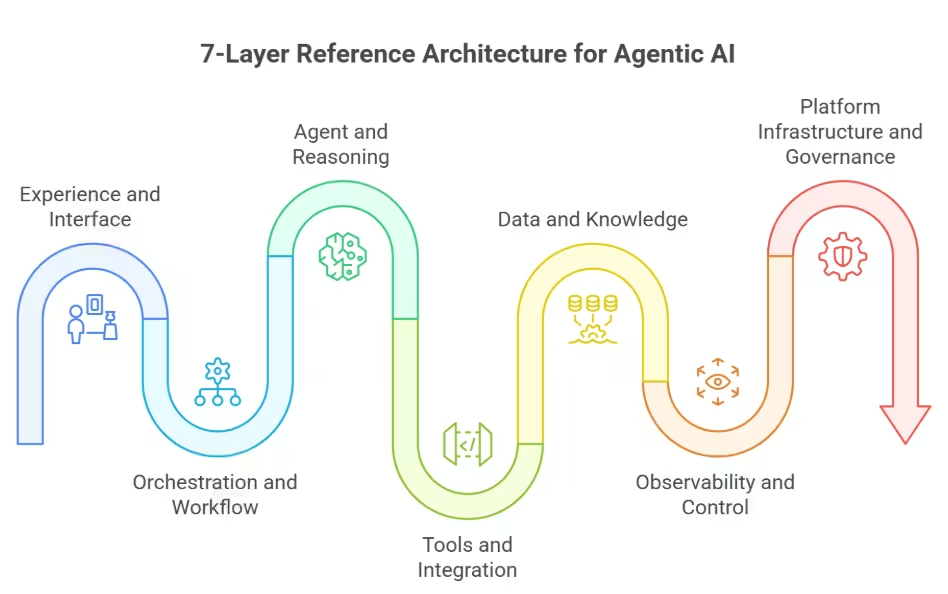
The design rationale follows a principle enterprise engineering teams already apply: separation of concerns. Each layer can be owned, scaled, secured, and versioned independently, mirroring how mature organizations manage infrastructure today.
| Layer | What Happens Here |
|---|---|
| 1. Experience and Interface | Where users and systems interact with the agentic system |
| 2. Orchestration and Workflow | Where routing, sequencing, and multi-step coordination happen |
| 3. Agent and Reasoning | Where planning, decision-making, and goal pursuit are executed |
| 4. Tools and Integrations | Where agents call APIs, databases, and external services |
| 5. Data and Knowledge | Where memory, context retrieval, and enterprise data access are managed |
| 6. Observability and Control | Where system behavior is monitored, and operational policies are enforced |
| 7. Platform Infrastructure and Governance | Where identity, security, compliance, and compute foundations sit |
Enterprises already have partial coverage across most of these layers. Agentic AI requires extending an existing organizational model for technical ownership, identifying gaps, and making targeted investments where they matter most.
Layer 1: Experience and Interface
What it protects: Consistent, role-appropriate access to agent capabilities across every business unit and channel.
Every interaction between the agentic system and its consumers passes through this layer. Those consumers include human users, upstream applications, and event-driven triggers.
On the input side, this layer accepts requests through chat interfaces, dashboards, API endpoints, and webhook listeners. On the output side, it renders structured responses, alerts, reports, and approval requests. The layer defines how work enters and exits the system.
Enterprise readiness here means supporting role-based views, context-specific interaction patterns, and multi-channel delivery. A finance analyst and an operations manager interact with the same underlying system through different interfaces. Delivery channels span web applications, messaging platform integrations, mobile interfaces, and internal portals. A single chatbot UI falls well short of enterprise requirements.
What goes wrong without it: The most common failure mode is tight coupling between interface logic and agent reasoning. When the experience layer directly encodes business logic or tool-calling sequences, the system becomes brittle. Adding a new channel or modifying an interaction pattern forces changes deep in the agent layer, creating maintenance overhead and slowing iteration.
Question for your team: Can we add a new delivery channel (a partner portal, a mobile app) to our agent system without modifying the underlying agent logic?
Pro Tip: Decouple the interface layer from the orchestration layer using a well-defined API contract. This allows teams to add or swap interfaces independently. A messaging bot, an internal portal, and a partner API can all connect to the same orchestration endpoint through separate interface implementations.
Layer 2: Orchestration and Workflow
What it protects: Predictable, auditable execution of multi-step agent workflows under enterprise SLAs.
This layer determines how work flows through the agentic system. It controls which agents are invoked, in what order, and under what conditions. Branching logic, retries, timeouts, and human-in-the-loop checkpoints all live here.
The most consequential decision at this layer is the choice between deterministic and dynamic orchestration. Deterministic orchestration uses predefined sequences to control agent execution, ideal for regulated workflows that demand strict auditability. Dynamic orchestration uses AI-driven routing, where the system decides at runtime which agent to invoke next, ideal for exploratory tasks where the execution path varies.
Most enterprise deployments require both. A compliance-driven approval chain needs the predictability of deterministic sequencing. An internal research assistant benefits from the flexibility of dynamic routing.
Multi-agent coordination patterns also sit at this layer. Sequential handoffs pass work from one agent to the next in a fixed order. Parallel execution dispatches work to multiple agents simultaneously and aggregates results. Hierarchical delegation assigns a supervisor agent to decompose tasks and distribute them to specialists. The right pattern depends on your latency requirements and auditability needs.
| Pattern | Speed | Auditability | Best For |
|---|---|---|---|
| Sequential | Slower (additive per step) | Strong (linear trail) | Regulated approval chains, document processing |
| Parallel | Faster (concurrent execution) | Moderate (requires aggregation tracking) | Data enrichment, multi-source research |
| Hierarchical | Variable | Strong (supervisor provides traceability) | Complex multi-domain tasks, enterprise reporting |
| Distributed | Fastest | Weakest (decentralized decisions) | Exploratory analysis, creative ideation |
What goes wrong without it: Orchestration that lacks state persistence means a partially completed workflow must restart from scratch after a failure. Orchestration that lacks audit trails makes debugging multi-agent workflows in production effectively impossible. Both issues surface under load and at scale, precisely when the business depends most on the system.
Question for your team: If a multi-step agent workflow fails at step four of six, can it resume from where it stopped with the full context intact? Can we trace exactly why each routing decision was made?
Layer 3: Agent and Reasoning
What it protects: Controlled, versioned, cost-managed decision-making at the core of every agent workflow.
This layer contains the cognitive core of the system. Agents receive context, reason about next steps, and produce outputs. Each agent is a goal-directed unit: a purposeful decision-maker, working within defined boundaries.
The reasoning engine is typically LLM-based, though rule engines, constraint solvers, and domain-specific models can supplement or replace LLM reasoning for structured tasks. The architecture should support multiple reasoning approaches within a single system.
Four architectural properties define each agent: its instructions, the tools it can access, its memory scope, and its permission boundaries. Configure these properties through versioned definitions in source control, enabling controlled rollouts, testing of reasoning strategies, and staged deployment of changes.
Agent vs. Model: A Critical Distinction for Leadership
A model generates text. An agent uses a model to reason, manages state, calls tools, follows goals, and operates within defined boundaries. This distinction matters because models are infrastructure components, while agents are operational entities with identities, permissions, and accountability requirements. Conflating the two leads to architecture that resists governance and creates risk at scale.
What goes wrong without it: Agents with hard-coded reasoning logic become impossible to update safely. Without versioning, there is no reliable way to roll back a change that causes degraded output quality. Without token-budget controls, a single agent reasoning loop can consume runaway compute costs. Without fallback behaviors, a low-confidence model output propagates downstream as though it were high-confidence.
Question for your team: Are our agent definitions versioned and testable, or are they embedded in application code? Do we have visibility into per-agent compute costs?
Layer 4: Tools and Integration
What it protects: Secure, governed access to enterprise systems of record with full traceability.
Tools give agents the ability to act on external systems. A well-defined tool layer lets agents execute API calls, run database queries, and trigger automation workflows. Agents limited to text generation provide minimal enterprise value. Acting on real systems is where the business impact lives.
Each tool should have a typed contract defining its inputs and outputs. Production systems require additional controls: explicit permission scoping, rate limiting, and usage logging. Every tool invocation should be traceable to the specific agent and reasoning step that triggered it.
Integration with existing systems of record is where most enterprise implementation efforts concentrate. ERP, CRM, ITSM, and data warehouse connections represent the real work of making agents useful. These integrations should be treated as managed services with defined SLAs, enabling reuse across agents and centralized monitoring of external system dependencies.
What goes wrong without it: Agents with unrestricted tool access represent one of the highest-risk patterns in enterprise AI. An agent handling customer inquiries should have zero write access to financial transaction systems. Without a tool registry and permission controls, scaling from ten agents to a thousand creates an ungovernable surface area where a single misconfigured agent can modify records, trigger transactions, or access data outside its intended scope.
Question for your team: Do we have a central catalog of every tool available to our agents, with clear ownership, permission scoping, and data sensitivity classifications?
Pro Tip: Build a tool registry early. Include metadata on permissions, rate limits, data sensitivity, and ownership for every tool. This registry becomes the control plane for tool governance as the agent count scales. Without it, tool sprawl creates risk that compounds with every new agent deployment.
Layer 5: Data and Knowledge
What it protects: Accurate, governed, timely context for every agent decision.
This layer manages every data asset that agents consume and produce. It spans three critical functions: short-term memory (session state within a single task), long-term memory (knowledge persisted across sessions), and enterprise data access (connections to the data platforms where organizational knowledge already lives).
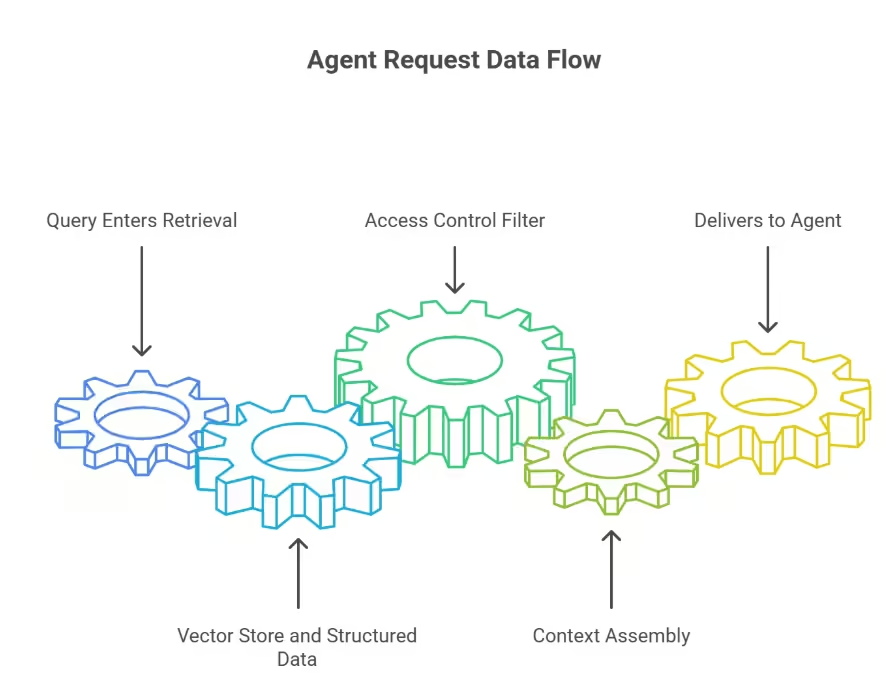
Retrieval-augmented generation (RAG) is the primary mechanism for injecting relevant context into agent reasoning. For leadership, the key concern is this: the quality of agent decisions is directly bound by the quality, timeliness, and governance of the data feeding those decisions.
Enterprise-grade RAG requires retrieval that respects access controls (agents see only data their permission scope allows), freshness guarantees tied to source system update cycles (agents reason over current information), and filtering that prevents sensitive data, such as personal or health information, from leaking into agent prompts.
Existing data platform investments directly accelerate agentic AI deployment. Organizations with mature data infrastructure can connect agents to governed, lineage-tracked data assets. Organizations lacking those foundations end up building shadow data pipelines that duplicate effort and bypass governance. This difference determines whether agentic AI scales or stalls.
What goes wrong without it: Agents reasoning over stale, ungoverned, or overly broad data produce decisions that erode trust. A procurement agent pulling from a vendor database updated quarterly instead of weekly will surface outdated pricing. An HR agent without access controls could surface compensation data to unauthorized users. Every data quality problem in the organization becomes an agent output quality problem.
Question for your team: Can we trace every agent decision back to the specific data that informed it? Are access controls enforced at the data retrieval layer, or only at the application layer?
Layer 6: Observability and Control
What it protects: Operational visibility, output quality assurance, and the ability to intervene before issues reach end users.
This layer provides visibility into system behavior and enforces operational policies across every other layer in the stack.
Standard application performance monitoring (including metrics, logs, and alerts) is necessary for agentic systems. It is also insufficient on its own. Agentic systems additionally require reasoning-trace capture: the full chain of agent thought, tool calls, results, and next thoughts for every task execution. Debugging a multi-step agent workflow without reasoning traces is comparable to debugging a distributed system with zero logging.
Also Read: What Is AI Governance? A Complete Guide
Evaluation pipelines are a core component here. Automated assessment measures agent output quality, error rates, and goal-completion rates. These evaluations feed continuous improvement loops and identify degradation before it reaches end users, providing the quantitative basis for deciding whether a new agent version should be promoted to production.
Control enforcement mechanisms include compute budget caps per agent and per task, rate limiting to prevent any single agent from monopolizing resources, human-in-the-loop approval gates for high-stakes actions, and the ability to immediately shut down agents when they behave outside defined parameters.
The Three Pillars of Agentic Observability:
- Reasoning trace capture for auditability. Record every step in the agent’s decision chain.
- Automated evaluation pipelines for quality. Continuously measure output accuracy, error rates, and goal completion.
- Operational SLAs and control enforcement for reliability. Define, monitor, and enforce performance boundaries across every layer.
Each pillar requires dedicated tooling and clear team ownership.
What goes wrong without it: Without reasoning traces, every debugging session becomes guesswork. Without evaluation pipelines, output quality degrades silently. Without control mechanisms, a misbehaving agent runs unchecked until a user reports the damage. These gaps are manageable with one agent in a demo. They become material business risks at the production scale.
Question for your team: If an agent produces a wrong output in production today, can we reconstruct the full reasoning chain that led to that output? How long does that take?
Layer 7: Platform Infrastructure and Governance
What it protects: The security, compliance, and operational foundation on which the entire architecture depends.
Governance anchors the entire architecture. Identity management, entitlement policies, data classification, and compliance controls propagate upward through every layer. Treating governance as a late-stage add-on creates systemic risk.
Agent identity is the starting point. Agents need identities just like users and services do. Each agent must authenticate to tools, data sources, and other agents using managed credentials. Secrets management systems handle tool credentials and API keys. Execution environments for agents that generate or run code require sandboxing to prevent arbitrary system access.
Compliance requirements for regulated industries add architectural constraints at the foundation level. Financial services, healthcare, and government organizations demand full reasoning-path traceability for every agent action. Data residency controls ensure that agent processing and storage comply with jurisdictional requirements. Model provenance documentation tracks which model versions produced which outputs. Audit-ready logging captures the complete decision chain in formats that satisfy regulatory review.
Infrastructure decisions at this layer cover compute provisioning for inference, model hosting and versioning, CI/CD pipelines for agent definitions and tool code, and environment management ensuring dev, staging, and production parity. Parity gaps cause agents that pass testing to behave differently in production due to data access differences or configuration drift.
What goes wrong without it: The security stakes for agentic systems are materially higher than for standard AI endpoints. An agent with tool access that gets compromised can exfiltrate data, modify records, and propagate through connected systems. The blast radius extends far beyond a single endpoint. Governance built after the fact means retrofitting controls into an architecture that was designed to move fast without them.
Question for your team: Do our agents have formal identities with scoped permissions, or are they running with shared service credentials? Could we produce a complete audit trail of every agent action for a regulatory review today?
Assessing Your Stack and Defining a Path Forward
Most enterprises already have partial coverage across the seven layers. The table below maps common existing investments against the agentic-specific gaps that require targeted attention.
| Layer | What You Likely Have | What Agentic AI Requires | Where to Start |
|---|---|---|---|
| 1. Experience & Interface | API gateways, web apps, messaging integrations | Multi-channel agent interaction, streaming responses, and role-based agent views | API contract between the interface and orchestration layers |
| 2. Orchestration & Workflow | Workflow engines, step functions | Dynamic AI-driven routing, human-in-the-loop checkpoints, and multi-agent coordination | Hybrid orchestration for a pilot workflow |
| 3. Agent & Reasoning | LLM API access via cloud providers | Versioned agent definitions, token budgets, fallback behaviors | Versioned agent configuration with evaluation harness |
| 4. Tools & Integration | Existing system integrations (ERP, CRM, ITSM) | Tool registry, tool-level access controls, typed schemas, usage logging | Tool registry with permission scoping and audit logging |
| 5. Data & Knowledge | Data platforms, catalogs, feature stores | Access-control-aware retrieval, sensitive data filtering, and lineage tracking | Retrieval pipeline with governance checkpoints |
| 6. Observability & Control | APM, logging, alerting | Reasoning trace capture, evaluation pipelines, and agent-specific SLAs | Reasoning trace logging and automated output evaluation |
| 7. Platform & Governance | Identity and Access Management (IAM), secrets management, CI/CD | Agent identity, sandboxed execution, compliance audit trails, model provenance | Agent identity framework and audit-ready reasoning logs |
A typical modernization sequence follows this progression:
Start with single-agent flows using deterministic orchestration for one well-defined use case. Add observability and evaluation pipelines to measure agent performance from day one. Formalize the data and knowledge layer with governed retrieval and lineage tracking. Introduce multi-agent patterns only after single-agent observability and governance are operational. Then scale with platform-level governance, tool registries, and standardized agent lifecycle management.
Organizational ownership matters as much as technology selection.
A common model assigns a centralized platform team to own Layers 5 through 7 (data infrastructure, observability, governance) while domain teams own Layers 1 through 4 (interfaces, workflows, agents specific to their business function). A joint governance forum sets cross-cutting policies on agent permissions, data access, and compliance requirements. This mirrors how mature engineering organizations already divide platform and product responsibilities.
Building Your Agentic AI Architecture on Solid Ground
Enterprise agentic AI succeeds when built as a layered system with clear ownership, governed data access, and operational controls at every boundary.
The seven-layer reference architecture separates interface, orchestration, reasoning, tools, data, observability, and governance into independently ownable concerns. Each layer maps to capabilities that most enterprises partially have. The gaps are agentic-specific: tool registries with access controls, reasoning trace capture, agent identity frameworks, and access-control-aware retrieval pipelines.
Start with a gap analysis. Map existing infrastructure against each layer. Identify where current investments in API gateways, workflow engines, and IAM already provide coverage. Focus initial investment on the layers with the widest agentic-specific gaps, which typically concentrate in orchestration, observability, and governance.
What RTS Labs Delivers
RTS Labs runs a structured assessment of your current stack against the seven-layer model. In two weeks, our team maps your existing coverage, identifies agentic-specific gaps, and delivers a prioritized investment plan sequenced to your compliance requirements and platform maturity.
From there, we help enterprise teams build what the assessment reveals: governed data foundations, production orchestration infrastructure, observability and evaluation pipelines, and the governance frameworks that make agent operations audit-ready.
The practical next step: Schedule an architecture assessment to find the shortest path from working demos to production-grade agentic AI systems that meet your enterprise compliance, performance, and ownership requirements.
Frequently Asked Questions (FAQs)
1. How does agentic AI architecture differ from traditional RPA architecture?
RPA follows rigid, pre-scripted rules on fixed sequences. Agentic AI architecture uses LLM-based reasoning to handle ambiguous tasks, select tools at runtime, and adapt execution paths. Intermediate results shape each subsequent decision, making the system fundamentally more flexible and more complex to govern.
2. Can enterprises build production agentic AI systems entirely on open-source components?
Open-source components cover individual layers effectively. Production readiness requires integration engineering, governance tooling, and SLA enforcement that open-source projects rarely provide out of the box. Most enterprises combine open-source and commercial components.
3. What is the typical timeline from an agentic AI pilot to production deployment?
A single-agent production deployment with governance takes six to twelve months. Multi-agent systems with full observability and compliance controls require twelve to eighteen months. Existing data platform maturity is the primary timeline variable.
4. How does agentic AI architecture handle multi-cloud or hybrid infrastructure requirements?
The seven-layer model is infrastructure-agnostic. Agent definitions, tool registries, and governance policies abstract cloud-specific implementations. Data residency requirements at Layer 7 drive deployment topology, while orchestration and observability layers require cross-cloud consistency.
5. What skills gaps do enterprise teams typically face?
Most teams have limited experience in agent orchestration design and reasoning trace observability. Tool-level access control is another common deficit. ML and platform engineering skills transfer well. Agent-specific governance and evaluation pipeline expertise is the primary gap to close.
6. How do agentic AI systems handle failure and recovery?
Agentic systems require reasoning-state recovery, going beyond transaction recovery. A failed agent mid-task must resume with its full reasoning context intact. Standard retry logic falls short without orchestration-layer state persistence and the ability to reconstruct the reasoning chain up to the failure point.